
Empathetic and empathic are two English words that can confuse even good English learners.
They look almost the same, sound similar, and both are connected with the ability to understand another person’s feelings. So, if you are not sure whether to say “She is very empathetic” or “She is very empathic,” you are not alone.
The good news is that there is no big difference in their basic meaning.
Both words are adjectives. Both can describe a person who understands or shares another person’s feelings and can respond with care and understanding.
Still, there is a small difference in usage, style, and commonness that is useful to know.
Empathetic is generally more common in everyday modern English, while empathic is also correct and is often found in psychology, academic writing, or more formal contexts.
Knowing the difference can help you sound more natural when speaking and writing English. It can also help you understand books, articles, conversations, and workplace communication more easily.
By the end of this guide, you will know what empathetic and empathic mean, how they are used in sentences, which one is more common, what mistakes to avoid, and an easy trick for remembering them.
What Does “Empathetic” Mean?
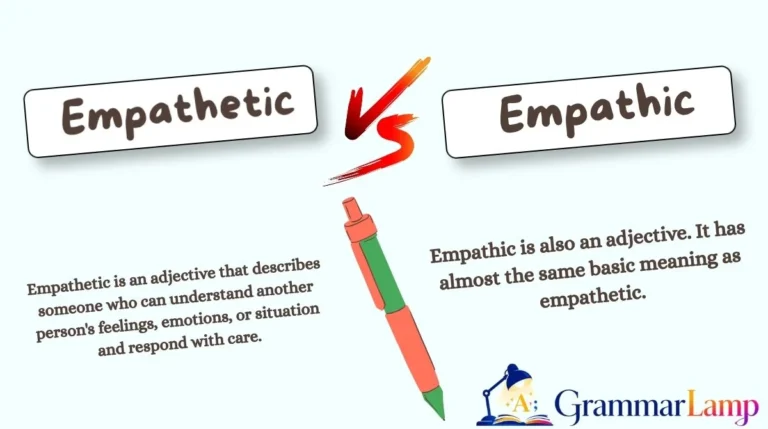
Empathetic is an adjective that describes someone who can understand another person’s feelings, emotions, or situation and respond with care.
In simple English, an empathetic person tries to understand how another person feels.
For example:
Maria was very empathetic when her friend lost her job.
This means Maria understood that her friend was having a difficult time and responded in a caring and understanding way.
The word empathetic is related to the noun empathy.
- Empathy = the ability to understand another person’s feelings
- Empathetic = showing or having empathy
- Empathetically = in an empathetic way
The word is especially common when talking about people, relationships, teachers, parents, doctors, managers, friends, and other situations where emotional understanding matters.
When Should You Use “Empathetic”?
Use empathetic when you want to describe someone who understands another person’s emotions or experiences.
It can describe a person’s general character:
My sister is very empathetic.
It can also describe a particular response or action:
The teacher gave an empathetic response to the student’s problem.
The word does not mean that the person agrees with everything another person says. It means the person can understand or recognize the other person’s feelings.
For example, you can understand why someone is angry without agreeing with their decision.
Grammar Rule for “Empathetic”
Empathetic is an adjective, so it normally comes before a noun or after a linking verb such as be, seem, look, feel, become, or remain.
Before a noun:
She is an empathetic teacher.
After a linking verb:
She is empathetic.
You can also use it with nouns such as person, friend, listener, teacher, parent, manager, doctor, response, approach, and attitude.
Examples of “Empathetic”
- She is an empathetic friend who always listens to me.
- Our teacher was very empathetic when we explained our problems.
- He gave an empathetic response to the worried customer.
- An empathetic manager understands that employees can have difficult days.
- My mother is naturally empathetic toward other people.
- The doctor was kind and empathetic during the conversation.
- Being empathetic can help you build stronger relationships.
- The counselor took an empathetic approach with the student.
A Common Confusion
Some learners think empathetic means “emotional.” That is not quite right.
An emotional person may feel emotions strongly. An empathetic person understands or responds to the feelings of other people.
For example:
He became emotional when he heard the news.
This tells us about his own feelings.
But:
He was empathetic when his friend heard the news.
This tells us about his ability to understand and support his friend’s feelings.
That difference is important.
What Does “Empathic” Mean?
Empathic is also an adjective. It has almost the same basic meaning as empathetic.
It describes someone or something connected with empathy or the ability to understand another person’s feelings.
For example:
She has an empathic understanding of her patients.
This means she understands her patients’ feelings and experiences.
Empathic is a perfectly correct English word. It is not a spelling mistake, and it is not a shorter version that should always be replaced with empathetic.
The two words overlap greatly in meaning.
When Should You Use “Empathic”?
You can use empathic when describing a person, behavior, understanding, response, communication style, or approach that involves empathy.
It is particularly common in contexts related to psychology, counseling, communication, healthcare, education, and academic writing.
For example:
The therapist used an empathic listening style.
You could also say:
The therapist used an empathetic listening style.
Both sentences are understandable and grammatically correct.
However, in many everyday conversations, empathetic may sound more familiar and natural to modern English speakers.
Grammar Rule for “Empathic”
Like empathetic, empathic is an adjective.
It can appear before a noun:
She is an empathic counselor.
It can also appear after a linking verb:
She is empathic.
It can describe a person:
He is an empathic person.
Or an action, quality, or approach:
The doctor showed an empathic attitude.
Examples of “Empathic”
- The counselor has an empathic way of listening.
- She is an empathic teacher who notices when students are struggling.
- His empathic response helped the patient feel understood.
- Good leaders need strong empathic communication skills.
- The therapist created an empathic connection with her client.
- He took an empathic approach to the disagreement.
- Her empathic nature makes people feel comfortable around her.
- The nurse showed an empathic understanding of the patient’s concerns.
A Common Confusion
Some learners believe that empathic is more correct than empathetic because it is closer to the word empathy.
That is not true.
Both are accepted adjectives. You do not need to choose empathic simply because it looks more directly connected to empathy.
Likewise, you should not think empathetic is wrong because it has the extra -etic ending.
Both forms have a place in English.
Difference Between Empathetic and Empathic
The easiest way to understand the difference is this:
Empathetic and empathic have almost the same meaning. The main difference is often style and usage rather than meaning.
| Feature | Empathetic | Empathic |
|---|---|---|
| Part of speech | Adjective | Adjective |
| Basic meaning | Showing or having empathy | Showing or having empathy |
| Related noun | Empathy | Empathy |
| Common in everyday English | Very common | Less common |
| Common in formal/academic contexts | Yes | Yes |
| Can describe a person | Yes | Yes |
| Can describe an approach | Yes | Yes |
| Can describe a response | Yes | Yes |
| Grammatically correct | Yes | Yes |
Meaning Difference
There is usually no important meaning difference.
Compare:
She is an empathetic teacher.
and:
She is an empathic teacher.
Both mean that the teacher understands students’ feelings and responds with care.
Another pair:
He gave an empathetic response.
He gave an empathic response.
Again, the basic idea is almost identical.
Usage Difference
The biggest practical difference is frequency and tone.
Empathetic is generally the safer choice for everyday English.
You are more likely to hear:
She is very empathetic.
than:
She is very empathic.
That does not make empathic incorrect. It simply means that empathetic is often more familiar to general English speakers.
Grammar Logic
Both words work in the same grammatical positions because both are adjectives.
You can say:
an empathetic person
or:
an empathic person
You can also say:
He is empathetic.
or:
He is empathic.
The grammar does not change just because the adjective changes.
Sentence Structure
The sentence structure is also the same.
Adjective + noun:
She is an empathetic manager.
She is an empathic manager.
Linking verb + adjective:
She is empathetic.
She is empathic.
Adjective + noun phrase:
We need an empathetic approach.
We need an empathic approach.
So, you do not need to learn a separate sentence pattern for each word.
Which One Should You Choose?
If you are writing a normal email, school assignment, blog post, conversation, or social media message, empathetic is usually a comfortable choice.
If you are reading psychology or academic material, you may see empathic more often.
The most important point is simple: do not treat one as correct and the other as incorrect.
Grammar Rules You Must Remember
Rule 1: Both Words Are Adjectives
Empathetic and empathic are adjectives.
They describe people, qualities, actions, responses, approaches, and similar nouns.
She is an empathetic person.
He has an empathic approach.
You cannot normally use them as nouns.
Do not say:
She is an empathetic.
Instead, say:
She is empathetic.
Or:
She is an empathetic person.
Rule 2: Use “an” Before a Singular Noun Starting With a Vowel Sound
When empathetic or empathic comes before a singular countable noun, you may need the article an.
She is an empathetic teacher.
He is an empathic counselor.
Notice that the adjective comes before the noun.
You can also remove the noun:
She is empathetic.
He is empathic.
Rule 3: Do Not Confuse These Words With “Empathy”
Empathy is a noun.
Empathetic and empathic are adjectives.
Compare:
Her empathy helped her understand the child.
She is empathetic toward the child.
The first sentence uses the noun.
The second sentence uses the adjective.
This is a very useful grammar distinction.
Rule 4: “Empathetically” Is the Adverb Form
When you want to explain how someone does something, you may need empathetically.
For example:
She listened empathetically to her friend.
Here, empathetically describes how she listened.
You can think of the forms like this:
- empathy → noun
- empathetic/empathic → adjective
- empathetically → adverb
For everyday English, empathetic is usually the easiest adjective choice.
Common Mistakes Students Make
Learners often make mistakes with these words because they look so similar.
Mistake 1: Thinking “Empathic” Is Wrong
Wrong idea:
“Empathic” is not a real English word.
Correction:
“Empathic” is a correct English adjective.
It has the same basic connection to empathy as empathetic.
Mistake 2: Using “Empathy” Instead of an Adjective
Incorrect:
She is very empathy.
Correct:
She is very empathetic.
Or:
She has a lot of empathy.
Remember that empathy is a noun, while empathetic and empathic are adjectives.
Mistake 3: Saying “An Empathy Person”
Incorrect:
He is an empathy person.
Correct:
He is an empathetic person.
Or:
He is an empathic person.
The adjective must describe the noun.
Mistake 4: Confusing Empathy With Sympathy
These words are related, but they are not exactly the same.
Empathy involves understanding or connecting with another person’s feelings.
Sympathy usually means feeling concern or sorrow for someone who is having a difficult experience.
For example:
I can understand why you feel hurt.
This can show empathy.
I’m sorry you’re going through this.
This can show sympathy.
Both can be kind responses, but they are not identical.
Mistake 5: Thinking Empathetic Means Agreeing
Being empathetic does not mean agreeing with someone.
You can understand someone’s feelings while still disagreeing with their actions.
For example:
I understand why you’re angry, but I don’t agree with what you did.
That can be an empathetic response.
The key is understanding the person’s feelings, not automatically accepting everything they say.
Easy Correction Tip
When you are unsure, ask yourself:
“Am I describing someone’s ability to understand another person’s feelings?”
If the answer is yes, empathetic or empathic may be appropriate.
For most general writing and conversation, empathetic is a safe and natural choice.
Easy Trick to Remember the Difference
Here is the simplest trick:
Think: Empathy → Empathetic / Empathic
The noun is:
empathy
The two common adjective forms are:
empathetic
empathic
So, instead of trying to remember a complicated rule, remember that both adjectives are connected to empathy.
There is another useful trick.
If you are speaking everyday English and you are not sure which one sounds more natural, choose:
empathetic
For example:
She is an empathetic person.
This sounds natural and clear in ordinary conversation.
If you are reading or writing about psychology, counseling, communication, or related academic subjects, you may come across:
empathic
For example:
The therapist used an empathic listening technique.
The important thing is not to think of empathetic as “right” and empathic as “wrong.”
Think of them as two correct adjectives with almost the same meaning.
Daily Life Examples
Here are some simple examples that show how these words can appear in real conversations.
Example 1: Talking About a Friend
A: Why does everyone talk to Sarah about their problems?
B: Because she is very empathetic. She really listens.
Sarah understands people’s feelings and makes them feel heard.
Example 2: Talking About a Teacher
Our teacher is very empathetic. When students are stressed, she gives them time to explain what is wrong.
Here, empathetic describes the teacher’s caring and understanding nature.
Example 3: At Work
My manager is empathetic when someone has a family problem.
The manager understands that personal difficulties can affect an employee.
Example 4: Talking About a Doctor
The doctor was very empathetic and listened carefully to my concerns.
The doctor did not simply focus on the medical issue. The doctor also showed understanding toward the patient’s feelings.
Example 5: Using “Empathic”
The counselor used an empathic communication style.
This sentence sounds suitable for a professional or educational setting.
Example 6: Helping a Friend
Try to be empathetic when your friend talks about a difficult experience.
This means you should try to understand the friend’s feelings rather than quickly judging them.
Example 7: Parenting
Good parents often need to be empathetic when children are upset.
Children may not always explain their feelings clearly, so understanding and patience can help.
Example 8: Customer Service
The customer service agent gave an empathetic response to the frustrated customer.
The agent recognized the customer’s frustration instead of simply ignoring it.
Example 9: A Relationship
An empathetic partner listens instead of immediately trying to win an argument.
The sentence focuses on emotional understanding and good communication.
Example 10: Everyday Conversation
I know you don’t agree with me, but I appreciate how empathetic you are.
Here, the speaker recognizes that the other person understands the speaker’s feelings even without sharing the same opinion.
Practice Section
Choose empathetic or empathic to complete each sentence.
1. Sarah is very ________ when her friends are having problems.
2. The therapist used an ________ approach during the session.
3. A good teacher should be ________ toward students who are struggling.
4. He gave an ________ response to his colleague’s concerns.
5. The counselor was known for her ________ communication style.
Answers
1. empathetic
Sarah is very empathetic when her friends are having problems.
2. empathic
The therapist used an empathic approach during the session.
3. empathetic
A good teacher should be empathetic toward students who are struggling.
4. empathetic
He gave an empathetic response to his colleague’s concerns.
5. empathic
The counselor was known for her empathic communication style.
Remember, some of these sentences could also use the other adjective without changing the basic meaning. The exercise mainly helps you become comfortable recognizing both forms.
FAQs
What is the difference between empathetic and empathic?
Empathetic and empathic are both adjectives related to empathy. They describe someone or something that shows or involves an understanding of another person’s feelings.
There is usually no major difference in meaning. Empathetic is generally more common in everyday English, while empathic is also common in some professional or academic contexts.
Is empathetic or empathic more common?
Empathetic is generally the more familiar choice in everyday modern English.
You will often hear sentences such as “She is very empathetic” or “He gave an empathetic response.”
Empathic is also correct and may appear frequently in writing about psychology, counseling, communication, and related subjects.
Is “empathic” a correct English word?
Yes. Empathic is a correct English word.
It is an adjective connected with empathy and can describe a person, response, approach, style, or understanding.
For example:
The counselor showed an empathic understanding of the client’s concerns.
Can empathetic and empathic be used interchangeably?
In many sentences, yes.
For example:
She is an empathetic teacher.
and:
She is an empathic teacher.
Both describe a teacher who understands students’ feelings.
The choice often depends on personal preference, context, and style rather than a major difference in meaning.
Can we use empathetic in questions?
Yes. Empathetic can easily be used in questions.
For example:
Is your manager empathetic?
Do you think she is an empathetic person?
Was the doctor empathetic toward you?
The word follows normal adjective grammar.
Is empathetic formal or informal?
Empathetic can be used in both everyday and formal English.
You can use it in casual conversation:
She’s really empathetic.
You can also use it in professional writing:
An empathetic leadership style can improve communication within a team.
It is therefore a flexible word.
Conclusion
Empathetic and empathic are both correct English adjectives. They are closely connected to empathy, and in most situations, they have almost the same meaning.
The biggest difference is not grammar or basic meaning. It is mainly usage and style. Empathetic is generally the more common and familiar choice in everyday English. Empathic is also correct and is often seen in professional, psychological, or academic contexts.
Both words can describe people, responses, communication styles, approaches, and other things related to understanding another person’s feelings.
If you are learning English and simply want the safest everyday choice, empathetic is a good word to remember.
Most importantly, do not worry about treating empathic as a mistake. It is a valid adjective. Once you understand that both words are connected to empathy, the confusion becomes much easier to handle.
Keep practicing them in real sentences. The more you see and use these words, the more natural the difference will feel.

Liam Derren is a language writer at GrammarLamp, creating simple, helpful content about grammar, words, and everyday English. He makes language learning clear, practical, and easy to understand.