
English has many words and phrases that seem to mean the same thing. However, small differences in their use can make a sentence sound more natural.
“Later” and “later on” are two common examples. Both refer to a time after the present moment or after another event, so many English learners wonder whether they can use them in the same way.
For example, you might tell a friend, “I will call you later,” or “I will call you later on.” Both sentences can be correct.
They tell your friend that the call will happen in the future, not right now. However, the two expressions can feel slightly different depending on the situation and the way the sentence is written.
This confusion often comes up in daily conversations, text messages, emails, and school assignments. Learners may also wonder whether “later on” is more formal, whether it needs a specific time, or whether one expression is grammatically better than the other.
The good news is that the difference is not difficult to understand. Both expressions talk about a future time, but “later” is the simpler and more direct choice, while “later on” can give a slightly stronger sense of time passing before something happens.
By the end of this guide, you will understand the meaning, grammar, sentence patterns, and everyday uses of both expressions.
You will also learn common mistakes, see practical examples, and practise choosing the right phrase with confidence.
More Useful posts
In Route vs En Route: Correct Meaning, Usage & Examples in 2026
Renumeration vs Remuneration 2026: Which Spelling Is Correct?
Endeavors vs Endeavours: What Is the Difference? 2026 Guide
Diddo vs Ditto: Which Spelling Is Correct in 2026?
What Does “Later” Mean?
Simple Definition of Later
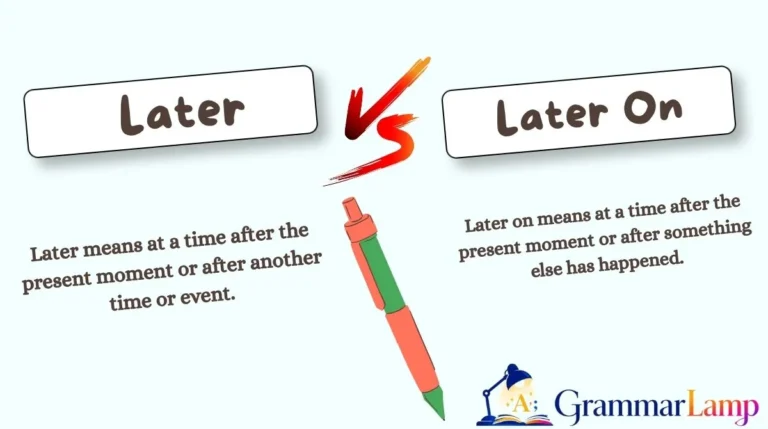
Later means at a time after the present moment or after another time or event. It is often used when the exact time is not known or does not need to be mentioned.
For example:
“I am busy right now. I will talk to you later.”
In this sentence, the speaker cannot talk at the moment but plans to talk at another time. The speaker does not say exactly when the conversation will happen.
“Later” is a common word in everyday English. People use it when making plans, arranging meetings, talking about past events, and explaining what will happen next.
When Should You Use Later?
Use “later” when you want to talk about something happening after now or after a particular event. It works well in both spoken and written English.
Here are some common situations in which you can use it.
1. When talking about future plans
You can use “later” when you plan to do something after finishing your current activity.
Example: “I will finish my homework later.”
The speaker plans to do the homework at another time, but the exact time is not important.
2. When arranging a conversation
“Later” is useful when you cannot talk to someone immediately.
Example: “I am in a meeting. Can I call you later?”
This is a natural way to ask someone whether you can contact them at a more convenient time.
3. When describing events in the past
You can also use “later” to describe something that happened after an earlier event.
Example: “We had lunch and went shopping later.”
Here, “later” refers to a time after lunch. The sentence describes events that happened in the past.
4. When describing a change over time
Sometimes, “later” describes how a situation changes after some time has passed.
Example: “She became a successful writer later in life.”
This means she became successful during a later period of her life, rather than when she was younger.
Grammar Rule for Later
“Later” is usually an adverb of time. It tells us when an action happens.
It often appears at the end of a sentence, although it can also appear in other positions when the sentence structure allows it.
Common patterns include:
- Subject + will + verb + later.
- Subject + verb + later.
- Later, + subject + verb.
- A period of time + later.
Examples:
- I will clean my room later.
- We can discuss this later.
- Later, he realized his mistake.
- Two days later, they returned home.
Notice that “later” can be used with different verb tenses. The correct tense depends on whether you are talking about the future, present, or past.
8 Example Sentences Using Later
- I will send you the pictures later.
- She is busy now, but she may join us later.
- We can discuss the problem later.
- He arrived at the office and called his manager later.
- I will finish this book later tonight.
- They moved to another city three years later.
- Later, I understood why he had refused the offer.
- Please remind me about the meeting later.
Each sentence refers to a time after the present moment or after another event. The word is short, clear, and suitable for most everyday situations.
Common Learner Confusion About Later
Some learners believe “later” must refer to a time far away. That is not true. It can refer to a time just a few minutes away or several years away.
For example:
“I will see you later.”
This could mean in an hour, in the evening, or at another time that both speakers understand from the situation.
Another common confusion is thinking that “later” must always be followed by a specific time. It does not need one.
You can say, “I will call you later,” without adding a time such as 5 p.m. If the exact time matters, you can make the sentence more specific: “I will call you later this evening.”
What Does “Later On” Mean?
Simple Definition of Later On
Later on means at a time after the present moment or after something else has happened. It is similar in meaning to “later,” but it can place a little more emphasis on the time between two events.
For example:
“We will go shopping later on.”
This means the shopping will happen at a future time, not immediately.
You might use “later on” when talking about plans, describing a series of events, or explaining what happened after some time had passed.
The phrase is common in everyday conversation and is also used in writing. It is not grammatically incorrect or automatically informal.
When Should You Use Later On?
“Later on” is useful when you want to refer to a future point in a conversation or story. It can make the order of events feel clearer.
1. When something will happen after the current activity
Example: “I have some work to do, but I will watch the movie later on.”
The speaker will watch the movie after dealing with the current work.
2. When talking about a future event without giving an exact time
Example: “We might visit our grandparents later on.”
The speaker has a plan or possibility in mind but has not given a specific time.
3. When telling a story
Example: “At first, I did not like the job. Later on, I began to enjoy it.”
The phrase helps the reader follow the change from one stage to another.
4. When explaining a result that appeared after some time
Example: “He ignored the warning, but later on, he understood its importance.”
The phrase highlights that his understanding came after the warning and after some time had passed.
Grammar Rule for Later On
“Later on” is a time expression that usually works as an adverbial phrase. It tells the reader or listener when something happens.
Like “later,” it can appear at the beginning or end of a sentence. It can also appear after a clause when the sentence structure supports it.
Common patterns include:
- Subject + will + verb + later on.
- Later on, + subject + verb.
- Subject + verb + later on.
- Some time later on, + subject + verb.
Examples:
- I will explain everything later on.
- Later on, we decided to leave.
- She called me later on.
- A few hours later on, the weather improved.
The last example is grammatically possible, but in ordinary English, “a few hours later” is generally more natural and concise. When a specific period is given, “later” is often the better choice.
8 Example Sentences Using Later On
- I will tell you the whole story later on.
- We can talk about your plans later on.
- Later on, she decided to study medicine.
- They went for a walk and had dinner later on.
- You may understand this lesson better later on.
- I was nervous at first, but later on, I felt more comfortable.
- We will probably visit the museum later on.
- Later on, he admitted that he had made a mistake.
These examples show that “later on” can be used for future plans and past events. The phrase often sounds natural when a speaker is moving from one event or stage to another.
Common Learner Confusion About Later On
A common mistake is believing that “later on” always means a much longer period than “later.” Although it can suggest that some time will pass, it does not have a fixed time meaning.
For example, “I will call you later on” does not automatically mean tomorrow or next week. It might mean later today.
Another misunderstanding is that “later on” is always more formal than “later.” Neither expression is strictly more formal. Both can be used in casual conversation and in many types of writing.
The main point is that “later on” is an alternative to “later,” not a phrase that must be used for a special length of time.
Difference Between Later and Later On (Detailed)
“Later” and “later on” are very close in meaning. In many sentences, you can replace one with the other without changing the main message.
For example:
- I will speak to you later.
- I will speak to you later on.
Both sentences mean that the conversation will happen at a future time.
However, the phrases are not always equally natural. “Later” is shorter and more direct. “Later on” may sound more conversational or place extra emphasis on the time that comes after the current moment.
Comparison Table
| Feature | Later | Later On |
|---|---|---|
| Basic meaning | At a time after now or another event | At a time after now or another event |
| Word form | One word | Two-word phrase |
| Main use | Future plans, past events, time comparisons | Future plans, stories, stages of events |
| Sentence position | Beginning, middle, or end | Beginning or end; other positions may be possible |
| Exact time required | No | No |
| Formality | Neutral; used in speech and writing | Neutral; often conversational |
| With a specific period | Very natural: “Two hours later” | Often less natural: “Two hours later on” |
| Can describe past events? | Yes | Yes |
| Can describe future events? | Yes | Yes |
| Is one always correct? | No; context matters | No; context matters |
1. Usage Difference
The most important difference is how the expressions sound in context.
“Later” is the standard, direct choice when you simply want to say that something will happen after the current time.
For example:
“I will finish the report later.”
This sentence is clear and natural. It does not need extra words.
“Later on” can be used in the same situation:
“I will finish the report later on.”
This is also correct. It may sound slightly more conversational or emphasize that the task will be completed after the current activity.
The difference is small. You do not need to give “later on” a special meaning every time you use it.
2. Grammar Logic
Both expressions work as time expressions. They answer a question such as “When will this happen?” or “When did this happen?”
Consider these sentences:
- She called me later.
- She called me later on.
Both tell us that the call happened after an earlier point in time.
The grammar does not change when you replace “later” with “later on.” The verb tense, subject, and main meaning can remain exactly the same.
However, “later” has an important advantage when you mention a measured period of time.
For example:
- He returned three days later.
- He returned three days later on.
The first sentence is the natural and standard choice. The second sounds awkward to many English speakers.
When the sentence includes a clear time period such as ten minutes, two weeks, or five years, use “later” in most cases.
3. Sentence Structure Difference
Both expressions can appear at the end of a sentence.
Examples:
- We will eat later.
- We will eat later on.
Both can also appear at the beginning of a sentence to show the order of events.
Examples:
- Later, we went to the park.
- Later on, we went to the park.
When you place either expression at the beginning, a comma is often used to separate it from the main clause.
You can also use “later” with a time phrase such as “that day,” “that evening,” or “in life.”
Examples:
- I will call you later today.
- She became famous later in life.
You can say “later on that day” in an appropriate context, but “later today” is usually simpler when you mean the current day. Do not add “on” automatically just because you are talking about the future.
4. Meaning Comparison in Real Situations
Imagine that your friend is asking you to join a video call, but you are busy.
You can reply:
“I will join later.”
This is a simple and direct response.
You could also say:
“I will join later on.”
That is correct too, though it may feel a little more conversational.
Now imagine that you are telling a story about your first day at school.
“At first, I was afraid. Later on, I made some good friends.”
Here, “later on” helps the listener move from the first part of the story to a later stage. Still, “later” would also be correct.
The lesson is simple: the phrases often share the same meaning, but the most natural choice depends on the sentence.
Explore More Posts
To Fast vs Too Fast: What Is the Difference? 2026 Guide
At the meeting vs in the meeting: Which One Is Correct in 2026?
Dis vs Mis: What Is the Difference? 2026 Easy Guide
Steer vs Stear: Which Spelling Is Correct in 2026?
Grammar Rules You Must Remember
Rule 1: Use Later for a Simple Reference to a Future Time
When you want to say that you will do something after your current activity, “later” is usually the easiest choice.
Examples:
- I will finish my homework later.
- We can discuss this matter later.
- She will reply later.
These sentences sound natural because they communicate the message directly. You do not need to add “on” to make them correct.
Rule 2: Later On Is Also Correct in Many Everyday Sentences
Do not think that “later on” is wrong simply because “later” is shorter. Both can be used to talk about a future action.
Examples:
- I will explain the details later on.
- We might go out later on.
- You can ask me about it later on.
The choice often depends on personal style and the flow of the conversation. If both expressions sound natural in the situation, either may work.
Rule 3: Use Later After a Specific Period of Time
When you mention an exact length of time, “later” is normally the preferred choice.
Examples:
- Ten minutes later, the teacher arrived.
- Two years later, they bought a house.
- A week later, I received a reply.
These sentences show how much time passed before the next event happened.
Avoid adding “on” without a good reason. “Two years later on” is usually less natural than “two years later.”
Rule 4: Both Expressions Can Describe Past Events
Neither expression is limited to the future. You can use both to tell stories or describe events that happened before now.
Examples:
- Later, I found my missing keys.
- Later on, I discovered the truth.
- She left the office and returned later.
- He struggled at first but improved later on.
Remember that the verb tense tells you whether the event happened in the past or will happen in the future. The time expression helps explain when it happens.
Common Mistakes Students Make
English learners sometimes use these expressions incorrectly because they focus too much on translating directly from their first language. Others believe that “later on” follows a special grammar rule that does not apply to “later.”
Here are some common mistakes and simple ways to correct them.
Mistake 1: Thinking Later On Is Always Wrong
Incorrect belief: “Later on” is grammatically incorrect, so I should never use it.
Correct understanding: Both “later” and “later on” are accepted English expressions.
Examples:
- Correct: I will call you later.
- Correct: I will call you later on.
The first version is more direct, but the second is also natural in many conversations. Choose the one that fits your sentence.
Mistake 2: Adding On After Every Time Period
Awkward: We reached the station two hours later on.
Better: We reached the station two hours later.
When a specific amount of time is mentioned, “later” is usually the natural choice. The word already shows that the event happened after the stated period.
Correction tip: If you see a number followed by a time unit, such as “three days” or “five minutes,” try using “later” without “on.”
Mistake 3: Believing Later Always Means Today
Incorrect belief: “Later” can only refer to another time on the same day.
Correct understanding: The meaning depends on the context.
Examples:
- I will call you later today.
- I will see you a few days later.
- She became more confident later in life.
If you need to make the time clear, add words such as “today,” “this evening,” or “next week.” Do not expect the word “later” to tell the reader the exact date.
Mistake 4: Using Both Expressions Together
Awkward: I will call you later later on.
Better: I will call you later.
Also correct: I will call you later on.
There is no need to use both expressions together because they communicate nearly the same time meaning. Choose one and keep the sentence simple.
Mistake 5: Using Later On When a Shorter Expression Sounds Better
Less natural: Five minutes later on, the bus arrived.
Better: Five minutes later, the bus arrived.
Although listeners may understand the first sentence, the second is more natural in standard English.
Correction tip: Read the sentence aloud. If “later” already expresses the intended meaning clearly, you usually do not need “on.”
Mistake 6: Forgetting Punctuation at the Beginning of a Sentence
Compare these examples:
- Later, we decided to go home.
- Later on, we decided to go home.
Both are correct. The comma helps separate the opening time expression from the main clause.
However, you do not normally need a comma when the expression appears naturally at the end of a short sentence:
- We decided to go home later.
- We decided to go home later on.
The main goal is to make the sentence easy to read.
Easy Trick to Remember the Difference
Here is a simple way to remember these expressions:
Later = the simple choice.
Later on = another natural way to say later, often useful when moving through a story or conversation.
Think about your daily routine. You are eating breakfast, but your friend asks you to play a game.
You can say, “I will play later.”
That is short, clear, and natural.
You could also say, “I will play later on.” This is correct, too. It gives the sentence a slightly different conversational feel, but it does not promise a longer wait.
Now imagine you are telling someone about a trip.
“First, we visited the museum. Later on, we went to a restaurant.”
The phrase helps move the story from one event to the next. You could use “later” instead, but “later on” works well in this kind of storytelling.
There is one more useful trick. When you give a specific time gap, such as two hours or three days, choose “later.”
For example:
“Three days later, we received the news.”
This pattern is easy to remember and sounds natural.
You do not need to memorize many complicated rules. Start with “later” when you are unsure. Then use “later on” when it fits the rhythm of your sentence.
Daily Life Examples: Later vs Later On
People use these expressions in conversations at home, at work, in school, and with friends. The examples below show how they work in ordinary situations.
1. Talking to a Friend
Ali: Are you free to talk right now?
Ahmed: Not really. Can we talk later?
Here, “later” means at another time when Ahmed is free.
2. Making Plans
Sara: Do you want to watch a movie?
Ayesha: Sure. I have to finish my work first. We can watch it later on.
The phrase shows that the movie will come after Ayesha finishes her work.
3. At the Office
Manager: Can you explain the report to me?
Employee: Yes, I will explain it later.
The employee agrees to explain the report at a future time.
4. Talking About School
Student: I do not understand this question.
Teacher: Do not worry. We will discuss it later on.
The teacher means that they will return to the question after some time or after another activity.
5. Making a Phone Call
Friend 1: Why did you not answer my call?
Friend 2: I was driving. I will call you later.
“Later” is a simple way to say that the call will happen when the speaker is available.
6. Telling a Story
Hassan: What happened after you reached the city?
Bilal: We checked into our hotel. Later on, we went out for dinner.
The phrase helps the listener follow the order of events.
7. Discussing a Problem
Mother: Can you help me clean the kitchen?
Daughter: Yes, Mom. I will help you later.
The daughter agrees to help at another time. If she knows when, she could say “after dinner” instead.
8. Talking About the Future
Friend 1: Are you going to learn how to drive?
Friend 2: Yes, I hope to learn later on.
The speaker talks about a future goal but does not give an exact date.
9. Explaining a Past Experience
Teacher: Did you enjoy your first day at the new school?
Student: Not really. But later, I made some great friends.
The student explains how the experience improved after some time.
10. Discussing a Decision
Amina: Why did you change your mind about the course?
Fatima: I thought it was too difficult at first, but later on, I realized I could do it.
The phrase marks a change in Fatima’s thinking after her first experience.
These conversations show that both expressions are useful. The best choice is the one that sounds clear and natural in the situation.
Practice Section
Test your understanding by choosing the best answer for each sentence. In some cases, both expressions may be grammatically possible, but one will sound more natural.
Questions
1. I am busy right now. I will call you ______.
a) later
b) latest
2. Three hours ______, the train finally arrived.
a) later on
b) later
3. At first, she disliked her new job. ______, she began to enjoy it.
a) Later on
b) Latest on
4. We can discuss your plans ______.
a) later
b) more later on
5. I have to finish my homework first. I will watch the movie ______.
a) later on
b) latest
Answers and Explanations
1. a) later
“Later” is a natural way to say that the call will happen at another time.
2. b) later
When a specific time period is mentioned, “three hours later” is the standard and natural expression.
3. a) Later on
“Later on” works well when describing a change from one stage or experience to another. “Later” would also be correct.
4. a) later
The sentence is already clear and natural. There is no need to add extra words.
5. a) later on
“Later on” is correct here because the movie will be watched after the homework is finished. “Later” would also be correct.
If you found these questions easy, try making your own sentences with both expressions. Using them in real situations is one of the best ways to remember their meanings.
More Helpful posts
Knob vs Nob: What’s the Difference? Meaning, Examples & Grammar Rules in 2026
Trek vs Treck: Which Spelling Is Correct in 2026?
Isle vs Aisle: Meaning, Difference, Examples & Easy Rules (2026)
Filed vs Filled: Meaning, Difference, Examples & Grammar Rules in 2026
FAQs
1. What Is the Difference Between Later and Later On?
Both expressions refer to a time after the present moment or after another event. “Later” is shorter and more direct, while “later on” can sound slightly more conversational or help move a story forward. In many sentences, they can be used interchangeably.
2. Is Later On Grammatically Correct?
Yes, “later on” is grammatically correct and widely used in English. You can use it when talking about future plans, past events, or changes over time. For example, “I will explain everything later on” is a correct sentence.
3. Is Later More Formal Than Later On?
Neither expression is automatically more formal than the other. Both are common in everyday speech and can also appear in writing. “Later” is often preferred in concise or formal writing because it is shorter, but the right choice depends on the sentence.
4. Can We Use Later and Later On in Questions?
Yes, both expressions can appear in questions. For example, you can ask, “Can we talk later?” or “Can we talk later on?” Both are correct. The first is more direct, while the second may sound a little more conversational.
5. Can Later On Be Used for Past Events?
Yes, you can use “later on” to describe something that happened after an earlier event. For example, “Later on, we discovered the truth.” The phrase helps show the order of events in a story or explanation.
6. Should I Say Two Hours Later or Two Hours Later On?
“Two hours later” is usually the more natural and standard choice. When you mention a specific period of time, “later” already communicates that the next event happened after that period. Adding “on” is generally unnecessary and can sound awkward.
Conclusion
Understanding the difference between “later” and “later on” is easier than it may seem.
Both expressions refer to a time after the present moment or after another event, and both are useful in everyday English. The main difference is how they sound and fit into a sentence.
“Later” is usually the simplest choice when you want to talk about a future plan, a past event, or something that will happen after a period of time. “Later on” is also correct and can sound natural when you are talking casually or moving from one event to another in a story.
Remember one important rule: when you mention a specific period, such as three days or two hours, “later” is normally the better choice. For example, say “Two hours later, we arrived,” rather than “Two hours later on, we arrived.”
You do not need to worry about choosing between these expressions in every sentence. Start with “later” when you want to be clear and direct, and use “later on” when it feels natural.
Practise with your own sentences, pay attention to how English speakers use these phrases, and your confidence will grow with time.

Liam Derren is a language writer at GrammarLamp, creating simple, helpful content about grammar, words, and everyday English. He makes language learning clear, practical, and easy to understand.