
Have you ever seen the words isle and aisle and wondered why they look so different but sound exactly the same? You are not alone.
These two words are a common problem for English learners because they are homophones. That means they have different spellings and different meanings, but they have the same pronunciation.
You may hear someone say, “Please walk down the aisle,” and then later read the word “isle” in a sentence about an island.
When you hear both words, you cannot know which spelling is correct just from the sound. You need to understand the meaning and the situation.
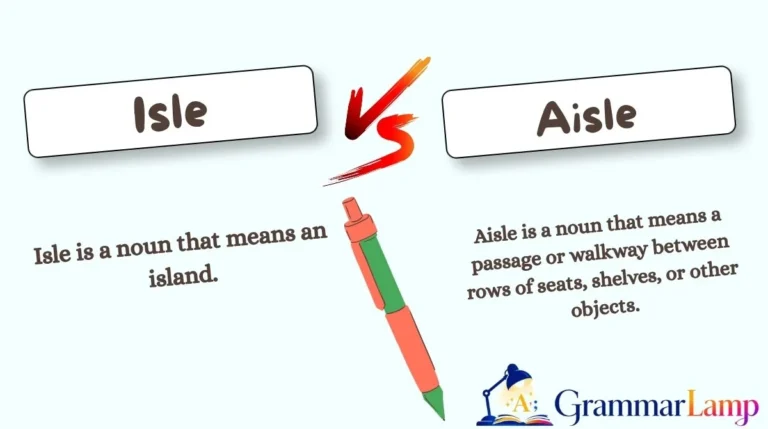
The good news is that the difference is actually very simple. Isle means an island, while aisle means a passage or walkway between rows of seats, shelves, or other objects. They are not interchangeable.
These words appear in everyday English. You may see aisle in a supermarket, airplane, theater, church, or classroom. You may see isle in travel writing, geography, history, and names of islands.
By the end of this guide, you will know exactly when to use isle and when to use aisle. You will also learn their grammar, common mistakes, pronunciation, useful expressions, and an easy memory trick that can help you remember the difference for a long time.
Explore More Posts
This Is She or This Is Her? The Correct Choice in English in 2026
Jewel vs Joule: Meaning, Difference, Examples & Easy Rules (2026)
Foul or Fowl: Meaning, Difference, Examples & Easy Rules for 2026
Dialog vs Dialogue: What’s the Difference? A Simple English Guide for 2026
What Does “Isle” Mean?
Isle is a noun that means an island.
An island is a piece of land surrounded by water. The word isle has the same basic meaning, but it is usually less common in everyday conversation than island. It often sounds more literary, poetic, geographical, or traditional.
For example:
- The small isle is famous for its beaches.
- We spent three days on a beautiful isle.
- The boat stopped near a remote isle.
- They live on a peaceful isle in the Mediterranean.
- The old castle stands on a rocky isle.
- Many birds visit the isle every year.
- The traveler dreamed of visiting a tropical isle.
- A narrow sea separated the isle from the mainland.
When Should You Use “Isle”?
Use isle when you are talking about an island.
In many normal conversations, island is the more common choice. For example, most people would naturally say:
We visited a small island.
You can also say:
We visited a small isle.
The second sentence is correct, but it may sound more literary or descriptive.
The word isle is also common in the names of certain places. Some place names use Isle as part of their official or traditional name. For this reason, you may see the word in maps, travel information, history books, and geographical names.
Grammar Rule for “Isle”
Isle is a countable noun.
That means you can use an with it when you are talking about one unspecified isle:
We found an isle near the coast.
You can also make it plural:
Several isles are visible from the boat.
Because it is a noun, it can work as the subject or object of a sentence.
As a subject:
The isle attracts many visitors.
As an object:
They explored the isle by boat.
Is “Isle” the Same as “Island”?
Yes, the main meaning is the same. Both words refer to land surrounded by water.
However, there is a difference in style and frequency. Island is the normal everyday word. Isle is often used in more formal, poetic, traditional, or place-name contexts.
Compare:
We rented a house on an island.
We rented a house on a quiet isle.
Both are correct. The first sounds more ordinary. The second gives a more literary or scenic feeling.
Common Learner Confusion About “Isle”
The biggest problem is that isle sounds exactly like aisle. When students learn the words by listening, they may know the pronunciation but not the spelling.
Another common mistake is using isle when they actually mean a walkway in a store or airplane.
For example:
❌ I left my bag in the isle of the supermarket.
That is incorrect if you mean the walkway between shelves.
The correct sentence is:
✅ I left my bag in the aisle of the supermarket.
Remember: isle = island.
What Does “Aisle” Mean?
Aisle is a noun that means a passage or walkway between rows of seats, shelves, or other objects.
You can find aisles in many places. Supermarkets have aisles between shelves. Airplanes have aisles between seats. Theaters and churches have aisles between rows of seats.
Here are some examples:
- Please keep the aisle clear.
- I found the cereal in the third aisle.
- She walked down the aisle slowly.
- My seat is next to the aisle.
- The flight attendant moved along the aisle.
- There was a box blocking the aisle.
- We met in the supermarket aisle.
- He chose an aisle seat for the long flight.
When Should You Use “Aisle”?
Use aisle when you mean a space that allows people to walk between rows or sections.
Think about a supermarket. The products are placed on shelves, and the open space between the shelves is the aisle.
Think about an airplane. There are seats on both sides, and the walking space in the middle is the aisle.
Think about a theater. People walk through the aisle to reach their seats.
Grammar Rule for “Aisle”
Aisle is also a countable noun.
You can say:
an aisle
two aisles
several aisles
Examples:
The store has an aisle for cleaning products.
There are six aisles in this section.
It can be singular or plural depending on the meaning.
Useful Expressions With “Aisle”
Some expressions with aisle are very common in English.
Aisle seat means a seat beside the walkway.
I always book an aisle seat on long flights.
Down the aisle means along the passage.
She walked down the aisle to her seat.
Across the aisle means on the other side of the central passage or in another section.
He was sitting across the aisle from me.
In the aisle means inside the walkway.
Please do not leave your shopping cart in the aisle.
“Aisle” in Different Places
The meaning stays the same even when the location changes.
At a supermarket:
The pasta is in the next aisle.
On an airplane:
Could I have an aisle seat, please?
We were sitting on the right side of the aisle.
The bride walked down the aisle.
A passenger was standing in the aisle.
The surroundings change, but the basic idea does not: an aisle is a passage for walking.
Common Learner Confusion About “Aisle”
Many learners spell aisle as isle because both words sound the same.
For example:
❌ Please meet me in the second isle.
If you mean a store walkway, the correct spelling is:
✅ Please meet me in the second aisle.
This is a spelling problem caused by pronunciation. The sound will not tell you which word to choose.
Difference Between Isle and Aisle
The most important point is simple:
Isle = island
Aisle = walkway or passage
They are homophones, so they sound the same but have different meanings and spellings.
| Word | Meaning | Part of Speech | Common Places | Example |
|---|---|---|---|---|
| isle | An island | Noun | Travel, geography, place names | We visited a quiet isle. |
| aisle | A passage between rows or shelves | Noun | Stores, planes, theaters, churches | The milk is in aisle five. |
Usage Difference
Use isle when water surrounds the land you are talking about.
The fishing village is on a small isle.
Use aisle when you are talking about a walkway between things.
The customer was standing in the aisle.
A simple way to ask yourself is:
“Am I talking about land surrounded by water?”
If yes, use isle.
“Am I talking about a place where people walk between rows?”
If yes, use aisle.
Grammar Logic
Both words are nouns, so they follow normal noun grammar.
The difficult part is not grammar. The difficult part is choosing the correct word because the pronunciation is identical.
Sentence Structure Difference
The sentence pattern can help you understand the meaning.
With isle, the sentence often includes words related to location, travel, nature, water, or geography:
The boat reached the isle before sunset.
With aisle, the sentence often includes words related to movement, shopping, seats, airplanes, or rows:
She walked down the aisle to her seat.
Look at the nouns around the word. They often give you a clue.
Meaning Comparison
These sentences sound almost identical if you hear them:
They live on an isle.
They walked down an aisle.
But the pictures in your mind should be completely different.
The first sentence gives you a picture of land and water.
The second sentence gives you a picture of a walkway.
That difference in meaning is the key to using the words correctly.
Grammar Rules You Must Remember
Rule 1: Use “Isle” for an Island
When you mean a piece of land surrounded by water, choose isle.
The fishermen live on a small isle.
Do not use aisle for land.
❌ They live on a small aisle.
✅ They live on a small isle.
Rule 2: Use “Aisle” for a Walkway
When you mean a passage between rows, shelves, or seats, use aisle.
The children were running in the aisle.
Do not use isle for a store or airplane walkway.
❌ Please keep the isle clear.
✅ Please keep the aisle clear.
Rule 3: Both Words Sound the Same
The pronunciation of isle and aisle is the same: /aɪl/.
The beginning of each word sounds like the vowel sound in eye.
This means you cannot always choose the spelling by listening. You need to understand the sentence.
For example, if someone says:
“I am sitting in the aisle.”
You need to think about the meaning. A person cannot normally sit in an island. The sentence is about a walkway, so aisle is correct.
Rule 4: Remember That Both Are Nouns
Both isle and aisle are nouns.
You can use them with:
- a/an
- the
- singular forms
- plural forms
- possessive forms
Examples:
an isle
an aisle
the isle
the aisle
several isles
several aisles
The grammar is similar, but the meaning is completely different.
More Useful posts
Learned vs Learnt: What’s the Difference? A Simple Guide for 2026
It’s vs Its: Simple Difference, Rules, Examples & Practice (2026)
Enamor vs Enamour: What’s the Difference? Meaning, Usage & Examples in 2026
Breath vs Breathe: Easy Difference, Meaning, Examples & Rules in 2026
Common Mistakes Students Make
Students often make mistakes with these words because English spelling and pronunciation do not always match.
Mistake 1: Using “isle” in a Supermarket
Wrong:
❌ The bread is in the fifth isle.
Correct:
✅ The bread is in the fifth aisle.
Why? Because a supermarket has walkways between shelves. Those walkways are called aisles.
Mistake 2: Using “aisle” for an Island
Wrong:
❌ They spent their vacation on a beautiful aisle.
Correct:
✅ They spent their vacation on a beautiful isle.
You are talking about land surrounded by water, so isle is the correct word.
Mistake 3: Spelling “Aisle” the Way It Sounds
A learner may hear “aisle” and write isle because that spelling looks easier.
This is understandable, but it creates a different word.
A good habit is to connect each spelling with an image.
When you see isle, picture:
🌴 water + land
When you see aisle, picture:
🛒 shelves + walkway
Mistake 4: Thinking “Isle” and “Aisle” Are Different Pronunciations
They are not. Both are normally pronounced “eye-l.”
The spelling is different because their histories and meanings are different.
So do not waste time trying to hear a pronunciation difference that is not there.
Easy Correction Tip
Whenever you are unsure, ask:
Is this about an island?
Use isle.
Is this about a walkway?
Use aisle.
That one question will solve most mistakes.
Easy Trick to Remember the Difference
Here is a very simple memory trick:
Isle has an “I”
Think:
I + island = isle
The word isle is connected in your memory with island.
You can imagine:
Isle → Island
Now think about aisle.
Imagine an Aisle in an Airplane.
The airplane has a central walkway, and that walkway is the aisle.
You can remember:
Aisle → Airplane walkway
Another useful trick is to picture two scenes.
For isle, imagine a tiny piece of land surrounded by blue water.
For aisle, imagine a supermarket with shelves on both sides.
Once you connect each spelling to a picture, the words become much easier to remember.
A Simple One-Line Memory Rule
Isle has water around it; aisle has things around it.
That is a very useful shortcut for beginners.
Daily Life Examples
Here are some natural examples you may hear or use in everyday English.
Example 1: At the Supermarket
A: Where can I find the rice?
B: It is in aisle four.
The word is aisle because the speaker is talking about the passage between the store shelves.
Example 2: On an Airplane
A: Which seat did you get?
B: I got an aisle seat.
An aisle seat is next to the walkway.
Example 3: Talking About an Island
A: Where are you going this summer?
B: We are visiting a small isle near the coast.
Here, isle means an island.
Example 4: In a Theater
A: Where is your seat?
B: It is three rows from the aisle.
The aisle is the walking space between rows.
Example 5: Shopping
A: Did you find the shampoo?
B: Yes. It is at the end of the next aisle.
The word refers to a store passage.
Example 6: Talking About a Vacation
A: What was the place like?
B: It was a quiet isle with beautiful beaches.
The meaning is island.
Example 7: On a Flight
A: Excuse me, can I get past you?
B: Sure. I am moving into the aisle.
The speaker is referring to the passage beside the seats.
Example 8: At a Wedding
A: Where will the bride enter?
B: She will walk down the aisle.
This is a common expression in wedding English.
Example 9: Reading a Travel Description
The tiny isle was home to only a few families.
The word creates a geographical or scenic image.
Example 10: In a Store
Please do not leave the boxes in the aisle.
The boxes are blocking the walkway.
These examples show why context matters so much. When the subject is travel and land, isle is likely. When the subject is shopping, seats, or walking between rows, aisle is likely.
Practice: Choose the Correct Word
Choose isle or aisle in each sentence.
1. The coffee is in the next ______.
a) isle
b) aisle
2. They built a small hotel on the ______.
a) aisle
b) isle
3. I always prefer an ______ seat on long flights.
a) isle
b) aisle
4. The boat reached the remote ______ before dark.
a) isle
b) aisle
5. Please move your bag out of the ______.
a) isle
b) aisle
Answers
1. aisle — It is a walkway in a store.
2. isle — It means an island.
3. aisle — An aisle seat is next to the airplane walkway.
4. isle — The boat reached a piece of land surrounded by water.
5. aisle — The bag is blocking a passage.
Try making five of your own sentences. Write one sentence about a supermarket, one about an airplane, and one about an island. This can help the difference become automatic.
Explore More Posts
No Longer Exist vs No Longer Exists: Which Is Correct? (2026 Guide)
Favourite vs Favorite: Meaning, Difference, Spelling & Usage Guide 2026
By Which vs In Which: Easy Difference, Rules, Examples & Practice (2026)
No Thank You vs No, Thank You: Which Is Correct in 2026?
FAQs
What is the difference between isle and aisle?
Isle means an island, or a piece of land surrounded by water. Aisle means a passage between rows, shelves, or seats. They have the same pronunciation but different spellings and meanings.
Are isle and aisle pronounced the same?
Yes. In standard English, both are normally pronounced /aɪl/, which sounds like “eye-l.” They are homophones, so you cannot depend on pronunciation alone to know which spelling is correct.
Can I use “aisle” for an island?
No. Aisle refers to a passage or walkway. When you mean land surrounded by water, use isle or, more commonly in everyday English, island.
Is “isle” a formal word?
It is not strictly a formal word, but it is less common in everyday speech than island. It often appears in geographical names, travel writing, literature, and descriptive language.
Can “aisle” be used in questions?
Yes. Aisle can be used naturally in questions.
For example:
Which aisle has the cooking oil?
Or:
Can I have an aisle seat, please?
Its use in questions is completely normal.
Which is correct: “aisle seat” or “isle seat”?
The correct expression is aisle seat. An aisle seat is a seat next to the walkway, especially on an airplane, train, or in a theater. Isle seat is incorrect when you mean a seat beside a passage.
Conclusion
Isle and aisle are easy to confuse because they sound exactly the same, but their meanings are completely different.
Use isle when you are talking about an island. It is often less common than the everyday word island, but it is correct and can appear in travel writing, geography, literature, and place names.
Use aisle when you are talking about a walkway between rows, shelves, or seats. You will often see this word in supermarkets, airplanes, churches, theaters, trains, and other places where people move between sections.
The easiest rule to remember is:
Isle = island.
Aisle = walkway.
Because the two words sound the same, context is your best guide. When you hear the word, ask yourself what the speaker is talking about. Land surrounded by water? Think isle. A passage between things? Think aisle.
A little practice with real sentences will make the difference much easier to remember.
The next time you are shopping, traveling, or talking about an island, stop for a second and choose the spelling that matches the meaning.

Liam Derren is a language writer at GrammarLamp, creating simple, helpful content about grammar, words, and everyday English. He makes language learning clear, practical, and easy to understand.