
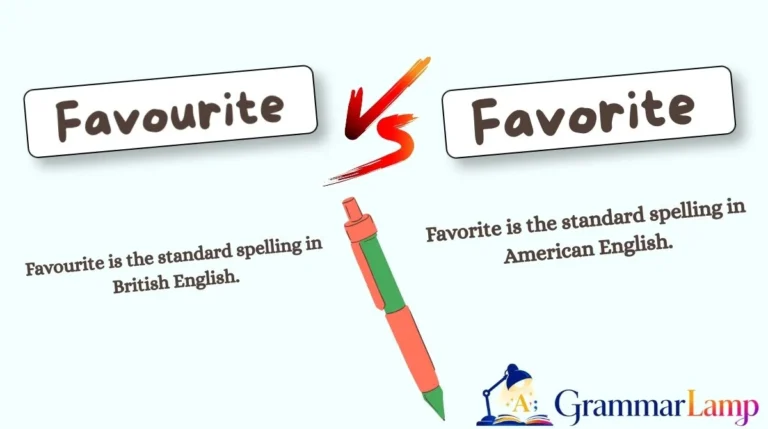
Favourite vs favorite is a common English spelling question. You may see favourite in a British English book and favorite on an American website.
At first, the two words look different enough to make learners wonder whether they have different meanings or different grammar rules.
The good news is simple: favourite and favorite mean exactly the same thing. The main difference is where the spelling is used.
Favourite is the usual spelling in British English, while favorite is the usual spelling in American English.
Both words describe a person or thing that you like more than others. For example, you can say, “Blue is my favourite color” or “Blue is my favorite color.” The meaning does not change.
This small spelling difference is important because English learners often write in one style while reading another. It can also matter in school assignments, exams, websites, emails, and professional writing.
By the end of this guide, you will know when to use each spelling, why the letter u appears in favourite, how the words work in sentences, and which spelling is best for British or American English.
You will also see simple everyday examples that make the difference easy to remember.
No Thank You vs No, Thank You: Which Is Correct in 2026?
Creek vs Creak: Meaning, Difference, Examples & Easy Rules (2026)
Ardor vs Ardour: Meaning, Difference, Spelling & Examples (2026)
Fillet vs Filet: What’s the Difference? Meaning, Spelling, and Examples in 2026
What Does “Favourite” Mean?
Favourite is the standard spelling in British English. It is also commonly used in other varieties of English influenced by British English, including English used in countries such as Australia and New Zealand.
The word means the person or thing you like best or prefer more than others.
For example:
- “What is your favourite movie?”
- “Chocolate cake is my favourite dessert.”
- “She is my favourite teacher.”
- “This is my favourite song.”
- “Blue is my favourite color.”
- “Football is his favourite sport.”
- “That was my favourite part of the trip.”
- “Who is your favourite actor?”
In these sentences, favourite tells us about a strong personal preference.
Favourite as an adjective
Most often, favourite works as an adjective. It describes a noun.
For example:
“This is my favourite book.”
Here, favourite describes the noun book. It tells us that the speaker likes this book more than other books.
Another example is:
“Pizza is my favourite food.”
The word favourite describes food.
A useful sentence pattern is:
my/your/his/her + favourite + noun
Examples:
- my favourite song
- your favourite color
- his favourite player
- her favourite restaurant
- our favourite place
- their favourite game
Favourite as a noun
Favourite can also be a noun. In this use, it means the person or thing that someone likes best.
For example:
“This song is my favourite.”
Here, favourite is not directly describing another noun. It means “the thing I like best.”
You might also hear:
“She is the favourite to win.”
In this sentence, the favourite means the person who is considered most likely to win.
A common learner confusion
Some learners think favourite is more formal than favorite. That is not the main difference.
The difference is British spelling versus American spelling.
A British writer may naturally write:
“What is your favourite book?”
An American writer will normally write:
“What is your favorite book?”
Neither sentence is more correct. The spelling simply follows a different variety of English.
What Does “Favorite” Mean?
Favorite is the standard spelling in American English.
It has exactly the same meaning as favourite. It describes someone or something that you like more than other people or things.
Here are some examples:
- “What is your favorite movie?”
- “Chocolate cake is my favorite dessert.”
- “She is my favorite teacher.”
- “This is my favorite song.”
- “Blue is my favorite color.”
- “Football is his favorite sport.”
- “That was my favorite part of the trip.”
- “Who is your favorite actor?”
Notice that the sentences are the same as the examples with favourite. Only the spelling changes.
Favorite as an adjective
Like favourite, favorite is often an adjective.
For example:
“Summer is my favorite season.”
The word favorite describes season. It tells us which season the speaker prefers.
Another example:
“This is my favorite restaurant.”
The word describes restaurant.
Common patterns include:
my favorite + noun
your favorite + noun
his/her favorite + noun
our favorite + noun
Examples:
- my favorite book
- your favorite subject
- his favorite player
- her favorite dress
- our favorite restaurant
- their favorite game
Favorite as a noun
Favorite can also be used as a noun.
For example:
“Which one is your favorite?”
Here, favorite means “the one you like best.”
You can also say:
“She is the favorite to win the competition.”
Again, this means she is considered the person most likely to win.
A common learner confusion
American English uses favorite, without the letter u.
British English uses favourite, with the letter u.
It is not a difference in pronunciation, meaning, or grammar. In normal speech, the two words are pronounced in essentially the same way.
Difference Between Favourite and Favorite
The easiest answer is this:
There is no difference in meaning. The difference is spelling and regional English.
| Point | Favourite | Favorite |
|---|---|---|
| Main variety | British English | American English |
| Meaning | Something you like best | Something you like best |
| Part of speech | Adjective or noun | Adjective or noun |
| Letter “u” | Yes | No |
| Pronunciation | Same | Same |
| Example | My favourite book | My favorite book |
| Correct spelling? | Yes | Yes |
Usage difference
If you are writing in British English, use favourite.
“My favourite subject is English.”
If you are writing in American English, use favorite.
“My favorite subject is English.”
Both sentences mean:
English is the subject I like best.
The important thing is to choose one spelling based on the variety of English you are using.
Grammar logic
There is no special grammar rule that makes one word an adjective and the other a noun. Both spellings can have the same grammatical functions.
Compare:
“This is my favourite book.”
“This is my favorite book.”
In both sentences, the word describes book, so it is an adjective.
Now compare:
“This book is my favourite.”
“This book is my favorite.”
In both sentences, the word acts as a noun, meaning the book that the speaker likes best.
Sentence structure
The basic sentence structures are also the same.
Adjective use:
Subject + be + possessive adjective + favourite/favorite + noun
Example:
“This is my favorite movie.”
Noun use:
Subject + be + possessive + favourite/favorite
Example:
“This movie is my favorite.”
So, there is no difference in sentence structure. The choice depends mainly on British or American spelling.
Meaning comparison
Consider these two sentences:
“What is your favourite color?”
“What is your favorite color?”
The meaning is exactly the same. The speaker wants to know which color you like best.
This is why you should not treat favourite and favorite as two separate vocabulary words. They are simply two spellings of the same word.
Grammar Rules You Must Remember
Rule 1: Use “favourite” in British English
When you are following British English spelling, write favourite with u.
Example:
“Tea is my favourite drink.”
This spelling is common in British English writing and in many educational materials that follow British conventions.
Rule 2: Use “favorite” in American English
American English normally removes the u and uses favorite.
Example:
“Coffee is my favorite drink.”
The meaning has not changed. Only the spelling follows American English conventions.
Rule 3: Both words can be adjectives or nouns
Do not think that favourite is an adjective while favorite is a noun. Both can perform both roles.
Adjective:
“She is my favourite singer.”
Noun:
“She is my favourite.”
And in American English:
“She is my favorite singer.”
“She is my favorite.”
The grammar works in exactly the same way.
Rule 4: Keep your spelling style consistent
If you are writing an essay in British English, it is usually better to use favourite consistently.
For example:
“My favourite sport is football. My favourite player is also from England.”
Do not switch unnecessarily to favorite in the next sentence.
The same applies to American English:
“My favorite sport is basketball. My favorite player is Stephen Curry.”
Consistency makes your writing look polished and clear.
Enamor vs Enamour: What’s the Difference? Meaning, Usage & Examples in 2026
Breath vs Breathe: Easy Difference, Meaning, Examples & Rules in 2026
No Longer Exist vs No Longer Exists: Which Is Correct? (2026 Guide)
Favourite vs Favorite: Meaning, Difference, Spelling & Usage Guide 2026
Common Mistakes Students Make
The biggest mistake is believing that one spelling is correct and the other is wrong.
That is not true.
Mistake 1: Calling “favorite” incorrect
Wrong idea:
“Favorite is wrong because favourite has a u.”
Correct understanding:
Favorite is the standard American English spelling.
For example:
“What is your favorite movie?”
This is completely correct in American English.
Mistake 2: Calling “favourite” incorrect
The opposite mistake also happens.
A learner may see favourite and think there is a spelling error.
But this is correct British English:
“What is your favourite movie?”
The letter u is part of the British spelling.
Mistake 3: Mixing styles without a reason
Suppose a student writes:
“My favourite food is pizza. My favorite restaurant is nearby.”
There is nothing grammatically wrong with the sentence, but the spelling is inconsistent if the student is trying to follow one variety of English.
A better British English version is:
“My favourite food is pizza. My favourite restaurant is nearby.”
A better American English version is:
“My favorite food is pizza. My favorite restaurant is nearby.”
Mistake 4: Thinking pronunciation changes
The spelling difference may make learners expect a different pronunciation.
Usually, you should not worry about this. Favourite and favorite are pronounced essentially the same in standard speech.
The difference is mainly visible when you write the word.
Mistake 5: Forgetting the noun meaning
Learners often know the phrase “my favorite book” but do not realize that favorite can stand alone.
For example:
“Which shirt do you like?”
“The blue one is my favorite.”
Here, favorite means “the one I like best.”
The same applies to favourite.
Easy correction tip
Whenever you see this word, ask yourself one simple question:
Am I using British English or American English?
- British English → favourite
- American English → favorite
That one question solves most spelling problems.
Easy Trick to Remember the Difference
Here is a simple memory trick:
British English = favourite = U
Think of the British spelling as the longer spelling:
favour → favourite
American English uses:
favor → favorite
So you can remember:
British keeps the U. American drops the U.
The same pattern appears in other words.
For example:
| British English | American English |
|---|---|
| colour | color |
| honour | honor |
| labour | labor |
| neighbour | neighbor |
| favourite | favorite |
This does not mean every British and American spelling difference works this way, but it is a useful pattern to recognize.
Another easy trick is to connect favourite with the British spelling favour.
If you write:
“I favour this idea.”
then the related adjective/noun spelling can remind you:
“This is my favourite choice.”
In American English:
“I favor this idea.”
and:
“This is my favorite choice.”
Daily Life Examples
These words appear often in everyday English, especially when people talk about food, entertainment, sports, school, travel, and personal preferences.
1. Talking about food
“What is your favourite food?”
American English:
“What is your favorite food?”
A natural answer is:
“Pizza is my favourite.”
2. Talking about colors
“Blue is my favourite color.”
In American English:
“Blue is my favorite color.”
You can also ask:
“What is your favourite color?”
3. Talking about movies
“What is your favourite movie?”
“My favourite movie is a comedy.”
American English:
“What is your favorite movie?”
“My favorite movie is a comedy.”
4. Talking about school
A student might say:
“English is my favourite subject.”
Or:
“Math is my favorite subject.”
Both sentences are natural.
5. Talking about sports
“Who is your favourite football player?”
A possible answer:
“He is my favourite player.”
American English simply changes the spelling:
“Who is your favorite football player?”
6. Talking about places
“London is one of my favourite cities.”
An American writer might say:
“London is one of my favorite cities.”
7. Choosing between two things
Imagine two shirts are on a table.
You might say:
“The black shirt is my favourite.”
In American English:
“The black shirt is my favorite.”
Here, the word stands alone as a noun.
8. Asking someone about a preference
“Which one is your favourite?”
This is a very common question.
The American version is:
“Which one is your favorite?”
9. Talking about a person
“She is my favourite teacher.”
This means you like or appreciate her more than your other teachers.
In American English:
“She is my favorite teacher.”
10. Talking about a memory
“That was my favourite part of the holiday.”
An American writer would normally write:
“That was my favorite part of the vacation.”
Notice that favourite/favorite stays the same in meaning even when other vocabulary changes between varieties of English.
Practice Section
Choose the correct spelling for the variety mentioned in each sentence.
1. British English
“Chocolate is my ______ dessert.”
A. favorite
B. favourite
2. American English
“What is your ______ book?”
A. favourite
B. favorite
3. British English
“She is my ______ singer.”
A. favorite
B. favourite
4. American English
“This restaurant is my ______.”
A. favourite
B. favorite
5. British English
“Blue is my ______ color.”
A. favorite
B. favourite
Answers
- favourite
- favorite
- favourite
- favorite
- favourite
The key is not the meaning. The key is the English variety being used.
Foul or Fowl: Meaning, Difference, Examples & Easy Rules for 2026
Dialog vs Dialogue: What’s the Difference? A Simple English Guide for 2026
Learned vs Learnt: What’s the Difference? A Simple Guide for 2026
It’s vs Its: Simple Difference, Rules, Examples & Practice (2026)
FAQs
What is the difference between favourite and favorite?
There is no difference in meaning. Both words mean a person or thing that you like best or prefer most. Favourite is the standard British English spelling, while favorite is the standard American English spelling.
Can we use favourite or favorite in questions?
Yes. Both can be used naturally in questions.
British English:
“What is your favourite movie?”
American English:
“What is your favorite movie?”
The grammar and meaning are the same.
Is favourite more formal than favorite?
No. The spelling does not show formality. Favourite is mainly associated with British English, while favorite is mainly associated with American English. Both can be used in formal and informal writing.
Which is correct: “my favourite” or “my favorite”?
Both are correct. Choose my favourite when following British English spelling and my favorite when following American English spelling. Both can also be used as adjectives before a noun, such as “my favorite book.”
Is favourite used in British English?
Yes. Favourite is the normal British English spelling. It is also common in several other English varieties that generally follow British spelling conventions. The u is part of the spelling.
Is favorite used in American English?
Yes. Favorite is the normal American English spelling. American English usually removes the u found in the British spelling favourite. The pronunciation and meaning remain essentially the same.
Conclusion
The difference between favourite and favorite is much easier than it first appears. They have the same meaning, pronunciation, and grammatical use. The only important difference is the spelling used in different varieties of English.
Use favourite when you are writing in British English. Use favorite when you are writing in American English.
Both words can work as adjectives:
“This is my favourite book.”
or:
“This is my favorite book.”
They can also work as nouns:
“This book is my favourite.”
or:
“This book is my favorite.”
The best habit is to choose one English style and stay consistent with it. If your school, workplace, audience, or website follows British English, keep the u. If it follows American English, leave it out.
Once you remember British = favourite and American = favorite, this common spelling problem becomes very simple. Keep reading, writing, and using the word in everyday sentences, and you will soon choose the right form naturally.

Liam Derren is a language writer at GrammarLamp, creating simple, helpful content about grammar, words, and everyday English. He makes language learning clear, practical, and easy to understand.
1 thought on “Favourite vs Favorite: Meaning, Difference, Spelling & Usage Guide 2026”