
Foul and fowl are two English words that sound exactly the same, but they have completely different meanings. This is why many English learners confuse them when writing.
They are called homophones—words that have the same pronunciation but different spellings and meanings.
For example, you may hear someone say, “The smell is foul.” Here, foul means very unpleasant or disgusting.
But if you hear, “The farmer keeps fowl,” the word fowl means birds, especially chickens, ducks, or other birds kept for food.
The confusion becomes even greater because foul has several meanings. It can describe a bad smell, dirty conditions, unfair behavior, bad weather, or an illegal action in sports. Fowl, on the other hand, is mainly connected with birds.
Knowing the difference matters because using the wrong spelling can completely change the meaning of your sentence. This is especially important in school writing, emails, exams, and everyday English.
The good news is that the difference is easy to remember once you connect each word with a simple idea.
By the end of this guide, you will know when to use foul and when to use fowl, how they work grammatically, the mistakes learners often make, and how to choose the correct word quickly.
Ardor vs Ardour: Meaning, Difference, Spelling & Examples (2026)
Fillet vs Filet: What’s the Difference? Meaning, Spelling, and Examples in 2026
Complaint vs Complain: Meaning, Difference, Grammar Rules & Examples (2026)
Differential vs Deferential: Meaning, Difference, Examples, and Grammar Rules (2026)
What Does “Foul” Mean?
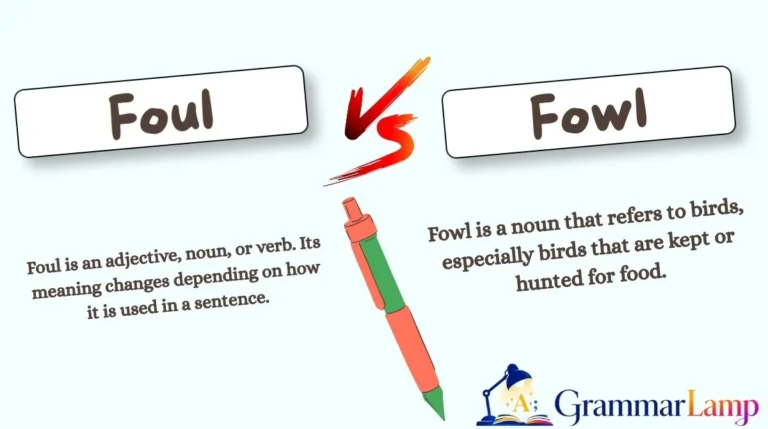
Foul is an adjective, noun, or verb. Its meaning changes depending on how it is used in a sentence.
As an adjective, foul often means very unpleasant, dirty, offensive, or bad.
For example:
- The kitchen had a foul smell.
- The water became foul after the flood.
- He used foul language in front of the children.
- We stayed inside because the weather was foul.
- The room was filled with foul air.
- That was a foul thing to say.
- The garbage produced a foul odor.
- The food had a foul taste.
The word can also describe something that is unfair or against the rules, especially in sports.
For example:
- The referee called a foul.
- The player committed a foul during the game.
- That was a foul move.
- The basketball player was punished for a foul.
As a verb, foul can mean to make something dirty or polluted.
- The oil fouled the water.
- Waste can foul the river.
- Mud fouled the machine.
As a noun, foul is commonly used in sports.
- The referee saw a foul.
- The player received a warning for the foul.
- That was his third foul of the game.
When Should You Use “Foul”?
Use foul when you are talking about something unpleasant, dirty, offensive, unfair, or against a rule.
It is especially common with words such as:
- foul smell
- foul language
- foul air
- foul weather
- foul taste
- foul play
- commit a foul
- call a foul
A useful grammar point is that foul can appear before a noun when it works as an adjective.
foul + noun
a foul smell
foul language
foul weather
a foul taste
It can also come after linking verbs such as be, smell, taste, or become.
The smell is foul.
The water smells foul.
The food tastes foul.
The air became foul.
Common Learner Confusion
The biggest problem is pronunciation. Foul sounds like fowl, so you cannot always decide which word to write by listening.
If someone says, “There was a foul smell,” you need to think about the meaning. The speaker is talking about something unpleasant, so the correct spelling is foul.
Remember: foul = bad, dirty, unpleasant, or against the rules.
What Does “Fowl” Mean?
Fowl is a noun that refers to birds, especially birds that are kept or hunted for food.
Common examples include:
- chickens
- ducks
- geese
- turkeys
For example:
- The farmer keeps fowl on his land.
- The children fed the fowl in the yard.
- Several fowl were walking near the pond.
- The farm has chickens and other fowl.
- Wild fowl flew across the lake.
- The farmer sells fresh fowl.
- We saw many fowl near the river.
- The dog chased a fowl across the garden.
The word can refer to one bird or birds as a group, depending on the context. In modern everyday English, people often use more specific words such as chicken, duck, or goose. Fowl sounds more general and is often used when talking about birds as a category.
You may also see the word poultry. Poultry usually means domestic birds raised for meat or eggs, such as chickens, turkeys, and ducks.
When Should You Use “Fowl”?
Use fowl when the subject is a bird, especially a domestic or game bird.
For example:
The farmer raises fowl.
Here, fowl refers to birds raised on a farm.
You can also use wild fowl when talking about wild birds that are hunted or found in nature.
The lake attracts many wild fowl.
The word is a noun, so it normally names the bird or group of birds.
Grammar Rule for “Fowl”
Because fowl is a noun, it can work as the subject or object of a sentence.
Subject + verb + fowl
The farmer feeds the fowl.
Fowl + verb
The fowl escaped from the yard.
In many contexts, fowl is used as a collective or uncountable-style noun when speaking generally about birds.
For individual birds, however, you can use a fowl when the meaning is one bird.
A fowl was sitting near the fence.
You may also encounter fowls when referring to individual birds or different birds in formal or specialized writing.
Common Learner Confusion
Many learners remember that both words sound like “foul” and then choose the spelling without thinking about meaning.
The easiest question to ask is:
“Am I talking about a bird?”
If the answer is yes, fowl is probably the word you need.
Remember:
fowl = bird
Difference Between Foul and Fowl
The main difference is simple: foul describes something bad or unpleasant, while fowl refers to birds.
Although the two words sound alike, their meanings, spellings, and grammatical uses are different.
| Word | Meaning | Common Grammar | Example |
|---|---|---|---|
| foul | unpleasant, dirty, offensive, unfair, or against rules | adjective, noun, verb | The room has a foul smell. |
| fowl | a bird, especially a domestic or game bird | noun | The farmer keeps fowl. |
Usage Difference
Use foul for conditions, behavior, smells, tastes, weather, and sports actions.
The garbage has a foul smell.
Use fowl for birds.
The fowl are feeding in the garden.
Grammar Logic
Foul has several grammatical jobs.
As an adjective:
It was a foul smell.
As a noun:
The referee called a foul.
As a verb:
The waste fouled the river.
Fowl is mainly a noun:
The farmer keeps fowl.
This grammatical difference can help you choose the correct spelling when you are unsure.
Meaning Comparison
Compare these two sentences:
The kitchen has a foul smell.
The smell is unpleasant.
The kitchen has a fowl problem.
This second sentence would mean something related to birds, although it sounds unusual. The writer might mean that birds are causing a problem.
Another useful pair is:
The player committed a foul.
The player broke a sports rule.
The farmer raised fowl.
The farmer raised birds.
The pronunciation is the same, but the meaning is completely different.
Favourite vs Favorite: Meaning, Difference, Spelling & Usage Guide 2026
No Thank You vs No, Thank You: Which Is Correct in 2026?
Creek vs Creak: Meaning, Difference, Examples & Easy Rules (2026)
Ardor vs Ardour: Meaning, Difference, Spelling & Examples (2026)
Grammar Rules You Must Remember
Rule 1: Use “foul” for something unpleasant or bad
When something smells, tastes, looks, or feels very unpleasant, foul can be the correct word.
The garbage gave off a foul smell.
Here, foul describes the smell.
Other examples include:
The water has a foul odor.
He left the room because of the foul air.
Rule 2: Use “fowl” when you mean birds
If you are talking about chickens, ducks, geese, turkeys, or similar birds, use fowl.
The farmer raises fowl for food.
The word is about birds, not something unpleasant.
We saw wild fowl near the lake.
Rule 3: “Foul” is common in sports
In many sports, a foul is an action that breaks a rule.
The referee called a foul.
You can also use the verb:
The defender fouled the attacker.
Notice the spelling carefully. The sports meaning is always foul, not fowl.
Rule 4: Check the meaning, not the sound
Because foul and fowl are homophones, pronunciation cannot tell you which spelling to use.
Instead, ask yourself:
Is the sentence about something bad or unfair?
Use foul.
Is the sentence about a bird?
Use fowl.
For example:
The chicken smells foul.
Here, foul describes the smell.
But:
The chicken is a fowl.
Here, fowl identifies the bird.
Common Mistakes Students Make
Mistake 1: Writing “fowl smell”
A learner may write:
❌ The garbage has a fowl smell.
This is incorrect if the intended meaning is “an unpleasant smell.”
The correct sentence is:
✅ The garbage has a foul smell.
Why? Because foul means unpleasant.
Correction tip: If you can replace the word with bad or disgusting, choose foul.
Mistake 2: Writing “foul” when talking about birds
A learner may write:
❌ The farmer keeps foul.
If the meaning is birds, the spelling should be:
✅ The farmer keeps fowl.
Correction tip: If you can replace the word with birds, choose fowl.
Mistake 3: Confusing sports “foul” with birds
Consider:
❌ The referee called a fowl.
This is wrong.
The correct sentence is:
✅ The referee called a foul.
A sports foul is a rule violation.
Mistake 4: Choosing the spelling from pronunciation
This is perhaps the most understandable mistake. Both words sound alike.
For example, when someone says:
“The farmer has fowl.”
You cannot know the spelling simply from the sound. You must understand the meaning and context.
This is why learning meaning + spelling together is more useful than memorizing pronunciation alone.
Easy Trick to Remember the Difference
Here is a simple memory trick:
Fowl has “owl” inside it.
Look at the spelling:
fOWL
You can see OWL at the end.
An owl is a bird.
So think:
fOWL → bird
That makes fowl easier to remember.
Now think about foul.
Foul = bad, dirty, unpleasant, or against the rules.
You can connect it with phrases you already know:
- foul smell
- foul language
- foul weather
- foul play
- sports foul
So remember this short rule:
Fowl flies. Foul is bad.
It is not a perfect definition of every use, but it is a very useful memory trick for beginners.
When you see fowl, think bird.
When you see foul, think bad or unfair.
Daily Life Examples
These words appear in different situations, so real conversations can make the difference easier to understand.
1. Talking about a bad smell
Ali: What is that smell?
Sara: I don’t know, but it smells foul.
Here, foul means very unpleasant.
2. Talking about a farm
Ali: What animals does your uncle keep?
Sara: He keeps chickens, ducks, and other fowl.
Here, fowl refers to birds.
3. Talking about sports
Ahmed: Why did the referee stop the game?
Bilal: A player committed a foul.
The word refers to a violation of the rules.
4. Talking about food
Mother: Don’t eat that fish.
Son: Why?
Mother: It has a foul smell.
Here, foul describes something unpleasant.
5. Talking about birds
Tourist: What are those birds near the lake?
Guide: They are wild fowl.
The word means birds.
6. Talking about language
Teacher: Please don’t use foul language in class.
Here, foul language means rude or offensive language.
7. Talking about a farmyard
Farmer: Please close the gate.
Child: Why?
Farmer: The fowl might escape.
The birds may get out.
8. Talking about weather
John: Are you going hiking today?
Mike: No. The weather is foul.
Here, foul means unpleasant or very bad weather.
9. Talking about water
Sara: Why can’t we drink from this stream?
Dad: The water is foul and may be polluted.
The word describes dirty or unpleasant water.
10. Talking about a game
Coach: Be careful not to commit another foul.
Player: I’ll try, Coach.
Here, the word has its sports meaning.
Practice Section
Choose foul or fowl to complete each sentence.
1.
The garbage has a ______ smell.
2.
The farmer keeps several kinds of ______.
3.
The referee called a ______.
4.
The water became ______ after the pollution.
5.
Wild ______ gathered near the lake.
Answers
- foul — It describes an unpleasant smell.
- fowl — It means birds.
- foul — It means a rule violation in sports.
- foul — It means dirty or unpleasant.
- fowl — It refers to birds.
A quick test can help you check your answer: Can you replace the word with “bad” or “unpleasant”? If yes, use foul. Can you replace it with “bird” or “birds”? If yes, use fowl.
It’s vs Its: Simple Difference, Rules, Examples & Practice (2026)
Enamor vs Enamour: What’s the Difference? Meaning, Usage & Examples in 2026
Breath vs Breathe: Easy Difference, Meaning, Examples & Rules in 2026
No Longer Exist vs No Longer Exists: Which Is Correct? (2026 Guide)
FAQs
What is the difference between foul and fowl?
Foul usually means unpleasant, dirty, offensive, unfair, or against the rules. Fowl means a bird, especially a domestic or game bird such as a chicken, duck, or turkey. They sound the same but have different spellings and meanings.
Can we use “foul” in questions?
Yes. Foul can be used in questions just like other adjectives or nouns.
For example: “Why does the water smell foul?” or “Did the referee call a foul?” The correct spelling depends on the meaning, not on whether the sentence is a question.
Is “fowl” formal or informal?
Fowl is a normal English noun, but it can sound more formal or less common in everyday conversation than specific words such as chicken, duck, or goose. It is often useful when speaking about birds as a group.
Is a chicken a fowl?
Yes. A chicken can be called fowl, especially when talking about poultry or birds kept for food. However, chicken is much more common in everyday English when you mean one specific animal.
Does “foul” always mean something bad?
Not always exactly “bad,” but it usually has a negative meaning. It can mean unpleasant, dirty, offensive, unfair, or against a rule. In sports, for example, a foul is an action that breaks the rules.
Why do foul and fowl sound the same?
They are homophones. Homophones are words that have the same pronunciation but different meanings and spellings. English has many such pairs, including flower/flour, right/write, and sea/see.
Conclusion
The difference between foul and fowl becomes much easier when you focus on meaning instead of sound.
Use foul when you mean something unpleasant, dirty, offensive, unfair, or against the rules. You can talk about a foul smell, foul language, foul weather, or a foul in sports.
Use fowl when you are talking about birds, especially birds such as chickens, ducks, geese, and turkeys. A simple memory trick is to notice that fOWL contains OWL, which is a bird.
The two words sound the same, so even good English speakers can sometimes hesitate when writing them. The important thing is to stop and check the meaning.
If you are talking about something bad, think foul. If you are talking about a bird, think fowl.
A few minutes of practice with real sentences will make the difference feel natural, and soon you will choose the correct spelling without having to think twice.

Liam Derren is a language writer at GrammarLamp, creating simple, helpful content about grammar, words, and everyday English. He makes language learning clear, practical, and easy to understand.
1 thought on “Foul or Fowl: Meaning, Difference, Examples & Easy Rules for 2026”