
If you have ever seen both fillet and filet, you may have wondered whether they are two different words or simply two spellings of the same word. The confusion is understandable.
They look almost identical, they refer to the same kind of food, and both can be used as nouns and verbs.
The main difference is regional spelling and usage. In British English, fillet is the usual spelling. In American English, filet is also very common, especially in food-related writing. Dictionaries such as Oxford and Cambridge list filet as an especially North American form of fillet.
There can also be a difference in pronunciation. British English commonly says fillet as FILL-it, while American English often pronounces fillet/filet as fill-AY.
This matters when you are writing recipes, menus, school assignments, emails, or articles for an international audience.
Choosing the right spelling can make your English look more natural.
By the end, you will know exactly what fillet and filet mean, where each spelling is common, how to pronounce them, how to use them in sentences, and which form is safest when writing for British or American readers.
Berth vs Birth: Meaning, Difference, Examples & Easy Rules for 2026
Realise or Realize: Which Spelling Is Correct in 2026?
Insight vs Incite: What’s the Difference? Easy Guide for 2026
In the Same Day vs On the Same Day: Which Is Correct? A Simple Guide for 2026
What Does “Fillet” Mean?
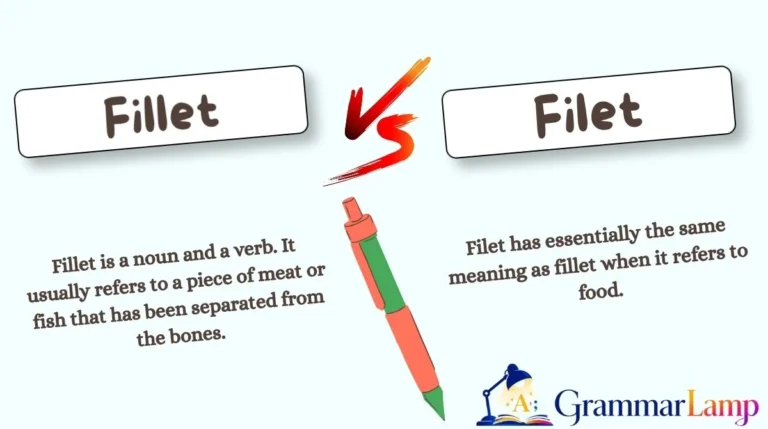
Fillet is a noun and a verb. It usually refers to a piece of meat or fish that has been separated from the bones.
As a noun, a fillet is a piece of meat or fish without bones. For example, a fish fillet is a piece of fish that has been cut away from the bones.
As a verb, fillet means to remove the bones from fish or meat or to cut the flesh into fillets. Cambridge gives this basic meaning as cutting a piece of meat or fish from the bones.
Fillet as a noun
Here are some simple examples:
- I ordered a grilled salmon fillet for dinner.
- The chef placed the fish fillet on a warm plate.
- This recipe uses a fresh cod fillet.
- The restaurant serves beef fillet with vegetables.
- Please put the fish fillet in the oven.
- He cooked a fillet of salmon with lemon.
- The chicken fillet was tender and juicy.
In these sentences, fillet names a piece of food. It is therefore functioning as a noun.
You will often see it after words such as fish, chicken, beef, salmon, or cod.
For example:
- fish fillet
- chicken fillet
- beef fillet
- salmon fillet
- cod fillet
Oxford lists examples such as fillet steak, fillet of beef, and fillet of cod.
Fillet as a verb
Fillet can also describe an action.
For example:
- The chef filleted the fish.
- He knows how to fillet a salmon.
- She filleted the trout before cooking it.
Here, fillet means to remove the flesh from the bones.
Notice the grammar:
Subject + fillet + object
For example:
The chef filleted the fish.
The chef = subject
filleted = verb
the fish = object
The past form is filleted, and the -ing form is filleting. Oxford lists these forms in its verb entry.
Is “fillet” British or American?
Fillet is strongly associated with British English, but it is not limited to Britain. It is also used in North American English.
Oxford lists fillet as the main word and notes filet as another form, especially in North American English.
So, if you are learning British English, fillet is the spelling you are most likely to see.
Common learner confusion
A common mistake is thinking that fillet and filet have completely different meanings.
Usually, they do not.
When talking about a piece of boneless meat or fish, they generally refer to the same thing. The important difference is usually regional spelling and pronunciation, not meaning.
What Does “Filet” Mean?
Filet has essentially the same meaning as fillet when it refers to food.
It can be a noun meaning a piece of meat or fish without bones. It can also be a verb meaning to remove meat or fish from the bones.
The spelling filet is especially common in American English. Oxford describes it as especially North American English, while Cambridge marks filet as the US form of fillet.
Filet as a noun
Look at these examples:
- I ordered a filet of beef.
- The restaurant serves grilled fish filets.
- She cooked a chicken filet for lunch.
- The menu has a filet with mashed potatoes.
- He bought two salmon filets.
- The filet was cooked medium-rare.
- This dish comes with a beef filet.
- The fish filet was served with rice.
Here, filet is a noun.
It refers to the boneless piece of meat or fish.
You may especially notice this spelling on American restaurant menus, food packaging, and American cooking websites.
Filet as a verb
Filet can also be used as a verb, particularly in American English.
For example:
- The chef fileted the fish.
- Can you filet this fish for me?
- He learned how to filet a trout.
The meaning is the same basic idea: removing the flesh from the bones.
Cambridge identifies filet as the US form of the verb fillet.
How do you pronounce “filet”?
This is one of the most interesting parts of the fillet vs filet question.
In American English, filet is commonly pronounced approximately:
fill-AY
The final sound is like the sound at the end of day.
Cambridge gives the American pronunciation as /fɪˈleɪ/.
For example:
filet → fill-AY
This can surprise English learners because the spelling does not clearly show that pronunciation.
Is “filet” informal?
No. Filet is not simply a casual or incorrect spelling.
It is a standard English spelling, especially in American English. You can find it in dictionaries and formal writing. Oxford and Cambridge both recognize it.
So an American restaurant menu saying filet is not making a spelling mistake.
Difference Between Fillet and Filet
The easiest way to understand the difference is this:
Fillet and filet usually have the same meaning. The main difference is where and how they are used.
Comparison table
| Feature | Fillet | Filet |
|---|---|---|
| Basic meaning | Boneless piece of meat or fish | Boneless piece of meat or fish |
| Word type | Noun and verb | Noun and verb |
| Common spelling | British English | American English |
| American usage | Also used | Very common |
| British usage | Very common | Less common |
| Common pronunciation | Often FILL-it in British English | Often fill-AY in American English |
| Example noun | fish fillet | fish filet |
| Example verb | fillet the fish | filet the fish |
Cambridge’s dictionary entries make the regional distinction clear: fillet is the standard UK form, while filet is the US form.
Usage difference
Suppose you are writing for a British audience:
I bought a salmon fillet.
That will sound completely natural.
For an American audience, you may see:
I bought a salmon filet.
Both sentences communicate the same basic idea.
The difference becomes especially noticeable in food-related vocabulary.
For example:
British-style spelling:
We had grilled chicken fillets for dinner.
American-style spelling:
We had grilled chicken filets for dinner.
Neither sentence is automatically wrong.
Grammar logic
There is no major grammar rule that says one form must be used as a noun and the other as a verb.
This is important.
Some learners think:
“Fillet is the noun, and filet is the verb.”
That is not the rule.
Both forms can work as nouns and verbs.
For example:
The chef prepared a fish fillet.
Here, fillet is a noun.
And:
The chef filleted the fish.
Here, filleted is a verb.
In American English, you can also encounter:
The chef prepared a fish filet.
and:
The chef fileted the fish.
The spelling mainly reflects regional preference.
Sentence structure difference
The sentence structure does not change because you use fillet or filet.
As a noun:
I cooked a fish fillet.
The structure is:
Subject + verb + noun
As a verb:
I filleted the fish.
The structure is:
Subject + verb + object
The same basic patterns can be used with filet:
I cooked a fish filet.
I fileted the fish.
So the grammar is not really about choosing between two different grammatical meanings. It is about choosing the spelling that fits your variety of English.
Mine as Well or Might as Well? The Correct Phrase Explained in Simple English (2026)
Alternative of vs Alternative for vs Alternative to: Which Is Correct? 2026 Guide
Realise or Realize: Which Spelling Is Correct in 2026?
Berth vs Birth: Meaning, Difference, Examples & Easy Rules for 2026
Grammar Rules You Must Remember
Rule 1: Use “fillet” for British English
If your school, workplace, website, or course follows British English, fillet is generally the best choice.
Example:
The chef prepared a salmon fillet.
British English commonly uses this spelling. Cambridge lists fillet as the UK form.
Rule 2: “Filet” is especially common in American English
If you are writing American English, filet is a very normal choice.
Example:
The restaurant serves a grilled beef filet.
Cambridge identifies filet as the US form, and Oxford calls it especially North American English.
Rule 3: Both words can be nouns and verbs
Do not memorize this as a noun-versus-verb difference.
Both can describe the food:
I ordered a fish fillet.
And both can describe the action:
The chef filleted the fish.
In American usage:
I ordered a fish filet.
The chef fileted the fish.
Oxford lists fillet as both a noun and a verb.
Rule 4: Keep your spelling consistent
If you are writing an article in British English, do not switch randomly between fillet and filet.
For example, this looks inconsistent:
The recipe uses two fish fillets. Later, add the fish filets to the pan.
A better British-English version is:
The recipe uses two fish fillets. Later, add the fish fillets to the pan.
For American English, filet may be preferred throughout.
Consistency is especially useful in professional writing, websites, recipes, and educational content.
Common Mistakes Students Make
Mistake 1: Thinking one word is wrong
A learner may see filet and think:
“That must be a spelling mistake.”
Not necessarily.
Filet is a standard spelling, especially in American English.
Correction tip: Before correcting the word, ask which variety of English is being used.
Mistake 2: Thinking they have completely different meanings
Some students memorize them as two separate vocabulary words.
That makes the topic harder than it needs to be.
In the food sense, they generally mean the same thing: a piece of meat or fish without bones.
Easy correction:
fillet = filet
Then remember:
fillet → more common in British English
filet → especially common in American English
Mistake 3: Using “filet” because it looks more French
The spelling filet does look closer to the French word filet, and English did get the word through French. Oxford traces fillet back through Middle English to Old French filet, ultimately connected with Latin filum, meaning “thread.”
But you should not choose the spelling simply because it “looks French.”
Choose based on the English variety you are using.
Mistake 4: Thinking “fillet” is always pronounced “fill-it”
This is not always true.
In British English, fillet is commonly pronounced approximately FILL-it.
In American English, the related forms are commonly pronounced fill-AY. Cambridge gives the American pronunciation of filet as /fɪˈleɪ/.
So pronunciation can change along with regional usage.
Mistake 5: Writing “filet” in a British-English assignment
This is not necessarily a serious error because the spelling is a real English word. However, if your teacher expects British English, fillet is the more natural choice.
The same principle applies to many spelling differences:
- colour / color
- centre / center
- favourite / favorite
- organise / organize
English has several regional spelling systems.
Easy Trick to Remember the Difference
Here is a simple trick:
British English → fillet
American English → filet
Think of the extra l in fillet as the spelling you are more likely to see in British English.
Then connect filet with American restaurant language.
For example:
British: fish fillet
American: fish filet
There is no need to memorize a complicated grammar rule.
Think about the location of the reader, not the food itself.
A salmon does not change because you cross the Atlantic. The spelling changes because English speakers in different regions have different conventions.
One more useful point: fillet is the safer choice if you are following British English, while filet is very common in American English.
Daily Life Examples
Here are some natural examples you might hear or read in everyday situations.
1. At a restaurant
Waiter: What would you like for dinner?
Customer: I’ll have the grilled salmon fillet, please.
2. Talking about shopping
A: What did you buy?
B: I bought two chicken fillets for dinner.
3. Cooking at home
A: Is the fish ready?
B: Almost. I just need to fillet it.
4. Talking about an American menu
A: What does the restaurant serve?
B: They have a grilled beef filet with vegetables.
5. Asking a butcher
Customer: Could you fillet this fish for me?
6. Talking about a recipe
The recipe says: Season the fish fillets with salt and pepper.
7. Talking about dinner
A: What are you making tonight?
B: Chicken fillets with rice and salad.
8. Talking about a restaurant in the US
A: What did you order?
B: I had a beef filet with mashed potatoes.
9. Giving cooking instructions
First, fillet the fish and remove the bones.
10. Talking about food quality
The fish fillet was fresh, soft, and perfectly cooked.
These examples show an important point: the word is common in ordinary conversations about cooking, restaurants, shopping, and recipes.
Practice Section
Choose fillet or filet in each sentence. More than one answer may sometimes be possible depending on the variety of English.
1.
The chef prepared a fresh fish ______ for dinner.
2.
The American restaurant serves a beef ______.
3.
Can you ______ the salmon before we cook it?
4.
We bought four chicken ______ from the supermarket.
5.
The recipe says to place the fish ______ in a baking dish.
Answers
1. fillet/filet — Both can be correct depending on regional English.
2. filet — This is especially natural in American English.
3. fillet/filet — Both can be used as verbs, although the preferred spelling depends on the variety of English.
4. fillets/filets — Both forms are possible; fillets is especially common in British English.
5. fillet/filet — Both can work, depending on the style of English.
The key is not to memorize one spelling as “correct” and the other as “wrong.” Think about British English versus American English.
Better Understand vs Understand Better: Meaning, Grammar, and Correct Usage (2026)
Hear vs Here: Meaning, Difference, Grammar Rules & Examples in 2026
Hasn’t vs Haven’t: Easy Grammar Rules, Examples & Differences in 2026
Smooth vs Smoothe: Which Spelling Is Correct? Complete Guide for 2026
FAQs
1. What is the difference between fillet and filet?
In the food-related sense, fillet and filet usually have the same meaning: a piece of meat or fish without bones. Fillet is the common British spelling, while filet is especially common in American English.
2. Is “filet” a correct English word?
Yes. Filet is a standard English word, not simply a misspelling of fillet. It is particularly common in American English. You can use it when writing for an American audience.
3. Is “fillet” British or American?
Fillet is especially common in British English, but Americans also use it. American English also commonly uses filet, particularly in food terms. So fillet is not exclusively British.
4. How do you pronounce fillet?
In British English, fillet is commonly pronounced approximately FILL-it. In American English, fillet can be pronounced fill-AY, and filet is commonly pronounced fill-AY. Dictionary pronunciations show this regional difference.
5. Which is correct: fish fillet or fish filet?
Both can be correct. Fish fillet is especially natural in British English, while fish filet is common in American English. If you are writing for a British audience, choose fillet; for American English, filet is often preferred.
6. Can “fillet” and “filet” be verbs?
Yes. Both can be used as verbs meaning to remove the flesh of fish or meat from the bones. For example, “The chef filleted the fish” and American “The chef fileted the fish.” Oxford and Cambridge both recognize the verb use.
Conclusion
The difference between fillet vs filet is much simpler than it first appears.
In most food-related situations, both words refer to a piece of meat or fish without bones. They can also be used as verbs for removing the flesh from bones. The biggest difference is regional spelling and pronunciation.
If you are writing British English, fillet is usually the natural choice. If you are writing American English, filet is especially common, although fillet is also used.
Remember this simple rule:
British English → fillet
American English → filet
Also remember that these words are not divided into “noun” and “verb.” Both can function as nouns and verbs.
Once you understand the regional difference, you do not need to worry every time you see the other spelling. It is not automatically a mistake.
English has many words that change slightly between regions, and fillet/filet is a good example.
The best habit is to choose one variety of English and stay consistent. That will make your writing clearer, more natural, and easier for your readers to understand.

Liam Derren is a language writer at GrammarLamp, creating simple, helpful content about grammar, words, and everyday English. He makes language learning clear, practical, and easy to understand.
3 thoughts on “Fillet vs Filet: What’s the Difference? Meaning, Spelling, and Examples in 2026”