
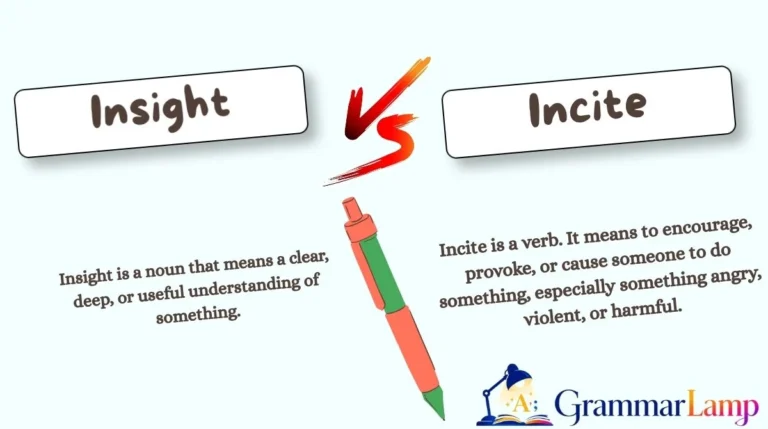
English has many words that sound almost the same but have completely different meanings. Insight and incite are good examples.
They can easily confuse learners because both begin with the same sound, and both are often used in serious writing, news reports, books, and everyday conversations.
However, these two words have very different jobs. Insight is connected with understanding.
When someone gives you insight, they help you understand a person, problem, situation, or idea more clearly.
Incite, on the other hand, means to encourage or cause people to do something, especially something angry, harmful, or violent.
For example, you might say, “The teacher gave me valuable insight into the problem.” Here, insight means a deeper understanding.
But you could say, “The speech was designed to incite anger.” Here, incite means to encourage a strong reaction.
Once you understand the basic idea behind each word, the difference becomes much easier.
You will learn when to use insight and incite, how they work grammatically, common mistakes to avoid, and simple ways to remember which word you need.
What Does “Insight” Mean?
Insight is a noun that means a clear, deep, or useful understanding of something.
When you have insight into a situation, you understand something about it that may not be obvious at first. It can be a new understanding, a useful idea, or a deeper view of a problem.
Think of insight as understanding that helps you see something more clearly.
When Do We Use “Insight”?
We use insight when talking about understanding people, situations, problems, ideas, behavior, or subjects.
It is common in education, business, psychology, science, books, and everyday conversations.
For example:
- A teacher can give you insight into a difficult subject.
- A doctor may gain insight into a patient’s condition.
- A book can provide insight into another culture.
- A manager may ask an employee for insight into a problem.
The word is especially useful when the understanding is deeper than a simple fact.
Knowing that a company lost money is a fact. Understanding why it lost money and what that tells us about the company is closer to insight.
Grammar Rule for “Insight”
Insight is usually a countable or uncountable noun, depending on how it is used.
When speaking generally, we often use it without an article:
Good research can provide insight into the problem.
When referring to one particular understanding or idea, we can use an insight:
Her experience gave me an insight into the challenges faced by new teachers.
We also commonly use these patterns:
- insight into something
- insight on something
- provide insight
- gain insight
- offer insight
- valuable insight
- useful insight
- deep insight
The phrase insight into is particularly common.
Examples of “Insight”
- The book gives readers valuable insight into human behavior.
- Her experience gave me an insight into life in another country.
- The teacher provided useful insight into the topic.
- His comments gave us a new insight into the problem.
- The interview offers interesting insight into the actor’s career.
- Talking to my grandfather gave me insight into how life was different in the past.
- The report provides insight into why sales have fallen.
- The manager’s experience gave the team valuable insight.
Common Learner Confusion
A common mistake is thinking that insight means simply “information.”
It does not always mean ordinary information.
For example:
The website contains information about the company.
This means the website tells you facts.
But:
The interview gives us insight into the company.
This suggests that the interview helps us understand how the company works, thinks, or operates.
So, information gives you facts, while insight often gives you deeper understanding.
What Does “Incite” Mean?
Incite is a verb. It means to encourage, provoke, or cause someone to do something, especially something angry, violent, or harmful.
It is pronounced approximately like in-SITE.
The word often appears when people are encouraged to react strongly.
For example:
The speech was intended to incite violence.
This means the speech was intended to encourage people to become violent.
Another example:
His comments could incite anger.
Here, his comments could cause or encourage anger.
When Do We Use “Incite”?
We usually use incite when someone or something encourages a particular reaction or action.
The word often has a negative meaning.
You may see it in news reports, discussions about protests, politics, social conflict, crime, or public disorder.
Common expressions include:
- incite violence
- incite hatred
- incite anger
- incite fear
- incite people to protest
- incite a riot
- incite conflict
For example:
The speaker was accused of trying to incite hatred.
The speaker was accused of encouraging people to hate others.
Grammar Rule for “Incite”
Because incite is a verb, it describes an action.
It can be followed by a noun:
The speech incited anger.
It can also be followed by a person or group plus to + verb:
The leader incited the crowd to protest.
A useful structure is:
incite + someone + to + verb
For example:
The message incited people to fight.
Another structure is:
incite + noun
For example:
The article incited fear.
Examples of “Incite”
- The speech was criticized for inciting violence.
- His comments could incite anger among local residents.
- The message attempted to incite people to protest.
- The video was accused of inciting hatred.
- The leader urged his supporters not to incite conflict.
- The article may incite fear among readers.
- The group was accused of trying to incite a riot.
- The teacher warned students not to say anything that might incite violence.
Common Learner Confusion
The biggest problem is that insight and incite look and sound somewhat similar.
But their parts of speech are different:
- Insight = noun
- Incite = verb
Their meanings are also completely different.
Insight is about understanding.
Incite is about encouraging an action or reaction.
Difference Between Insight and Incite
The easiest way to understand the difference is to focus on the main idea behind each word.
| Word | Part of Speech | Main Meaning | Common Use | Example |
|---|---|---|---|---|
| Insight | Noun | Deep or useful understanding | Ideas, people, problems, situations | The book gave me insight into the issue. |
| Incite | Verb | Encourage or provoke an action/reaction | Anger, violence, hatred, protests | The speech could incite violence. |
1. They Have Different Meanings
Insight helps you understand something.
The discussion gave me insight into the problem.
You learned something that helped you understand the problem better.
Incite encourages someone to do something.
The speech could incite people to violence.
The speech could encourage people to act violently.
2. They Have Different Parts of Speech
This is an important grammar difference.
Insight is a noun:
I gained valuable insight.
You can gain, receive, provide, or offer insight.
Incite is a verb:
The speech may incite anger.
You can incite something or incite someone to do something.
3. Their Sentence Structures Are Different
With insight, common structures include:
provide insight into something
gain insight into something
offer insight into something
give someone insight into something
With incite, common structures include:
incite someone to do something
incite violence
incite anger
incite hatred
Notice how different the grammar is.
4. Their Meanings Can Be Remembered Simply
Think:
Insight → understanding
Incite → action or reaction
If someone helps you understand a difficult problem, they give you insight.
If someone encourages people to react strongly, they may incite them.
Grammar Rules You Must Remember
Rule 1: “Insight” Is a Noun
Use insight when you are talking about understanding or a deeper idea.
The teacher gave us useful insight into the subject.
Do not use insight as a verb.
Incorrect:
The teacher insighted us about the problem.
Correct:
The teacher gave us insight into the problem.
There is no normal verb insighted in standard English for this meaning.
Rule 2: “Incite” Is a Verb
Use incite when you mean “encourage” or “provoke.”
The speech could incite anger.
You can change the tense:
The speech incited anger.
The speech is inciting anger.
The speech may incite anger.
The word remains a verb in each example.
Rule 3: “Insight Into” Is a Common Expression
When talking about deeper understanding of a subject, insight into is a very common pattern.
The documentary gave us insight into climate change.
She has valuable insight into children’s behavior.
You will often see this phrase in formal and everyday English.
Rule 4: “Incite Someone to Do Something” Is a Useful Pattern
When a person encourages another person or group to take an action, use:
incite + person/group + to + verb
For example:
The speaker tried to incite the crowd to protest.
Another example:
The message was designed to incite people to fight.
Remember that incite normally involves encouraging an action or strong reaction, not simply giving information.
Common Mistakes Students Make
Because the words look similar, learners sometimes choose the wrong one without checking the meaning.
Mistake 1: Using “Incite” When You Mean “Insight”
Incorrect:
The book gave me valuable incite into the problem.
Correct:
The book gave me valuable insight into the problem.
Here, you need a noun meaning understanding, so insight is correct.
Mistake 2: Using “Insight” as a Verb
Incorrect:
The speech insighted anger.
Correct:
The speech incited anger.
The action is “encouraged” or “provoked,” so the verb incited is needed.
Mistake 3: Confusing “Incite” With “Insight” in Writing
Incorrect:
The report provides incite into customer behavior.
Correct:
The report provides insight into customer behavior.
A useful trick is to look at the words around the blank.
If you see provides, gives, offers, or gains, you probably need the noun insight.
Mistake 4: Forgetting That “Incite” Is Often Negative
Learners sometimes use incite as if it simply means “encourage.”
Although it can mean encourage, it often suggests encouraging a strong, harmful, angry, or dangerous reaction.
For example:
The coach encouraged the players to work harder.
This is normal and positive.
You would not usually say:
The coach incited the players to work harder.
The word incite would sound unnecessarily strong and unusual in that context.
Easy Correction Tip
Ask yourself one question:
“Am I talking about understanding or encouraging action?”
If it is understanding → insight.
If it is encouraging a reaction or action → incite.
Easy Trick to Remember the Difference
Here is a simple memory trick:
Insight = “I see!”
The word insight contains the sound sight.
Think of:
Insight → seeing something clearly
You are not literally seeing with your eyes. You are understanding something clearly in your mind.
For example:
I finally gained insight into why she was upset.
You now “see” or understand the reason.
Incite = “Start!”
Think of incite as something that can start a reaction.
A speech can incite anger.
A message can incite a protest.
A statement can incite violence.
So remember:
INSIGHT = SEE/UNDERSTAND
INCITE = START/ENCOURAGE
This small mental picture can help you choose the right word quickly.
Daily Life Examples
These examples show how the two words appear naturally in real English.
Example 1: Talking About a Book
“What did you learn from the book?”
“It gave me some interesting insight into human behavior.”
The book helped the speaker understand human behavior better.
Example 2: Talking About a Teacher
“Why did you enjoy her class?”
“She gave us real insight into how businesses work.”
The teacher provided deeper understanding.
Example 3: Talking About a News Report
“Why was the speaker criticized?”
“People said his comments could incite anger.”
His comments might encourage an angry reaction.
Example 4: Talking About a Difficult Problem
“Did the meeting help?”
“Yes. It gave us useful insight into the problem.”
The meeting improved their understanding.
Example 5: Talking About a Public Speech
“Why was the speech controversial?”
“Some people believed it could incite violence.”
The speech was seen as something that could encourage violent behavior.
Example 6: Talking About Work
“What did the customer interviews tell you?”
“They gave us valuable insight into what customers want.”
The interviews helped the company understand customers.
Example 7: Talking About Social Media
“Why was the post removed?”
“It was accused of trying to incite hatred.”
The post allegedly encouraged hateful feelings or behavior.
Example 8: Talking About a Research Project
“What did your research show?”
“It gave us new insight into how students learn.”
The research created a better understanding of student learning.
Example 9: Talking About a Crowd
“Why did the police become concerned?”
“They feared someone might incite the crowd to violence.”
Someone might encourage the crowd to become violent.
Example 10: A Simple Everyday Comparison
“The conversation gave me insight into his decision.”
This means you understand his decision better.
“The speech could incite people to protest.”
This means the speech could encourage people to take action.
The two words may appear in similar serious discussions, but their meanings remain very different.
Practice Section
Choose insight or incite to complete each sentence.
1. The documentary gave us valuable ______ into life in the region.
2. The speech was accused of trying to ______ hatred.
3. Her experience gave me useful ______ into the problem.
4. The message could ______ people to protest.
5. The report provides new ______ into customer behavior.
Answers
1. insight
The documentary gives understanding, so insight is correct.
2. incite
The speech is accused of encouraging hatred, so incite is correct.
3. insight
The experience provides deeper understanding.
4. incite
The message may encourage people to take action.
5. insight
The report provides understanding about customer behavior.
A good learner does not just memorize the spelling. Try to understand the meaning of each sentence. That will make the difference much easier to remember.
FAQs
1. What is the difference between insight and incite?
Insight is a noun meaning deep or useful understanding. Incite is a verb meaning to encourage or provoke someone to take an action or have a strong reaction. For example, a book can provide insight, while a speech can incite anger.
2. Can “incite” be used in questions?
Yes. Incite can be used in questions just like other verbs.
For example:
“Did the speech incite violence?”
You can also ask:
“Could this message incite people to protest?”
The question is about whether something may encourage a particular action or reaction.
3. Is “insight” a formal word?
Insight is common in both formal and everyday English. It is especially common in education, business, psychology, research, and professional writing. However, native speakers also use it in normal conversations, such as “That gave me some insight into the situation.”
4. Is “incite” a negative word?
It is often negative because it commonly describes encouraging anger, hatred, violence, conflict, or disorder. It can sometimes simply mean “encourage,” but it usually suggests a strong or troubling reaction. Therefore, it is not normally used for ordinary positive encouragement.
5. What is the difference between “insight into” and “incite”?
Insight into means gaining a deeper understanding of something.
The interview gave us insight into her life.
Incite means encouraging an action or reaction.
The speech could incite violence.
The first is about understanding; the second is about provoking action or emotion.
6. How can I easily remember insight and incite?
Think of insight as “seeing clearly.” It helps you understand something. Think of incite as “starting a reaction.” It can encourage people to become angry, protest, fight, or take another strong action. Remember: insight = understanding; incite = encourage/provoke.
Conclusion
Insight and incite may look and sound similar, but they have very different meanings and grammatical roles. Insight is a noun connected with understanding.
When something gives you insight, it helps you see a person, problem, idea, or situation more clearly. Common expressions include gain insight, provide insight, and insight into.
Incite is a verb. It means to encourage or provoke someone to take action or have a strong reaction. It is often used with words such as anger, hatred, violence, conflict, and protest.
The simplest way to remember the difference is this:
Insight = understanding.
Incite = encourage or provoke action.
When you meet these words while reading, stop for a second and think about the meaning of the sentence.
With a little practice, you will quickly recognize which word belongs there. Good grammar is often less about memorizing difficult rules and more about noticing how words are naturally used.

Liam Derren is a language writer at GrammarLamp, creating simple, helpful content about grammar, words, and everyday English. He makes language learning clear, practical, and easy to understand.
2 thoughts on “Insight vs Incite: What’s the Difference? Easy Guide for 2026”