
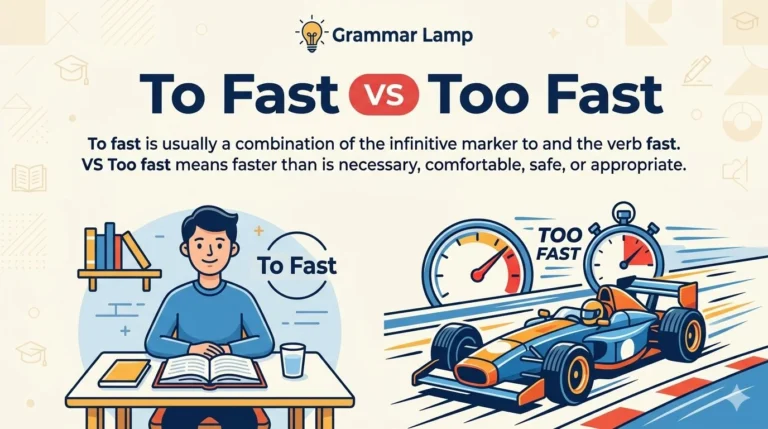
When you hear “to fast” and “too fast,” they may sound almost the same. That small difference in sound can cause a lot of confusion, especially for English learners. But these two expressions do not have the same job in a sentence.
Usually, when people say something like “You are driving too fast,” they mean that the speed is higher than it should be. Here, too is very important because it means “more than necessary” or “more than is suitable.”
On the other hand, to fast can have a completely different meaning. It can be part of an infinitive structure, such as “I need to fast before the medical test,” where fast is a verb meaning to stop eating for a period of time.
This difference matters in everyday English. A single letter can change the meaning of a sentence and sometimes make the sentence grammatically wrong.
The good news is that the rule is not difficult once you understand what to and too do. After learning the difference, you will know why we say “too fast” when talking about speed, and when “to fast” can actually be correct.
You will also see common mistakes, simple rules, conversation examples, and an easy memory trick that can help you choose the right form quickly.
More Useful posts
Insight vs Incite: What’s the Difference? Easy Guide for 2026
In the Same Day vs On the Same Day: Which Is Correct? A Simple Guide for 2026
Licence or License: Which Spelling Is Correct in 2026?
I’ve Added vs I Added: Easy Difference, Rules & Examples (2026)
What Does “To Fast” Mean?
To fast is usually a combination of the infinitive marker to and the verb fast.
The verb fast means to stop eating food for a period of time, often for health, medical, religious, or personal reasons.
For example:
I have to fast before my medical test.
Here, to fast means “to stop eating before the test.”
This is very different from talking about speed. When fast means “quickly,” we usually do not put to before it in the same way. Instead, we may use too fast, very fast, so fast, or simply fast, depending on the sentence.
The Basic Grammar Rule
When fast is used as a verb, we can use to fast after another verb or structure that takes an infinitive.
The pattern is:
verb + to + fast
Examples include:
- I need to fast before surgery.
- She decided to fast for a day.
- He plans to fast tomorrow.
- We were told to fast before the blood test.
In these sentences, fast is an action. It does not describe speed.
Examples of “To Fast”
Here are some easy examples:
- I need to fast before my blood test.
I must stop eating before the test. - She decided to fast for 24 hours.
She chose not to eat for a certain period. - The doctor told me to fast overnight.
The doctor said I should not eat during the night. - He wants to fast during the day.
He plans not to eat for a period of time. - We were asked to fast before the procedure.
We were told not to eat before it. - Some people choose to fast for personal reasons.
Some people decide not to eat for a certain time. - I forgot that I had to fast before the test.
The speaker forgot that eating was not allowed. - They plan to fast until sunset.
They plan not to eat until sunset.
A Common Learner Confusion
One major problem happens when learners see fast and think only about speed.
For example, a learner may want to say:
❌ The car is moving to fast.
That is incorrect when the meaning is “the car is moving more quickly than it should.”
The correct sentence is:
✅ The car is moving too fast.
Why? Because too is being used to show an excessive amount or degree of speed.
So remember: to fast can be correct, but usually not when you are talking about excessive speed.
What Does “Too Fast” Mean?
Too fast means faster than is necessary, comfortable, safe, or appropriate.
The word too is an adverb. In this expression, it tells us that the speed is beyond a suitable limit.
For example:
You are driving too fast.
This means the person is driving at a speed that is higher than they should.
The important word is too. It adds the idea of more than is wanted or needed.
The Basic Grammar Rule
When fast describes speed, too fast is a common adverbial phrase.
The usual pattern is:
too + adverb
Since fast can work as an adverb meaning “quickly,” we can say:
- too fast
- very fast
- so fast
- really fast
- incredibly fast
For example:
The train is going too fast.
Here, too fast tells us about the speed of the train.
Examples of “Too Fast”
- You are walking too fast.
Your walking speed is higher than I can comfortably follow. - The car is going too fast.
The car is moving at an unsafe or unsuitable speed. - He speaks too fast for me to understand.
His speaking speed is higher than what the listener can follow. - This computer is running too fast.
Its operation is happening at a speed that causes a problem. - The children are growing up too fast.
Their growth seems to be happening very quickly, perhaps sooner than expected. - You typed the answer too fast.
You typed it so quickly that you may have made mistakes. - The river is flowing too fast today.
The water is moving faster than is safe or normal. - She was driving too fast on the narrow road.
Her speed was too high for that road.
Why “Too Fast” Can Be Negative
The word too often gives the sentence a negative or unwanted meaning.
Compare these sentences:
She runs fast.
This simply tells us about her speed.
She runs very fast.
This emphasizes that her speed is high.
She runs too fast.
This suggests that her speed is higher than suitable for the situation.
That small word too changes the meaning.
Difference Between “To Fast” and “Too Fast”
The clearest way to understand the difference is to look at the job each expression performs.
| Expression | Main Function | Meaning | Example |
|---|---|---|---|
| to fast | Infinitive + verb | to stop eating | I need to fast before the test. |
| too fast | Adverb phrase | more quickly than suitable | You are driving too fast. |
| fast | Adverb/adjective | quickly / moving quickly | He runs fast. |
| very fast | Adverb phrase | at a high speed | The car is very fast. |
The biggest difference is grammatical.
To fast contains to + verb. It often refers to the action of not eating.
Too fast contains too + adverb. It usually describes an excessive speed or rate.
Usage Difference
Consider these two sentences:
I have to fast before the operation.
I am walking too fast.
The first sentence is about not eating.
The second sentence is about speed.
They may sound similar when spoken, but their meanings are completely different.
Grammar Logic
English uses to and too for different purposes.
To is commonly used:
- before a base verb in an infinitive
- to show direction
- to connect certain parts of a sentence
Examples:
I want to sleep.
She needs to study.
We plan to leave.
In to fast, the word fast is a base verb.
But too is used to show an excessive amount or degree.
Examples:
too hot
too cold
too expensive
too slowly
too fast
So:
The test is too difficult.
means the test is more difficult than is suitable.
In the same way:
He is driving too fast.
means his speed is higher than it should be.
Sentence Structure Difference
Look at these patterns:
To fast:
subject + verb + to fast
Example:
I need to fast.
Too fast:
subject + verb + too fast
Example:
He drives too fast.
You can see that to fast often comes after another verb such as need, want, decide, plan, have, or try.
Meanwhile, too fast often comes after a verb that describes movement, speaking, working, typing, driving, or another action.
Meaning Comparison
A useful question is:
Am I talking about not eating, or am I talking about speed?
If you mean not eating, to fast may be correct.
If you mean more quickly than is suitable, use too fast.
For example:
I need to fast before the exam.
This means the person must avoid food.
But:
I studied too fast.
This means the person studied too quickly, perhaps without enough care.
Explore More Posts
This Is She or This Is Her? The Correct Choice in English in 2026
Jewel vs Joule: Meaning, Difference, Examples & Easy Rules (2026)
Foul or Fowl: Meaning, Difference, Examples & Easy Rules for 2026
Dialog vs Dialogue: What’s the Difference? A Simple English Guide for 2026
Grammar Rules You Must Remember
Rule 1: Use “too” for an excessive degree
Use too when something is more than necessary, suitable, comfortable, or acceptable.
Examples:
The soup is too hot.
The box is too heavy.
He drives too fast.
In the last example, too fast means “faster than is suitable.”
Rule 2: Use “to” before a base verb in an infinitive
When fast is being used as a verb meaning “stop eating,” you can use to fast.
Examples:
I need to fast before the test.
She decided to fast tomorrow.
They were told to fast overnight.
Here, to is part of the infinitive.
Rule 3: Do not use “to” when you mean excessive speed
A very common mistake is:
❌ You are driving to fast.
The correct form is:
✅ You are driving too fast.
The word too is needed because the meaning is “faster than appropriate.”
The same pattern appears with many words:
too slow
too loud
too early
too late
too quickly
too fast
Rule 4: “Fast” can already describe speed
You do not need to before fast just because you are talking about speed.
For example:
She runs fast.
He speaks fast.
The car moves fast.
If you want to say the speed is excessive, add too:
She runs too fast.
He speaks too fast.
The car moves too fast.
That gives you a very useful pattern:
fast = quickly
too fast = more quickly than suitable
Common Mistakes Students Make
Many learners confuse these expressions because to and too sound almost identical in everyday speech. When people hear them instead of seeing them in writing, the difference can disappear completely.
Another problem is that learners often memorize the phrase to + verb but do not notice that fast has two important meanings.
It can be:
- a verb meaning “not eat”
- an adjective or adverb related to speed
That is why context matters.
Mistake 1: “Drive to fast”
Wrong:
❌ Please don’t drive to fast.
Correct:
✅ Please don’t drive too fast.
The speaker is talking about speed, not fasting.
Mistake 2: “I need too fast”
Wrong:
❌ I need too fast before my test.
Correct:
✅ I need to fast before my test.
The speaker means they need to stop eating.
Mistake 3: “She speaks to fast”
Wrong:
❌ She speaks to fast, so I cannot understand her.
Correct:
✅ She speaks too fast, so I cannot understand her.
The problem is speaking speed, so too fast is needed.
Mistake 4: Thinking “too” is always wrong
Some learners remember that to comes before verbs and then use it everywhere.
But too has its own important job.
Compare:
I want to eat.
I eat too much.
These words sound similar, but their grammar is different.
The same idea applies to to fast and too fast.
Easy Correction Tip
Before writing to fast or too fast, ask yourself:
What does fast mean here?
If it means not eating, you may need to fast.
If it means quickly, and you want to say the speed is excessive, use too fast.
This one question can prevent many mistakes.
Easy Trick to Remember the Difference
Here is a simple memory trick:
“TO” = action
“TOO” = more than needed
Think of to fast as an action:
I need to fast.
You are doing something: you are not eating.
Now think of too fast as a problem with degree:
You are driving too fast.
The speed is more than it should be.
Another easy trick is to replace the phrase with a longer meaning.
If you can replace it with:
“to stop eating”
then to fast may be right.
Example:
I have to fast.
→ I have to stop eating.
But if you can replace it with:
“faster than is suitable”
then too fast is right.
Example:
He is driving too fast.
→ He is driving faster than is suitable.
You can also connect too with other words:
too hot
too cold
too expensive
too difficult
too fast
In all these examples, too means there is more of something than is wanted or suitable.
Daily Life Examples
These expressions become much easier when you see them in normal conversations.
Example 1: At the Doctor’s Office
Doctor: Please don’t eat anything after midnight.
Patient: So I have to fast?
Doctor: Yes, you need to fast before the test.
Here, to fast means not eating.
Example 2: In a Car
Passenger: Please slow down.
Driver: Am I going too fast?
Passenger: Yes, a little.
Here, too fast is about speed.
Example 3: Talking to a Friend
Ali: Can you repeat that?
Sara: Sure.
Ali: You were speaking too fast.
The speed of speech was higher than Ali could follow.
Example 4: Before a Medical Test
Nina: Can I have breakfast before my appointment?
Sam: You should check the instructions. You may need to fast.
Here, to fast means avoiding food.
Example 5: Walking Together
A: Wait for me!
B: Sorry. Am I walking too fast?
A: Yes. I can’t keep up.
The phrase describes walking speed.
Example 6: Watching a Video
Student: The teacher is explaining everything too fast.
Friend: Try slowing the video down.
Again, it is about the rate of speaking.
Example 7: Preparing for Surgery
Nurse: Have you eaten anything this morning?
Patient: No. I was told to fast.
This is an infinitive using fast as a verb.
Example 8: Driving on a Small Road
Dad: Don’t go too fast on this road.
Son: Okay, I’ll slow down.
The road makes high speed unsuitable.
Example 9: Reading Instructions
Teacher: Don’t answer too fast. Read the whole question first.
The teacher means “do not answer more quickly than you should.”
Example 10: A Conversation About Food
Friend: Why aren’t you eating?
Me: I have to fast until my appointment.
This clearly shows the difference between the two expressions.
Practice Section
Choose the correct option: to fast or too fast.
1. You are driving ______ on this road.
Answer: too fast
The sentence is about excessive speed.
2. I need ______ before my medical test.
Answer: to fast
Here, fast is a verb meaning not to eat.
3. She speaks ______ for the new students.
Answer: too fast
Her speaking speed is higher than they can comfortably follow.
4. The doctor told him ______ overnight.
Answer: to fast
The doctor told him not to eat.
5. Don’t walk ______. I can’t keep up.
Answer: too fast
The person is walking more quickly than the speaker can follow.
A quick check is to look at the meaning rather than the sound. Ask whether the sentence is about not eating or excessive speed.
More Helpful posts
Learned vs Learnt: What’s the Difference? A Simple Guide for 2026
It’s vs Its: Simple Difference, Rules, Examples & Practice (2026)
Enamor vs Enamour: What’s the Difference? Meaning, Usage & Examples in 2026
Breath vs Breathe: Easy Difference, Meaning, Examples & Rules in 2026
FAQs
What is the difference between “to fast” and “too fast”?
To fast usually means “to stop eating for a period of time,” with to acting as the infinitive marker.
Too fast means “more quickly than is suitable, safe, or necessary.”
They sound similar, but they have different grammar and different meanings.
Can we use “too fast” in questions?
Yes, absolutely. Too fast is common in questions.
For example:
Am I talking too fast?
Is the car going too fast?
Did I type too fast?
These questions ask whether the speed is higher than is appropriate.
Is “to fast” formal or informal?
To fast is a normal English expression when fast is used as a verb meaning to stop eating. It can appear in everyday, medical, religious, and formal contexts.
For example:
I need to fast before the test.
The expression itself is not unusually formal.
Why do “to” and “too” sound the same?
In normal English pronunciation, to and too can sound very similar, especially when people speak quickly. That is one reason learners often confuse them in writing.
The spelling must be chosen according to the meaning and grammar of the sentence.
Is “You are going to fast” correct?
It depends on what you mean.
If you mean you are about to move quickly, the sentence can be grammatically possible in another structure, such as:
You are going too fast.
If you mean you will stop eating, then:
You are going to fast.
This second sentence could be correct in a context where someone plans to fast, although a fuller sentence such as “You are going to fast tomorrow” is usually clearer.
Is “to fast” always wrong when talking about speed?
Yes, when your intended meaning is “too quickly” or “faster than suitable,” you need too fast, not to fast.
For example:
❌ The car is moving to fast.
✅ The car is moving too fast.
However, fast can appear with to when it is actually a verb about not eating.
Conclusion
The difference between to fast and too fast is small in spelling but big in meaning. To fast uses fast as a verb and usually means to stop eating for a period of time. For example, “I need to fast before the test.”
Too fast, on the other hand, is used when something happens at a speed that is greater than necessary, safe, comfortable, or suitable. For example, “You are driving too fast.”
The easiest way to remember the difference is to connect to with an action and too with “more than needed.” When you are unsure, look at the meaning of the sentence instead of only listening to the sound.
With a little practice, this common spelling problem becomes easy. Pay attention when you read and write everyday English, especially sentences about driving, speaking, walking, studying, and medical instructions. Soon, choosing between to fast and too fast will feel natural.

Liam Derren is a language writer at GrammarLamp, creating simple, helpful content about grammar, words, and everyday English. He makes language learning clear, practical, and easy to understand.