
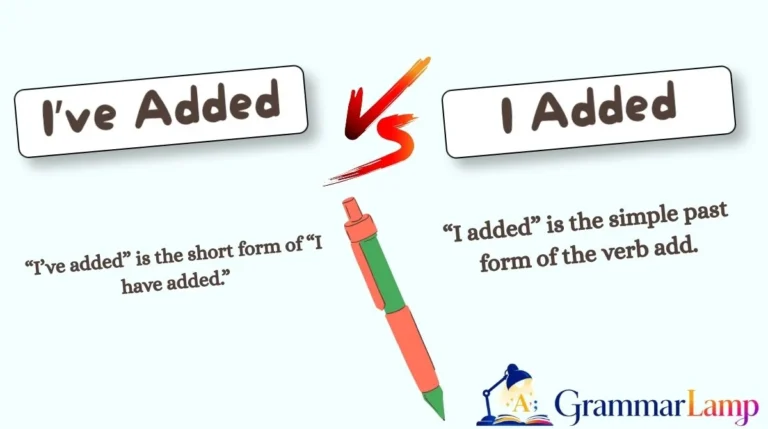
“I’ve added” and “I added” look very similar, so it is easy to use the wrong one. Both sentences talk about adding something, but they do not always carry the same meaning.
For example:
- I’ve added your name to the list.
- I added your name to the list yesterday.
The first sentence focuses on the present result. Your name is now on the list. The second sentence simply tells us that the action happened in the past. The word “yesterday” gives us a finished past time.
This small difference is very important in everyday English. You will hear both forms in conversations, emails, messages, classrooms, workplaces, and online communication.
Am I talking about a past action with a finished time, or am I talking about a past action that is important now?
Once you understand that idea, choosing between “I’ve added” and “I added” becomes much easier.
By the end of this guide, you will understand the grammar behind both expressions, know when to use each one, avoid common mistakes, and feel more confident using them in everyday English.
Sleeve vs Sleave: Which Is Correct? Meaning, Difference, and Examples in 2026
Time off vs time-off: The Complete Grammar Guide for 2026
I’m vs I Am: Complete Difference, Rules, Examples & Usage Guide 2026
Sun vs Son: Meaning, Difference, Rules, and Examples (2026)
What Does “I’ve Added” Mean?
“I’ve added” is the short form of “I have added.”
It uses the present perfect tense:
I have + past participle
The past participle of add is added, so:
I have added → I’ve added
We use this form when an action happened in the past but has a connection with the present.
The exact past time is usually not important or is not mentioned.
When should you use “I’ve added”?
Use “I’ve added” when you want to focus on the result now.
For example:
I’ve added your email address to my contacts.
The important information is that your email address is now in my contacts. We are not saying exactly when I did it.
Another example:
I’ve added some sugar to the tea.
The action happened a moment ago, but the result matters now. The tea now contains sugar.
Here are more examples:
- I’ve added your name to the guest list.
- I’ve added the information to the report.
- I’ve added a new photo to my profile.
- I’ve added some notes to the document.
- I’ve added your phone number to my contacts.
- I’ve added two more questions to the test.
- I’ve added some examples to the lesson.
- I’ve added the meeting to my calendar.
Notice something important: these sentences do not normally tell us when the action happened.
You can add words such as already, just, and recently:
I’ve already added the information.
I’ve just added your name.
I’ve recently added a new section.
These words work naturally with the present perfect.
A common learner confusion
Many learners think that “I’ve added” simply means “I added something recently.”
That is not quite right.
The main idea is not simply that the action was recent. The important point is that the action has a connection to the present.
Compare:
I’ve added your name to the list.
This sounds like an update about the current situation.
But:
I added your name to the list yesterday.
This tells us about a completed action at a specific past time.
That difference is the key.
What Does “I Added” Mean?
“I added” is the simple past form of the verb add.
It tells us that something happened and was completed in the past.
The basic structure is:
Subject + past form of the verb
For the verb add:
I added
You added
He added
She added
We added
They added
Unlike the present perfect, the simple past is very comfortable with finished past-time expressions.
For example:
I added the file yesterday.
The word “yesterday” tells us exactly when the action happened.
When should you use “I added”?
Use “I added” when you are talking about a completed event in the past, especially when the past time is clear or stated.
Examples:
- I added your name yesterday.
- I added the details last night.
- I added some salt five minutes ago.
- I added the photo this morning.
- I added the information during the meeting.
- I added another paragraph last week.
- I added your number to my phone on Monday.
- I added the final question before the class started.
Here, the speaker is looking back at a past event.
The action is finished, and the sentence places it in a past situation.
A useful point about “I added”
“I added” does not always need a specific time word.
You can say:
I added the file.
This is grammatically correct.
The listener may understand the time from the conversation.
For example:
“Where is the report?”
“I added it to the folder.”
Here, there is no need to say “yesterday” or “an hour ago.” The context tells us when the action happened.
Common learner confusion
Some students think that the simple past can never be used when something still has a result now.
That is not true.
You can say:
I added your name to the list.
The name may still be on the list now. The simple past is possible because you are simply reporting the past action.
The important difference is what the speaker chooses to focus on.
The present perfect focuses more strongly on the connection with now.
The simple past focuses on the past event.
Difference Between “I’ve Added” and “I Added” — Detailed Explanation
The biggest difference is the speaker’s focus.
| “I’ve added” | “I added” |
|---|---|
| Present perfect | Simple past |
| Focuses on the present result or current situation | Focuses on a completed past event |
| Usually does not give a finished past time | Can easily be used with a finished past time |
| “I have added” | “I added” |
| Common with already, just, yet, recently | Common with yesterday, last week, in 2025, two days ago |
| The exact past time is often unimportant | The past time can be important |
| Connected to the present | Viewed as a past event |
1. Difference in time
Consider these sentences:
I’ve added the information.
We know the information has been added. The exact time is not important.
Now compare:
I added the information yesterday.
The action happened yesterday. The speaker is placing the action in a finished past time.
This is why the following sounds natural:
I added it yesterday.
But this is generally not standard English:
❌ I’ve added it yesterday.
Use:
✅ I added it yesterday.
2. Difference in focus
Imagine your friend asks:
“Have you added my name to the list?”
You can answer:
Yes, I’ve added your name.
You are giving a current update. Your friend wants to know the situation now.
But if you are telling a story about yesterday, you might say:
I added your name yesterday after lunch.
Now the focus is on a past event.
3. Grammar logic
The present perfect connects a past action with the present:
I have added → action happened + result matters now
The simple past places the action completely in a past situation:
I added → completed past action
This does not mean that the result disappears. It simply means the grammar is presenting the event as a past event rather than emphasizing its present connection.
4. Sentence structure
The structures are different.
Present perfect:
Subject + have/has + past participle
I’ve added the file.
Simple past:
Subject + past form
I added the file.
Remember that “added” is the past participle after have/has, and it is also the simple past form of add.
That can make this verb slightly confusing for learners.
A or an: Easy Rules, Examples, and Common Mistakes in 2026
From My End or From My Side? Which Is Correct in English? (2026 Guide)
Honor or Honour: What Is the Difference? A Simple Guide for 2026
Collaborate vs Corroborate: Meaning, Difference, and Examples in 2026
Grammar Rules You Must Remember
Rule 1: Use “I’ve added” for a present connection
If the action has a result or importance now, the present perfect can be a good choice.
I’ve added your number to my contacts.
The important fact is that your number is now saved.
Another example:
I’ve added the new information to the report.
The report is now updated.
Rule 2: Use “I added” with a finished past time
When you mention a completed time such as yesterday, last week, last year, two hours ago, or in 2024, use the simple past.
I added the file yesterday.
I added the details two hours ago.
I added that paragraph last week.
A finished past time normally calls for the simple past, not the present perfect.
Rule 3: Avoid using the present perfect with finished-time expressions
This is one of the most useful rules for beginners.
Avoid:
❌ I’ve added it yesterday.
Use:
✅ I added it yesterday.
Also:
❌ I’ve added it last night.
✅ I added it last night.
And:
❌ I’ve added it two days ago.
✅ I added it two days ago.
The problem is the combination of present perfect + finished past time.
Rule 4: Context can decide which form sounds better
Sometimes both forms are grammatically possible, but the meaning or focus changes.
For example:
I’ve added three new examples.
This sounds like a current update.
I added three new examples during yesterday’s class.
This clearly reports a past event.
So do not choose only by looking for a time word. Think about what you are trying to tell the listener.
Common Mistakes Students Make
Mistake 1: “I’ve added it yesterday.”
This is probably the most common mistake.
❌ I’ve added the file yesterday.
Why is it wrong?
Yesterday is a finished past time. Use the simple past.
✅ I added the file yesterday.
An easy correction tip is:
See “yesterday”? Think simple past.
Mistake 2: Using “I added” when giving a current update
Suppose someone asks:
“Have you added my email?”
You can say:
Yes, I’ve added it.
This naturally tells the person that the task is complete.
“I added it” is also possible in some contexts, but it may sound more like you are reporting a past action rather than directly giving a current update.
Mistake 3: Thinking “I’ve” always means “I had”
It does not.
I’ve is short for:
I have
So:
I’ve added it.
means:
I have added it.
It does not mean:
I had added it.
“Had added” belongs to the past perfect.
Mistake 4: Forgetting that “added” is the past participle
With have, use the past participle:
I have added
Not:
❌ I have add
And not:
❌ I have adding
Correct:
✅ I have added
Mistake 5: Believing that “I’ve added” always means “just now”
The present perfect does not automatically mean the action happened a few seconds ago.
For example:
I’ve added several new features to the website this month.
The action may have happened at different times during the month.
The focus is on the current result or experience, not necessarily the exact moment.
Easy Trick to Remember the Difference
Here is a simple classroom trick.
Think: “NOW” or “THEN?”
If your sentence is connected to NOW, think:
I’ve added
If you are talking about THEN, a finished past situation, think:
I added
For example:
Current update:
I’ve added the document to the folder.
Think: “It is there now.”
Past event:
I added the document yesterday.
Think: “This happened yesterday.”
You can also remember this little formula:
Present result → I’ve added
Finished past event → I added
Look for time expressions, too.
Words such as yesterday, last night, last year, two days ago, in 2023, and on Monday usually point to the simple past.
Words such as already, just, yet, and recently often work naturally with the present perfect.
For example:
I’ve already added it.
I’ve just added it.
But:
I added it yesterday.
This trick will not solve every possible sentence, but it works very well for everyday English.
Daily Life Examples
The difference becomes much clearer when you see it in real conversations.
Example 1: Adding a contact
Sam: Have you saved my number?
Ali: Yes, I’ve added it to my contacts.
The current result matters. The number is saved now.
Example 2: Talking about yesterday
Sara: When did you save Ali’s number?
Mina: I added it yesterday.
The question asks about a past time, so the simple past fits naturally.
Example 3: Updating a document
Manager: Is the new information in the report?
Employee: Yes, I’ve added it.
The employee is giving a current status update.
Example 4: Talking about a meeting
Tom: What did you change during the meeting?
John: I added two new points to the report.
The speaker is describing a past event.
Example 5: Adding something to food
Dad: Is there enough salt in the soup?
Daughter: Yes, I’ve added some.
The current condition of the soup matters.
Example 6: Explaining what happened earlier
Dad: What did you do before dinner?
Daughter: I added some salt to the soup.
Now the speaker is reporting a past action.
Example 7: Adding a calendar event
Friend: Did you put our meeting on your calendar?
You: Yes, I’ve added it.
This is a current confirmation.
Example 8: Talking about last week’s work
Boss: What did you do last week?
Employee: I added three new sections to the report.
“Last week” is a finished past period, so the simple past is the natural choice.
Example 9: Updating a shopping list
Mom: Did you remember the milk?
Son: Yes, I’ve added it to the shopping list.
The list is now updated.
Example 10: Talking about a previous shopping trip
Mom: What did you put on the list yesterday?
Son: I added milk and bread.
The conversation is about a specific past time.
Practice Section
Choose the correct option: “I’ve added” or “I added.”
1. ______ your name to the list, so you are ready to join us.
2. ______ your name to the list yesterday.
3. ______ the new information already.
4. ______ three new questions last night.
5. ______ the meeting to my calendar.
Answers
1. I’ve added
The sentence focuses on the current result.
2. I added
“Yesterday” is a finished past time.
3. I’ve added
“Already” commonly works with the present perfect when giving an update.
4. I added
“Last night” is a finished past time.
5. I’ve added
The speaker is confirming that the meeting is now on the calendar.
Seam vs Seem: Difference, Meaning, Examples & Grammar Rules (2026)
All the Time vs Every Time: Meaning, Difference, Rules & Examples (2026)
Afterward or Afterwards? Meaning, Difference, and Correct Usage in 2026
A MA or an MA Degree? The Correct Grammar Rule in 2026
FAQs
What is the difference between “I’ve added” and “I added”?
“I’ve added” is the present perfect and usually connects a past action with the present. “I added” is the simple past and describes a completed past event. For example, “I’ve added the file” gives a current update, while “I added the file yesterday” talks about a past event.
Can we use “I’ve added” in questions?
Yes. The present perfect is very common in questions.
For example:
Have you added my name to the list?
Have you added the new information?
These questions usually ask whether something has been completed and whether the result is true now.
Is “I’ve added” formal or informal?
“I’ve added” is natural in both spoken and written English. The contraction “I’ve” is especially common in everyday communication. In more formal writing, you can write “I have added”, but the grammar and meaning are the same.
Can I say “I’ve added it yesterday”?
No, this is not the standard form in English. “Yesterday” refers to a finished past time, so use the simple past:
I added it yesterday.
If you remove the finished-time expression, you can say:
I’ve added it.
Is “I added it” always correct?
Not always. It depends on the situation and the meaning you want to express. If you are clearly talking about a finished past event, it is correct. If someone is asking for a current update, “I’ve added it” may be the more natural choice.
Can both forms be correct in the same situation?
Yes. Sometimes both forms are grammatically possible, but they give slightly different focus.
I’ve added the details.
This sounds like a current update.
I added the details.
This simply reports the action.
The surrounding context usually tells you which one sounds better.
Conclusion
The difference between “I’ve added” and “I added” is mainly about how you view the past action.
Use “I’ve added” when the action has a connection with the present or when you are giving a current update:
I’ve added your name to the list.
Use “I added” when you are talking about a completed event in the past, especially with a finished time:
I added your name yesterday.
The easiest question to ask yourself is: “Am I focusing on the result now, or am I talking about a finished past event?”
Also watch for time expressions. Words such as yesterday, last week, last night, and two days ago normally require the simple past.
Do not worry if the difference feels confusing at first. Native speakers use these forms naturally because they think about the time and focus of an event. With a little practice, you can do the same.
Try making a few sentences about things you have added today, and then make sentences about things you added yesterday or last week. That simple exercise can make the difference much easier to remember.

Liam Derren is a language writer at GrammarLamp, creating simple, helpful content about grammar, words, and everyday English. He makes language learning clear, practical, and easy to understand.
2 thoughts on “I’ve Added vs I Added: Easy Difference, Rules & Examples (2026)”