
Sun vs son is a common English confusion, especially for beginners and non-native speakers.
The two words sound exactly the same in standard English, but they have completely different meanings and uses. This can make them tricky when you hear them in a conversation.
The good news is that the difference is actually very simple once you connect each word with its meaning.
Sun is the bright star that gives Earth light and heat. Son means a male child in relation to his parents.
The confusion often happens because sun and son are homophones. Homophones are words that have the same pronunciation but different spellings and meanings.
English has many pairs like this, and they can cause problems in writing even when speaking is easy.
Understanding this pair will help you write more accurately in school, emails, messages, stories, and everyday English.
By the end, you will know when to use sun and when to use son, how they work in sentences, and a simple trick that makes the difference easy to remember.
What Does “Sun” Mean?
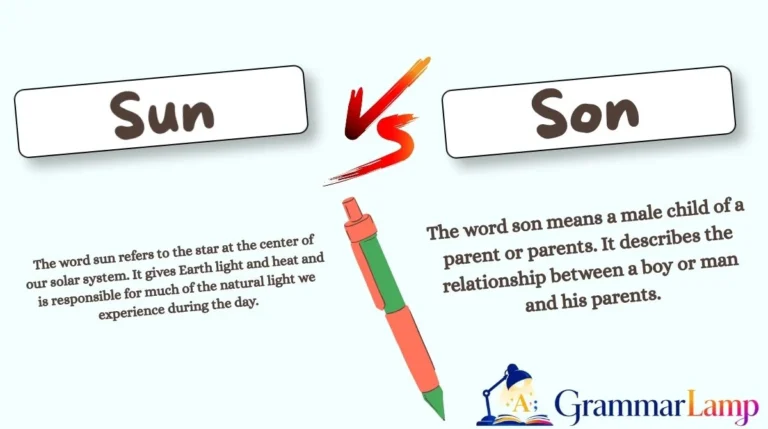
The word sun refers to the star at the center of our solar system. It gives Earth light and heat and is responsible for much of the natural light we experience during the day.
We normally use sun when talking about sunlight, hot weather, daytime, the sky, or the star itself.
Simple definition
Sun = the star that gives Earth light and heat.
The word is a noun. A noun is a word used for a person, place, thing, or idea.
For example:
- The sun is shining.
- The sun rises in the east.
- The sun is very hot.
- We sat outside in the sun.
- The sun disappeared behind the clouds.
- I love watching the sun set.
- Too much sun can make your skin uncomfortable.
- The plants need sun to grow.
When should you use “sun”?
Use sun when your sentence is about the natural star, its light, its heat, or the conditions created by its light.
You can also use sun in common expressions.
For example:
- in the sun — “The children are playing in the sun.”
- sunlight — “The room is full of sunlight.”
- sunrise — “We woke up early to see the sunrise.”
- sunset — “The sunset was beautiful.”
- sunny — “It is a sunny day.”
Notice that these words are all connected to the same idea: light and heat from the sun.
Grammar rule for “sun”
Sun is usually a singular countable noun when we mean the specific star of our solar system, and it is commonly used with the.
For example:
The sun is shining.
The sun is behind the clouds.
We normally say the sun, not simply “sun,” when referring to our star.
However, sun can also be used without the in certain expressions.
For example:
We sat in the sun.
She enjoys lying in the sun.
Here, the phrase in the sun is a common expression.
A common learner confusion
Some learners write son when they mean the star or its light.
For example:
❌ The son is very bright today.
The correct sentence is:
✅ The sun is very bright today.
The mistake is understandable because sun and son sound the same. You cannot hear the spelling difference. You have to understand the meaning from the context.
What Does “Son” Mean?
The word son means a male child of a parent or parents. It describes the relationship between a boy or man and his parents.
Simple definition
Son = a male child in relation to his parent or parents.
For example, if a family has a boy, the parents can call him their son.
Here are some examples:
- I have one son.
- My son is ten years old.
- Their son studies at university.
- Her son plays football.
- His son lives in London.
- They are proud of their son.
- Our son is learning English.
- She called her son after dinner.
When should you use “son”?
Use son when talking about a male child or the family relationship between a male person and his parents.
The word can describe a young boy, but it can also describe an adult man in relation to his parents.
For example:
Their son is only five years old.
Here, son means a young male child.
But:
Their son is now 35 and has a family of his own.
The man is an adult, but he is still their son.
Grammar rule for “son”
Son is a countable noun. It can be singular or plural.
Singular:
She has one son.
Plural:
They have three sons.
The plural form is sons, not “sones.”
You can also use possessive forms:
My son’s bicycle is outside.
Her son’s teacher called today.
The apostrophe in son’s shows possession.
A common learner confusion
Because son sounds like sun, learners sometimes choose the wrong spelling.
For example:
❌ I have two suns.
If you mean two male children, the correct sentence is:
✅ I have two sons.
But suns can have a different meaning in scientific or fictional contexts when referring to multiple stars like our Sun. In normal everyday English, however, a parent with two male children has two sons.
Difference Between Sun and Son
The easiest way to understand sun vs son is to remember that the words have different meanings even though they sound alike.
Sun is connected to the sky, light, heat, and our solar system.
Son is connected to family, children, and parents.
Comparison table
| Word | Meaning | Part of Speech | Common Use | Example |
|---|---|---|---|---|
| sun | The star that gives Earth light and heat | Noun | Weather, sky, light, nature | The sun is bright. |
| son | A male child of a parent | Noun | Family and relationships | My son is seven. |
Usage difference
The meaning of the sentence tells you which spelling you need.
Compare:
The sun is hot.
This sentence is about the star.
Now compare:
My son is hot.
This sentence means your male child feels hot. The word son refers to a person, not the star.
Another pair makes the difference even clearer:
I watched the sun rise.
I watched my son rise from his chair.
The first sentence talks about nature. The second talks about a person.
Grammar logic
Both sun and son are nouns. However, they belong to completely different meaning groups.
Sun belongs to the vocabulary of nature and science:
- sun
- sunlight
- sunshine
- sunrise
- sunset
- solar
- sunny
Son belongs to the vocabulary of family relationships:
- mother
- father
- daughter
- son
- parents
- family
- child
Thinking about the word group can help you choose the correct spelling.
Sentence structure difference
Both words can be used in similar noun positions.
For example:
The sun is bright.
My son is happy.
In both sentences, the noun comes after a determiner:
The + sun
My + son
They can also appear after verbs:
I saw the sun.
I saw my son.
So the grammar structure may look similar. The meaning is what separates them.
Grammar Rules You Must Remember
Rule 1: Use “sun” for the star and its light
If you are talking about the star in the sky, use sun.
The sun is shining.
We need sunlight from the sun.
A quick question can help: Am I talking about the sky, light, or heat?
If yes, you probably need sun.
Rule 2: Use “son” for a male child
If you are talking about someone’s male child, use son.
Ali has a son.
Her son is studying medicine.
Ask yourself: Am I talking about someone’s boy or male child?
If yes, use son.
Rule 3: “Sun” and “son” sound the same
These two words are homophones. That means they have the same pronunciation but different spellings and meanings.
For example:
The sun is hot.
Her son is hot.
When you hear these sentences, pronunciation alone does not tell you which spelling is correct. You must use the meaning and context.
This is why spelling practice is important with homophones.
Rule 4: Use the surrounding words as clues
The words around sun or son can often tell you the answer.
Words connected with sun include:
- bright
- hot
- sky
- light
- rise
- set
- shine
- sunlight
Words connected with son include:
- mother
- father
- parents
- child
- family
- boy
- daughter
- brother
For example:
The ___ is setting.
The word setting strongly suggests sun, because we say sunset and the sun is setting.
But:
Her ___ is setting the table.
Here, the answer is son, because a person is setting the table.
Common Mistakes Students Make
The main reason students confuse these words is simple: they sound the same.
When you hear someone say “sun” or “son,” you cannot know the spelling just from the sound. You need to understand what the speaker means.
Mistake 1: Using “son” for the star
❌ The son is shining.
✅ The sun is shining.
Why? The sentence is about the star.
Correction tip: Think of the sky when you see sun.
Mistake 2: Using “sun” for a male child
❌ She has a sun.
✅ She has a son.
Why? The sentence is about a person’s child.
Correction tip: Think of family when you see son.
Mistake 3: Confusing “sons” and “suns”
❌ They have two suns.
✅ They have two sons.
When talking about children, the plural of son is sons.
Remember:
one son → two sons
Mistake 4: Choosing the spelling from pronunciation
A learner may think:
“They sound the same, so either spelling should be okay.”
It is not.
English spelling often contains words with the same pronunciation but different meanings. Context does not change the spelling.
For example:
The sun came out.
Their son came home.
The pronunciation of the two words is the same, but the written words must match the meaning.
Easy Trick to Remember the Difference
Here is a very simple memory trick:
SUN = SKY
Both sun and sky are related to nature.
Think:
SUN → SKY → LIGHT → HEAT
Now think:
SON = FAMILY
A son is part of a family.
Think:
SON → FAMILY → PARENTS → CHILD
There is also a useful visual trick.
Imagine a big bright sun in the sky. The word sun has a u, and you can think of u as being up in the sky.
For son, think of a family: son is the male child of parents.
You do not need a complicated grammar rule. Just connect each spelling with its meaning.
Sun = the star.
Son = a male child.
That one sentence can solve most mistakes.
Daily Life Examples
These examples show how sun and son appear in normal spoken and written English.
1. Talking about the weather
A: Why are you wearing sunglasses?
B: Because the sun is very bright today.
Here, sun refers to the star and its light.
2. Talking about a child
A: Do you have any children?
B: Yes, I have one son.
Here, son means a male child.
3. Talking about outdoor activities
We usually eat breakfast outside when the sun is warm.
The topic is sunlight and warmth, so sun is correct.
4. Talking about family
My son is learning how to ride a bicycle.
The sentence is about a child, so we need son.
5. Talking about sunrise
We woke up early to watch the sun rise.
The verb rise is commonly connected with the sun.
6. Talking about someone’s family
Her son works at a bank.
A person can work at a bank, so son is correct.
7. Talking about a hot day
The sun made the room very warm.
The word refers to heat from the star.
8. Talking about parents
His parents are very proud of their son.
The word parents gives you a strong clue that son is the correct choice.
9. Talking about sunset
We took some pictures while the sun was going down.
The sentence is about the setting sun.
10. Talking about family plans
A: Who is coming to dinner tonight?
B: My son and his wife.
The sentence is about a family member, so the correct spelling is son.
Practice Section
Choose sun or son to complete each sentence.
1. The ___ is shining brightly this morning.
2. My ___ is playing in the garden.
3. We watched the ___ set over the hills.
4. Her ___ is five years old.
5. Plants need water and ___ to grow.
Take a moment to answer before checking below.
Answers
- sun
- son
- sun
- son
- sun
A useful way to check your answers is to ask what the sentence is about. If it is about light, heat, or the sky, choose sun. If it is about a male child or family member, choose son.
FAQs
What is the difference between sun and son?
Sun is the star at the center of our solar system and is associated with light and heat. Son means a male child in relation to his parents. They are pronounced the same but have different spellings and meanings.
Are sun and son pronounced the same?
Yes. Sun and son are homophones in standard English. They have the same pronunciation, but they do not have the same meaning. You must use the context to understand which word is intended.
Can “sun” be used in a sentence?
Yes. Sun is a noun and can be used in many sentences about nature, light, and heat.
For example:
The sun is very bright today.
You will often see it in expressions such as the sun, in the sun, sunlight, and sunset.
Can “son” be used for an adult man?
Yes. A son does not have to be a young boy. A man remains his parents’ son even after he becomes an adult.
For example:
Their son is 30 years old and lives abroad.
Is “son” formal or informal?
Son is a normal, neutral English word. It is suitable for everyday conversation as well as formal writing when discussing family relationships.
For example, “She has two sons” is completely natural in both spoken and written English.
Why do people confuse sun and son?
People confuse them because they are homophones. They sound the same, so learners cannot rely on pronunciation to choose the spelling.
The easiest solution is to focus on meaning: sun = sky and light, while son = family and a male child.
Conclusion
Understanding sun vs son is much easier when you stop thinking about their pronunciation and focus on their meanings.
Both words sound the same, but they belong to very different parts of everyday vocabulary.
Use sun when you are talking about the star in the sky, its light, its heat, sunrise, sunset, or sunlight. Use son when you are talking about a male child in relation to his parents.
Remember the simple rule:
Sun = sky, light, and heat.
Son = family and a male child.
Because these words are homophones, even advanced English learners can occasionally make spelling mistakes with them. The best way to avoid errors is to notice the words around them and ask what the sentence actually means.
Try writing a few sentences of your own using both words. With a little practice, choosing between sun and son will become automatic.

Liam Derren is a language writer at GrammarLamp, creating simple, helpful content about grammar, words, and everyday English. He makes language learning clear, practical, and easy to understand.
3 thoughts on “Sun vs Son: Meaning, Difference, Rules, and Examples (2026)”