
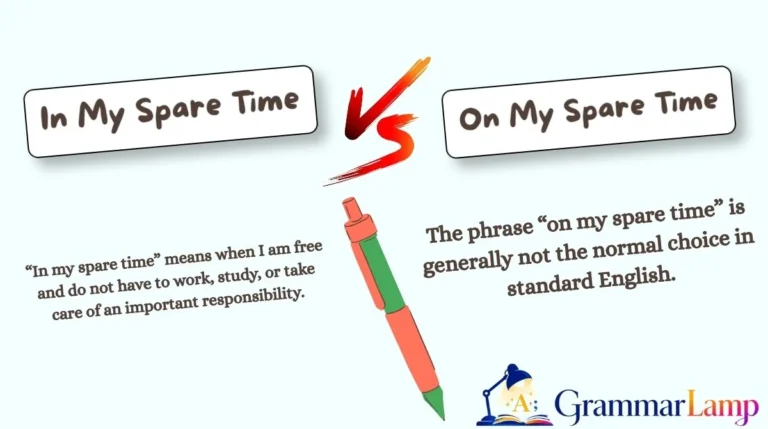
Should you say “in my spare time” or “on my spare time”? This is a small grammar question, but it can cause a lot of confusion for English learners.
Both expressions may seem logical because English uses several different prepositions when we talk about time.
We say on Monday, in July, at night, and during the weekend. So it is natural to wonder which preposition belongs before my spare time.
The correct and natural expression in standard English is “in my spare time.” We use it when we talk about something we do when we are free from work, school, or other responsibilities.
For example, you can say, “I read books in my spare time,” or “She learns Spanish in her spare time.”
The expression “on my spare time” is generally not used in standard English. Learners sometimes use it because they connect it with phrases such as “on Monday” or “on my own time.” However, those are different patterns.
This difference matters because spare time is a common phrase in everyday English. You may hear it in conversations, job interviews, school assignments, emails, and casual questions about hobbies.
By the end of this guide, you will understand exactly why we say in my spare time, when to use it, how it differs from on my own time, and how to avoid this common preposition mistake.
More Useful posts
Sun vs Son: Meaning, Difference, Rules, and Examples (2026)
A Majority of vs The Majority of: Easy Grammar Guide for 2026
Tomatoes or Tomatos: Which Spelling Is Correct? [2026]
In the Morning vs On the Morning: Complete Grammar Guide for 2026
What Does “In My Spare Time” Mean?
Simple definition
“In my spare time” means when I am free and do not have to work, study, or take care of an important responsibility.
The phrase spare time means free time. It is the time left after you have finished the things you need to do.
For example:
- I watch movies in my spare time.
- She plays tennis in her spare time.
- I like reading in my spare time.
In all three examples, the activity happens during a person’s free time.
When do we use “in my spare time”?
We use in my spare time when we want to talk about hobbies, interests, personal activities, or things we choose to do when we are free.
It is especially common when answering questions such as:
“What do you do in your spare time?”
A natural answer could be:
“I usually listen to music and read books in my spare time.”
You can also change the possessive word:
- in my spare time
- in your spare time
- in his spare time
- in her spare time
- in our spare time
- in their spare time
The basic pattern stays the same.
Grammar rule
The common grammar pattern is:
in + possessive adjective + spare time
Examples:
- in my spare time
- in your spare time
- in his spare time
- in her spare time
- in our spare time
- in their spare time
Here, in is the preposition, and my/your/his/her/our/their tells us whose free time we mean.
Example sentences
- I study English in my spare time.
- My brother plays football in his spare time.
- She enjoys painting in her spare time.
- We often go hiking in our spare time.
- What do you do in your spare time?
- He learns programming in his spare time.
- They watch documentaries in their spare time.
- I like writing stories in my spare time.
All of these sentences sound natural in standard English.
Common learner confusion
Many students think on should be used because English often uses on for time:
- on Monday
- on Friday
- on my birthday
- on the weekend
But prepositions do not work by one simple rule for every time expression. Different phrases have different patterns.
We do not choose a preposition just because the sentence refers to time. We learn the natural expression as a whole.
So remember:
in my spare time ✅
on my spare time ❌ generally not standard
What Does “On My Spare Time” Mean?
Simple definition
The phrase “on my spare time” is generally not the normal choice in standard English.
A learner may understand what you mean if you say it, but native speakers would normally say:
“in my spare time.”
For example:
Less natural/nonstandard:
“I play games on my spare time.”
Natural standard English:
“I play games in my spare time.”
The problem is not the meaning. The meaning is usually easy to understand. The problem is the preposition.
Why do learners say “on my spare time”?
There are a few common reasons.
First, learners may remember expressions such as:
- on Monday
- on Saturday
- on holiday
- on the weekend
Second, they may confuse “in my spare time” with “on my own time.”
Third, students sometimes translate directly from their first language. Direct translation can be useful for learning vocabulary, but it can also create unnatural English expressions.
Grammar rule
For the normal expression meaning free time, use:
in + spare time
Examples:
- in my spare time
- in your spare time
- in her spare time
- in our spare time
Do not normally replace in with on.
Example sentences
- I read books in my spare time.
- She practices the piano in her spare time.
- He watches football in his spare time.
- We cook together in our spare time.
- What do you do in your spare time?
- I learn new words in my spare time.
- They travel in their spare time.
- My friend draws pictures in her spare time.
These are the natural forms you should copy and use.
Common learner confusion
The expression “on my spare time” may appear in non-native speech or writing, but that does not make it the preferred standard form. When you are writing for school, work, exams, or a general English audience, “in my spare time” is the safer and more natural choice.
A different expression: “on my own time”
There is another phrase that uses on correctly:
“on my own time.”
This does not mean exactly the same thing as “in my spare time.”
For example:
“I finished the report on my own time.”
This can suggest that you did the work using your personal time rather than company time or official working hours.
Compare:
“I read novels in my spare time.”
This is about a hobby or activity during free time.
“I finished the paperwork on my own time.”
This can emphasize that you did something outside the time provided by your employer or organization.
That small difference is one reason learners sometimes mix up in and on.
Difference Between “In My Spare Time” and “On My Spare Time”
The main difference is simple: “in my spare time” is the standard expression for free-time activities, while “on my spare time” is generally not standard English.
| Expression | Standard English? | Meaning | Common use |
|---|---|---|---|
| in my spare time | Yes ✅ | during my free time | Hobbies and personal activities |
| on my spare time | Generally no ❌ | Intended to mean free time | Common learner error |
| on my own time | Yes ✅ | using my personal time | Work/tasks outside official time |
Usage difference
Use in my spare time when you talk about what you enjoy doing when you are free.
I play chess in my spare time.
Use on my own time when you want to stress that you are using your personal time for something.
I completed the training on my own time.
Do not confuse the two.
Grammar logic
The expression in my spare time treats spare time as a period in which an activity happens.
Think of your spare time as a period or space:
I read in that period.
That makes in natural.
This is similar to expressions such as:
- in the morning
- in the afternoon
- in the evening
- in my free time
However, English has many fixed expressions, so it is better to learn the complete phrase rather than trying to calculate every preposition.
Sentence structure
The common structure is:
Subject + verb + in + possessive adjective + spare time
Examples:
I + read + in + my + spare time.
She + studies + in + her + spare time.
You can also put the phrase at the beginning:
In my spare time, I read science books.
Both positions are correct.
Meaning comparison
In my spare time = during free time.
On my own time = using personal time, often instead of official or scheduled time.
This difference becomes clearer in a workplace.
Imagine your manager gives you two hours to complete a task. You might say:
“I finished the report in my spare time.”
That sounds like the task was something you did while you happened to be free.
But:
“I finished the report on my own time.”
This may imply that you worked on it outside your scheduled working hours.
Explore More Posts
In the Morning vs On the Morning: Complete Grammar Guide for 2026
Inside of vs Inside: The Easy Difference Explained in 2026
Attend vs Tend: Meaning, Differences, Grammar Rules & Examples (2026)
Better Understand vs Understand Better: Meaning, Grammar, and Correct Usage (2026)
Grammar Rules You Must Remember
Rule 1: Use “in” with “spare time”
The safest rule is:
Say “in my spare time,” not “on my spare time.”
Example:
Correct: I watch documentaries in my spare time.
Incorrect: I watch documentaries on my spare time.
This is the most important rule to remember.
Rule 2: The expression changes with the person
The possessive adjective changes, but in stays the same.
Examples:
- I exercise in my spare time.
- You exercise in your spare time.
- He exercises in his spare time.
- She exercises in her spare time.
- We exercise in our spare time.
- They exercise in their spare time.
Notice the pattern. Only the possessive word changes.
Rule 3: “Spare time” and “free time” usually work the same way
You can often use either:
in my spare time
or
in my free time
For example:
I learn coding in my spare time.
I learn coding in my free time.
Both are natural.
The word spare often gives the idea of time left over after necessary tasks.
Rule 4: Do not choose prepositions only because you are talking about time
This is a very useful lesson for English learners.
We use:
- at 5 p.m.
- on Monday
- in July
- in the morning
- during the meeting
- for two hours
The word “time” does not automatically tell you which preposition to use.
The best approach is to learn common combinations as chunks:
in my spare time
at the same time
on time
in time
These phrases are easy to remember when you learn them in context.
Common Mistakes Students Make
Mistake 1: Saying “on my spare time”
This is the biggest mistake.
Wrong: I play basketball on my spare time.
Correct: I play basketball in my spare time.
The correction is simple: replace on with in.
Mistake 2: Mixing “in my spare time” with “on my own time”
These phrases are close in meaning, but they are not identical.
I read in my spare time.
Here, reading is a personal activity.
I answered the emails on my own time.
Here, the focus is on using personal time to complete a task.
Mistake 3: Saying “at my spare time”
Some students also use at.
Wrong: I study at my spare time.
Correct: I study in my spare time.
The phrase at my spare time is not the standard expression.
Mistake 4: Forgetting the possessive word
Students sometimes say:
I play games in spare time.
In some contexts, this may be understood, but when talking about a person’s free time, the natural form is usually:
I play games in my spare time.
The possessive adjective makes the meaning clear.
Easy correction tip
When you see spare time, think:
“IN the free-time period.”
Then use:
in my spare time
in your spare time
in his spare time
That one habit can prevent the mistake.
Easy Trick to Remember the Difference
Here is a simple memory trick:
Think of your spare time as a “box”
Imagine your free time is like a box.
You put activities inside that period:
I read in my spare time.
I exercise in my spare time.
I learn English in my spare time.
So think:
spare time = a period → in that period
This is not a rule for every English time expression, but it is an easy way to remember this particular phrase.
Another trick: memorize the question
Memorize this common question:
“What do you do in your spare time?”
This sentence appears often in real conversations, interviews, introductions, and classroom activities.
Once the question becomes familiar, the answer naturally follows:
“In my spare time, I usually…”
For example:
“In my spare time, I usually watch movies.”
“In my spare time, I like to read.”
“In my spare time, I practice English.”
Learn the whole pattern instead of trying to remember in separately.
Daily Life Examples
The best way to make grammar stick is to see it in normal conversation.
Example 1: Talking about hobbies
Ali: What do you do in your spare time?
Usman: I usually play football and listen to music.
This is probably one of the most common situations where you will hear the expression.
Example 2: Talking about reading
Sara: Do you like reading?
Mina: Yes. I read novels in my spare time.
The phrase tells us when she reads.
Example 3: Talking about learning
Teacher: What do you do outside school?
Student: I learn coding in my spare time.
This is a natural answer for a student.
Example 4: Talking about exercise
A: Do you exercise?
B: Yes, I go for a walk in my spare time.
Simple and natural.
Example 5: Talking about creative hobbies
A: Your drawings are really good.
B: Thanks. I practice drawing in my spare time.
The expression works well when describing personal interests.
Example 6: Talking about travel
A: What do you enjoy doing when you are free?
B: I love visiting new places in my spare time.
Again, the phrase means during free time.
Example 7: Talking about work-life balance
A: What do you normally do after work?
B: I spend time with my family in my spare time.
The phrase can be used in casual everyday speech.
Example 8: Talking about music
A: Do you play any instruments?
B: Yes. I play the guitar in my spare time.
Very natural English.
Example 9: Talking about online learning
A: Why is your English getting better so quickly?
B: I practice speaking in my spare time.
This is a useful sentence for English learners.
Example 10: Job interview conversation
Interviewer: What do you do in your spare time?
Candidate: I enjoy reading, walking, and learning new skills.
This question is common because hobbies can help people get to know you beyond your work experience.
11. Practice Section
Choose the correct option.
1. I read books ___ my spare time.
A. on
B. in
C. at
2. She practices English ___ her spare time.
A. in
B. on
C. at
3. What do you do ___ your spare time?
A. on
B. at
C. in
4. I finished the extra work ___ my own time.
A. in
B. on
C. at
5. He plays basketball ___ his spare time.
A. on
B. in
C. at
Answers
- B. in
- A. in
- C. in
- B. on
- B. in
The fourth answer is different on purpose. “On my own time” is a valid expression, while “on my spare time” is generally not the standard form.
More Helpful posts
Hear vs Here: Meaning, Difference, Grammar Rules & Examples in 2026
Hasn’t vs Haven’t: Easy Grammar Rules, Examples & Differences in 2026
Smooth vs Smoothe: Which Spelling Is Correct? Complete Guide for 2026
Mine as Well or Might as Well? The Correct Phrase Explained in Simple English (2026)
FAQs
What is the difference between “in my spare time” and “on my spare time”?
“In my spare time” is the normal and standard expression. It means during the time when you are free. “On my spare time” is generally considered incorrect or nonstandard in everyday standard English.
Can we use “in my spare time” in questions?
Yes. It is very common in questions.
For example:
“What do you do in your spare time?”
This is a natural way to ask someone about hobbies, interests, or activities they enjoy when they are free.
Is “in my spare time” formal or informal?
It works in both informal and formal English. You can use it in daily conversation, school writing, emails, interviews, and general descriptions of your hobbies.
For example:
“In my spare time, I enjoy reading.”
Is “on my spare time” ever correct?
It is not the normal standard expression when you mean free time. Most learners should avoid it. Use “in my spare time” instead.
There is a related expression, “on my own time,” which is correct but has a somewhat different meaning.
Is “in my free time” also correct?
Yes. “In my free time” is completely natural and has almost the same meaning as “in my spare time.”
For example:
“I watch movies in my free time.”
Both expressions are common.
What should I say: “in spare time” or “in my spare time”?
Use “in my spare time” when you are talking about your own free time. Use “in your spare time,” “in his spare time,” and so on when the person changes.
The possessive adjective tells us whose spare time we mean.
Conclusion
The correct expression for talking about free time is “in my spare time.” This is the natural standard form used by English speakers.
Use it when you talk about hobbies, learning, exercise, entertainment, travel, or any activity you do when you are free.
For example:
“I read books in my spare time.”
“I practice English in my spare time.”
“What do you do in your spare time?”
The expression “on my spare time” should generally be avoided. The confusion often happens because English uses on with other time expressions, or because learners mix it up with “on my own time.”
Remember that “on my own time” is a different expression and can suggest that something is done using personal time rather than official or scheduled time.
A good way to remember the correct phrase is to learn it as one complete chunk:
in my spare time
Use it a few times in your own sentences, and it will soon feel natural.

Liam Derren is a language writer at GrammarLamp, creating simple, helpful content about grammar, words, and everyday English. He makes language learning clear, practical, and easy to understand.