
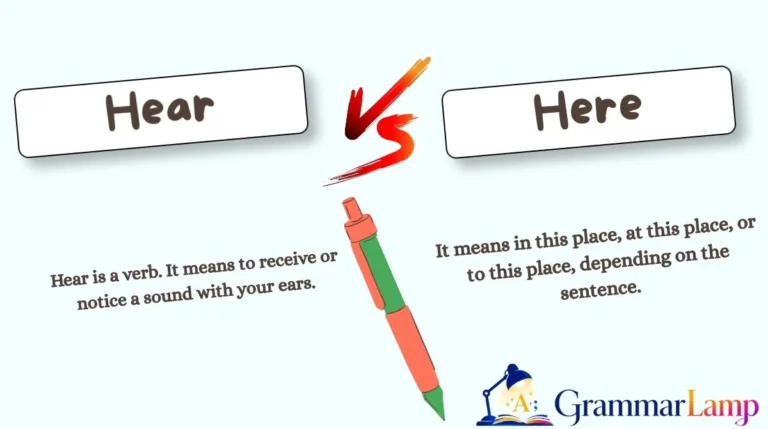
Hear and here are two small English words that sound exactly the same, but they have completely different meanings. This is why they often confuse English learners, especially when writing.
If someone says, “Come here,” and “I can hear you,” the words here and hear may sound almost identical when spoken.
However, you cannot switch them in writing. Using the wrong word can change the meaning of a sentence or simply make the sentence grammatically incorrect.
The good news is that the difference is easy to understand once you connect each word with its main idea. Hear is related to your ears and the ability to receive sound. Here is related to a place or location.
These words are especially important in everyday English. You will hear them in conversations, messages, instructions, questions, phone calls, classrooms, and workplaces. You may also see them often in online writing.
By the end of this guide, you will know exactly when to use hear and when to use here. You will also learn their grammar rules, common mistakes, simple memory tricks, and useful examples from daily conversations.
What Does “Hear” Mean?
Hear is a verb. It means to receive or notice a sound with your ears.
For example:
I can hear music.
This means that your ears are receiving the sound of music.
We use hear when we talk about sounds, voices, music, conversations, noises, or information that we receive by listening.
When should you use “hear”?
Use hear when the sentence is connected to the sense of hearing.
You can hear:
- a person speaking
- music
- a dog barking
- a phone ringing
- a noise
- a sound
- someone’s voice
- news or information
For example:
Can you hear me?
Here, the speaker wants to know whether the other person can receive their voice through their ears.
Another example is:
I heard a strange noise last night.
The person noticed a noise with their ears.
Grammar rule for “hear”
Hear is normally used as a verb.
Its common forms are:
- hear — present
- hears — present, third-person singular
- heard — past
- heard — past participle
- hearing — -ing form
Examples:
I hear a strange sound.
She hears music from her room.
We heard a loud bang.
He has heard that story before.
They are hearing a strange noise outside.
The past form of hear is heard, not “heared.”
That is an important point for learners.
8 examples of “hear”
- Can you hear me clearly?
- I can hear a baby crying.
- She heard a loud noise outside.
- Did you hear the phone ring?
- We heard some good news today.
- He hears music every morning.
- I couldn’t hear the teacher because of the noise.
- Have you heard this song before?
Notice that every sentence has something to do with sound, listening, or receiving information.
A common confusion with “hear”
Many students remember that hear sounds like here, but they forget which spelling belongs to which meaning.
A useful question is:
“Is this sentence about sound?”
If the answer is yes, you probably need hear.
For example:
I can ___ you.
The sentence is about receiving someone’s voice, so the correct word is:
I can hear you.
Not:
I can here you.
What Does “Here” Mean?
Here is mainly an adverb of place. It tells us about a location.
It means in this place, at this place, or to this place, depending on the sentence.
For example:
Please sit here.
The speaker is telling someone to sit in this particular place.
Another example:
I live here.
This means the speaker lives in the place where they currently are.
When should you use “here”?
Use here when you are talking about a place, position, or location.
You might use it to:
- point to a place
- tell someone where something is
- invite someone to come closer
- describe your current location
- give directions
- refer to something in a particular place
Examples:
Come here, please.
Your bag is here.
I am waiting here.
Put the box here.
In each sentence, here refers to a place.
Grammar rule for “here”
Here is usually an adverb, but it can work in several common sentence patterns.
For example:
Subject + verb + here
I live here.
Verb + here
Come here.
Here + be + noun
Here is your book.
Here + are + plural noun
Here are your keys.
This makes here very useful in everyday English.
8 examples of “here”
- Please come here.
- I am waiting here.
- Your shoes are here.
- We live here.
- Put your bag here.
- Here is your coffee.
- Here are the documents you requested.
- Can you stand here for a moment?
None of these examples is about hearing a sound. They are about a place or something being presented at a place.
A common confusion with “here”
Students sometimes write here when they mean hear because the two words have the same pronunciation.
For example:
I can’t here you.
This is incorrect.
The correct sentence is:
I can’t hear you.
Why? Because the sentence is about sound, not location.
A simple question can help:
“Can I replace this word with ‘in this place’?”
If yes, here is probably correct.
For example:
Put the book here.
You could think:
Put the book in this place.
That makes sense, so here is correct.
Difference Between Hear and Here
The biggest difference between hear and here is their meaning and grammatical function.
Hear is connected to sound.
Here is connected to place.
Although they sound the same, they are spelled differently and perform different jobs in a sentence.
Hear vs here comparison table
| Feature | Hear | Here |
|---|---|---|
| Main meaning | Receive sound with your ears | In or at this place |
| Part of speech | Verb | Usually an adverb |
| Main idea | Sound | Location |
| Related to | Ears, listening, sounds | Place, position, direction |
| Example | I can hear music. | Come here. |
| Past form | Heard | No past form |
| Can describe a place? | No | Yes |
| Can describe hearing? | Yes | No |
Usage difference
Consider these two sentences:
I can hear you.
Please come here.
The first sentence talks about sound. The second sentence talks about location.
This difference remains true even when the words appear in longer sentences.
I can hear someone talking outside.
The important idea is sound.
Someone is waiting here outside.
The important idea is location.
Grammar logic
One useful way to understand the difference is to identify what job the word is doing.
Hear describes an action or ability involving sound.
She can hear the birds.
The verb hear tells us what she can do.
Here points to a place.
She is standing here.
The word here tells us where she is standing.
So, if you are describing what someone hears, use hear.
If you are describing where someone or something is, use here.
Sentence structure difference
Hear often appears after a subject and may be followed by an object.
I hear music.
She heard a noise.
We heard the teacher.
Common pattern:
Subject + hear/hears/heard + sound/person/thing
Here often appears to show location.
I am here.
Come here.
The book is here.
It can also appear at the beginning of a sentence:
Here is your pen.
Here are your shoes.
Common patterns include:
Subject + verb + here
or
Here + is/are + noun
Meaning comparison
Compare these examples carefully:
I hear a dog.
I can hear the sound of a dog.
I am here.
I am in this place.
One word is about your ears. The other is about a place.
That is the main distinction you need to remember.
Grammar Rules You Must Remember
Rule 1: Use “hear” for sounds
When you are talking about receiving or noticing sound, use hear.
I can hear the rain.
Did you hear that noise?
Do not use here for this meaning.
Incorrect:
Did you here that noise?
Correct:
Did you hear that noise?
Rule 2: Use “here” for a place
When you mean in this place or at this place, use here.
Your phone is here.
Come here.
I work here.
If you can replace the word with “in this place,” here is usually the correct choice.
For example:
Sit here.
means:
Sit in this place.
Rule 3: “Hear” changes form, but “here” does not
Because hear is a verb, it changes according to tense and subject.
Present:
I hear music.
Third-person singular:
She hears music.
Past:
She heard music.
Present participle:
She is hearing music.
Here, however, does not change in this way.
We do not say “heres,” “hered,” or “hering” when we mean a location.
Rule 4: The two words can appear in the same sentence
This is a great way to see the difference.
Can you hear me from here?
The sentence contains both words.
Hear refers to sound.
Here refers to the current place.
Another example:
I can hear music from here.
Again, hear is about sound, while here identifies the speaker’s location.
Common Mistakes Students Make
The most common mistake is using here when the sentence needs hear, or using hear when the sentence needs here.
This happens because the words are homophones. Homophones are words that sound the same but have different meanings and spellings.
Mistake 1: “I can here you.”
Incorrect:
I can here you.
Correct:
I can hear you.
The sentence is about receiving someone’s voice, so hear is needed.
Mistake 2: “Come hear.”
Incorrect:
Come hear.
Correct:
Come here.
The speaker is telling someone to come to a particular place.
Mistake 3: “Your bag is hear.”
Incorrect:
Your bag is hear.
Correct:
Your bag is here.
The sentence gives the location of the bag.
Mistake 4: “Did you here the news?”
Incorrect:
Did you here the news?
Correct:
Did you hear the news?
The meaning is “Did you receive or learn this information?”
Why do these mistakes happen?
English spelling does not always match pronunciation. This can be difficult for learners because hearing the word alone does not tell you which spelling to use.
If someone says:
“Come here.”
you hear a sound that is almost identical to the word hear.
You must use the meaning and grammar to choose the spelling when writing.
Easy correction tip
Before writing the word, ask yourself:
Is it about sound or place?
- Sound → hear
- Place → here
This simple check will solve most mistakes.
Easy Trick to Remember the Difference
Here is a simple memory trick:
Hear = Ear
Look at the spelling:
hEAR
The word ear is inside hear.
Your ears help you hear sounds.
So remember:
HEAR → EAR → SOUND
For example:
I can hear music.
Now remember here:
HERE → PLACE
You can point to a place and say:
Come here.
Another useful trick is to ask two questions.
Question 1: What can my ears do?
They can hear.
Question 2: Where am I?
I am here.
You can even remember the pair like this:
Hear with your ear. Be here in a place.
This is especially helpful for beginners because it connects the spelling with a real-life idea.
Daily Life Examples
Here are some natural examples you might hear in everyday conversations.
1. On a phone call
A: Can you hear me?
B: Yes, I can hear you clearly.
The word hear is used because the conversation is about sound.
2. Calling a child
Come here, please. I want to talk to you.
Here means the place where the speaker is.
3. In a classroom
I can’t hear the teacher because the students are talking.
The problem is with sound, so hear is correct.
4. At home
Your keys are here on the table.
Here tells us where the keys are.
5. Talking about music
Can you hear that song?
The sentence asks whether the listener can receive the sound.
6. Giving directions
Come here and stand next to me.
Here identifies the place where the person should stand.
7. Talking about a noise
Did you hear that?
The speaker noticed a sound and asks whether the other person noticed it too.
8. Offering something
Here is your book.
The word here introduces or presents the book.
9. Talking about location
I have been living here for five years.
The word here means the place where the speaker lives.
10. Using both words together
I can hear the children playing from here.
This sentence is an excellent example because it uses both words correctly.
Hear = receive the sound.
Here = this location.
Practice Section
Choose hear or here to complete each sentence.
1.
Can you ___ the birds singing?
2.
Please put your shoes ___.
3.
I can’t ___ you very well.
4.
Your phone is ___ on the desk.
5.
Did you ___ that loud noise?
Try to answer all five before looking at the answers.
Answers
- Can you hear the birds singing?
- Please put your shoes here.
- I can’t hear you very well.
- Your phone is here on the desk.
- Did you hear that loud noise?
A quick check can help you remember the rule:
Sound = hear. Place = here.
FAQs
1. What is the difference between hear and here?
Hear is a verb related to sound. It means to receive or notice something with your ears.
Here usually refers to a place or location. For example, “I can hear music” is about sound, while “I am here” is about location.
2. Can we use “hear” in questions?
Yes. Hear is very common in questions.
For example:
Can you hear me?
Did you hear the news?
Have you heard this song?
These questions are connected to sound, listening, or receiving information.
3. Can we use “here” in questions?
Yes. Here is often used in questions about location.
For example:
Are you here?
Is your brother here?
Can I sit here?
In each case, here refers to a particular place.
4. Is “hear” formal or informal?
Hear is a normal English verb used in both formal and informal English.
You can use it in everyday conversations, school writing, business communication, and formal writing. For example, “We heard the announcement” is perfectly natural in many situations.
5. Is “here” formal or informal?
Here is also a normal word used in both formal and informal English.
You may hear “Come here” in casual conversation, while formal writing can contain expressions such as “Here are the results.” The word itself is not limited to one level of formality.
6. Why do hear and here sound the same?
Hear and here are homophones. This means they have the same or nearly the same pronunciation but different spellings and meanings.
English has many homophones, so learners often need to use context to choose the correct spelling. Remembering hEAR can make hear easier to identify.
Conclusion
The difference between hear and here is simple once you connect each word with its main meaning.
Use hear when you are talking about sound, listening, voices, music, or something received by your ears. For example:
I can hear you.
Use here when you are talking about a place or location. For example:
Please come here.
The two words sound the same, which is why they cause problems in writing. But their meanings are completely different.
The easiest memory trick is to notice that hEAR contains ear. Your ears help you hear. For here, think about a place: “I am here.”
Try to notice these words in messages, books, conversations, and videos. The more you see them used correctly, the easier the difference becomes.
A few minutes of practice can make this common English confusion much easier to avoid.

Liam Derren is a language writer at GrammarLamp, creating simple, helpful content about grammar, words, and everyday English. He makes language learning clear, practical, and easy to understand.
3 thoughts on “Hear vs Here: Meaning, Difference, Grammar Rules & Examples in 2026”