
English learners often stop when they hear a sentence like “This is she” or “This is her.” Both can sound strange at first. After all, we normally learn that she is used for the subject and her is used for the object.
So why do native speakers sometimes say “This is her”?
The confusion comes from a small but important grammar point. The verb be works differently from many other verbs, and everyday spoken English does not always follow the same pattern as very formal grammar.
This is especially noticeable when introducing a person, answering the telephone, or identifying someone.
For example, imagine that someone calls you and asks, “May I speak to Sarah?” Sarah might answer:
“This is she.”
She might also say:
“This is her.”
Both expressions can be heard in English, but they have different grammatical backgrounds and different levels of formality. “This is she” follows the traditional rule about pronouns after the linking verb be, while “This is her” is very common in natural modern speech.
Understanding this difference will help you avoid awkward sentences and feel more confident in conversations.
Hear vs Here: Meaning, Difference, Grammar Rules & Examples in 2026
Hasn’t vs Haven’t: Easy Grammar Rules, Examples & Differences in 2026
Smooth vs Smoothe: Which Spelling Is Correct? Complete Guide for 2026
Mine as Well or Might as Well? The Correct Phrase Explained in Simple English (2026)
What Does “She” Mean?
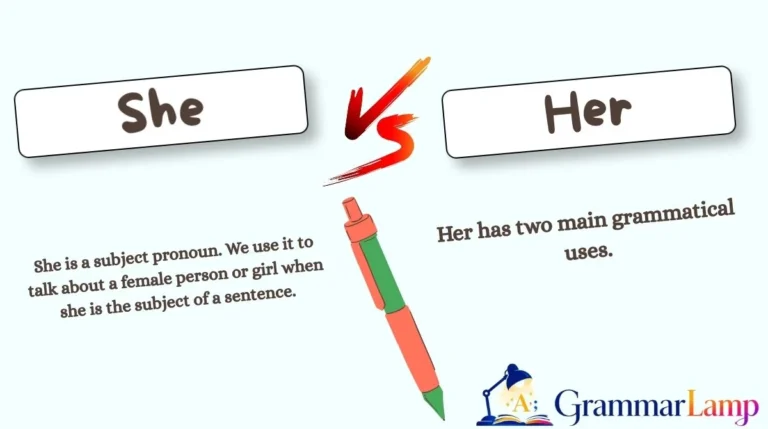
She is a subject pronoun. We use it to talk about a female person or girl when she is the subject of a sentence.
In simple terms, she usually tells us who is doing the action.
For example:
- She works at a bank.
- She called me yesterday.
- She likes chocolate.
- She is my sister.
- She lives next door.
- She speaks English very well.
- She wants to become a doctor.
- She is waiting outside.
Look at this sentence:
She called John.
Who did the calling? She did. Therefore, we use the subject pronoun she.
The basic grammar pattern is:
She + verb
For example:
She works.
She studies.
She sings.
She drives.
We also use she before the verb be when it is the subject:
She is my teacher.
She is very friendly.
She is from Lahore.
This is easy because she is clearly the person we are talking about.
Why does “This is she” sound unusual?
The interesting part comes when she appears after is.
Traditionally, English grammar teaches that after a linking verb such as be, a pronoun referring back to the subject should be in the subject form.
For example:
This is she.
The traditional grammatical idea is that this and she refer to the same person.
It is similar to:
She is the winner.
The sentence can be understood as:
This person = she.
Because she is a subject-form pronoun, traditional grammar considers “This is she” correct.
However, there is an important point: “This is she” is grammatically formal and can sound old-fashioned or stiff in ordinary conversation.
You may hear it in formal writing, traditional grammar exercises, or formal telephone conversations.
Examples with “she”
Here are more examples:
- She is my best friend.
- She works in a hospital.
- She called earlier.
- She wants to join us.
- She is the person I told you about.
- She lives in the next apartment.
- She teaches English.
- She is waiting for you.
Remember the main point:
She = subject pronoun
It usually comes before the verb when the female person is performing an action or being described as the subject.
What Does “Her” Mean?
Her has two main grammatical uses.
First, her can be an object pronoun. Second, her can be a possessive determiner.
For beginners, the easiest way to understand the first use is:
Her usually means “that female person” when she receives an action.
For example:
I called her.
Here, I did the calling. The female person received the action, so we use her, not she.
Compare:
She called me.
I called her.
This is one of the most important differences between the two forms.
We use her after many verbs and prepositions:
- I saw her.
- We invited her.
- He helped her.
- I spoke to her.
- They waited for her.
- Give the book to her.
- Everyone likes her.
“Her” as a possessive word
Her can also show that something belongs to a female person:
This is her phone.
That is her car.
I like her dress.
In these sentences, her comes before a noun.
The basic pattern is:
her + noun
Examples:
- her book
- her mother
- her house
- her idea
- her bag
- her phone
This is different from the object use of her.
Compare:
I saw her.
Here, her is an object pronoun.
But:
I saw her car.
Here, her shows possession.
Why do people say “This is her”?
Now we come to the main question.
In everyday modern English, speakers very commonly say:
This is her.
For example, imagine that you are looking at a photograph with your friend:
“Who is the woman in the picture?”
You might answer:
“This is her.”
Or someone may point to a person and say:
“Is that Maria?”
You can naturally answer:
“Yes, that’s her.”
The expression “This is her” is extremely common in conversational English.
Although traditional grammar may prefer “This is she” in certain structures, modern English often uses the object form her after be in this kind of identification.
That is why learners may hear both versions.
Examples with “her”
- I called her yesterday.
- We invited her to dinner.
- I spoke to her this morning.
- That is her bag.
- I think this is her.
- Yes, that’s her.
- Everyone knows her.
- Can you give this to her?
The key idea is:
Her = object pronoun or possessive determiner
The exact meaning depends on how it is used.
Difference Between “This Is She” and “This Is Her”
The difference becomes much clearer when we look at grammar, meaning, and real-life use together.
| Expression | Grammar | Style | Common use |
|---|---|---|---|
| This is she. | Traditional subject-form pronoun | Formal/traditional | Formal identification, older-style telephone English |
| This is her. | Object-form pronoun used in everyday identification | Natural/informal | Everyday spoken English |
| She is here. | Subject pronoun | Neutral | Normal statement |
| I saw her. | Object pronoun | Neutral | Normal statement |
| This is her bag. | Possessive determiner | Neutral | Showing ownership |
1. “This is she”
“This is she” is based on the traditional idea that a pronoun following a linking verb such as is should match the subject form.
For example:
This is she.
The older grammatical analysis treats she as a subject complement.
You may also hear it in telephone conversations:
“May I speak with Mrs. Khan?”
“This is she.”
This means:
“You are speaking to Mrs. Khan.”
It is grammatically traditional and quite formal.
However, many modern speakers would simply say:
“This is her.”
Or:
“Speaking.”
Or:
“Yes, that’s me.”
2. “This is her”
“This is her” is common in modern conversational English.
It sounds natural when you identify a woman or girl.
For example:
“Who is that?”
“That’s her.”
Or:
“Is this the woman you were talking about?”
“Yes, this is her.”
This type of sentence is so common that it should not be treated as a strange or incorrect expression in everyday English.
The important grammar point
There is a difference between traditional grammatical analysis and modern everyday usage.
Traditional grammar may say:
This is she.
Modern spoken English frequently says:
This is her.
So if your question is simply, “Which one will I hear in everyday English?”, the answer is usually “This is her” when identifying a female person.
If your question is, “Which form follows the traditional subject-complement rule?”, the answer is “This is she.”
That distinction solves most of the confusion.
Grammar Rules You Must Remember
Rule 1: Use “she” as the subject
When the female person performs the action, use she.
She called me.
Not:
Her called me.
A simple test is to ask:
Who is doing the action?
If the answer is the female person, use she.
She opened the door.
She helped her mother.
She bought a new phone.
Rule 2: Use “her” as an object
When the female person receives the action, use her.
I called her.
He helped her.
We invited her.
Ask:
Who received the action?
If the answer is the female person, use her.
Compare:
She called John.
John called her.
This simple contrast is very useful.
Rule 3: Use “her” before a noun to show possession
When something belongs to a female person, use her before the noun.
This is her book.
That is her car.
I like her idea.
Do not say:
This is she book.
Instead:
This is her book.
Notice that her is directly connected to the noun.
Rule 4: “This is she” and “This is her” can both be heard
Do not assume that one expression is always correct and the other is always wrong.
“This is she” is the traditional and more formal construction.
“This is her” is very common in modern spoken English.
The best choice depends on the situation.
For an English grammar test that specifically tests traditional pronoun case after be, your teacher may expect:
This is she.
For normal conversation, especially when identifying someone in a picture or place, you will often hear:
This is her.
Context matters.
In the Morning vs On the Morning: Complete Grammar Guide for 2026
Inside of vs Inside: The Easy Difference Explained in 2026
Attend vs Tend: Meaning, Differences, Grammar Rules & Examples (2026)
Better Understand vs Understand Better: Meaning, Grammar, and Correct Usage (2026)
Common Mistakes Students Make
English learners often make mistakes here because they learn a simple rule:
She = subject. Her = object.
That rule is useful, but it does not explain every sentence containing be.
Mistake 1: Thinking “This is her” is always wrong
A learner may think:
“Her is an object pronoun, so ‘This is her’ must be incorrect.”
That is too strict for modern English.
Native speakers commonly use her in identification expressions:
That’s her.
This is her.
Yes, that’s him.
That’s me.
These are normal conversational sentences.
Mistake 2: Thinking “This is she” is the only correct form
The opposite mistake is also common.
A student may learn:
“This is she” is grammatically correct.
Then they hear people saying:
“This is her.”
They may think native speakers are making mistakes.
Usually, they are not.
Language changes over time, and actual spoken English does not always follow older formal rules in the same way.
Mistake 3: Using “her” as a subject
This is a different issue.
Do not say:
Her went to school.
Say:
She went to school.
Do not say:
Her called me.
Say:
She called me.
The fact that “This is her” is natural does not mean you can use her everywhere.
Mistake 4: Confusing “her” and “hers”
Learners sometimes also confuse these two words.
This is her book.
But:
This book is hers.
We use her before a noun:
her book
We use hers when the noun is not repeated:
The book is hers.
This is another useful distinction to remember.
Easy Trick to Remember the Difference
Here is a simple classroom trick.
Think: “Who does the action?”
If the female person does the action, use:
SHE
If the female person receives the action, use:
HER
For example:
She called me.
She did the calling.
I called her.
She received the call.
That rule works in thousands of everyday sentences.
But what about “This is her”?
Treat “This is her” as a common identification expression.
When you point to someone and say:
“This is her.”
you are not describing an action like “I called her.” You are identifying the person.
The same pattern happens with other pronouns:
That’s me.
That’s him.
That’s them.
This is us.
These sound completely natural in conversation.
So a useful memory trick is:
Action → check subject/object.
Identification → listen to natural usage and consider formality.
If you need a very formal or traditional grammatical form, “This is she” is the safer choice. In ordinary conversation, “This is her” is very natural.
Daily Life Examples
Here are some situations where you may hear these expressions in real life.
1. Looking at a photograph
A: Who is the woman standing next to your brother?
B: This is her. She is my cousin.
Here, her is used naturally to identify the woman.
2. Talking about someone at a party
A: Is that Emma?
B: Yes, that’s her.
This is a very common spoken expression.
3. Answering the phone formally
A: May I speak to Mrs. Ahmed?
B: This is she.
This sounds formal and traditional.
4. Answering the phone naturally
A: Hi, is Sarah there?
B: Yes, this is her.
This is common in casual conversation.
5. Identifying a person
A: Which person is your teacher?
B: The woman in the blue dress. That’s her.
Again, her sounds natural in everyday speech.
6. Talking about an action
A: Who sent this message?
B: She did.
Here, she is the subject because she performed the action.
7. Talking about an object
A: Who did you invite?
B: I invited her.
Here, her is the object because she received the action.
8. Talking about ownership
A: Whose laptop is this?
B: It’s her laptop.
Here, her shows possession.
9. Introducing someone
A: Who is the new student?
B: This is her. Her name is Ayesha.
This is conversational and natural.
10. A formal introduction
A: Is this Dr. Brown?
B: Yes, this is she.
This can sound quite formal, but it follows the traditional construction.
Practice Section
Choose she or her in each sentence.
1. ___ is my sister.
2. I called ___ yesterday.
3. ___ works at a school.
4. This is ___.
5. May I speak to Mrs. Ali? — This is ___.
Answers
1. She
She is my sister.
She is the subject.
2. Her
I called her yesterday.
She is the object of called.
3. She
She works at a school.
She performs the action.
4. Her
This is her.
This is a natural modern conversational identification.
5. She in the traditional formal construction:
This is she.
In everyday speech, however, many speakers would say:
This is her.
So the answer depends on whether the exercise is testing traditional formal grammar or modern conversational usage.
A Majority of vs The Majority of: Easy Grammar Guide for 2026
Tomatoes or Tomatos: Which Spelling Is Correct? [2026]
In the Morning vs On the Morning: Complete Grammar Guide for 2026
Inside of vs Inside: The Easy Difference Explained in 2026
FAQs
1. What is the difference between “This is she” and “This is her”?
“This is she” is the traditional, formal construction. It treats she as the subject-form pronoun after the linking verb is.
“This is her” is very common in modern spoken English, especially when identifying a person. It usually sounds more natural and conversational.
2. Is “This is her” grammatically correct?
Yes, “This is her” is widely used in modern English, especially in everyday speech.
Traditional grammar often prefers “This is she” in this structure. However, real-world English frequently uses object pronouns after be in identification expressions, such as “That’s him” and “That’s me.”
3. Is “This is she” formal or informal?
“This is she” is generally formal or traditional.
It may sound natural in a very formal telephone conversation, but some speakers may consider it old-fashioned or stiff. In ordinary conversation, “This is her” is often more comfortable.
4. Can I use “This is she” when answering the phone?
Yes. In fact, this is one of the situations where “This is she” has traditionally been taught.
For example:
“May I speak to Ms. Taylor?”
“This is she.”
However, many modern speakers simply say:
“This is her.”
Both can be understood, but the first has a more formal or traditional sound.
5. Which is better: “This is she” or “This is her”?
It depends on your purpose.
For formal or traditional grammar, choose “This is she.”
For natural everyday conversation, “This is her” is very common.
If you are writing for a grammar test, follow the rule your course or teacher expects. If you are speaking naturally with people, you will hear and use “This is her” quite often.
6. Why do we say “This is her” if “her” is an object pronoun?
This happens because English has a long history of using object-form pronouns in certain constructions involving be, especially in everyday speech.
Traditional grammar analyzes the structure differently and prefers the subject form in sentences such as “This is she.”
Modern spoken English, however, commonly uses forms such as:
That’s me.
That’s him.
This is her.
So grammar rules and natural usage are not always identical.
Conclusion
The difference between “This is she” and “This is her” becomes much easier when you separate traditional grammar from modern spoken English.
She is the subject pronoun. We normally use it when a female person performs an action:
She called me.
Her is usually an object pronoun or a possessive determiner:
I called her.
This is her phone.
When identifying a person, however, modern English commonly uses “This is her.” It sounds natural in everyday conversation.
“This is she” is the traditional and more formal version, and you may still hear it, especially in formal telephone conversations.
The most useful rule is simple: use she as a normal subject, her as an object or possessive word, and remember that identification expressions such as “This is her” follow common modern usage.
Don’t worry if the two forms seemed confusing at first. Pay attention to how people use them in real conversations, practice a few examples aloud, and the difference will soon feel natural.

Liam Derren is a language writer at GrammarLamp, creating simple, helpful content about grammar, words, and everyday English. He makes language learning clear, practical, and easy to understand.
2 thoughts on “This Is She or This Is Her? The Correct Choice in English in 2026”