
Hasn’t vs haven’t is a common grammar problem for English learners. The two words look very similar because both are short forms of negative expressions.
Hasn’t means has not, while haven’t means have not. The difficult part is knowing which one to use with different subjects.
You may hear sentences such as “She hasn’t finished,” “They haven’t arrived,” “I haven’t seen him,” and “He hasn’t called.” They all sound natural to fluent speakers, but choosing the wrong form can make your English sound incorrect.
The good news is that the basic rule is quite simple. The choice usually depends on the subject of the sentence.
Once you understand which subjects take has and which take have, the difference becomes much easier.
This grammar point is especially important because hasn’t and haven’t are used often in everyday English.
You will hear them in conversations, text messages, emails, questions, and school or workplace English. They are also very common in the present perfect tense, such as “She hasn’t eaten yet.”
By the end of this guide, you will know exactly when to use hasn’t and haven’t, how they work in questions and negative sentences, what mistakes to avoid, and how to remember the difference without memorizing complicated grammar terms.
What Does “Hasn’t” Mean?
Hasn’t is the short form of has not.
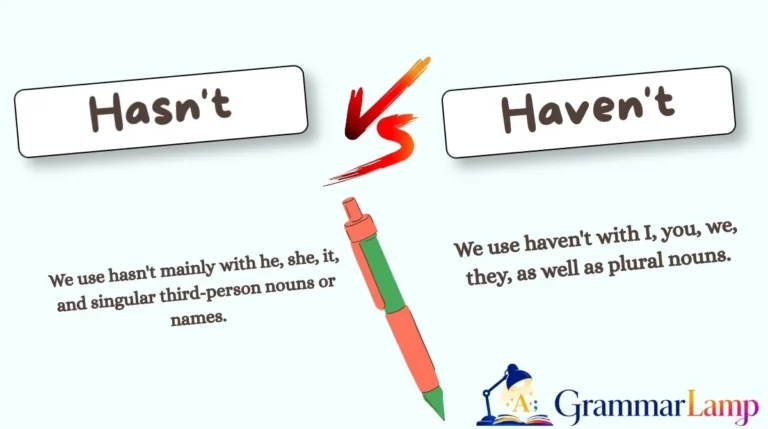
We use hasn’t mainly with he, she, it, and singular third-person nouns or names.
The basic pattern is:
He/She/It + hasn’t + past participle
For example:
- She hasn’t finished her homework.
- He hasn’t called me.
- The dog hasn’t eaten yet.
- Maria hasn’t arrived.
- My brother hasn’t seen that movie.
Here, hasn’t tells us that something has not happened, or a person has not done something.
When do we use “hasn’t”?
One of the most common uses is the present perfect tense.
The structure is:
Subject + has not + past participle
For example:
She hasn’t finished her work.
The word finished is the past participle of finish.
Another example is:
David hasn’t visited London.
The past participle visited comes after hasn’t.
We also use hasn’t when the subject is a singular thing or person:
The bus hasn’t arrived.
My phone hasn’t charged.
The baby hasn’t woken up.
Sarah hasn’t replied to my message.
Notice that we do not use hasn’t simply because a sentence is negative. The subject matters.
8 examples with “hasn’t”
- He hasn’t eaten breakfast yet.
- She hasn’t finished her project.
- Ali hasn’t called me today.
- My sister hasn’t come home.
- The train hasn’t arrived yet.
- The computer hasn’t started.
- It hasn’t stopped raining.
- The teacher hasn’t checked our homework.
A common learner confusion
Many learners think that hasn’t should be used whenever the subject is one person.
That is not always true.
For example:
I haven’t finished my homework. ✅
Not:
I hasn’t finished my homework. ❌
Although I refers to one person, English uses have, not has, with I.
The same thing happens with you:
You haven’t finished yet. ✅
Not:
You hasn’t finished yet. ❌
So, don’t simply think “one person = has.” Remember the actual subject groups:
He, she, it → has
I, you, we, they → have
What Does “Haven’t” Mean?
Haven’t is the short form of have not.
We use haven’t with I, you, we, they, as well as plural nouns.
The basic pattern is:
Subject + haven’t + past participle
For example:
I haven’t finished.
They haven’t arrived.
We haven’t eaten.
You haven’t answered my question.
The meaning is negative. It tells us that something has not happened or someone has not done something.
When do we use “haven’t”?
Like hasn’t, haven’t is very common with the present perfect tense.
The structure is:
I/You/We/They + haven’t + past participle
For example:
I haven’t seen that movie.
We haven’t decided yet.
They haven’t arrived.
The word after haven’t is usually a past participle.
Some common combinations are:
- haven’t finished
- haven’t seen
- haven’t eaten
- haven’t gone
- haven’t done
- haven’t called
- haven’t heard
- haven’t spoken
8 examples with “haven’t”
- I haven’t finished my homework.
- You haven’t answered my question.
- We haven’t eaten lunch yet.
- They haven’t arrived at the station.
- I haven’t seen John today.
- You haven’t told me the truth.
- We haven’t decided what to do.
- The students haven’t completed the test.
Notice the last example:
The students haven’t completed the test.
Students is plural, so we use haven’t.
Compare it with:
The student hasn’t completed the test.
Student is singular, so we use hasn’t.
That small difference between student and students changes the helping verb.
A common learner confusion
A very common mistake is using haven’t with he, she, or it.
For example:
She haven’t finished. ❌
The correct sentence is:
She hasn’t finished. ✅
Why? Because she belongs to the has group.
Another mistake is:
I hasn’t seen him. ❌
The correct sentence is:
I haven’t seen him. ✅
Why? Because I belongs to the have group.
Difference Between Hasn’t and Haven’t
The main difference between hasn’t and haven’t is the subject they agree with.
Both are negative forms, and both can be used to make negative present perfect sentences. The important question is: Who or what is the subject?
Comparison table
| Form | Full form | Used with | Example |
|---|---|---|---|
| hasn’t | has not | he, she, it, singular nouns | She hasn’t arrived. |
| haven’t | have not | I, you, we, they, plural nouns | They haven’t arrived. |
The easiest way to see the difference is to compare similar sentences:
He hasn’t finished.
They haven’t finished.
The action is the same: finish. The only thing that changes is the subject and the helping verb.
Another pair:
The boy hasn’t eaten.
The boys haven’t eaten.
Boy is singular, so we use hasn’t.
Boys is plural, so we use haven’t.
The grammar logic
English verbs change according to the subject.
With the present perfect, we use:
has + past participle for third-person singular subjects.
We use:
have + past participle with I, you, we, and they.
When we make the form negative, we add not:
- has + not = hasn’t
- have + not = haven’t
So:
She has finished.
becomes:
She hasn’t finished.
And:
They have finished.
becomes:
They haven’t finished.
The main verb does not change because of the negative contraction. The helping verb carries the difference.
Sentence structure
The most common structure is:
Subject + hasn’t/haven’t + past participle + other information
Examples:
He hasn’t called me.
We haven’t finished the work.
She hasn’t opened the door.
They haven’t seen this place before.
You can also add words such as yet, already, ever, never, and still depending on the meaning.
She hasn’t arrived yet.
We haven’t finished yet.
He hasn’t ever visited Pakistan.
They haven’t already left.
The exact placement of these words depends on the sentence, but hasn’t/haven’t still follows the subject rule.
Grammar Rules You Must Remember
Rule 1: Use “hasn’t” with he, she, and it
This is the most important rule.
Use hasn’t with third-person singular subjects:
- he
- she
- it
- one person
- one thing
- a singular noun
Examples:
He hasn’t called yet.
She hasn’t finished her work.
It hasn’t stopped raining.
Ahmed hasn’t arrived.
The car hasn’t started.
A quick test is to replace the noun with he, she, or it. If that works, hasn’t is usually the correct choice.
Rule 2: Use “haven’t” with I, you, we, and they
Use haven’t with:
- I
- you
- we
- they
- plural nouns
Examples:
I haven’t eaten.
You haven’t listened to me.
We haven’t decided.
They haven’t arrived.
The children haven’t gone home.
Remember that I uses have, even though it refers to only one person.
This is an important exception to the simple idea that singular means “has.”
Rule 3: Use a past participle after “hasn’t” or “haven’t” in the present perfect
When these forms are being used as present perfect auxiliaries, the structure is:
hasn’t/haven’t + past participle
Correct:
She hasn’t gone home.
I haven’t seen him.
He hasn’t done his homework.
They haven’t finished the job.
Incorrect:
She hasn’t went home. ❌
Correct:
She hasn’t gone home. ✅
Why? Went is the simple past form of go, while gone is its past participle.
Another example:
I haven’t saw him. ❌
I haven’t seen him. ✅
This rule is especially useful for learners who confuse the simple past with the present perfect.
Rule 4: The same rule applies in questions
You can use hasn’t and haven’t in negative questions.
Use hasn’t with he, she, it, and singular nouns:
Hasn’t she finished?
Hasn’t he called?
Hasn’t the bus arrived?
Use haven’t with I, you, we, and they:
Haven’t you eaten?
Haven’t they arrived?
Haven’t we met before?
You may also hear:
Haven’t I seen you before?
This is completely natural English.
The question form changes the word order, but the subject agreement stays the same.
Common Mistakes Students Make
Mistake 1: “She haven’t”
A learner may say:
She haven’t finished her work. ❌
The correct version is:
She hasn’t finished her work. ✅
She takes has, so the negative form is hasn’t.
Mistake 2: “I hasn’t”
Some students remember “one person = has” and write:
I hasn’t finished. ❌
But I always takes have in this structure:
I haven’t finished. ✅
Do not change have to has simply because I refers to one person.
Mistake 3: “They hasn’t”
Another common error is:
They hasn’t arrived. ❌
The correct sentence is:
They haven’t arrived. ✅
They takes have, whether it refers to two people, ten people, or a group of things.
Mistake 4: Using “hasn’t” with plural nouns
The children hasn’t eaten. ❌
The children haven’t eaten. ✅
Children is plural.
Compare:
The child hasn’t eaten. ✅
The children haven’t eaten. ✅
The noun changes from singular to plural, so the helping verb changes too.
Mistake 5: Using the wrong verb form
He hasn’t went there. ❌
He hasn’t gone there. ✅
We haven’t saw that movie. ❌
We haven’t seen that movie. ✅
After hasn’t/haven’t in the present perfect, use the past participle, not the simple past form.
Easy correction tip
Before choosing the word, ask yourself:
“Who is the subject?”
If the answer is:
he/she/it/one thing/one person → hasn’t
If the answer is:
I/you/we/they/more than one → haven’t
Then check the verb:
hasn’t/haven’t + past participle
This two-step check catches most mistakes.
Easy Trick to Remember the Difference
Here is a simple memory trick:
HAS = He, She, It
Think:
H-S-I → HAS
- He has
- She has
- It has
So:
- He hasn’t
- She hasn’t
- It hasn’t
Now remember:
HAVE = I, You, We, They
These four subjects use have:
- I have
- You have
- We have
- They have
So:
- I haven’t
- You haven’t
- We haven’t
- They haven’t
A useful classroom sentence to remember is:
He, she, it — hasn’t. I, you, we, they — haven’t.
Say it a few times aloud. It is much easier to remember when you hear the pattern.
There is one more helpful idea: don’t focus on whether the subject is a person or thing. Focus on the grammar group.
For example:
The car hasn’t started.
A car is not a person, but car is singular, so it works like it.
On the other hand:
The cars haven’t started.
Cars is plural, so it works like they.
That makes the rule much easier.
Daily Life Examples
These forms appear constantly in normal conversations.
1. Talking about food
A: Have you eaten?
B: No, I haven’t eaten yet.
Here, I takes haven’t.
2. Talking about a friend
A: Where is Sarah?
B: She hasn’t arrived yet.
Sarah is one person, so hasn’t is correct.
3. Talking about a group
A: Are the children home?
B: No, they haven’t come back yet.
They takes haven’t.
4. Talking about work
A: Has Tom finished the report?
B: No, he hasn’t finished it.
He takes hasn’t.
5. Talking about a bus
A: Is the bus here?
B: No, it hasn’t arrived yet.
The bus is one thing, so it can be replaced with it.
6. Talking about plans
A: Have you decided what to do?
B: No, we haven’t decided yet.
We takes haven’t.
7. Talking about a movie
A: Have you seen the new movie?
B: No, I haven’t seen it.
Again, I takes haven’t.
8. Talking about homework
A: Has your brother done his homework?
B: No, he hasn’t done it yet.
Brother is singular, so hasn’t is correct.
9. Talking about friends
A: Have your friends called you?
B: No, they haven’t called me.
Friends is plural, so haven’t is used.
10. Talking about the weather
A: Is the rain still falling?
B: Yes, it hasn’t stopped yet.
It takes hasn’t.
These examples show why the forms are so useful in spoken English. You do not need complicated vocabulary to use them correctly. The key is simply to match the subject with has or have.
Practice Section
Choose hasn’t or haven’t to complete each sentence.
1. She ______ finished her homework.
2. I ______ seen that movie.
3. They ______ arrived yet.
4. My brother ______ called me today.
5. We ______ decided where to go.
Answers
1. hasn’t — She hasn’t finished her homework.
2. haven’t — I haven’t seen that movie.
3. haven’t — They haven’t arrived yet.
4. hasn’t — My brother hasn’t called me today.
5. haven’t — We haven’t decided where to go.
A good way to practice is to stop looking at the answer immediately. Say each sentence aloud first. Then ask yourself which subject is being used.
FAQs
What is the difference between hasn’t and haven’t?
Hasn’t is the contraction of has not, while haven’t is the contraction of have not. Use hasn’t with he, she, it, and singular nouns. Use haven’t with I, you, we, they, and plural nouns.
Can we use hasn’t and haven’t in questions?
Yes. Both can be used in negative questions. For example, “Hasn’t she arrived?” uses hasn’t because the subject is she. “Haven’t they arrived?” uses haven’t because the subject is they.
Is hasn’t formal or informal?
Hasn’t is a normal contraction used in everyday English. It is common in speaking, informal writing, emails, and many other situations. In very formal writing, you may sometimes see has not instead of hasn’t, but the contraction itself is not incorrect.
Is haven’t formal or informal?
Haven’t is also a normal and widely used English contraction. It is especially common in conversation and everyday writing. In formal contexts, have not may be preferred in some situations, but haven’t is grammatically correct.
Can I say “I hasn’t”?
No. The correct form is “I haven’t.” Although I refers to one person, English uses have with I. For example, “I haven’t finished my work” is correct, while “I hasn’t finished my work” is incorrect.
Should I use hasn’t or haven’t with a name?
It depends on whether the name refers to one person or more than one person. A singular name takes hasn’t: “John hasn’t arrived.” A plural name or group takes haven’t: “John and Ali haven’t arrived.”
Conclusion
The difference between hasn’t and haven’t becomes easy once you focus on the subject.
Use hasn’t for he, she, it, and singular nouns:
She hasn’t arrived.
The phone hasn’t worked.
Use haven’t for I, you, we, they, and plural nouns:
I haven’t finished.
They haven’t arrived.
Remember that hasn’t = has not and haven’t = have not. In the present perfect, both are normally followed by a past participle, such as finished, seen, gone, or done.
The most useful sentence to memorize is:
He, she, it → hasn’t.
I, you, we, they → haven’t.
Once this pattern feels natural, you will start choosing the correct form without thinking about it. Try using these words in short sentences about your own day.
A little practice with real conversations can make this grammar rule stick much faster.

Liam Derren is a language writer at GrammarLamp, creating simple, helpful content about grammar, words, and everyday English. He makes language learning clear, practical, and easy to understand.
3 thoughts on “Hasn’t vs Haven’t: Easy Grammar Rules, Examples & Differences in 2026”