
Have you ever stopped while writing and wondered whether you should use desert or dessert? You are not alone. These two words look almost the same, and they sound similar too. However, their meanings are completely different.
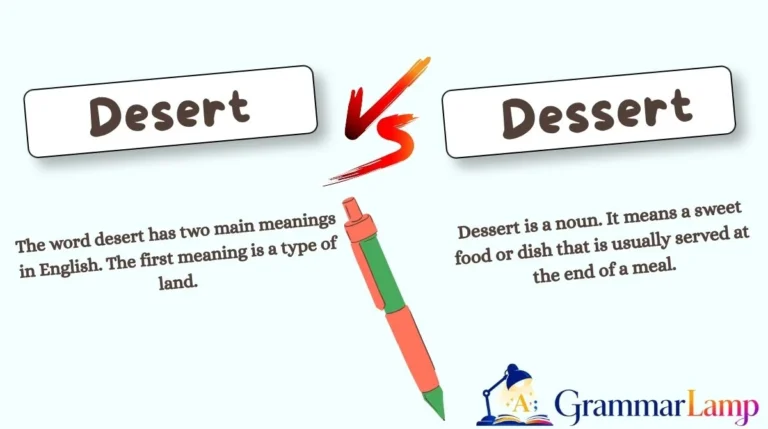
Desert usually refers to a very dry area of land where little rain falls. It can also be used as a verb meaning to leave someone or something behind.
Dessert, on the other hand, is a sweet food usually eaten at the end of a meal. Cake, ice cream, pudding, and pie can all be desserts.
The extra s in dessert is small, but it makes a big difference. Many English learners remember the spelling incorrectly, especially when they are writing quickly.
The problem becomes even more confusing because the word desert has more than one meaning and can be pronounced differently depending on how it is used.
Learning the difference is useful because both words appear often in everyday English. You may talk about visiting a desert, living in a dry climate, or eating dessert after dinner. You may also see these words in books, school lessons, travel writing, menus, and conversations.
By the end of this guide, the difference between desert vs dessert will be much easier to remember.
You will learn their meanings, grammar rules, pronunciation, common mistakes, everyday examples, and a simple memory trick that can help you choose the correct spelling.
More Useful posts
Alternative of vs Alternative for vs Alternative to: Which Is Correct? 2026 Guide
Realise or Realize: Which Spelling Is Correct in 2026?
Berth vs Birth: Meaning, Difference, Examples & Easy Rules for 2026
Insight vs Incite: What’s the Difference? Easy Guide for 2026
What Does “Desert” Mean?
The word desert has two main meanings in English. The first meaning is a type of land. The second meaning is a verb that means to leave someone or something, usually when you should not leave them.
Desert as a Noun
As a noun, a desert is a large, dry area of land that gets very little rain.
Deserts often have very hot days and very dry conditions. Some deserts are famous for their sand dunes, but not every desert is covered in sand. A desert can also have rocks, mountains, dry soil, or very little vegetation.
Some well-known deserts include the Sahara Desert, the Gobi Desert, and the Mojave Desert.
For example:
- The Sahara is a huge desert in Africa.
- We drove through the desert for several hours.
- Very few trees grow in this desert.
- The desert can be extremely hot during the day.
- My brother wants to visit a desert one day.
- We saw camels walking across the desert.
- The road passes through a dry desert.
- There was almost no water in the desert.
In these sentences, desert is a noun because it names a place or type of land.
Desert as a Verb
Desert can also be a verb. As a verb, it means to leave someone or something and not come back, especially when the person or place needs you.
For example:
- The soldier was accused of deserting his post.
- He decided to desert his team.
- The dog was deserted by its owner.
This use is less common in simple daily conversation than the land meaning, but it is important to know.
There is also an important pronunciation difference here. When desert is a noun meaning dry land, the stress is usually on the first syllable: DEZ-ert.
When desert is a verb meaning “to leave,” the stress is on the second syllable: di-ZURT.
So, although the spelling is the same, the pronunciation can change because the meaning changes.
When Should You Use “Desert”?
Use desert when you are talking about:
- A dry area of land
- A place with very little rain
- Leaving someone or something behind
For most learners, the first meaning is the one they will see most often.
Common Confusion with “Desert”
The biggest problem is usually spelling. People sometimes write dessert when they mean a dry place.
For example:
❌ The camel walked across the dessert.
✅ The camel walked across the desert.
The first sentence sounds as if the camel is walking across cake or ice cream!
A useful clue is to look at the meaning before choosing the spelling. If you are talking about sand, heat, dry land, camels, or a place with little rain, use desert.
What Does “Dessert” Mean?
Dessert is a noun. It means a sweet food or dish that is usually served at the end of a meal.
Common desserts include:
- Cake
- Ice cream
- Cookies
- Pie
- Pudding
- Brownies
- Fruit salad
- Cheesecake
For example:
- We had ice cream for dessert.
- What did you order for dessert?
- My favorite dessert is chocolate cake.
- The restaurant has many dessert options.
- She made a delicious dessert for the guests.
- Would you like dessert after dinner?
- They shared a dessert at the table.
- We skipped dessert because we were already full.
In each sentence, dessert is a noun because it names a type of food.
When Should You Use “Dessert”?
Use dessert when you are talking about sweet food eaten after a meal.
You might hear it in restaurants, at home, at parties, or during family dinners.
For example:
“Do you want dessert?”
“Yes, I’ll have some chocolate cake.”
Here, dessert refers to the sweet food served after the main meal.
Why Does “Dessert” Have Two S’s?
This is where many learners make mistakes.
Dessert has two s’s:
D-E-S-S-E-R-T
The extra s is part of the correct spelling. Writing desert when you mean sweet food changes the meaning completely.
Compare:
- desert = dry land
- dessert = sweet food
One extra letter creates a completely different word.
Common Confusion with “Dessert”
Learners sometimes remember the pronunciation but forget the spelling. Others accidentally use the spelling of desert.
For example:
❌ We ate chocolate cake for desert.
✅ We ate chocolate cake for dessert.
The correct spelling is dessert because you are talking about food.
Difference Between Desert and Dessert
The easiest way to understand desert vs dessert is to remember that these words may look alike, but they describe very different things.
| Word | Meaning | Part of Speech | Example |
|---|---|---|---|
| Desert | A very dry area of land | Noun | We traveled through the desert. |
| Desert | To leave someone or something | Verb | He deserted his team. |
| Dessert | Sweet food eaten after a meal | Noun | We had cake for dessert. |
Usage Difference
The main difference is meaning.
Desert is commonly connected with nature and dry land. Think about sand, heat, rocks, mountains, little rain, and dry weather.
Dessert is connected with food. Think about cake, chocolate, ice cream, pie, and dinner.
A simple comparison can make this clear:
- The desert is dry.
- The dessert is sweet.
The two words can appear in the same sentence, which is a fun way to see the difference:
We traveled through the desert and ate dessert at the hotel.
Here, the first word describes land, while the second word describes food.
Grammar Logic
There is no special grammar rule connecting these two words. They are simply different vocabulary words with different meanings and spellings.
Desert can be a noun or a verb.
As a noun:
The desert is very dry.
As a verb:
The soldier deserted his post.
Dessert is normally used as a noun:
The dessert was delicious.
Because dessert is a noun, it often appears after words such as:
- a
- the
- my
- your
- some
- this
- that
Examples:
This dessert looks amazing.
I ordered a dessert.
The dessert was too sweet.
Sentence Structure Difference
When desert means a dry place, you often use it with location words and verbs.
Examples:
They crossed the desert.
We live near the desert.
The desert gets very little rain.
When dessert means sweet food, it is often connected to meals and eating.
Examples:
We had dessert after dinner.
She made dessert for the children.
What is your favorite dessert?
The sentence structure changes because the meaning changes.
Meaning Comparison
Here is a simple way to compare them:
Desert = dry land
Dessert = sweet food
The extra s in dessert is one of the most important spelling clues.
You can think of the two s’s as giving you something sweet.
That memory trick is especially helpful for beginners.
Explore More Posts
Hear vs Here: Meaning, Difference, Grammar Rules & Examples in 2026
Hasn’t vs Haven’t: Easy Grammar Rules, Examples & Differences in 2026
Smooth vs Smoothe: Which Spelling Is Correct? Complete Guide for 2026
Mine as Well or Might as Well? The Correct Phrase Explained in Simple English (2026)
Grammar Rules You Must Remember
Rule 1: Use “Desert” for Dry Land
When you are talking about a very dry region with little rainfall, use desert with one s.
Correct:
The camel lives in the desert.
Incorrect:
The camel lives in the dessert.
Think about geography and nature. That usually means desert.
Rule 2: Use “Dessert” for Sweet Food
When you mean cake, ice cream, pie, or another sweet dish served after a meal, use dessert with two s’s.
Correct:
We had ice cream for dessert.
Incorrect:
We had ice cream for desert.
When food is involved, choose dessert.
Rule 3: “Desert” Can Also Be a Verb
Do not forget that desert is not only a noun.
It can also mean to leave someone or something behind.
For example:
The sailor deserted his ship.
Here, deserted has nothing to do with sand or dry land.
The verb is often used in serious or formal situations, so it may appear more often in books, news reports, or historical writing than in casual conversation.
Rule 4: Check the Meaning Before the Spelling
When you are unsure, do not focus only on the letters.
Ask yourself:
Am I talking about dry land?
Use desert.
Am I talking about sweet food?
Use dessert.
Meaning is often the fastest way to find the correct spelling.
Common Mistakes Students Make
Many students confuse these words because the spelling is almost identical. The pronunciation can also be confusing, especially for learners who are hearing the words rather than seeing them in writing.
Mistake 1: Using “Desert” for Food
❌ I had cake for desert.
✅ I had cake for dessert.
Why does this happen? The learner knows the sound but has not memorized the spelling.
Easy tip: Dessert has two S’s because you want seconds of something sweet.
Mistake 2: Using “Dessert” for a Dry Place
❌ The Sahara is a large dessert.
✅ The Sahara is a large desert.
Why is this wrong? The Sahara is a dry region, not a food item.
Easy tip: Connect desert with dry.
Mistake 3: Forgetting That “Desert” Can Be a Verb
Some learners think desert always means a dry place.
But consider:
He deserted his family.
Here, deserted means he left them.
Understanding both meanings helps you avoid confusion when reading English.
Mistake 4: Spelling the Words from Sound Alone
English spelling is not always easy to guess from pronunciation.
Two words may sound very similar but have different meanings and spellings.
That is why it is better to learn these words as pairs:
desert = dry land
dessert = sweet food
Mistake 5: Mixing Them Up in Fast Writing
Even strong English speakers can make spelling mistakes when typing quickly.
When proofreading, look for these clues:
If the sentence contains words such as sand, camel, dry, hot, Sahara, land, check for desert.
If it contains cake, ice cream, dinner, sweet, chocolate, restaurant, check for dessert.
Easy Trick to Remember the Difference
Here is a simple memory trick that many students find useful.
“Dessert Has Two S’s Because You Want Seconds”
Imagine your favorite cake or ice cream.
You eat one serving, and it tastes so good that you want another.
You want seconds.
The word dessert has two S’s.
So remember:
Dessert = two S’s = something sweet
Then the shorter spelling is:
Desert = one S = dry land
Another easy trick is to think:
Desert is dry.
Both words start with D, but the meaning tells you which spelling to choose.
You can also imagine a picture in your mind:
Desert → sand → dry
Dessert → cake → sweet
This method is often easier than trying to memorize a complicated spelling rule.
One More Useful Memory Line
Try saying this to yourself:
“A desert is dry, but dessert is delicious.”
The sentence uses the meaning of each word, making the difference easier to remember.
Daily Life Examples (Very Important)
Here are some natural examples that you may hear or use in everyday English.
Example 1: Talking About Dinner
A: Are you full?
B: A little, but I still want dessert.
Here, dessert means sweet food after a meal.
Example 2: Ordering at a Restaurant
Waiter: Would you like to see the dessert menu?
Customer: Yes, please. Do you have cheesecake?
Again, dessert refers to sweet food.
Example 3: Talking About Travel
A: Where are you going for your vacation?
B: We are planning to visit the desert.
Here, desert means a dry area of land.
Example 4: Talking About Nature
A: Why are there so few trees here?
B: This area is part of the desert.
The word describes the dry environment.
Example 5: Family Dinner
Mom: Finish your vegetables first, and then you can have dessert.
Child: Can I have ice cream?
Here, dessert is the sweet food served after dinner.
Example 6: Travel Story
A: Did you see anything interesting on your trip?
B: Yes. We rode camels across the desert.
The word desert describes the landscape.
Example 7: Talking About Favorites
A: What is your favorite dessert?
B: Chocolate cake. I love it.
The correct spelling is dessert because the conversation is about food.
Example 8: Describing Weather
A: What is the weather like in the desert?
B: It can be extremely hot and dry.
Here, desert refers to a dry region.
Example 9: Talking About a Restaurant
A: Did you order dessert?
B: Yes. I got a bowl of ice cream.
The second speaker chose a sweet dish.
Example 10: The Two Words Together
After driving through the desert, we stopped at a hotel and ordered dessert.
This sentence is excellent practice because both words appear together.
Desert = dry land
Dessert = sweet food
Practice Section
Choose the correct word: desert or dessert.
1. We had chocolate cake for ______.
a) desert
b) dessert
2. The Sahara is the world’s famous ______.
a) desert
b) dessert
3. What is your favorite ______?
a) desert
b) dessert
4. Very little rain falls in the ______.
a) desert
b) dessert
5. We ordered ice cream for ______.
a) desert
b) dessert
Answers
- dessert
- desert
- dessert
- desert
- dessert
A good way to check your answers is to ask what the word means.
If it is dry land, choose desert.
If it is sweet food, choose dessert.
More Helpful posts
In the Morning vs On the Morning: Complete Grammar Guide for 2026
Inside of vs Inside: The Easy Difference Explained in 2026
Attend vs Tend: Meaning, Differences, Grammar Rules & Examples (2026)
Better Understand vs Understand Better: Meaning, Grammar, and Correct Usage (2026)
FAQs
What is the difference between desert and dessert?
Desert usually means a dry area of land where very little rain falls. It can also be a verb meaning to leave someone or something behind. Dessert means sweet food served after a meal.
Can “desert” and “dessert” be used in questions?
Yes. Both can appear in questions.
For example:
What did you have for dessert?
And:
Have you ever visited a desert?
The correct word depends on what you are asking about.
Is “dessert” formal or informal?
Dessert is a normal everyday English word. It is used in both casual and formal situations. You can use it at home, in restaurants, at school, or in professional writing.
Why does dessert have two S’s?
There is no simple grammar rule that creates the spelling, so learners usually memorize it. A popular memory trick is: dessert has two S’s because you want seconds.
Is “desert” always a noun?
No. Desert can be a noun or a verb. As a noun, it means dry land. As a verb, it means to leave someone or something. The pronunciation can also change depending on the meaning.
How can I remember desert vs dessert easily?
Think of two simple ideas:
Desert = dry
Dessert = sweet
You can also remember that dessert has two S’s because you may want seconds of your favorite sweet food.
Conclusion
The difference between desert and dessert becomes much easier when you focus on meaning instead of spelling alone.
Desert usually means a very dry area of land. It can also be used as a verb meaning to leave someone or something. Dessert is a sweet food that is usually eaten after a meal.
The spelling clue is simple: dessert has two S’s.
Try this memory line:
A desert is dry, but dessert is delicious.
When you see words like sand, camel, hot, or Sahara, think desert. When you see words like cake, ice cream, chocolate, or dinner, think dessert.
Do not worry if you mix them up at first. These words confuse many English learners. A little practice will make the difference feel natural.
Once you connect each word with its meaning, choosing the correct one becomes quick and easy.

Liam Derren is a language writer at GrammarLamp, creating simple, helpful content about grammar, words, and everyday English. He makes language learning clear, practical, and easy to understand.
1 thought on “Desert vs Dessert: Meaning, Difference, Examples & Easy Trick (2026)”