
Berth and birth are two English words that often confuse learners because they sound almost exactly the same.
When people speak quickly, it can be difficult to know which word they mean. The problem becomes even bigger when you see the words in writing because their spellings and meanings are completely different.
Birth is connected with being born. We use it when talking about the time a person is born, the process of being born, or someone’s family background.
For example, “She was blind from birth” and “The baby was healthy at birth.”
Berth, on the other hand, is usually connected with a place to sleep or a place for a ship, boat, or sometimes a person or team.
You might hear someone say, “I booked a berth on the train.” You may also hear the expression “give someone a wide berth,” which means to keep a safe or comfortable distance from someone.
The two words are especially tricky because their pronunciation is very similar. In many varieties of English, berth and birth are pronounced the same or nearly the same.
By the end of this guide, you will know when to use berth, when to use birth, how they work in sentences, and how to avoid common spelling mistakes.
What Does “Berth” Mean?
Berth is mainly a noun. It has several related meanings, but the most common ones are a place to sleep, a place for a ship or boat, and a position or place in a competition or organization.
The meaning depends on the situation.
1. Berth means a place to sleep
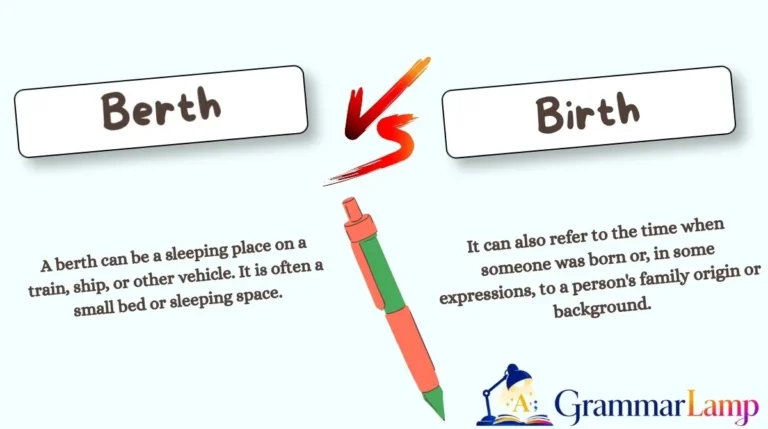
A berth can be a sleeping place on a train, ship, or other vehicle. It is often a small bed or sleeping space.
For example:
- I booked a berth on the overnight train.
- The train has six sleeping berths.
- She shared a berth with her sister.
- We were given a lower berth on the train.
- He slept in his berth during the journey.
- My ticket includes a sleeping berth.
- The cabin has two comfortable berths.
- I prefer a lower berth because it is easier to reach.
Here, berth refers to a physical place where someone can sleep.
In some countries, especially where overnight train travel is common, you may hear this word quite often.
2. Berth means a place for a ship or boat
A berth can also be a specific place where a ship or boat is kept at a port.
For example:
- The ship arrived at its berth early in the morning.
- The captain guided the boat into its berth.
- Our boat has a permanent berth at the marina.
- The harbor has enough berths for large ships.
- The ferry is waiting for a berth.
- The ship left its berth at sunrise.
In this meaning, a berth is similar to a parking place for a boat or ship.
That is a useful way to remember it. A car needs a parking space, while a ship needs a berth.
3. Berth can mean a place or position
Berth can also mean a position or place that someone or something gets, especially in a competition.
For example:
- The team earned a berth in the final.
- The victory gave them a berth in the championship.
- She won a berth on the national team.
- The club secured a berth in the tournament.
Here, berth does not mean a bed or a place for a ship. It means a place or position that has been earned or obtained.
4. Berth as a verb
Berth can also be used as a verb. It means to provide a place for a ship or boat to stop or stay.
For example:
- The harbor can berth several large ships.
- The port will berth the new vessel.
- The boat was berthed near the entrance.
- The ship was berthed safely overnight.
The past form is usually berthed.
A common expression: “give someone a wide berth”
One of the most useful expressions with this word is give someone a wide berth.
It means to keep away from someone or something or to give them plenty of space.
For example:
I would give that angry dog a wide berth.
This means I would stay well away from the dog.
You can also use it for people:
She was in a bad mood, so I gave her a wide berth.
This means I stayed away from her because I did not want to cause a problem.
Common learner confusion with “berth”
The biggest problem is spelling. A learner may hear berth and write birth because both words sound alike.
Remember that berth is connected with space, a place, or a position.
Think:
BERTH = a place
A sleeping place, a ship’s place, or a place in a competition.
What Does “Birth” Mean?
Birth is mainly a noun. It refers to the process or event of being born.
It can also refer to the time when someone was born or, in some expressions, to a person’s family origin or background.
1. Birth means the event of being born
This is the most basic meaning.
For example:
- The birth of their first child was a happy event.
- Her birth was recorded at the local hospital.
- The baby weighed three kilograms at birth.
- His parents were very happy after his birth.
- The doctor helped during the birth.
- We celebrated the baby’s birth.
- She wrote down the exact time of the child’s birth.
- The family announced the birth of their daughter.
In all these examples, birth is connected with a baby being born.
2. “At birth”
We often use at birth when talking about something that was true when a person was born.
For example:
- He was given the name Ali at birth.
- The baby weighed four kilograms at birth.
- She had a hearing problem at birth.
- The child was healthy at birth.
3. “From birth”
We also commonly say from birth.
This means since the time someone was born.
For example:
- He has lived in this city from birth.
- She has been interested in music from birth.
- The child has had the condition from birth.
A more natural expression in many situations is since birth:
- He has been blind since birth.
- She has known the language since birth.
4. “Give birth”
One of the most important expressions is give birth.
It means to have a baby.
For example:
- She gave birth to a healthy baby boy.
- My sister gave birth last month.
- The mother gave birth at the hospital.
- She gave birth to twins.
- The woman gave birth early in the morning.
Notice the structure:
give birth to + baby/child
For example:
She gave birth to a daughter.
5. Birth and family origin
The word can also appear in expressions connected with someone’s origin or family background.
For example:
- He is a British citizen by birth.
- She is a Pakistani national by birth.
- He returned to his birthplace after many years.
- London is his birthplace.
Birthplace means the place where someone was born.
Can “birth” be a verb?
Yes, birth can be used as a verb, although this use is less common for beginners.
For example:
The mother birthed a healthy baby.
However, everyday English usually prefers gave birth to:
The mother gave birth to a healthy baby.
So, when talking about a mother having a baby, give birth to is the safer and more natural expression for most learners.
Common learner confusion with “birth”
Learners sometimes use birth when they actually need berth.
For example:
❌ I booked a birth on the train.
✅ I booked a berth on the train.
The train does not have a “birth.” It has a berth, meaning a sleeping place.
Think:
BIRTH = being born
Difference Between Berth and Birth
The easiest way to understand the difference is to focus on their meanings rather than their sounds.
| Word | Part of speech | Main meaning | Example |
|---|---|---|---|
| Berth | Noun | A sleeping place | I booked a berth on the train. |
| Berth | Noun | A place for a ship or boat | The ship entered its berth. |
| Berth | Noun | A place or position in a competition | The team earned a berth in the final. |
| Berth | Verb | To provide a place for a ship | The port berthed the vessel. |
| Birth | Noun | The act or event of being born | The baby was healthy at birth. |
| Birth | Noun | The time someone was born | He was weak at birth. |
| Birth | Noun | Origin or family status | She is American by birth. |
The main difference
Berth is about a place or position.
Birth is about being born.
Compare these sentences:
I booked a berth on the train.
The word means a sleeping place.
The baby was healthy at birth.
The word means the event of being born.
The meanings have nothing to do with each other, even though the words sound alike.
Grammar difference
Birth is most commonly used as a noun:
The birth of the baby was announced yesterday.
Berth is also commonly used as a noun:
Our berth was comfortable.
But berth can also be a verb:
The ship was berthed at the port.
This is an important difference for learners because birth and berth do not behave in exactly the same way.
Sentence structure
Common structures with berth include:
book + a berth
We booked a berth on the train.
enter + a berth
The ship entered its berth.
give + someone + a wide berth
I gave the dog a wide berth.
Common structures with birth include:
give birth to + person/baby
She gave birth to a son.
at birth
The child was healthy at birth.
since birth
He has lived here since birth.
by birth
She is British by birth.
Knowing these common structures makes the difference much easier to remember.
Grammar Rules You Must Remember
Rule 1: Use “birth” for being born
When you are talking about a baby being born or the event of being born, use birth.
✅ The baby’s birth was a joyful event.
❌ The baby’s berth was a joyful event.
A good clue is that birth is closely related to born.
Rule 2: Use “berth” for a sleeping place
If you are talking about a sleeping space on a train or ship, use berth.
✅ I reserved a lower berth.
❌ I reserved a lower birth.
Think of a berth as a small bed or sleeping area.
Rule 3: Use “berth” for a ship’s place
A ship or boat can have a berth at a port or marina.
✅ The boat is in its berth.
❌ The boat is in its birth.
You can remember this by thinking of a berth as a parking space for a boat.
Rule 4: Learn the common expressions with “birth”
Several common expressions use birth.
- at birth
- from birth
- since birth
- give birth
- give birth to
- by birth
- birthplace
For example:
She has lived here since birth.
His mother gave birth to twins.
Learning these phrases as complete expressions is often easier than trying to memorize the word alone.
Common Mistakes Students Make
These mistakes usually happen because berth and birth sound the same or very similar.
Mistake 1: Using “birth” for a train sleeping place
❌ I booked a birth on the night train.
✅ I booked a berth on the night train.
A train can have sleeping berths. A birth is connected with being born.
Mistake 2: Using “berth” when talking about a baby
❌ The berth of the baby was announced yesterday.
✅ The birth of the baby was announced yesterday.
Here, you are talking about a child being born, so birth is correct.
Mistake 3: Confusing “give birth” with “give berth”
❌ She gave berth to a baby boy.
✅ She gave birth to a baby boy.
The fixed expression is give birth to.
Mistake 4: Confusing “birthplace” with a place to sleep
The word birthplace means the place where someone was born.
Lahore is his birthplace.
It does not mean a sleeping place.
A sleeping place on a train or ship is a berth.
Mistake 5: Spelling what you hear
Because the pronunciation can be the same, you cannot always choose the spelling by sound.
For example, if someone says:
“I booked a berth.”
You might hear something that sounds like birth.
The surrounding words give you the answer.
If the sentence talks about a train, ship, bed, port, or tournament, think berth.
If it talks about a baby, being born, parents, birthplace, or age from birth, think birth.
Easy Trick to Remember the Difference
Here is a simple classroom trick:
BIRTH = BORN
Both birth and born are about being born.
Think:
BIRTH → BORN → BABY
Whenever you see a baby, being born, or the time someone was born, choose birth.
BERTH = BED OR BOAT
Think:
BERTH → BED → BOAT
A berth can be a sleeping place, especially on a train or ship. It can also be a place where a boat or ship stays.
So remember:
Birth = born
Berth = bed/boat
This little trick can help you make the correct choice quickly.
There is another useful idea: a berth is a place.
You can have:
- a berth on a train
- a berth on a ship
- a berth at a port
- a berth in a competition
But you have:
- a birth of a baby
- a birth date
- a birthplace
- a birth certificate
Once you connect each word with these groups, the spelling becomes much easier.
Daily Life Examples
Here are some natural examples you might hear in everyday English.
Example 1: On a train
Ali: Did you book the overnight train?
Sara: Yes. I booked a lower berth.
Here, berth means a sleeping place.
Example 2: Talking about a baby
Ali: When was your daughter born?
Sara: She was born in June. Her birth was a very happy moment for our family.
Here, birth refers to being born.
Example 3: At a port
Captain: Is the ship ready to leave?
Worker: Yes. It is still in its berth.
The ship’s berth is its place at the port.
Example 4: Giving birth
Ayesha: How is your sister?
Mariam: She’s doing well. She gave birth to a baby girl yesterday.
The expression gave birth to means she had a baby.
Example 5: Keeping distance
Tom: Why are you standing so far away?
Mike: That dog looks nervous, so I’m giving it a wide berth.
Here, the phrase means keeping a safe distance.
Example 6: Talking about a person’s origin
David: Is she Canadian?
Emma: Yes, she is Canadian by birth.
By birth refers to nationality or origin connected with birth.
Example 7: A sports competition
Coach: Did our team qualify?
Player: Yes! We earned a berth in the final.
Here, berth means a place or position in the final.
Example 8: Talking about a child’s health
Doctor: Was the baby healthy?
Mother: Yes. He was perfectly healthy at birth.
At birth means when he was born.
Example 9: Booking a journey
Passenger: Do I need a seat or a sleeping space?
Clerk: If you’re traveling overnight, you can book a berth.
This is a common travel use.
Example 10: Talking about a birthplace
John: Where were you born?
Sam: My birthplace is a small town near the coast.
Here, birthplace means the place where Sam was born.
Practice Section
Choose the correct word: berth or birth.
1. I booked a sleeping ______ on the overnight train.
2. The baby was healthy at ______.
3. The ship entered its ______ at noon.
4. She gave ______ to a baby boy.
5. The team earned a ______ in the championship.
Answers
1. berth
A sleeping place on a train is a berth.
2. birth
The time when a baby is born is birth.
3. berth
A ship’s place at a port is a berth.
4. birth
The correct expression is give birth to.
5. berth
A place in a competition can be called a berth.
Quick test
Ask yourself:
“Am I talking about being born?”
If yes → birth
“Am I talking about a place, sleeping space, ship, or position?”
If yes → berth
That simple question will solve most cases.
FAQs
1. What is the difference between berth and birth?
Birth relates to being born, a baby’s arrival, or the time someone was born. Berth usually means a sleeping place, a ship’s place at a port, or a position in a competition. They may sound the same, but their meanings are completely different.
2. Are berth and birth pronounced the same?
In many accents, berth and birth are pronounced the same or very similarly. This is why they are easy to confuse when listening. Their spelling and meaning must usually be understood from the context.
3. Can we use berth in a sentence about a train?
Yes. A berth can be a sleeping place on a train, especially an overnight train.
For example:
I reserved a lower berth for the journey.
Do not use birth for a train sleeping place.
4. Is birth a noun or a verb?
Birth is mainly used as a noun, especially in everyday English. It can also be used as a verb, but that use is less common. For most learners, expressions such as give birth and give birth to are more useful.
5. What does “give someone a wide berth” mean?
Give someone a wide berth means to keep away from them or give them plenty of space. It can also be used for animals, objects, or situations.
For example:
The dog looked angry, so I gave it a wide berth.
6. What is the easiest way to remember berth and birth?
Remember birth = born. Use birth when you are talking about being born. Remember berth = bed or boat. Use berth for a sleeping place, a ship’s place, or a position in a competition.
Conclusion
Berth and birth are easy to confuse because they can sound the same, but their meanings are very different. Birth is connected with being born. We use it in expressions such as at birth, since birth, by birth, and give birth to.
Berth is connected with a place or position. It can mean a sleeping place on a train or ship, a place where a boat stays at a port, or a position in a competition.
You may also hear the expression give someone a wide berth, meaning to keep away from someone or something.
The easiest memory trick is simple: birth = born, while berth = bed or boat.
Because pronunciation does not always help, pay attention to the meaning of the sentence.
If you are talking about a baby or being born, choose birth. If you are talking about a sleeping place, ship, port, or competition position, choose berth.
With a little practice, these two words will stop causing confusion. The key is to learn them through real sentences rather than only memorizing their spellings.

Liam Derren is a language writer at GrammarLamp, creating simple, helpful content about grammar, words, and everyday English. He makes language learning clear, practical, and easy to understand.
2 thoughts on “Berth vs Birth: Meaning, Difference, Examples & Easy Rules for 2026”