
English learners often feel confused when they need to ask a question politely or talk about something they want to know.
For example, should you say “I wonder where he is,” “I am wondering where he is,” or “I was wondering where he was”? All three sentences can be correct, but they do not always sound the same.
These expressions are common in everyday English. You may hear them at work, in school, during phone calls, or when talking with friends. Native English speakers use them to ask questions, show curiosity, make polite requests, and talk about things they do not know.
The confusing part is that these expressions use different verb forms. “I wonder” uses the simple present tense, “I am wondering” uses the present continuous tense, and “I was wondering” uses the past continuous tense.
However, their meanings are not always limited to their basic grammar rules. For example, people often use “I was wondering” to make a present-day request sound softer and more polite.
Understanding these small differences can help you speak more naturally and avoid common grammar mistakes. You will learn when to use each expression, how to build correct sentences, and how their meanings change in different situations.
By the end, you will be able to choose the right expression when asking a question, expressing curiosity, or making a polite request in daily English.
More Useful posts
You Is vs You Are: Which Is Correct in 2026? Simple Grammar Guide
Glueing vs Gluing: Which Spelling Is Correct in 2026?
Phenomenon vs Phenomena: What Is the Difference? (2026)
Nobody vs No One: What’s the Difference? A Simple 2026 Grammar Guide
What Does “I Wonder” Mean?
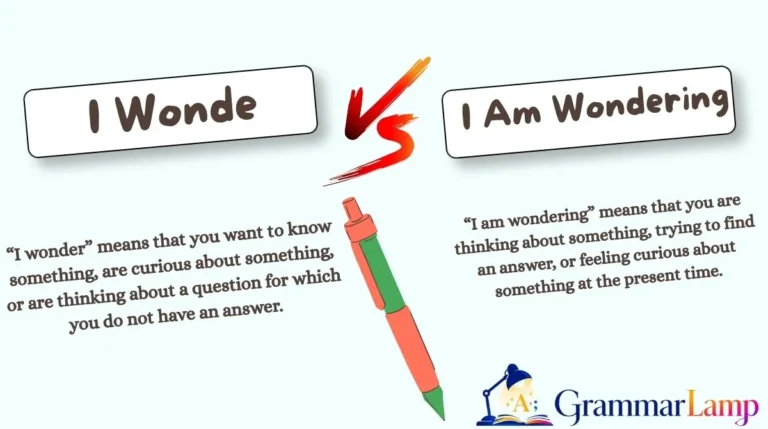
“I wonder” means that you want to know something, are curious about something, or are thinking about a question for which you do not have an answer.
It is one of the simplest ways to express curiosity in English. You can use it when thinking about another person, asking yourself a question, or talking about something that may happen in the future.
When Should You Use “I Wonder”?
Use “I wonder” when you want to express a thought, curiosity, or uncertainty. It is especially useful when you do not know something and want to think about it aloud.
For example:
“I wonder where Ali is.”
This sentence means that you do not know Ali’s location and are curious about it.
You can also use this expression to talk about possible reasons, future events, or other people’s thoughts.
Grammar Rule for “I Wonder”
The basic sentence structure is:
Subject + wonder + question word + subject + verb
Examples:
- I wonder where she lives.
- I wonder why he left.
- I wonder when they will arrive.
You can also use “if” or “whether” when you are unsure about a yes-or-no question.
- I wonder if she is at home.
- I wonder whether he knows the answer.
Remember that when you use a question word inside this structure, the word order is usually the same as in a normal statement, not a direct question.
Correct: I wonder where he is.
Incorrect: I wonder where is he.
8 Examples of “I Wonder”
- I wonder where my keys are.
- I wonder why she looks so upset.
- I wonder if the shop is still open.
- I wonder what he is doing right now.
- I wonder when the results will be announced.
- I wonder whether they will come to the party.
- I wonder how this machine works.
- I wonder who sent me this message.
Each example shows curiosity or uncertainty. The speaker wants to know something but does not have the answer.
Common Confusion About “I Wonder”
Some learners think “I wonder” must refer to something happening regularly because it uses the simple present tense. That is not true.
You can use it to express curiosity about the past, present, or future.
- I wonder why he left yesterday. (Past)
- I wonder where he is now. (Present)
- I wonder if it will rain tomorrow. (Future)
The tense of the main verb does not limit the time of the event you are curious about.
What Does “I Am Wondering” Mean?
“I am wondering” means that you are thinking about something, trying to find an answer, or feeling curious about something at the present time.
It uses the present continuous tense. This tense is formed with the helping verb “am” and the -ing form of the main verb “wonder.”
For example:
“I am wondering why she has not called me.”
The speaker is currently thinking about the reason for the missing phone call.
When Should You Use “I Am Wondering”?
Use “I am wondering” when you want to focus on a thought or question that is on your mind now. It can sound natural when discussing a current problem, considering an option, or asking someone about a situation.
It is also useful for polite questions and requests, especially when you want to sound thoughtful rather than direct.
For example:
“I am wondering if you could help me with this task.”
This sentence presents the request in a gentle way. It sounds less direct than “Can you help me with this task?” in some situations.
However, the expression is not automatically more polite in every context. Your tone, relationship with the listener, and the rest of the sentence also matter.
Grammar Rule for “I Am Wondering”
The basic structure is:
Subject + am/is/are + wondering + question word + clause
Examples:
- I am wondering why he is late.
- She is wondering where you went.
- They are wondering if the meeting is canceled.
For the first-person singular subject “I,” always use “am.”
Correct: I am wondering what happened.
Incorrect: I is wondering what happened.
8 Examples of “I Am Wondering”
- I am wondering where everyone has gone.
- I am wondering why my computer is not working.
- I am wondering if you have finished your homework.
- I am wondering what we should eat tonight.
- I am wondering whether I should buy this phone.
- I am wondering why the bus is taking so long.
- I am wondering if you can explain this rule.
- I am wondering how we can solve this problem.
These sentences describe questions or thoughts that are active in the speaker’s mind.
Common Confusion About “I Am Wondering”
Learners sometimes use “I am wondering” for every question about the present. Although it is grammatically possible in many situations, “I wonder” may sound more natural when expressing a general thought or curiosity.
Compare:
- I wonder why he is always late.
- I am wondering why he is late today.
The first sentence can express a general question about his habit. The second focuses more on the present situation.
The difference is not absolute. Both forms can be correct, depending on the context and the speaker’s intended meaning.
What Does “I Was Wondering” Mean?
“I was wondering” uses the past continuous tense. Its basic meaning is that you were thinking about something or wanted to know something at an earlier time.
However, this expression has another very common use. English speakers often use it to make a present-day question or request sound polite and less direct.
For example:
“I was wondering if you could help me.”
The speaker is probably asking for help now, even though the sentence uses the past tense.
This is a normal and widely used pattern in English. The past form creates a softer tone rather than necessarily placing the request in the past.
When Should You Use “I Was Wondering”?
Use this expression in two main situations.
1. To talk about a thought in the past
For example:
“I was wondering where you were yesterday.”
You were thinking about the person’s location at an earlier time.
2. To make a polite request or inquiry
For example:
“I was wondering if you had a few minutes to talk.”
You are asking about the person’s availability now or soon. The past form makes the question feel less forceful.
This expression is particularly useful in emails, workplace conversations, customer service, and situations where you want to show respect.
Grammar Rule for “I Was Wondering”
The basic structure is:
Subject + was/were + wondering + question word + clause
Use “was” with “I,” “he,” “she,” and “it.” Use “were” with “you,” “we,” and “they.”
Examples:
- I was wondering why she left.
- He was wondering where you lived.
- They were wondering if the event was canceled.
For a polite request, you can use this pattern:
I was wondering if/whether + subject + could/would + verb
For example:
“I was wondering if you could send me the report.”
8 Examples of “I Was Wondering”
- I was wondering where you went last night.
- I was wondering why the office was closed yesterday.
- I was wondering if you could help me with my assignment.
- I was wondering whether you had time for a quick meeting.
- I was wondering if I could borrow your pen.
- I was wondering when the next class would begin.
- I was wondering if you could call me later.
- I was wondering whether you had received my email.
The first two examples clearly refer to past situations. The remaining examples show how the expression can be used for polite requests or inquiries.
Common Confusion About “I Was Wondering”
The biggest mistake is assuming that “I was wondering” always means the speaker was curious in the past.
That is not always the case.
For example:
“I was wondering if you could open the window.”
The speaker is making a request in the present. The sentence does not necessarily mean the speaker wanted the window opened at some earlier time.
Also, remember that “I was wondering” is not a direct question by itself. It is usually followed by a question clause.
Correct: I was wondering where you were.
Incorrect: I was wondering where were you.
Difference Between “I Wonder,” “I Am Wondering,” and “I Was Wondering”
All three expressions communicate curiosity or a desire to know something. The main difference lies in how the speaker presents that thought and what tone they want to create.
Comparison Table
| Expression | Main use | Common meaning or tone | Example |
|---|---|---|---|
| I wonder | Expressing curiosity | A thought or question | I wonder where he is. |
| I am wondering | Focusing on a current thought | Thinking about something now | I am wondering what to do. |
| I was wondering | Referring to a past thought or making a polite request | Often softer and less direct | I was wondering if you could help. |
1. Usage Difference
“I wonder” is a good choice when you simply want to express curiosity. It can be used for questions about the past, present, or future.
“I wonder why she is upset” sounds like a natural way to share a thought.
“I am wondering” puts more focus on the thought that is happening now. It is often useful when discussing a current situation or considering a decision.
“I am wondering whether we should leave early” suggests that the speaker is thinking through a choice.
“I was wondering” often sounds more polite when asking someone to do something. It can help make a request feel less direct.
“I was wondering if you could check this document” is a gentle way to ask for help.
2. Grammar Logic
Each expression uses a different verb tense.
- I wonder: Simple present tense.
- I am wondering: Present continuous tense.
- I was wondering: Past continuous tense.
The simple present often describes a thought or state of curiosity. The present continuous focuses on a thought in progress. The past continuous describes a thought in progress in the past, but it can also soften a present request.
The word “wonder” often describes a mental state, so the simple present is especially common. The continuous forms are also natural in many contexts, particularly when the speaker wants to emphasize a specific thought or use a polite expression.
3. Sentence Structure Difference
The structures are slightly different because the helping verbs change.
Simple present:
Subject + wonder + clause
Example: I wonder why he is angry.
Present continuous:
Subject + am/is/are + wondering + clause
Example: I am wondering why he is angry.
Past continuous:
Subject + was/were + wondering + clause
Example: I was wondering why he was angry.
Notice that the tense inside the second part of the sentence may also change. For instance, “why he was angry” describes a past situation, while “why he is angry” describes a current situation.
However, the tense of the clause does not always have to match the tense of “wonder.” The correct choice depends on the time and meaning you want to express.
4. Meaning Comparison in Real Situations
Imagine you want to ask a colleague for help.
- “I wonder if you can help me.” This expresses curiosity about whether the person can help.
- “I am wondering if you can help me.” This focuses on your current question and can sound thoughtful.
- “I was wondering if you could help me.” This is a common, polite way to make the request.
All three may be understandable, but the third is often the most natural choice when you want to ask for a favor politely.
Now imagine you are thinking about a friend who has not arrived.
- “I wonder where she is.” You are curious about her location.
- “I am wondering where she is.” You are emphasizing that you are thinking about her location now.
- “I was wondering where she was.” You were thinking about her location at an earlier time, or you may be using a past form in a context where it sounds less direct.
The surrounding conversation helps the listener understand your intended meaning.
Explore More Posts
Tinder vs Tender: Meaning, Difference, Examples, and Grammar Rules in 2026
Prophecy vs Prophesy: Meaning, Difference, Examples, and Grammar Rules in 2026
Made It Home Safe vs Made It Home Safely: Which Is Correct in 2026?
Ax vs Axe: Which Spelling Is Correct in 2026?
Grammar Rules You Must Remember
Rule 1: Use “I Wonder” for Simple Expressions of Curiosity
When you want to express curiosity naturally, “I wonder” is often the easiest choice.
Examples:
- I wonder why he is laughing.
- I wonder if the train is late.
- I wonder what she wants.
You do not need to use a continuous tense just because you are thinking about something right now.
Rule 2: Use “I Am Wondering” to Emphasize a Current Thought
The present continuous can highlight a question that is on your mind at the moment.
Examples:
- I am wondering how to fix this problem.
- I am wondering whether we should order food.
Remember the correct form: “am wondering,” not “am wonder.”
Rule 3: Use “I Was Wondering” for Polite Requests
This is one of the most useful patterns for daily conversation.
Examples:
- I was wondering if you could explain this.
- I was wondering whether you would like to join us.
Although the verb is in the past form, the request can be about the present or future.
Rule 4: Use Statement Word Order Inside Indirect Questions
When these expressions are followed by a question clause, use normal statement word order.
Correct:
- I wonder where she is.
- I am wondering why he left.
- I was wondering what you wanted.
Incorrect:
- I wonder where is she.
- I am wondering why did he leave.
- I was wondering what did you want.
Direct questions and indirect questions follow different word-order patterns. This is a common source of mistakes for English learners.
Common Mistakes Students Make
Many learners understand the basic meaning of these expressions but struggle to use them in natural sentences. These mistakes often happen because learners translate directly from their first language or use the same tense in every situation.
Mistake 1: Using the Wrong Helping Verb
Incorrect: I is wondering where he lives.
Correct: I am wondering where he lives.
Why? The subject “I” takes “am” in the present continuous tense.
Easy tip: Remember the pattern “I am,” “he is,” and “they are.”
Mistake 2: Forgetting the -ing Form
Incorrect: I am wonder why she is late.
Correct: I am wondering why she is late.
Why? The present continuous tense requires a form of “be” followed by the verb ending in -ing.
Easy tip: Whenever you use “am” in this structure, check whether the next verb ends in -ing.
Mistake 3: Using Question Word Order Inside an Indirect Question
Incorrect: I wonder where is the bank.
Correct: I wonder where the bank is.
Why? The clause after “I wonder” is an indirect question, so it uses statement word order.
Easy tip: After “I wonder,” imagine you are making a normal statement. Say “the bank is,” not “is the bank.”
Mistake 4: Thinking “I Was Wondering” Always Refers to the Past
Incorrect understanding: “I was wondering if you could help me” can only describe an old request.
Natural usage: “I was wondering if you could help me” can be a polite request made now.
Why? English speakers often use the past form to make requests sound less direct.
Easy tip: Look at the situation, not just the tense. If someone is asking you for help now, the sentence can still use “was wondering.”
Mistake 5: Using “I Am Wondering” in Every Situation
Less natural in many contexts: I am wondering what time the sun rises every day.
More natural: I wonder what time the sun rises every day.
Why? The simple present is often a better fit for general curiosity or a question about a regular fact.
Easy tip: For a general question or a thought you are sharing, try “I wonder” first. Use the continuous form when you want to emphasize a current thought.
Mistake 6: Adding “Do” Incorrectly
Incorrect: Do I wonder where he is?
Correct for ordinary curiosity: I wonder where he is.
Why? You do not normally need “do” to form this kind of statement. The expression is not a direct question about whether you wonder.
Easy tip: Begin with “I wonder” when sharing a thought. Use a question form only when the sentence genuinely calls for one.
Easy Trick to Remember the Difference
Here is a simple way to remember all three expressions.
I wonder = a thought.
Use it when you want to express curiosity.
Example: “I wonder why the sky is blue.”
I am wondering = a thought on your mind now.
Use it when you want to emphasize that you are thinking about a current question or decision.
Example: “I am wondering which course I should choose.”
I was wondering = a past thought or a polite request.
Use it when describing an earlier thought or when you want to ask someone for something in a gentle way.
Example: “I was wondering if you could give me some advice.”
Think of these three expressions as different ways of presenting the same question. The simple present is straightforward, the present continuous emphasizes a current thought, and the past continuous often makes a request softer.
One important point: these are helpful memory clues, not strict rules that work in every sentence. English speakers can choose different forms depending on the situation, the tone, and the meaning they want to express.
Daily Life Examples: Natural Spoken English
These short conversations show how the three expressions work in everyday situations.
1. Asking About a Friend
Ali: Sara has not arrived yet.
Hamza: I wonder where she is.
Hamza is curious about Sara’s location.
2. Choosing a Restaurant
Mina: What should we eat tonight?
Ayesha: I am wondering whether we should order pizza or cook at home.
Ayesha is thinking about a current decision.
3. Asking for Help at Work
Employee: I was wondering if you could check my report.
Manager: Of course. Send it to me.
The employee makes a polite request.
4. Talking About the Weather
Bilal: The sky looks very dark.
Usman: I wonder if it will rain today.
Usman is curious about a possible future event.
5. Asking a Teacher a Question
Student: Excuse me, I was wondering if you could explain this question again.
Teacher: Certainly. Which part is confusing?
The student uses a polite expression to ask for help.
6. Thinking About a Problem
Nadia: You look worried. Is something wrong?
Hira: I am wondering how I will finish all this work before Friday.
Hira is thinking about a problem she needs to solve.
7. Asking a Colleague About a Meeting
Worker: I was wondering whether you would be available for a short meeting tomorrow.
Colleague: Yes, I should be free in the morning.
The question sounds polite and professional.
8. Talking About the Past
Ahmed: Why did you call me yesterday?
Zain: I was wondering where you had put my notebook.
Zain explains the thought he had earlier.
9. Thinking About the Future
Friend 1: Do you think we will pass the exam?
Friend 2: I wonder how difficult the paper will be.
The second speaker is curious about the exam.
10. Asking a Friend for a Favor
Friend 1: Are you busy this afternoon?
Friend 2: Not really. Why?
Friend 1: I was wondering if you could help me move a table.
The expression makes the request sound friendly and less direct.
Practice Section
Choose the best option for each sentence. Think about the meaning and situation before checking the answers.
- ______ why the baby is crying.
- A. I wonder
- B. I am wonder
- C. I was wondering why is
- ______ if you could send me the file.
- A. I was wondering
- B. I am wondering if could
- C. I wonder if could
- ______ which laptop I should buy right now.
- A. I am wondering
- B. I am wonder
- C. I was wonder
- Yesterday, ______ why the shop was closed.
- A. I wonder
- B. I was wondering
- C. I am wondering
- ______ when the next train will arrive.
- A. I wonder
- B. I wondering
- C. I am wonder
Answers and Explanations
- A. I wonder — This is a correct way to express curiosity.
- A. I was wondering — This is a natural, polite way to make a request.
- A. I am wondering — The present continuous emphasizes a current thought.
- B. I was wondering — The sentence refers to a thought from yesterday.
- A. I wonder — The simple present works naturally for a question about the next train.
Remember that context can sometimes make more than one expression possible. These answers are the best choices for the meanings suggested by each sentence.
More Helpful posts
Married To vs Married With 2026: Which One Is Correct?
Seel vs Seal: Meaning, Difference, and Correct Usage in 2026
Lies Ahead vs Lays Ahead: Which Is Correct? (2026 Guide)
Grisly vs Grizzly: Meaning, Difference, and Examples You Need in 2026
FAQs
1. What is the difference between “I wonder” and “I am wondering”?
“I wonder” is commonly used to express curiosity or share a thought. “I am wondering” puts more focus on a question or thought that is on your mind now. Both can be correct, and the best choice depends on the context.
2. Is “I was wondering” more polite than “I wonder”?
Often, yes. “I was wondering if you could help me” is a common way to make a polite request. “I wonder if you can help me” is also correct, but it may sound more like a question about the person’s ability or willingness to help.
3. Can I use “I was wondering” for a present request?
Yes. English speakers often use “I was wondering” to ask for help, information, or permission in the present. For example, “I was wondering if I could leave early today” is a polite request about the current situation.
4. Is “I am wondering” grammatically correct?
Yes. It is the present continuous form of “wonder.” You can use it to emphasize a current thought or question, as in “I am wondering how to solve this problem.” It is correct, although “I wonder” may sound more natural in some contexts.
5. Can I use “I wonder” in a question?
Yes, but its usual form is a statement that expresses curiosity, such as “I wonder where he is.” You can also ask someone, “I wonder if you could help me,” although the tone may vary. For a direct question, “Do you ever wonder why this happens?” is also correct.
6. Should I say “I was wondering if you can” or “I was wondering if you could”?
Both forms are possible, but “I was wondering if you could” is a very common polite request. “Could” helps make the request sound less direct. For example, “I was wondering if you could explain this rule” sounds natural in both workplace and classroom situations.
Conclusion
Understanding the difference between “I wonder,” “I am wondering,” and “I was wondering” can make your English clearer and more natural.
Although these expressions share a similar meaning, each one can create a slightly different feeling.
Use “I wonder” when you want to express curiosity or share a thought. Choose “I am wondering” when you want to focus on a question or decision that is on your mind now. Use “I was wondering” when talking about an earlier thought or making a polite request.
The most important lesson is that tense is not the only thing that matters. Context, tone, and your reason for speaking also help determine which expression sounds best.
Try using these phrases in your daily conversations. When you want to know something, say “I wonder.” When you are thinking through a choice, try “I am wondering.” When you need to ask for help politely, “I was wondering if you could…” is an excellent starting point.
Keep practicing with real examples, and choosing the right expression will soon feel much easier.

Liam Derren is a language writer at GrammarLamp, creating simple, helpful content about grammar, words, and everyday English. He makes language learning clear, practical, and easy to understand.