
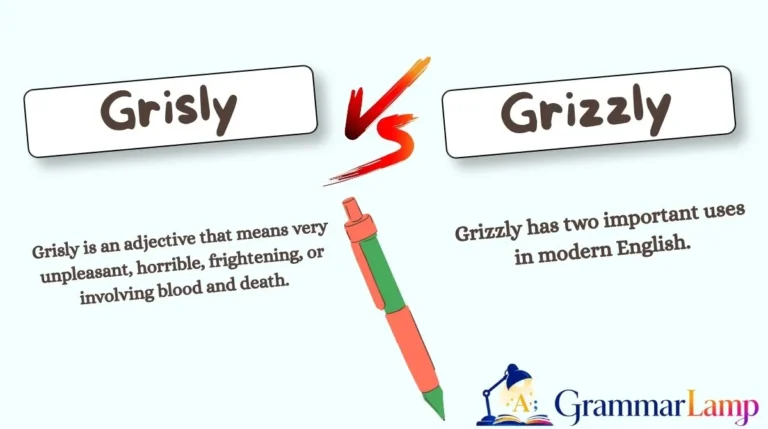
Grisly and grizzly are two English words that look almost the same. They are only one letter apart, and they sound very similar when spoken.
Because of this, even strong English learners can sometimes mix them up.
The good news is that their meanings are quite different. Grisly is mainly used to describe something horrible, bloody, or disturbing.
Grizzly, on the other hand, is most commonly connected with the grizzly bear, a large type of bear found mainly in North America. It can also describe something that is gray or grayish in color.
This small spelling difference can change the whole meaning of a sentence. For example, saying “a grisly bear” is not the same as saying “a grizzly bear.”
The first phrase suggests that the bear is connected with something terrible or disturbing. The second refers to a type of bear.
These words matter in everyday English because they often appear in news stories, books, movies, nature programs, and ordinary conversations.
Once you understand the difference, choosing the right word becomes much easier.
You will learn what grisly means, what grizzly means, how their grammar works, where learners make mistakes, and how to remember the difference without having to think too hard each time.
More Useful posts
Insight vs Incite: What’s the Difference? Easy Guide for 2026
Licence or License: Which Spelling Is Correct in 2026?
I’ve Added vs I Added: Easy Difference, Rules & Examples (2026)
This Is She or This Is Her? The Correct Choice in English in 2026
What Does “Grisly” Mean?
Grisly is an adjective that means very unpleasant, horrible, frightening, or involving blood and death. We normally use it when something is disturbing to look at, hear about, or imagine.
For example, a grisly murder is a murder described as especially horrible or bloody. A grisly scene is a scene that is shocking or disturbing, often because it involves injury, blood, or death.
The word is usually used for serious or unpleasant situations. It often appears in writing, news reports, stories, crime discussions, and descriptions of frightening events.
How to Use “Grisly”
Because grisly is an adjective, it normally comes before a noun or after a linking verb.
Common structures include:
- grisly + noun
- subject + be + grisly
- a grisly scene
- a grisly discovery
- the scene was grisly
The word does not name a person, object, or animal by itself. It tells us what something is like.
Examples of “Grisly”
- The police arrived at a grisly crime scene.
- The newspaper described the grisly details of the accident.
- We saw a grisly scene in the horror movie.
- The hikers made a grisly discovery in the forest.
- The old story contains some grisly descriptions.
- The detective was shocked by the grisly evidence.
- The film became too grisly for some viewers.
- The accident left behind a grisly scene on the road.
Notice that grisly adds a feeling of horror or disturbance. It does not simply mean “bad.” The word is stronger and is normally connected with death, injury, violence, or something visually unpleasant.
Common Confusion About “Grisly”
Many learners see the word grisly and connect it with gray because of its spelling. That can cause trouble.
For example:
The grisly bear walked across the road.
This sentence would usually be understood as saying that the bear itself is horrible or disturbing. It does not identify the animal as a grizzly bear.
When you want to talk about the animal, the correct word is grizzly.
Another common mistake is using grisly when you mean “bear.”
Wrong:
We saw a grisly in the national park.
Correct:
We saw a grizzly in the national park.
The first word describes something frightening. The second word can name the animal.
What Does “Grizzly” Mean?
Grizzly has two important uses in modern English.
First, it is a noun or adjective connected with the grizzly bear, a large North American bear with brown fur that often has grayish or silver-tipped hairs.
Second, grizzly can be used as an adjective meaning grayish or streaked with gray, especially when describing hair, fur, or a person’s appearance.
For most learners, the most important meaning is the animal.
“Grizzly” as a Noun
As a noun, grizzly is a shorter way of saying grizzly bear.
For example:
- We saw a grizzly near the river.
- The park is home to many grizzlies.
The plural form is often grizzlies.
Here, grizzly acts like a normal noun. It names an animal.
“Grizzly” as an Adjective
As an adjective, grizzly commonly appears before bear.
Examples:
- a grizzly bear
- a young grizzly bear
- a large grizzly bear
- a wild grizzly bear
The adjective helps identify the type of bear.
It can also describe something grayish or mixed with gray.
For example:
His beard was grizzly with age.
A more familiar example is the idea of grizzly hair, meaning hair containing noticeable gray.
Examples of “Grizzly”
- A grizzly bear was spotted near the mountain trail.
- The photographer waited quietly for the grizzly to appear.
- The guide warned us not to approach the grizzly.
- Grizzlies can be dangerous when they feel threatened.
- We watched a grizzly fishing in the river.
- The park is famous for its grizzly bears.
- The old man had thick, grizzly hair.
- A grizzly crossed the road early in the morning.
In examples 1, 3, and 6, grizzly describes the type of bear. In examples 2, 4, and 8, grizzly is being used as a noun to mean a grizzly bear.
Common Confusion About “Grizzly”
The biggest problem is simply the spelling.
Learners may write:
grisly bear
when they actually mean:
grizzly bear
That one letter changes the meaning.
Remember that grizzly is strongly connected with the animal grizzly bear. When you are talking about the bear, use grizzly.
If you are describing something horrible, bloody, or disturbing, use grisly.
Difference Between Grisly and Grizzly
The easiest way to understand the difference is to focus on the idea behind each word.
Grisly = horrible or disturbing
Grizzly = a type of bear, or grayish
Although the spellings are close, the meanings are not interchangeable.
Comparison Table
| Word | Part of Speech | Main Meaning | Common Use | Example |
|---|---|---|---|---|
| grisly | Adjective | Horrible, bloody, disturbing | Describing a scene, event, death, injury, or discovery | It was a grisly scene. |
| grizzly | Noun | A grizzly bear | Naming the animal | A grizzly crossed the road. |
| grizzly | Adjective | Related to a grizzly bear; grayish | Describing a bear or grayish appearance | We saw a grizzly bear. |
Usage Difference
The word grisly describes the nature of something. It tells us that something is shocking, horrible, or unpleasant.
The reporter described the grisly accident.
Here, the accident itself is disturbing.
The word grizzly usually points to an animal.
The reporter photographed a grizzly bear.
Here, the word identifies the type of bear.
These are completely different ideas.
Grammar Logic
Grisly works as an adjective. It modifies a noun.
You can say:
- grisly murder
- grisly accident
- grisly discovery
- grisly scene
- grisly story
You normally cannot use it as the name of an animal.
Grizzly can work as either an adjective or a noun.
As an adjective:
We saw a grizzly bear.
As a noun:
We saw a grizzly.
That difference is very important. When grizzly is standing alone and referring to the animal, it is a noun.
Sentence Structure Difference
The structures are also easy to spot.
For grisly, use:
grisly + noun
Examples:
a grisly murder
a grisly scene
a grisly discovery
You can also place it after a linking verb:
The details were grisly.
For grizzly, use:
grizzly + bear
Example:
A grizzly bear entered the area.
Or use grizzly alone as a noun:
A grizzly entered the area.
Meaning Comparison
Compare these two sentences:
The movie showed a grisly bear attack.
Here, grisly describes the attack. The attack was horrible or disturbing.
The movie showed a grizzly bear attack.
Here, grizzly bear identifies the animal that carried out the attack.
This is a perfect example of why spelling matters.
The first sentence focuses on how horrible the attack was.
The second sentence focuses on what kind of bear was involved.
Sometimes both words can appear in the same sentence:
The documentary showed a grisly attack by a grizzly bear.
This sentence uses both words correctly. The attack was grisly, while the bear was grizzly.
Explore More Posts
Jewel vs Joule: Meaning, Difference, Examples & Easy Rules (2026)
Foul or Fowl: Meaning, Difference, Examples & Easy Rules for 2026
Dialog vs Dialogue: What’s the Difference? A Simple English Guide for 2026
Learned vs Learnt: What’s the Difference? A Simple Guide for 2026
Grammar Rules You Must Remember
Rule 1: Use “grisly” to describe something horrible or disturbing
Grisly is an adjective, so it describes a noun.
The detective found a grisly scene.
The scene was disturbing.
You can use it for accidents, murders, injuries, discoveries, stories, or other events that are shocking or unpleasant.
Rule 2: Use “grizzly” for the bear
When you mean the North American bear, use grizzly.
We saw a grizzly bear in the distance.
You can also use grizzly alone as a noun.
A grizzly was walking through the forest.
This is one of the easiest rules to remember: grizzly = grizzly bear.
Rule 3: “Grizzly” can be both an adjective and a noun
As an adjective:
A grizzly bear was nearby.
As a noun:
A grizzly was nearby.
The grammar changes depending on the sentence, but the basic meaning stays connected to the animal.
Rule 4: Do not swap the two words because they sound similar
The pronunciation can make learners depend too much on their ears.
grisly and grizzly are close in sound, especially in fast speech. That is why spelling becomes important.
Before writing the word, ask yourself:
Am I describing something horrible, or am I talking about a bear?
Horrible = grisly
Bear = grizzly
That simple question can prevent most mistakes.
Common Mistakes Students Make
These words are easy to confuse because English has many pairs that look and sound almost identical.
One major mistake is writing grisly bear when the intended meaning is grizzly bear.
Mistake 1: Wrong Bear Spelling
Wrong:
We saw a grisly bear in the park.
Correct:
We saw a grizzly bear in the park.
The second sentence clearly identifies the animal.
Mistake 2: Using “Grizzly” for Something Horrible
Wrong:
The crime scene was grizzly.
Correct:
The crime scene was grisly.
The sentence is describing a disturbing scene, so grisly is needed.
Mistake 3: Using “Grisly” as a Noun for the Bear
Wrong:
A grisly was standing near the road.
Correct:
A grizzly was standing near the road.
Only grizzly can be used this way to mean the bear.
Mistake 4: Confusing “Grisly” with “Gray”
Because grisly may visually look related to words for gray, learners sometimes use it to describe color.
For example:
Wrong:
He has grisly hair.
When the intended meaning is simply gray hair, a clearer choice is:
He has gray hair.
Remember that grisly is mainly about something unpleasant or horrifying, not an ordinary color.
Why Do These Mistakes Happen?
There are three main reasons.
First, the words are almost identical in spelling.
Second, their pronunciation is very similar.
Third, English learners may remember the sound without remembering the meaning.
The best solution is not to memorize both spellings separately with no connection. Give each word its own mental picture.
Grisly → blood, horror, a disturbing scene
Grizzly → bear, forest, wildlife
That makes the difference much easier to recall.
Easy Trick to Remember the Difference
Here is a simple classroom trick:
“Grizzly has a Z for the zoo.”
This is not a formal grammar rule, but it can help you remember the spelling.
Think:
grizzly → zoo → bear
A grizzly is a bear.
Then connect the other word with a different idea:
grisly → gruesome
Both words begin with gr and have similar sounds, but the meanings are completely different.
You can also remember this pair:
Grisly = gruesome
Grizzly = grizzly bear
Imagine two pictures in your mind.
The first picture is a scary crime scene. Write GRISLY under it.
The second picture is a large bear walking through a forest. Write GRIZZLY under it.
This visual method works especially well for students because it connects the spelling to meaning.
There is another useful clue: grizzly contains a double “z.” When you see that unusual spelling, think about the grizzly bear.
You do not need to remember a complicated linguistic explanation. A clear mental connection is enough.
Daily Life Examples
Here are natural examples that show how these words work in real conversations.
Example 1
Ali: What did you see on the hiking trip?
Sara: We saw a grizzly bear from a safe distance.
Here, grizzly names the type of bear.
Example 2
Ali: Was the movie suitable for children?
Sara: Not really. Some of the scenes were quite grisly.
Here, grisly means disturbing or bloody.
Example 3
Teacher: Why is this news report difficult to read?
Student: Because it contains some grisly details.
The details are disturbing.
Example 4
Tourist: Are there grizzlies in this area?
Guide: Yes, but you should keep your distance.
Here, grizzlies means grizzly bears.
Example 5
Mike: Why did you stop watching the film?
John: The violence became too grisly for me.
The speaker means the violence became too horrible or graphic.
Example 6
Emma: Did you see the animal near the campsite?
David: Yes. It looked like a grizzly.
Here, grizzly is a noun.
Example 7
Reporter: What did the police discover?
Witness: They found a grisly scene inside the building.
The scene was horrible or disturbing.
Example 8
Traveler: What kind of bears live here?
Guide: Grizzly bears are common in some parts of the region.
Grizzly describes the type of bear.
Example 9
Tom: Why did everyone react so strongly to the photograph?
Lisa: It showed a grisly accident.
The photograph was disturbing because of the accident.
Example 10
Sarah: Did you notice the man’s beard?
James: Yes, it was thick and grayish.
In this kind of description, English speakers would usually say grayish or grizzled rather than using grisly for ordinary gray hair. That is another useful reminder that grisly is linked to something unpleasant, while grizzly has its main modern connection with the bear.
Practice Section
Choose the correct word: grisly or grizzly.
1. We saw a ______ bear near the river.
2. The detective described the ______ details of the case.
3. A ______ crossed the road just before sunset.
4. The horror film contains some very ______ scenes.
5. The national park is known for its ______ bears.
Answers
1. grizzly — It is a type of bear.
2. grisly — The details were disturbing or horrible.
3. grizzly — Here, it is a noun meaning a grizzly bear.
4. grisly — The scenes are frightening or disturbing.
5. grizzly — The phrase refers to grizzly bears.
A useful habit is to explain the answer to yourself rather than only checking the spelling. When you know why the word is correct, you are much less likely to make the same mistake later.
More Helpful posts
It’s vs Its: Simple Difference, Rules, Examples & Practice (2026)
Enamor vs Enamour: What’s the Difference? Meaning, Usage & Examples in 2026
Breath vs Breathe: Easy Difference, Meaning, Examples & Rules in 2026
No Longer Exist vs No Longer Exists: Which Is Correct? (2026 Guide)
FAQs
What is the difference between grisly and grizzly?
Grisly is an adjective meaning horrible, disturbing, or involving blood, death, or violence. Grizzly usually refers to a grizzly bear and can be either an adjective or a noun. The two words look similar but have different meanings.
Can we use grizzly in questions?
Yes. Grizzly can be used naturally in questions.
For example: “Did you see a grizzly?” or “Are there grizzly bears in this area?” In these questions, the word refers to the animal.
Is grisly formal or informal?
Grisly is a normal English adjective and is more common in serious descriptions, journalism, books, documentaries, and discussions of accidents or violence. It is not slang, although it may sound stronger than simple words such as bad or horrible.
Is grizzly only used for bears?
No. Grizzly can also describe something grayish or streaked with gray, especially in descriptions of hair or appearance. However, for everyday learners, its most important meaning is the grizzly bear.
Is “grisly bear” correct English?
It can be grammatically possible, but it means something very different from grizzly bear. Grisly means horrible or disturbing, while grizzly identifies a type of bear. When talking about the animal, use grizzly bear.
Why are grisly and grizzly so confusing?
They have very similar spellings and sounds, so learners often remember them by pronunciation alone. Their meanings are different, though. Connecting grisly with horror and grizzly with a bear is an easy way to keep them separate.
Conclusion
Grisly and grizzly may look like twins, but they do very different jobs in English.
Use grisly when you are describing something horrible, bloody, frightening, or disturbing. You can talk about a grisly accident, a grisly murder, a grisly scene, or grisly details.
Use grizzly when you are talking about the animal, especially a grizzly bear. As a noun, you can even say “a grizzly” when the meaning is clear. The word can also describe something grayish in certain contexts.
The easiest memory trick is simple: grisly = gruesome, while grizzly = bear.
English becomes much easier when small spelling differences are connected to clear meanings. Try making your own sentences with both words today.
After a little practice, choosing between grisly and grizzly will feel natural.

Liam Derren is a language writer at GrammarLamp, creating simple, helpful content about grammar, words, and everyday English. He makes language learning clear, practical, and easy to understand.
1 thought on “Grisly vs Grizzly: Meaning, Difference, and Examples You Need in 2026”