
If you have ever seen both enamor and enamour, you may have wondered whether they are two different English words. They look slightly different, but the difference is much simpler than it first appears.
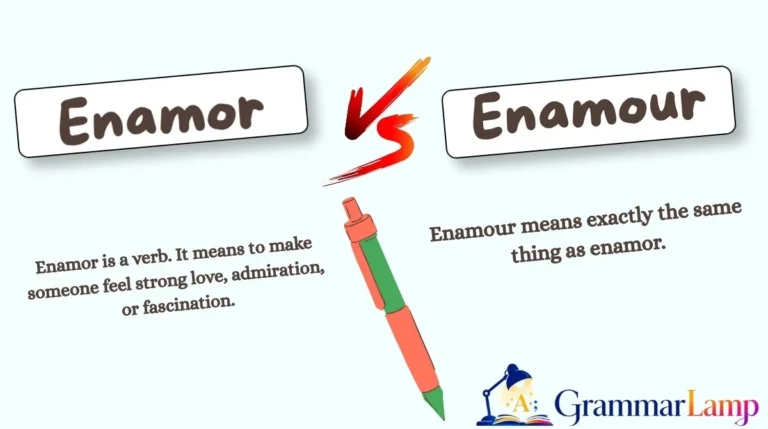
Enamor and enamour have the same meaning. The main difference is spelling: enamor is the usual American English spelling, while enamour is chiefly used in British English. Merriam-Webster also lists enamour as the chiefly British spelling of enamor.
This can be confusing for English learners because English has many spelling differences between American and British English.
Think about color/colour, favorite/favourite, and honor/honour. The same kind of difference appears here.
The word itself means to make someone feel strong love, admiration, interest, or fascination.
In everyday English, however, you will often see it in the form enamored or enamoured, meaning strongly attracted to or fascinated by someone or something.
Merriam-Webster defines enamored as being affected by strong feelings of love, admiration, or fascination.
Once you understand the spelling difference, the grammar becomes quite easy. You will also learn which form to choose in American or British writing, how to use enamored/enamoured with and enamored/enamoured of, and which common mistakes to avoid.
A or an: Easy Rules, Examples, and Common Mistakes in 2026
From My End or From My Side? Which Is Correct in English? (2026 Guide)
Honor or Honour: What Is the Difference? A Simple Guide for 2026
Collaborate vs Corroborate: Meaning, Difference, and Examples in 2026
What Does “Enamor” Mean?
Enamor is a verb. It means to make someone feel strong love, admiration, or fascination.
For example:
The beautiful city enamored her.
This means that the beautiful city made her feel strongly attracted to it.
Merriam-Webster defines enamor as a verb meaning “to inflame with love” and also “to cause to feel a strong or excessive interest or fascination.” It is commonly used in the passive form.
When should you use “enamor”?
Enamor is mainly used in American English. It is especially common in formal writing, books, journalism, and descriptive English.
The basic verb pattern is:
Subject + enamor + object
For example:
The music enamored the audience.
Here, the music is the subject, and the audience is the object.
However, native speakers often prefer the passive form:
Subject + be + enamored + of/with + noun
For example:
She was enamored with the little village.
This means she became very interested in or attracted to the village.
Examples of “enamor”
- The young artist was enamored with the beauty of the mountains.
- The new teacher quickly enamored her students with his friendly personality.
- He became enamored of the old house and decided to buy it.
- The children were enamored with the colorful toys.
- She was completely enamored with the city after her first visit.
- The movie enamored audiences around the world.
- I became enamored of classical music when I was a teenager.
- The charming little café quickly enamored tourists.
Notice something important: the meaning is not limited to romantic love. You can be enamored with a person, place, idea, hobby, book, food, or experience.
So:
I am enamored with her.
can suggest strong romantic affection or admiration.
But:
I am enamored with this new camera.
does not mean you are romantically in love with the camera. It means you are extremely pleased with or fascinated by it.
A common learner confusion
Many learners think enamor must always describe romantic love because it is connected with the idea of love.
That is not true.
The word can describe strong admiration or fascination as well as love. Merriam-Webster specifically includes strong interest and fascination in its definition.
So both are possible:
He is enamored with his girlfriend.
and:
He is enamored with his new car.
The first may express romantic affection. The second expresses strong enthusiasm or fascination.
What Does “Enamour” Mean?
Enamour means exactly the same thing as enamor.
The only major difference is the spelling.
Enamour is chiefly the British English spelling, while enamor is the usual American English spelling.
So a British writer might write:
She was enamoured with the beautiful countryside.
An American writer would normally write:
She was enamored with the beautiful countryside.
The meaning does not change.
When should you use “enamour”?
Use enamour when you are following British English spelling conventions.
You may see it in writing from the United Kingdom and in other varieties of English that commonly follow British spelling.
The word is often seen in its adjective-like past participle form:
- enamoured
- enamoured of
- enamoured with
Oxford Learner’s Dictionaries lists enamoured as an adjective and gives the American form as enamored. It also notes that the word can mean liking something a lot or, in a literary sense, being in love with somebody.
Examples of “enamour”
- She was enamoured with the peaceful village.
- He became enamoured of the old university.
- The visitors were enamoured with the local food.
- I am not particularly enamoured with the idea.
- The young prince was enamoured of the beautiful princess.
- They quickly became enamoured with the coastal town.
- She has always been enamoured of classical literature.
- The children were completely enamoured with the new playground.
The important point is that enamour is not a different meaning or a different grammar rule. It is simply the British spelling of the same verb.
A common learner confusion
A student may see enamour in a British book and enamor on an American website and assume that one is wrong.
Neither is wrong.
Compare:
- American English: enamor, enamored
- British English: enamour, enamoured
This is similar to:
- color / colour
- favor / favour
- honor / honour
The spelling changes, but the meaning remains the same.
Difference Between Enamor and Enamour
The easiest answer is this:
Enamor and enamour have the same meaning. The difference is mainly regional spelling.
Comparison table
| Feature | Enamor | Enamour |
|---|---|---|
| Meaning | To make someone feel love, admiration, or fascination | Same |
| Main variety | American English | British English |
| Verb | Yes | Yes |
| Past participle | enamored | enamoured |
| Common phrase | enamored with/of | enamoured with/of |
| Pronunciation | Essentially the same | Essentially the same |
| Meaning difference | None | None |
| Best choice | US English writing | UK English writing |
Merriam-Webster identifies enamour as the chiefly British spelling of enamor.
Usage difference
The biggest difference is where the spelling is normally used.
If you are writing for an American audience, choose:
enamor
If you are writing for a British audience, choose:
enamour
For example:
American English:
The tourists were enamored with the beautiful beaches.
British English:
The tourists were enamoured with the beautiful beaches.
Both sentences mean exactly the same thing.
Grammar logic
Both forms are verbs.
The verb can be used actively:
The beautiful scenery enamored the visitors.
Or in the passive form:
The visitors were enamored with the scenery.
The second pattern is much more useful for learners because enamored/enamoured is commonly used to describe a person’s feelings.
The Oxford Learner’s Dictionary examples also show enamoured of and enamoured with.
Sentence structure
A useful structure to remember is:
Someone + is/was + enamored/enamoured + with/of + something/someone
Examples:
Maria was enamored with the new restaurant.
Maria was enamoured with the new restaurant.
Or:
Daniel was enamored of the old painting.
Daniel was enamoured of the old painting.
The structure is the same. Only the spelling changes.
Meaning comparison
There is no meaningful difference between:
She is enamored with Paris.
and:
She is enamoured with Paris.
Both mean that she has developed a strong liking, attraction, or fascination with Paris.
Seam vs Seem: Difference, Meaning, Examples & Grammar Rules (2026)
All the Time vs Every Time: Meaning, Difference, Rules & Examples (2026)
Afterward or Afterwards? Meaning, Difference, and Correct Usage in 2026
A MA or an MA Degree? The Correct Grammar Rule in 2026
Grammar Rules You Must Remember
Rule 1: Enamor and enamour are spelling variants
Do not treat them as two separate words with different meanings.
American English:
He is enamored with the idea.
British English:
He is enamoured with the idea.
The meaning is unchanged.
Rule 2: Use “enamored/enamoured with” or “of”
The most useful form for learners is:
be + enamored/enamoured + with/of
For example:
She is enamored with the new design.
She is enamoured with the new design.
You can also use of:
He was enamored of the actress.
Both with and of are established patterns. Merriam-Webster notes both enamored of and enamored with as common constructions.
Rule 3: The word can describe more than romantic love
Do not use it only for romantic relationships.
For example:
She is enamored with her husband.
This can describe love or strong affection.
But:
She is enamored with photography.
This means she is fascinated by or very enthusiastic about photography.
The meaning depends on the context.
Rule 4: Keep your spelling style consistent
If you are writing an essay in American English, use enamor/enamored.
If you are following British English, use enamour/enamoured.
Do not unnecessarily switch between the two forms in the same piece of writing.
For example, an American-style essay should preferably use:
He was enamored with the city.
rather than switching later to:
She was enamoured with the countryside.
The second spelling is not incorrect, but consistency makes your writing cleaner.
Common Mistakes Students Make
Mistake 1: Thinking “enamour” is incorrect
Some learners see the extra u and assume it is a spelling mistake.
It is not.
Enamour is a valid British spelling.
Incorrect idea:
“Enamour is wrong. It should always be enamor.”
Better understanding:
“Enamor is common in American English, while enamour is chiefly British.”
Mistake 2: Thinking the words have different meanings
They do not have different core meanings.
Compare:
She was enamored with the city.
She was enamoured with the city.
The sentences mean the same thing.
The difference is spelling, not meaning.
Mistake 3: Using “enamor” when you mean “enamored”
This happens because learners know enamor is a verb but are unsure how to build the sentence.
For example:
She is enamor with the book. ❌
A natural correction is:
She is enamored with the book. ✅
In British English:
She is enamoured with the book. ✅
Remember that is/was + past participle requires enamored/enamoured here.
Mistake 4: Forgetting the preposition
A learner may write:
I am enamored this song. ❌
A better sentence is:
I am enamored with this song. ✅
You can also say:
I am enamored of this song. ✅
For everyday learner English, enamored with is an easy pattern to remember.
Mistake 5: Thinking it always means romantic love
Consider:
The students were enamored with the new science experiment.
Nobody is necessarily in love with the experiment.
It means the students found it very interesting or exciting.
So remember:
enamor/enamour = strong attraction, love, admiration, or fascination.
Easy Trick to Remember the Difference
Here is a simple memory trick:
American = ENAMOR
British = ENAMOUR
Think of other spelling pairs:
color → colour
honor → honour
favor → favour
Now add:
enamor → enamour
The British form keeps the u.
You can also remember it this way:
If your English uses “colour,” it will probably use “enamour.”
And:
If your English uses “color,” it will probably use “enamor.”
This is not a grammar difference. It is a spelling convention.
One more useful point: the word is related historically to the idea of love. Merriam-Webster traces enamor to Middle English enamouren, from Anglo-French enamourer, connected with amour, meaning love.
So the basic idea of the word makes sense: someone or something causes strong feelings of love or attraction.
Daily Life Examples
Here are some natural examples you may actually see or hear.
1. Talking about a place
A: Did you enjoy your trip to London?
B: Yes! I was completely enamored with the city.
British spelling:
I was completely enamoured with the city.
2. Talking about food
I became enamored with Korean food after my first visit to Seoul.
Here, enamored means very interested in and fond of the food.
3. Talking about a hobby
She is enamored with photography these days.
She has developed a strong interest in photography.
4. Talking about a person
He was enamored with her from the moment they met.
Here, the meaning can be romantic.
5. Talking about an idea
The manager was not enamored with the proposal.
This means the manager did not particularly like or support the proposal.
Notice that the negative form is completely natural.
6. Talking about a movie
I was enamored with the movie’s beautiful photography.
This means the speaker was deeply impressed by it.
7. Talking about a new phone
My brother is completely enamored with his new phone.
This means he is very excited about and fascinated by it.
8. Talking about a city
The visitors quickly became enamoured of the quiet coastal town.
This British spelling means the visitors developed a strong liking for the town.
9. Talking about music
She has always been enamored with classical music.
This means she has always had a strong interest in it.
10. Talking about an experience
The children were enamored with the magic show.
They found it exciting and fascinating.
Practice Section
Choose the correct option in each sentence.
1. She was ______ with the beautiful garden.
a) enamor
b) enamored
c) enamour
2. In British English, which spelling is preferred?
a) enamor
b) enamour
3. He became ______ with the new technology.
a) enamored
b) enamor
4. Which sentence is correct?
a) I am enamored with this book.
b) I am enamor with this book.
5. Complete the sentence in British English:
They were ______ with the countryside.
a) enamored
b) enamoured
Answers
1. b) enamored
The sentence needs the past participle after was.
2. b) enamour
Enamour is chiefly the British spelling.
3. a) enamored
The natural structure is became enamored with.
4. a) I am enamored with this book.
The common pattern is be + enamored + with/of.
5. b) enamoured
British English normally uses the spelling with -our.
All Is vs All Are: Which One Is Correct? Complete Grammar Guide for 2026
At the Weekend or On the Weekend? 2026 Guide to British and American English
To Discuss or Discuss About: Which Is Correct? | Easy Grammar Guide 2026
Upmost vs Utmost: Meaning, Difference, and Correct Usage in 2026
FAQs
1. What is the difference between enamor and enamour?
There is no major difference in meaning. Enamor is the usual American English spelling, while enamour is chiefly the British English spelling. Both mean to cause someone to feel strong love, admiration, interest, or fascination.
2. Is “enamour” a correct English word?
Yes. Enamour is a correct English word and is especially associated with British English. It is not a misspelling of enamor. British dictionaries use the form enamoured, while American English normally uses enamored.
3. Is enamor American or British English?
Enamor is mainly the American English spelling. British English normally uses enamour. If you are writing for an American audience, enamor and enamored are the safer choices.
4. Can we use enamored in questions?
Yes. You can use enamored in questions naturally.
For example:
Are you enamored with the new design?
You can also ask:
Was she enamored with him?
The word works in questions just like other adjectives or past participles.
5. Is “enamored” formal or informal?
Enamored is more common in formal, literary, descriptive, and written English than in very casual conversation. Oxford marks enamoured as formal in the sense of liking something a lot.
In casual speech, people may simply say love, really like, be obsessed about, or be fascinated by.
6. Should I use “enamored of” or “enamored with”?
Both are correct. Enamored with is very common, while enamored of is also well established. Merriam-Webster specifically records both patterns.
For simple everyday English, enamored with is an easy pattern to learn:
She is enamored with the city.
Final Conclusion
The difference between enamor and enamour is much easier than it may seem. They have the same basic meaning and the same grammar. The main difference is spelling.
Enamor is the usual American English form, while enamour is chiefly the British English form. The same difference appears in enamored/enamoured.
Both forms can describe strong love, admiration, interest, or fascination. They are not limited to romantic relationships. You can be enamored with a person, a place, a hobby, an idea, a book, or even a new piece of technology.
For most learners, the easiest sentence pattern to remember is:
Someone is enamored/enamoured with something or someone.
If you write American English, choose enamor/enamored. If you write British English, choose enamour/enamoured.
Most importantly, do not worry when you see the other spelling. It is not a different word with a different meaning—it is simply another English spelling convention.

Liam Derren is a language writer at GrammarLamp, creating simple, helpful content about grammar, words, and everyday English. He makes language learning clear, practical, and easy to understand.
5 thoughts on “Enamor vs Enamour: What’s the Difference? Meaning, Usage & Examples in 2026”