
“From my end” and “from my side” are two short English phrases that often confuse learners. You may hear both in office meetings, emails, WhatsApp messages, customer service conversations, and everyday discussions.
For example, someone might say:
“Everything is ready from my end.”
Another person might say:
“Everything is ready from my side.”
At first, these sentences seem exactly the same. And in many situations, they are very close in meaning. Both can tell someone that something is okay, completed, or handled on your part.
The confusion starts because end and side have several meanings in English. Also, the way these phrases are used can depend on the situation, the speaker, and the level of formality.
https://en.wikipedia.org/wiki/Speaker_of_the_National_Assembly_of_PakistanModern English speakers sometimes use them interchangeably, especially in workplace communication.
However, there are useful differences in emphasis that can help you choose the better expression.
The good news is that you do not need to memorize complicated grammar rules. Once you understand the basic idea behind “my end” and “my side,” the choice becomes much easier.
What Does “From My End” Mean?
Simple definition
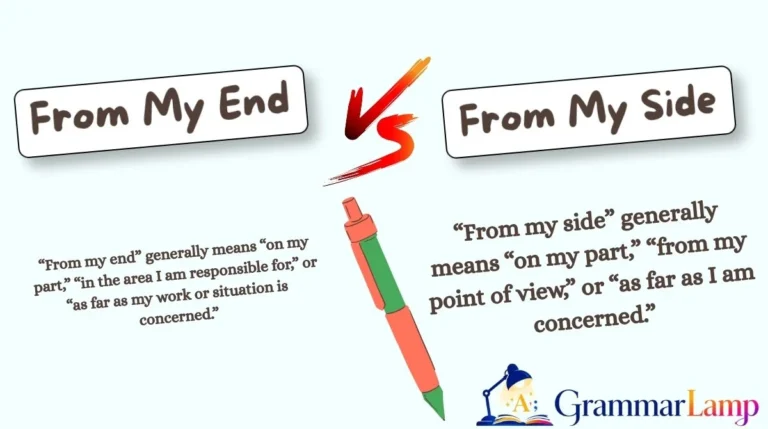
“From my end” generally means “on my part,” “in the area I am responsible for,” or “as far as my work or situation is concerned.”
It is especially common when people are talking about:
- Work that has been completed
- A task or responsibility
- A project
- A technical problem
- A process
- A business update
- Something happening within a person’s area of responsibility
Think of my end as my part of the process.
For example:
“The report is complete from my end.”
This means:
“I have completed the part of the report that I am responsible for.”
The phrase does not necessarily mean that the entire project is finished. It may simply mean that your part is finished.
This is why “from my end” appears frequently in team communication. When several people are working on one project, each person may have a different responsibility.
When should you use “from my end”?
Use it when you want to give an update about your work, responsibility, system, process, or part of a task.
It is particularly common in professional and technical communication. For example, an employee might tell a manager:
“There are no pending tasks from my end.”
The speaker is not necessarily giving an opinion. They are reporting the status of their own responsibilities.
Grammar rule
The basic structure is:
From my end + comma + main clause
For example:
“From my end, everything is ready.”
It can also appear at the end:
“Everything is ready from my end.”
The phrase is a prepositional phrase beginning with the preposition from. It gives information about the source, position, or area being considered.
Examples of “from my end”
- From my end, the report is ready.
- There are no problems from my end.
- Everything has been completed from my end.
- The payment has been sent from my end.
- The system is working normally from my end.
- I have finished all the assigned tasks from my end.
- There is nothing pending from my end.
- From my end, we can start the project tomorrow.
Notice that most of these examples involve status, work, responsibility, or a process.
A common learner confusion
Some learners believe that “from my end” means only “from my physical location.” That is not usually the intended meaning in workplace English.
For example:
“The file is ready from my end.”
The speaker is not saying the file is physically located at one end of a room. They mean that their part of the work has been handled.
Another important point is that “from my end” does not always mean “I personally did everything.”
Consider:
“The issue has been fixed from my end.”
Depending on the context, this could mean that the speaker’s part of the problem has been dealt with. It does not necessarily describe exactly who performed every action.
What Does “From My Side” Mean?
Simple definition
“From my side” generally means “on my part,” “from my point of view,” or “as far as I am concerned.”
It can be used for work and responsibility, but it can also be used when talking about:
- Opinions
- Feelings
- Agreement
- Support
- Personal position
- Cooperation
- A person’s involvement in a situation
This makes “from my side” a little broader in some contexts.
For example:
“From my side, I have no objection.”
This is mainly about the speaker’s position or opinion.
Another example:
“There is no problem from my side.”
This could mean:
“I have no problem with it.”
The exact meaning comes from the context.
When should you use “from my side”?
Use it when you want to show your position, involvement, agreement, support, or personal perspective.
It can also be used for work updates:
“Everything is complete from my side.”
Here, it is very close to:
“Everything is complete from my end.”
This is one reason learners get confused. The two expressions overlap a lot.
Grammar rule
The common structure is:
From my side + comma + main clause
For example:
“From my side, the plan is fine.”
It can also come after the main clause:
“The plan is fine from my side.”
Again, from is a preposition, and my side is the noun phrase following it.
Examples of “from my side”
- From my side, everything is fine.
- There is no problem from my side.
- From my side, I agree with the plan.
- You have my full support from my side.
- Everything is ready from my side.
- From my side, we can continue the discussion.
- I have no objection from my side.
- There is nothing else to add from my side.
Some of these sentences sound more natural in certain varieties of English than others. In particular, phrases such as “from my side” are widely heard in international English and workplace communication, while many native speakers may prefer simpler alternatives such as “for me,” “on my end,” “as far as I’m concerned,” or “from my perspective.”
Common learner confusion
A frequent mistake is thinking that “from my side” always means “from my opinion.”
That is not true.
For example:
“I have completed the work from my side.”
Here, the speaker is talking about responsibility or work, not an opinion.
So context matters.
Difference Between “From My End” and “From My Side”
Both expressions can be correct. In many workplace situations, they can even be exchanged without changing the basic message. Usage evidence shows that both are commonly used to indicate a person’s part or standpoint.
However, there is a useful difference in emphasis.
| Point | From my end | From my side |
|---|---|---|
| Main idea | My part of a process | My part, position, or perspective |
| Often used for | Tasks and work | Opinions, agreement, involvement, and work |
| Common setting | Office, projects, technical work | Meetings, discussions, everyday workplace talk |
| Focus | Responsibility or status | Position or personal involvement |
| Example | “The report is ready from my end.” | “I agree from my side.” |
| Natural alternative | “On my end” / “I’ve finished it.” | “For me” / “As far as I’m concerned.” |
1. Usage difference
If you are talking about a task, “from my end” often gives a clear sense of responsibility.
“The documents have been submitted from my end.”
The meaning is roughly:
“I have handled my part of the submission.”
“From my side” can also work:
“The documents have been submitted from my side.”
But it can sound slightly more like a statement about your involvement.
2. Grammar logic
Neither phrase is a special tense or complicated grammar structure.
They are prepositional phrases:
- from + my + end
- from + my + side
The possessive adjective my modifies the noun end or side.
The grammar is therefore simple. The real question is meaning and natural usage, not whether one phrase follows a completely different grammar rule.
3. Sentence structure
Both phrases can appear at the beginning or end of a sentence.
Beginning:
“From my end, the work is complete.”
“From my side, the work is complete.”
End:
“The work is complete from my end.”
“The work is complete from my side.”
The first position is useful when you want to make your viewpoint clear before giving the main information.
4. Meaning comparison
A useful way to remember the difference is:
From my end = my part of the process
From my side = my position or my part
The difference is not absolute. Real speakers often use these expressions more flexibly.
For example:
“Everything looks fine from my end.”
Here, “from my end” means the situation appears fine where I am or within my area of responsibility.
“Everything looks fine from my side.”
Here, the meaning is almost identical.
So do not worry if you see both expressions used in similar sentences. English has many expressions that overlap in meaning.
Grammar Rules You Must Remember
Rule 1: Both phrases can be grammatically correct
Do not assume that one is automatically wrong.
Correct: Everything is ready from my end.
Correct: Everything is ready from my side.
The exact choice depends on context, style, and regional usage.
Rule 2: Use “from my end” naturally for tasks and processes
When you are reporting your progress, “from my end” is often a good choice.
“From my end, all the files have been checked.”
It tells the listener that your part of the process is handled.
In many business and technical settings, this usage is especially common.
Rule 3: “From my side” can express a viewpoint
When you are giving your personal position, “from my side” can work.
“From my side, I have no objection.”
However, in everyday native English, a simpler sentence may sound more natural:
“I have no objection.”
Or:
“I’m fine with it.”
This is an important lesson for English learners: grammatically possible does not always mean the most natural choice.
Rule 4: Use simpler English when it sounds better
You do not need to use either phrase in every situation.
Instead of:
“Everything is completed from my end.”
You can simply say:
“I’ve completed everything.”
Instead of:
“There is no problem from my side.”
You can say:
“I have no problem with it.”
Clear English is often better than complicated English.
Common Mistakes Students Make
Mistake 1: Thinking “from my end” is always better
Some learners see “from my end” in office emails and start using it everywhere.
That can make their English sound repetitive.
For example:
“From my end, I went to the shop.”
This sounds unnatural because there is no clear process or responsibility being discussed.
Better:
“I went to the shop.”
Mistake 2: Thinking “from my side” is always about opinions
As explained earlier, this is not true.
“The work is complete from my side.”
This is understandable and can be used to describe someone’s part of a task.
If you want to make the sentence clearer, though, you can say:
“I’ve completed my part of the work.”
That removes all uncertainty.
Mistake 3: Using the phrases too often
Imagine an employee saying:
“From my end, I checked the email. From my end, I called the customer. From my end, I updated the file. From my end, I sent the report.”
The grammar is not the main problem. The repetition makes the communication sound mechanical.
A better version would be:
“I checked the email, called the customer, updated the file, and sent the report.”
Use these expressions when they add useful meaning, not simply because they sound professional.
Mistake 4: Using “from my side” to end every meeting
You may hear:
“That’s all from my side.”
This is understandable, especially in international workplace English. But it is not the most natural closing phrase for every situation.
In a casual meeting, you could say:
“That’s all from me.”
Or:
“That’s all I have.”
In a formal presentation:
“That concludes my presentation.”
The best phrase depends on the situation.
Easy Trick to Remember the Difference
Here is a simple classroom trick:
Think of “end” as a process.
Imagine a long road.
Your team is traveling along that road. You are responsible for one section.
Your section is your end.
So:
From my end = What is happening in my part of the process?
Examples:
- The report is ready.
- The payment was sent.
- The system works.
- My tasks are complete.
Now think of side as a person’s position.
Imagine two people discussing a decision. One person stands on one side, and another person stands on the other side.
So:
From my side = What is my position or involvement?
Examples:
- I agree.
- I have no objection.
- I support the idea.
- I am comfortable with the plan.
But remember: the two expressions overlap. This is a memory trick, not an unbreakable grammar law.
Daily Life Examples
Here are some natural situations where you may hear these phrases.
1. At work
A: “Have you finished the report?”
B: “Yes. Everything is complete from my end.”
Meaning: B has completed their part.
2. During a technical problem
A: “Can you access the website?”
B: “Yes, it’s working fine from my end.”
Meaning: The website works normally on B’s side/system.
3. During a team project
A: “Is there anything left for you to do?”
B: “No, there’s nothing pending from my end.”
Meaning: B has no remaining responsibility.
4. During a discussion
A: “Are you okay with the new plan?”
B: “Yes, there’s no problem from my side.”
Meaning: B has no objection.
5. In an email
“From my end, the requested documents have been submitted.”
This is a workplace-style status update.
6. In a meeting
“From my side, I think we should wait until Friday.”
Here, the speaker is giving a personal position.
A more natural alternative in many situations would be:
“I think we should wait until Friday.”
7. Talking about payment
“The payment has been made from my end.”
This means the speaker has handled the payment.
A simpler alternative:
“I’ve made the payment.”
8. Talking about cooperation
“From my side, I’m happy to help.”
This means the speaker is willing to help.
A more natural everyday version is:
“I’m happy to help.”
9. Ending a team update
“That’s all from my side.”
This can be understood as “I have nothing more to add.” It is common in some international workplace settings, although many native speakers would simply say “That’s all from me” or “That’s all I have.”
10. Checking a computer problem
“I’ve restarted the computer, but the problem is still there from my end.”
This tells the other person what is happening on the speaker’s side of the technical setup.
Practice Section
Choose from my end or from my side.
1.
“Everything is complete ______.”
2.
“I have no objection ______.”
3.
“The software is working correctly ______.”
4.
“______ , I think this is the best option.”
5.
“There are no pending tasks ______.”
Answers
1. From my end / From my side — Both can work.
2. From my side — This focuses on the speaker’s position or opinion.
3. From my end — This is a technical/status situation.
4. From my side — It introduces the speaker’s personal position. However, “In my opinion” or simply “I think” would often sound more natural.
5. From my end — This focuses on responsibility and unfinished work.
Remember that some answers can have more than one possible choice. Context is important.
FAQs
1. What is the difference between “from my end” and “from my side”?
Both can mean “on my part” or “as far as I am concerned.” “From my end” often emphasizes work, responsibility, processes, or status. “From my side” can also do this but may emphasize a person’s position, involvement, or viewpoint.
2. Is “from my end” grammatically correct?
Yes. “From my end” is grammatically acceptable and widely used, especially in workplace and technical communication. For example: “There are no issues from my end.” However, simpler wording such as “I don’t see any issues” may sound more natural in casual conversation.
3. Is “from my side” grammatically correct?
Yes, “from my side” is also understandable and used in English. Its naturalness can vary by region and context. In some situations, native speakers may prefer “from my perspective,” “for me,” “on my end,” or simply “I agree.”
4. Which is more professional: “from my end” or “from my side”?
Neither is automatically more professional. “From my end” is particularly common for project updates, tasks, technical issues, and responsibilities. “From my side” can work well in discussions about agreement or personal involvement. For formal writing, direct sentences are often best.
5. Can I use “from my end” in questions?
Yes, but it is not usually necessary. For example, you could ask, “Is everything okay from my end?” However, the meaning may be unclear depending on the situation. More natural alternatives are often “Is everything okay on my end?” or “Have I done everything I need to do?”
6. Can I say “That’s all from my side”?
Yes, people will understand it, especially in workplace meetings. However, it may sound like international business English rather than the most natural everyday English for some native speakers. “That’s all from me” or “That’s all I have” is often simpler and more natural.
Conclusion
So, from my end or from my side? The answer is that both expressions can be correct, and they often have almost the same meaning.
The easiest way to remember the difference is to think about emphasis. “From my end” commonly points to your part of a task, process, project, system, or responsibility.
“From my side” can also describe your part, but it is often used when talking about your position, agreement, support, or involvement.
Still, these are not strict rules. English speakers use the two phrases in overlapping ways, and regional and workplace habits can affect which one sounds more natural.
Most importantly, do not feel that you must use either phrase to sound professional. Very often, simple English is stronger:
“I’ve finished my part.”
“I agree.”
“Everything is ready.”
“I have no problem with it.”
These sentences are clear, natural, and easy to understand.
Practice the expressions in real situations, listen to how different English speakers use them, and pay attention to context.
With a little practice, choosing between “from my end” and “from my side” will become much easier.

Liam Derren is a language writer at GrammarLamp, creating simple, helpful content about grammar, words, and everyday English. He makes language learning clear, practical, and easy to understand.
1 thought on “From My End or From My Side? Which Is Correct in English? (2026 Guide)”