
English spelling can be confusing, especially when a word sounds different from the way it looks. Sometimes, you hear a word in a conversation, understand its meaning, and try to write it down.
However, when you check the spelling, you discover that the letters do not match the sound you expected. This is exactly what happens when people confuse minoot vs minute.
You may have heard someone use the word minute to describe something extremely small. Its pronunciation can sound like “my-noot,” which may lead you to think that minoot is the correct spelling.
This is an understandable mistake, particularly for English learners who are still getting used to the unusual patterns of English spelling.
The good news is that the spelling rule is simple. Minute is the correct spelling in standard English, while minoot is a nonstandard spelling that people sometimes use when writing the word according to its sound.
However, there is another interesting point: the word minute has two different meanings and two different pronunciations.
One meaning refers to a unit of time equal to 60 seconds. The other describes something extremely small or a detail that requires close attention. Although the meanings and pronunciations differ, the spelling remains the same.
Understanding this difference will help you improve your spelling, pronunciation, vocabulary, and everyday communication.
You will also learn how to use minute correctly in conversations, schoolwork, emails, and professional writing without worrying about which spelling to choose.
More Useful posts
Accept vs Except: Meaning, Difference, Rules, and Examples (2026)
Manor vs Manner vs Manir: Meaning, Difference & Correct Usage in 2026
Desert vs Dessert: Meaning, Difference, Examples & Easy Trick (2026)
Unsecure vs Insecure (2026): What Is the Difference and Which Word Is Correct?
What Does “Minoot” Mean?
Definition of Minoot
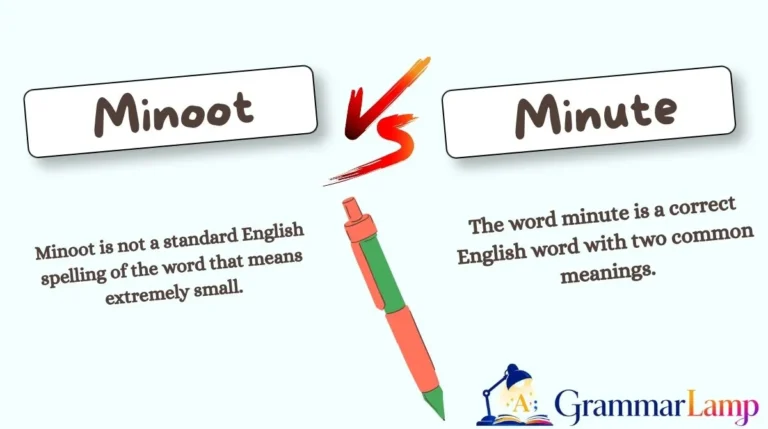
Minoot is not a standard English spelling of the word that means extremely small. It is usually a phonetic misspelling of minute, particularly when minute is pronounced with the meaning of “tiny” or “extremely small.”
A phonetic spelling is an attempt to write a word the way it sounds. This can feel natural when you are learning English because hearing a word is often easier than remembering its traditional spelling.
For example, when someone says, “There was a minute difference between the two results,” the word minute may sound like “my-noot.” A learner might naturally write minoot because that spelling seems to match the sound.
However, English spelling does not always follow pronunciation exactly. The accepted spelling is still minute, even when the word sounds different from the spelling most learners know.
When Do People Use Minoot?
People may write minoot when they have heard the adjective minute but are not familiar with its correct written form. They may also use it accidentally in text messages, online searches, school assignments, or informal notes.
It is important to understand that recognizing this mistake does not mean the spelling is acceptable in standard English. In formal writing, educational content, and professional communication, use minute.
Grammar Rule for Minoot
There is no standard grammar rule that allows minoot to replace minute when describing something small. Instead, remember this spelling rule:
Write minute, not minoot, when you mean extremely small, tiny, or very detailed.
The following sentences show common mistakes and their corrections.
- Incorrect: The scientist found a minoot particle.
Correct: The scientist found a minute particle. - Incorrect: There was a minoot difference between the answers.
Correct: There was a minute difference between the answers. - Incorrect: The artist added minoot details to the painting.
Correct: The artist added minute details to the painting. - Incorrect: We noticed a minoot crack in the glass.
Correct: We noticed a minute crack in the glass. - Incorrect: The machine requires minoot adjustments.
Correct: The machine requires minute adjustments. - Incorrect: The report described every minoot change.
Correct: The report described every minute change.
These corrections show that you do not need a new spelling to represent the smallness meaning. You simply need to learn the correct spelling of the word.
Why Do English Learners Confuse Minoot and Minute?
The main reason is pronunciation. Learners often expect English words to sound the way their letters suggest. When they hear an unfamiliar pronunciation, they may try to spell the word based on the sound alone.
Another reason is that the time-related meaning of minute is more familiar to many students. They learn phrases such as “wait a minute” or “give me five minutes” long before they encounter sentences about minute particles, minute changes, or minute details.
As a result, the unusual pronunciation can make the word appear to have a different spelling. Once you understand that one spelling can have more than one pronunciation, the confusion becomes much easier to solve.
What Does “Minute” Mean?
The word minute is a correct English word with two common meanings. It can refer to a unit of time or describe something extremely small. The meaning depends on the sentence, and each meaning has its own pronunciation.
1. Minute as a Unit of Time
When minute refers to time, it is a noun. One minute equals 60 seconds, or one-sixtieth of an hour.
This is the meaning you use when talking about appointments, travel, waiting, cooking, sports, work, or daily plans. The word is pronounced MIN-it, with the stress on the first syllable.
For example, if a friend asks how long you need to get ready, you might say, “Give me a minute.” You are asking for a short amount of time, not describing something tiny.
Here are eight examples:
- Please wait a minute while I check your order.
- The bus will arrive in five minutes.
- I need one minute to finish this message.
- She spoke to her teacher for ten minutes.
- We have only a minute left before the meeting starts.
- My brother can solve this problem in a minute.
- The train stopped for a minute and then continued its journey.
- I will call you in a few minutes.
In these examples, minute refers to time. It may also be used in expressions such as “at any minute,” meaning very soon, or “the minute I arrive,” meaning as soon as I arrive.
2. Minute as an Adjective Meaning Extremely Small
The second meaning of minute describes something very small, tiny, or difficult to notice. In this use, the word is an adjective.
It is pronounced differently from the time-related noun. In British English, it is commonly pronounced /maɪˈnjuːt/, while in American English it is commonly pronounced /maɪˈnuːt/. The main stress falls on the second syllable.
For example, consider this sentence:
“The scientist examined the minute particles under a microscope.”
Here, minute means extremely small. The scientist is not measuring a period of time. The sentence describes the size of the particles.
This use is often found in science, research, formal writing, and detailed descriptions. You may also see it used with nouns such as difference, detail, amount, change, and adjustment.
Here are eight examples:
- The detective noticed a minute scratch on the door.
- The two phones have a minute difference in size.
- The scientist measured a minute amount of liquid.
- She examined the painting for its minute details.
- A minute crack appeared in the glass.
- The machine needs a minute adjustment to work properly.
- The researcher recorded minute changes in temperature.
- The artist painted minute patterns on the small vase.
In these examples, minute describes size, amount, or detail. The spelling does not change simply because the pronunciation is different.
Common Confusion About Minute
Some learners assume that the time-related noun and the adjective must have different spellings because they sound different. This is not the case.
English has words that share the same spelling but have different pronunciations and meanings. Such words are often called heteronyms.
The word minute is one example. The sentence around it usually makes its meaning clear. For instance, “Wait a minute” refers to time, while “a minute detail” describes something extremely small or fine.
Difference Between Minoot and Minute (Detailed)
The main difference between minoot and minute is spelling accuracy. Minoot is generally a nonstandard attempt to spell the adjective minute according to how it sounds. Minute is the correct standard spelling for both the time-related meaning and the smallness-related meaning.
The two forms are not equal alternatives. If you want to write correct English, use minute.
Comparison Table
| Feature | Minoot | Minute |
|---|---|---|
| Standard spelling | No | Yes |
| Standard dictionary form for these meanings | No | Yes |
| Meaning of 60 seconds | Not standard | Yes |
| Meaning extremely small | Not standard | Yes |
| Used in formal writing | Incorrect for these meanings | Correct |
| Pronunciation-based spelling attempt | Often | No |
| Correct for school assignments | No | Yes |
| Correct for professional emails | No | Yes |
1. Usage Difference
The most important difference is how the words are used in writing. Minoot may appear when someone tries to represent a sound, but it should not be used as the normal spelling of the English word.
Use minute whenever you refer to 60 seconds:
- I will be ready in a minute.
- The meeting lasted thirty minutes.
- Please wait one more minute.
Use minute when describing something extremely small:
- We found a minute hole in the fabric.
- The report included minute details.
- There was a minute change in the results.
Both meanings are correct, even though the spoken forms differ.
2. Grammar Logic
The word minute can function as a noun or an adjective.
As a noun, it names a unit of time. It commonly appears after numbers, quantity words, and prepositions.
Examples include “one minute,” “ten minutes,” “in a minute,” and “for a minute.”
As an adjective, it describes a noun by telling the reader that something is extremely small or detailed. It usually appears before the noun it describes.
Examples include “a minute detail,” “minute particles,” and “a minute difference.”
The grammar role helps you understand which meaning is intended. However, neither role allows you to replace the spelling with minoot.
3. Sentence Structure Difference
The structure of a sentence can help you identify the meaning of minute.
When minute refers to time:
Subject + verb + time expression
- The class lasted ten minutes.
- I will return in a minute.
- We waited for five minutes.
In these examples, minute or minutes functions as a noun.
When minute describes something small:
Subject + verb + adjective + noun
- She noticed a minute crack.
- The researcher measured minute quantities.
- They recorded minute differences.
In these examples, minute is an adjective that describes the noun following it.
4. Meaning Comparison
The time-related meaning focuses on how long something takes. The adjective meaning focuses on how small something is or how fine its details are.
Compare these two sentences:
“I waited a minute.”
“The artist added a minute detail.”
In the first sentence, minute tells us how long the person waited. In the second, it describes the size or fineness of a detail in the artwork.
The surrounding words provide the clue. If you see a number or a phrase about waiting or duration, the time meaning is likely. If the word describes a physical object, difference, amount, or detail, the adjective meaning is likely.
Explore More Posts
Addicting vs Addictive: What’s the Difference? Easy Grammar Guide for 2026
Bored vs Board: Meaning, Difference, Examples & Grammar Rules in 2026
Simpler vs More Simple: Which One Is Correct? (2026)
Sprang vs Sprung: What’s the Difference? Easy Grammar Guide 2026
Grammar Rules You Must Remember
Learning four simple rules can help you spell and use this word correctly in everyday English.
Rule 1: Always Spell the Word “Minute”
When you mean 60 seconds or something extremely small, write minute. Do not change the spelling to match the way the adjective sounds.
Incorrect: Please give me one minoot.
Correct: Please give me one minute.
The same rule applies to formal writing, casual messages, essays, reports, and emails. The level of formality does not make minoot a correct spelling.
Rule 2: Use Minute as a Noun for Time
When the word refers to time, it is a countable noun. Use a minute for one minute and minutes for more than one.
Examples:
- I need a minute.
- She waited three minutes.
- We have ten minutes before class begins.
Remember the pronunciation associated with time. The stress is on the first syllable, and the word sounds like the familiar term in “wait a minute.”
Rule 3: Use Minute as an Adjective for Something Tiny
When minute means extremely small, it usually comes before the noun it describes.
Examples:
- The doctor noticed a minute mark on the image.
- The device can detect minute changes.
- We examined every minute detail.
This meaning is often more formal than small or tiny. In everyday conversation, you might say “a tiny mark,” while a scientific report might say “a minute mark.”
Rule 4: Use Context to Understand the Meaning
Because the spelling stays the same, you must use the sentence to understand which meaning is intended.
Examples:
- “Give me a minute.” This refers to time.
- “There was a minute difference.” This means the difference was extremely small.
Do not assume that every appearance of minute refers to time. Look at its place in the sentence and the other words around it.
Common Mistakes Students Make
Many spelling mistakes happen because learners focus on how words sound instead of how they are written. English has many unusual spelling patterns, so this habit is understandable. Still, learning a few examples can prevent repeated errors.
Mistake 1: Writing the Sound Instead of the Correct Spelling
Wrong: The difference was minoot.
Correct: The difference was minute.
The mistake happens because the adjective sounds unlike the time-related noun. When you hear it spoken, you may think it needs a different spelling.
Correction tip: Remember that the adjective’s pronunciation changes, but its standard spelling does not.
Mistake 2: Assuming Minute Always Refers to Time
Wrong interpretation: “She noticed a minute crack” means she noticed a crack for 60 seconds.
Correct interpretation: She noticed an extremely small crack.
The meaning of a word depends on how it is used in a sentence. Here, minute describes the crack, so it is an adjective.
Correction tip: Ask yourself whether the word answers “how long?” or describes “what kind or what size?” That simple question can help you identify the meaning.
Mistake 3: Using Minoot in School or Professional Writing
Wrong: The experiment showed a minoot change in temperature.
Correct: The experiment showed a minute change in temperature.
A reader might understand what you intended, but the spelling is not standard. In school assignments, academic reports, job applications, and professional emails, spelling matters.
Correction tip: Use your spell-checker, but do not rely on it alone. Learn the correct form so that you can recognize it even when a tool does not point out the mistake.
Mistake 4: Confusing Pronunciation with Spelling
Some learners try to pronounce both meanings in the same way. Others remember the sound of the adjective but forget how to write it.
For example, the time-related noun and the adjective meaning “very small” have different pronunciations. Both, however, are spelled minute.
Correction tip: Learn the word as two separate entries in your mind: one for time and one for size. Practice saying an example sentence for each meaning while keeping the same written spelling.
Easy Trick to Remember the Difference
Here is an easy memory trick: “One spelling, two meanings; never add the extra sound to the spelling.”
Whenever you mean 60 seconds, write minute. Whenever you mean extremely small, write minute again. The spelling remains the same even though the pronunciation changes.
You can also connect each meaning with a short example:
- Time: “Wait a minute.”
- Smallness: “A minute detail.”
Repeat these sentences a few times. Notice how the word looks exactly the same in both examples, even though it sounds different.
Another useful trick is to connect the word with a familiar phrase. Most learners already know “five minutes,” “ten minutes,” or “one minute.” Keep that spelling in mind when you encounter the adjective later.
Imagine a scientist looking through a microscope. The scientist may notice minute particles that are almost impossible to see. Although the word describes something tiny, you still write minute, just as you do when talking about time.
Finally, remember that minoot is usually an attempt to copy the adjective’s sound, not a separate standard word. If your goal is correct English spelling, choose minute every time you mean these two common definitions.
Daily Life Examples: Minute in Spoken English
The best way to remember a confusing word is to use it in realistic conversations. The following examples show how minute appears in everyday English.
Example 1: Waiting for Someone
Ali: Are you ready to leave?
Hamza: Give me a minute. I need to find my keys.
Here, minute refers to a short period of time. The speaker is asking for a little more time.
Example 2: Talking About a Bus
Sara: When does the bus arrive?
Ayesha: In about five minutes.
The word is a noun because it measures time.
Example 3: Finding a Small Mark
Friend A: Is there something wrong with my phone screen?
Friend B: There is a minute scratch near the corner.
Here, minute means extremely small. The scratch is present, but it may be difficult to notice.
Example 4: Discussing an Exam
Student A: Did you finish the test?
Student B: Yes, but I spent ten minutes on the last question.
This is the time-related meaning. The speaker explains how long they spent on the question.
Example 5: Looking at a Painting
Customer: This painting looks beautiful.
Artist: Thank you. I worked on every minute detail.
The adjective describes the tiny parts of the painting that the artist carefully created.
Example 6: Preparing Dinner
Mother: How long should I cook the vegetables?
Daughter: Give them another minute, then check if they are soft.
This use refers to time and is common in cooking instructions.
Example 7: Comparing Two Products
Buyer: These two bags look almost the same.
Seller: There is a minute difference in their stitching.
Here, the adjective means that the difference is very small.
Example 8: Working on a Report
Manager: Did you check the report carefully?
Employee: Yes. I checked every minute detail before sending it.
The phrase suggests careful attention to small details.
Example 9: Asking for a Phone Call
Friend A: Can I talk to you now?
Friend B: Sure, but I only have a minute before my next class.
In this example, minute describes a short amount of available time.
Example 10: Talking About a Science Project
Teacher: Did you notice anything unusual in the results?
Student: Yes, there was a minute change in the temperature.
The student is describing a very small change, not a period of time.
These conversations show why context is important. The spelling stays the same, while the sentence tells you which meaning fits.
Practice Section: Choose the Correct Option
Test what you have learned by choosing the correct word in each sentence. Remember that minute is the standard spelling for both meanings discussed here.
1. Please wait one ______ while I get my bag.
A. minoot
B. minute
2. The scientist found a ______ particle under the microscope.
A. minoot
B. minute
3. We have five ______ before the lesson starts.
A. minutes
B. minoots
4. There was a ______ difference between the two pictures.
A. minoot
B. minute
5. I will finish this task in a ______.
A. minoot
B. minute
Answers and Explanations
1. B — minute. The sentence refers to a short period of time.
2. B — minute. The adjective describes a particle that is extremely small.
3. A — minutes. The plural form of the time-related noun is minutes.
4. B — minute. Here, the word describes a very small difference.
5. B — minute. The speaker is talking about the time needed to finish the task.
If you answered all five correctly, you understand the main spelling rule. If you made a mistake, return to the two meanings and practice the example sentences again.
More Helpful posts
Accessory vs Accessary 2026: Meaning, Difference, Spelling & Easy Examples
Swifty vs Swiftie: What’s the Difference? Meaning, Usage & Examples in 2026
In the Books vs On the Books: Meaning, Difference & Examples (2026)
Promulgate vs Propagate: Meaning, Difference & Examples (2026 Guide)
Frequently Asked Questions
1. What is the difference between minoot and minute?
Minute is the correct standard English spelling when referring to 60 seconds or something extremely small. Minoot is generally a nonstandard spelling based on the pronunciation of the adjective. Use minute in schoolwork, emails, reports, and everyday writing.
2. Is minoot a real English word?
Minoot is not a standard English spelling for the common word meaning time or something tiny. People may write it because they are trying to copy the way the adjective minute sounds. In standard English, the correct spelling is minute.
3. How do you pronounce minute when it means time?
When minute means 60 seconds, it is pronounced MIN-it, with stress on the first syllable. For example, “Please wait a minute” uses this pronunciation. The plural form minutes is used for periods longer than one minute.
4. How do you pronounce minute when it means very small?
When minute means extremely small, it is pronounced differently, with stress on the second syllable. Its sound is often represented informally as “my-noot,” which explains why some people write minoot. The standard spelling remains minute.
5. Can minute be used as both a noun and an adjective?
Yes. As a noun, minute refers to a unit of time, as in “I waited a minute.” As an adjective, it describes something extremely small, as in “a minute crack.” The sentence structure and meaning help you identify its grammatical role.
6. Is minute formal or informal English?
Both meanings of minute are standard English. The time-related meaning is common in casual conversation, while the adjective meaning “extremely small” is often found in formal, scientific, or detailed descriptions. You can use the correct spelling in both formal and informal writing.
Conclusion
The difference between minoot vs minute is mainly a matter of correct spelling. Although minoot may look like a reasonable way to write a word that sounds like “my-noot,” it is not the standard spelling for the common English word you are trying to express. The correct form is minute.
Remember that minute has two common meanings. As a noun, it refers to 60 seconds and is pronounced differently from the adjective.
As an adjective, it means extremely small or very detailed. Even though these meanings have different pronunciations, the spelling does not change.
The easiest way to remember the rule is to practice two short sentences: “Wait a minute” and “a minute detail.” One refers to time, while the other describes something tiny. Both use exactly the same spelling.
Keep these examples in mind when writing messages, completing school assignments, or preparing professional documents.
With regular practice, you will become more confident in recognizing the difference between spelling and pronunciation. Whenever you are unsure, choose minute rather than minoot.

Liam Derren is a language writer at GrammarLamp, creating simple, helpful content about grammar, words, and everyday English. He makes language learning clear, practical, and easy to understand.