
“Sprang” and “sprung” are two forms of the irregular verb spring, and they often confuse English learners.
Both words talk about movement, sudden action, or something appearing quickly. They also look and sound very similar. So, it is easy to use the wrong one in a sentence.
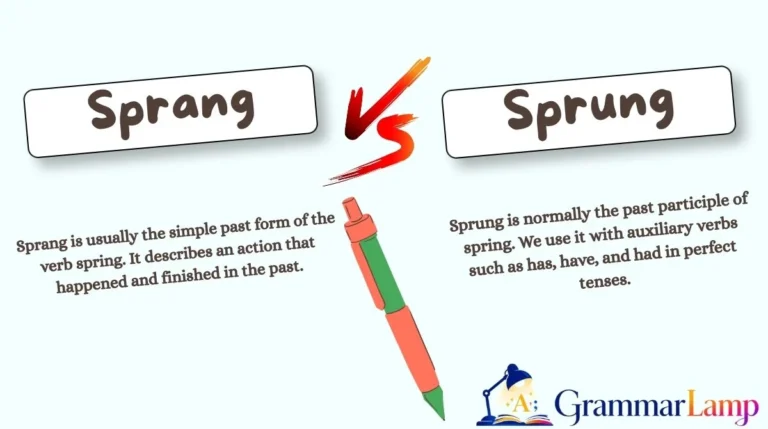
The main problem is grammar. Sprang is normally the simple past form of spring, while sprung is normally the past participle.
That means they do not always fit into the same sentence structure. For example, we say, “The cat sprang onto the table,” but “The cat has sprung onto the table.”
This difference matters in everyday English because spring is a useful verb. We use it for jumping, moving suddenly, appearing suddenly, and even producing a surprising action.
You may hear it in conversations, books, stories, news reports, and formal writing.
Once you understand the job of each word, the confusion becomes much smaller. You will learn when to use sprang, when to use sprung,
how auxiliary verbs affect the choice, and why sentences such as “has sprang” are incorrect.
You will also see common mistakes, simple memory tricks, and everyday examples that make the rule easier to remember.
More Useful posts
Promulgate vs Propagate: Meaning, Difference & Examples (2026 Guide)
Sneek vs Sneak: Which Spelling Is Correct in 2026?
In vs Into vs On vs Onto: Easy Grammar Rules and Examples in 2026
Couple of Hours vs Couple Hours: Which Is Correct in 2026?
What Does “Sprang” Mean?
Sprang is usually the simple past form of the verb spring. It describes an action that happened and finished in the past. Oxford and Cambridge both list sprang as the past simple form of spring.
The verb spring can mean to jump or move suddenly and quickly. It can also mean to appear suddenly or to start from a particular source. For example, a person can spring out of a chair, a cat can spring onto a sofa, or an idea can spring from an earlier experience.
When Do We Use “Sprang”?
Use sprang when you are talking about a completed action in the past and there is no need for an auxiliary verb such as has, have, or had.
The basic structure is:
Subject + sprang + rest of sentence
Here are some examples:
- The dog sprang over the fence.
The dog jumped over it suddenly. - She sprang out of bed when the alarm rang.
She got out of bed very quickly. - The cat sprang onto the table.
The cat jumped onto the table. - He sprang to his feet when he heard his name.
He stood up suddenly. - The door sprang open.
The door opened suddenly. - A smile sprang to her face.
A smile appeared suddenly. - The idea sprang from a simple conversation.
The idea started from that conversation. - The children sprang into action after the teacher arrived.
They became active very quickly.
Notice the pattern in these sentences. Sprang stands by itself as the main past-tense verb. There is no has, have, or had before it.
A Common Learner Confusion
One common mistake is using sprang after has, have, or had.
For example:
❌ She has sprang out of bed.
This is not the normal standard form.
The correct sentence is:
✅ She has sprung out of bed.
Why? Because has needs the past participle, and the past participle of spring is sprung.
So, when you see a sentence such as:
Yesterday, he sprang from his chair.
the simple past is being used.
But:
He has sprung from his chair.
uses the present perfect, so sprung is required.
What Does “Sprung” Mean?
Sprung is normally the past participle of spring. We use it with auxiliary verbs such as has, have, and had in perfect tenses. It can also be used in passive structures and some other verb patterns. Oxford lists sprung as the past participle, while Cambridge also identifies it as the past participle of spring.
The easiest way to understand sprung is to remember that it often needs a helping verb.
When Do We Use “Sprung”?
Common structures include:
has + sprung
have + sprung
had + sprung
Examples:
- The cat has sprung onto the sofa.
The cat has jumped onto it. - The trap has sprung shut.
The trap has suddenly closed. - She has sprung to her feet.
She has stood up suddenly. - Several problems have sprung up.
Several problems have appeared suddenly. - A new shop has sprung up near our house.
The shop has appeared or opened recently. - The idea had sprung from an old story.
The idea had come from that story. - The branch had sprung back into place.
The branch had suddenly moved back. - The secret was sprung on us at the last minute.
We were suddenly given an unexpected surprise.
The important point is that sprung usually works as the past participle, not as the basic simple past form.
“Sprung” Can Also Appear Without “Has” or “Have”
This is where the topic becomes a little more interesting.
In North American English, sprung is also used as a past simple form of spring. Oxford specifically lists sprung as an alternative past simple form in North American English.
For example, you may see:
He sprung out of the car and ran inside.
This form exists in American English. However, learners who want a safe general rule can remember:
simple past → sprang
past participle → sprung
That rule works very well in standard international English and prevents many common mistakes.
Difference Between Sprang and Sprung
The biggest difference is not really the meaning. Both come from spring and can describe sudden movement, jumping, appearing, or starting.
The main difference is their grammatical role.
| Word | Main grammatical role | Common use | Example |
|---|---|---|---|
| Sprang | Simple past | A completed past action | The boy sprang over the wall. |
| Sprung | Past participle | Perfect tenses and some passive structures | The boy has sprung over the wall. |
| Sprung | Alternative past simple in North American English | Past action in some US usage | He sprung out of the car. |
| Spring | Base form | Present, infinitive, modal structures | They spring into action quickly. |
1. Usage Difference
Use sprang when the sentence simply tells us that something happened in the past.
She sprang from her chair.
Use sprung when another helping verb creates a perfect construction.
She has sprung from her chair.
Compare these:
The rabbit sprang into the garden.
This tells us about a past action.
The rabbit has sprung into the garden.
This connects the past action with the present situation.
The basic event is similar, but the grammar is different.
2. Grammar Logic
English irregular verbs often have different forms for different grammatical jobs.
For spring, the traditional three main forms are:
spring → sprang → sprung
You can think of them like this:
Present: I spring.
Past: I sprang.
Past participle: I have sprung.
This pattern is similar to other irregular verbs:
sing → sang → sung
drink → drank → drunk
begin → began → begun
A learner normally would not say:
❌ I have sang.
Instead:
✅ I have sung.
The same logic applies to spring:
❌ I have sprang.
✅ I have sprung.
3. Sentence Structure Difference
The sentence structure can help you choose the correct word.
Simple past
Subject + sprang + complement
Example:
The horse sprang forward.
Present perfect
Subject + has/have + sprung + complement
Example:
The horse has sprung forward.
Past perfect
Subject + had + sprung + complement
Example:
The horse had sprung forward before the rider could react.
This is one of the easiest ways to decide between the two words. Look at what comes before the verb.
If you see has, have, or had, sprung is usually the form you need.
4. Meaning Comparison
The core meaning of spring stays almost the same in both forms.
Sprang:
He sprang out of the room.
Sprung:
He has sprung out of the room.
Both describe sudden movement. The difference comes from the tense and sentence structure.
So do not think of sprang and sprung as two completely different verbs. They are two forms of the same irregular verb.
Explore More Posts
Canceled vs Cancelled: Which Spelling Is Correct in 2026?
Ambiance vs Ambience: Meaning, Difference, Usage & Examples in 2026
Compared To vs As Compared To (2026): Meaning, Difference & Correct Usage
Gone to Soon vs Gone Too Soon: Which Is Correct? (2026 Guide)
Grammar Rules You Must Remember
Rule 1: Use “sprang” for the normal simple past
When a completed action happened in the past, sprang is normally the correct choice.
Example:
The bird sprang into the air.
The action happened in the past, and there is no helping verb.
Rule 2: Use “sprung” after “has,” “have,” and “had”
When spring is used in a perfect tense, use sprung.
Examples:
The weeds have sprung up everywhere.
The plant has sprung up quickly.
The idea had sprung from a small problem.
Oxford identifies sprung as the past participle, and Cambridge gives the same basic form.
Rule 3: Do not use “has sprang” in standard English
This is one of the most common mistakes.
❌ He has sprang from the chair.
✅ He has sprung from the chair.
The reason is simple: has is followed by a past participle, not the simple past.
Remember:
has + sprung
have + sprung
had + sprung
Rule 4: Be aware of North American usage
Some American English speakers use sprung as the simple past form.
For example:
He sprung the trap.
Oxford records sprung as an alternative past simple form in North American English.
However, when you are learning standard English, especially for exams, formal writing, or international communication, sprang is a reliable simple-past choice:
He sprang from his chair.
That gives learners a clear rule without ignoring real English usage.
Common Mistakes Students Make
Many learners confuse these forms because irregular verbs do not follow the normal -ed pattern. With regular verbs, the past and past participle are often the same:
walk → walked → walked
But spring changes:
spring → sprang → sprung
That makes the verb harder to remember.
Mistake 1: “Has sprang”
❌ The cat has sprang onto the table.
✅ The cat has sprung onto the table.
Why?
The word has tells us we are using the present perfect, so the past participle is needed.
Mistake 2: Using “sprung” for every past sentence
Some learners learn the word sprung and then use it everywhere.
❌ Yesterday, the dog sprung over the gate.
For standard general English:
✅ Yesterday, the dog sprang over the gate.
There is an important regional detail here because North American English does use sprung as an alternative past form. Still, sprang is the safer learner rule for simple past.
Mistake 3: Mixing the three forms
❌ I have spring onto the bus.
✅ I have sprung onto the bus.
❌ He sprang into action yesterday.
✅ This one is already correct.
❌ He has sprang into action.
✅ He has sprung into action.
The best way to avoid these errors is to memorize all three forms together:
spring – sprang – sprung
Easy Correction Tip
Whenever you are unsure, ask yourself:
“Is there a helping verb before the word?”
If the answer is no and you are talking about a normal past event, sprang is usually right.
If you see has, have, or had, choose sprung.
That one question can solve many mistakes.
Easy Trick to Remember the Difference
Here is a simple memory trick:
SPRANG = yesterday
SPRUNG = has/have/had
You can remember the pair this way:
I sprang.
I have sprung.
Imagine two little boxes:
Past box:
Yesterday, she sprang up.
Perfect box:
She has sprung up.
The word sprang sounds like a simple past form, and that is how you should usually treat it.
The word sprung should make you look for a helping verb:
has sprung
have sprung
had sprung
Think of sprung as a form that often needs a partner.
A Real-Life Way to Remember It
Imagine your friend suddenly jumps from a chair.
You tell the story later:
“He sprang from his chair.”
Now you are describing the result as part of the present situation:
“He has sprung from his chair.”
So the action is similar, but the grammar around it changes.
One very useful mini-formula is:
Past action = sprang
Perfect action = has/have/had + sprung
Keep this formula in your head when writing.
Daily Life Examples
1. Getting out of bed
Ali: Why are you awake so early?
Sara: I sprang out of bed when I heard the alarm.
The action happened in the past.
2. Talking about a recent event
Ali: Where is your brother?
Sara: He has sprung out of the house. He was in a hurry.
Here, has sprung is present perfect.
3. A cat jumping
Tom: What happened to the cat?
Mike: It sprang onto the kitchen table.
Simple past is enough because the action is being reported as a past event.
4. A problem appearing
Manager: Why are we having so many problems?
Worker: Several new issues have sprung up this week.
The phrase spring up means to appear or develop suddenly.
5. A surprise
Emma: Why did everyone look shocked?
John: The teacher sprang a surprise test on us.
To spring something on someone means to give them something unexpected.
6. Standing quickly
Mother: Why did you stand up so fast?
Son: I sprang to my feet when I heard the noise.
This is a common use of spring for sudden movement.
7. A plant appearing
Dad: When did these flowers grow?
Daughter: They have sprung up very quickly after the rain.
Here, have sprung up is correct because of the present perfect structure.
8. Something opening suddenly
Ben: Did you open the box?
Sam: No. The lid sprang open by itself.
The lid moved suddenly.
9. Talking about the past before another event
Teacher: What happened before I entered the room?
Student: Everyone had sprung to their feet.
The earlier action uses the past perfect.
10. A sudden idea
Nora: How did you think of that plan?
David: The idea sprang from a conversation with my friend.
Oxford also gives spring from in the sense of something being caused by or starting from something else.
Practice Section
Choose sprang or sprung in each sentence.
1.
The rabbit ______ across the road when it heard the car.
2.
Several new shops have ______ up in the area.
3.
She ______ out of bed at six o’clock.
4.
The idea had ______ from a simple question.
5.
The dog ______ over the wall yesterday.
Answers
1. sprang
The action happened as a simple past event.
2. sprung
We use have sprung up with the present perfect.
3. sprang
This is a completed past action.
4. sprung
The word had requires the past participle.
5. sprang
“Yesterday” points to a simple past action.
A useful study habit is to say the full forms aloud:
spring – sprang – sprung
Then make one sentence with each form. This helps you remember the grammar instead of memorizing a word list.
More Helpful posts
Stayed vs Staid: Meaning, Difference, Examples & Easy Rules in 2026
Newfound vs New-Found: Which Is Correct in 2026?
Over Time vs Overtime: Meaning, Difference, Examples & Rules in 2026
Year Old or Years Old? Easy Grammar Guide for 2026
FAQs
What is the difference between sprang and sprung?
Sprang is normally the simple past form of spring, while sprung is normally the past participle. For example, “She sprang up” is simple past, while “She has sprung up” uses the past participle.
Can we use “sprung” in a question?
Yes. You can use sprung in questions when the sentence uses a perfect tense.
For example: “Has the cat sprung onto the table?”
You can also ask: “Had the trap sprung shut?”
Is “sprang” formal or informal?
Sprang is a standard English form of the simple past and can be used in both everyday and formal writing. It is found in ordinary conversation, stories, reports, and other types of writing.
Is “has sprang” correct?
In standard English, has sprang is not the normal construction. The correct form is has sprung because has is followed by the past participle.
So write: She has sprung into action.
Is “sprung” ever a past-tense word?
Yes. North American English uses sprung as an alternative simple past form of spring. Oxford specifically records this usage. For learners, however, sprang is a useful standard choice for the simple past.
Which is correct: “I sprang” or “I sprung”?
Both can be found in English, but they are not equally common in all varieties. I sprang is the standard simple-past form used broadly. I sprung also occurs, especially in North American English. For general learner English, “I sprang” is the safest choice.
Conclusion
The difference between sprang and sprung becomes much easier once you focus on grammar instead of trying to memorize two separate meanings.
Sprang is normally the simple past form of spring:
She sprang from her chair.
Sprung is normally the past participle:
She has sprung from her chair.
The easiest rule to remember is:
sprang = simple past
sprung = past participle
So when you see has, have, or had, think of sprung. When you are simply describing a completed past action, sprang is usually the form you need.
Also remember that North American English sometimes uses sprung as a past form, so you may see it in real-world writing and speech.
Practice the three forms together—spring, sprang, sprung—and create your own short sentences. After a little practice, choosing between them will feel natural.

Liam Derren is a language writer at GrammarLamp, creating simple, helpful content about grammar, words, and everyday English. He makes language learning clear, practical, and easy to understand.
1 thought on “Sprang vs Sprung: What’s the Difference? Easy Grammar Guide 2026”