
English spelling can be tricky, especially when a word sounds different from the way we expect it to look.
Sneek vs sneak is a good example. When people hear the word sneak, they may expect it to be written with ee, just like words such as week, seek, and sleep.
That is why sneek sometimes appears in texts, messages, comments, and online searches.
However, when you are talking about the English verb that means to move quietly, go somewhere secretly, or do something without being noticed, the correct spelling is sneak.
Cambridge Dictionary lists sneak as the standard English word and gives meanings related to secret movement and actions.
There is one interesting detail: Sneek can be correct when it is used as a proper name. Sneek is the name of a city in Friesland in the Netherlands.
So the spelling is not always meaningless; it depends on what you are trying to say.
For everyday English, though, the choice is simple: use sneak when you mean to move or act secretly.
By the end of this guide, you will know the meaning, spelling, grammar, common mistakes, useful expressions, and easy ways to remember the difference.
Explore More Posts
It’s vs Its: Simple Difference, Rules, Examples & Practice (2026)
Enamor vs Enamour: What’s the Difference? Meaning, Usage & Examples in 2026
No Longer Exist vs No Longer Exists: Which Is Correct? (2026 Guide)
Breath vs Breathe: Easy Difference, Meaning, Examples & Rules in 2026
What Does “Sneek” Mean?
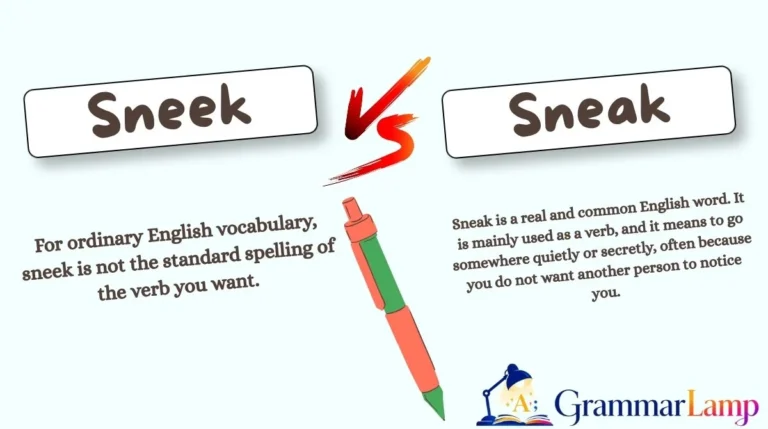
For ordinary English vocabulary, sneek is not the standard spelling of the verb you want. When a writer types sneek but means “to move quietly or secretly,” it is normally a spelling mistake.
The correct word is sneak.
This mistake is easy to understand. The word sneak is pronounced /sniːk/, with a long ee sound. Because English has many common words with this sound spelled ee, learners sometimes write sneek naturally. But English spelling does not always match pronunciation in a simple way.
So, when you want to describe someone going somewhere quietly without being noticed, do not write:
He tried to sneek outside.
Write:
He tried to sneak outside.
Is “Sneek” Ever Correct?
Yes, but not as the normal English verb.
Sneek is the name of a city in the Netherlands. The official city tourism website uses Sneek as the city’s name and describes it as a water city in Friesland.
For example:
- Sneek is a city in Friesland.
- We visited Sneek during our trip to the Netherlands.
- Sneek is known for its canals and water-related activities.
In these sentences, Sneek is a proper noun, so the spelling is correct.
The important point is context. If you are talking about a person quietly entering a room, sneek is not the spelling you need. If you are talking about the Dutch city, Sneek is perfectly correct.
Common Confusion With “Sneek”
Many learners make this mistake because they spell the word according to its sound.
Compare these:
- week → ee
- seek → ee
- peek → ee
- sneak → ea
The pronunciation can make the last one feel strange, but the spelling must still be learned correctly.
Here are some common incorrect examples:
- I want to sneek into the room. ❌
I want to sneak into the room. ✅ - She tried to sneek away. ❌
She tried to sneak away. ✅ - Don’t sneek out after midnight. ❌
Don’t sneak out after midnight. ✅ - He was sneeking around the house. ❌
He was sneaking around the house. ✅ - Can I sneek a look at your notes? ❌
Can I sneak a look at your notes? ✅ - The children sneeked into the kitchen. ❌
The children sneaked into the kitchen. ✅ - She wants to sneek past the teacher. ❌
She wants to sneak past the teacher. ✅ - I saw him sneeking outside. ❌
I saw him sneaking outside. ✅
The easiest rule is this: when the meaning is secret or quiet movement, spell it sneak, not sneek.
What Does “Sneak” Mean?
Sneak is a real and common English word. It is mainly used as a verb, and it means to go somewhere quietly or secretly, often because you do not want another person to notice you.
Cambridge Dictionary defines sneak as going somewhere secretly or taking someone or something somewhere secretly. It also gives common patterns such as sneak in, sneak out, and sneak up on.
You can use sneak when a person wants to avoid being seen or heard.
When Do We Use “Sneak”?
We use sneak in several common situations.
You can use it when someone:
- enters a place secretly
- leaves a place quietly
- moves close to someone without being noticed
- takes something somewhere secretly
- looks at something secretly
- does something quickly or quietly without drawing attention
For example:
She sneaked out of the house.
This means she left quietly or secretly.
The boy tried to sneak into the kitchen.
This means he entered the kitchen without wanting people to notice him.
Grammar Rule for “Sneak”
The base form is:
sneak
Its common forms are:
- Present: sneak
- Third-person singular: sneaks
- -ing form: sneaking
- Past tense: sneaked or snuck
Cambridge Dictionary lists sneaked and, especially in US English, snuck as past forms of sneak.
Here are some natural examples:
- I will sneak into the room quietly.
- She sneaks out when everyone is asleep.
- The cat sneaked into the bedroom.
- He snuck out before the meeting ended.
- We are sneaking through the back door.
- The children tried to sneak upstairs.
- She sneaked a quick look at the clock.
- He tried to sneak up on his brother.
The word can also appear in common expressions such as sneak a look, sneak a peek, sneak out, sneak in, and sneak up on someone.
Difference Between Sneek and Sneak
The biggest difference between sneek vs sneak is spelling and context.
For standard English, sneak is the correct spelling when you mean quiet or secret movement. Sneek is normally a misspelling in that context.
There is one exception: Sneek can be a proper noun for the city in the Netherlands.
Comparison Table
| Point | Sneek | Sneak |
|---|---|---|
| Standard English verb | No | Yes |
| Means move secretly | No | Yes |
| Common everyday English | No | Yes |
| Correct in “sneak out” | No | Yes |
| Correct in “sneak up on” | No | Yes |
| Can be a proper noun | Yes | Yes |
| Name of a city in the Netherlands | Yes | No |
Usage Difference
Consider these two sentences:
He tried to sneek out of the house. ❌
He tried to sneak out of the house. ✅
The first sentence has a spelling error. The second uses the normal English verb.
Now compare:
We traveled to Sneek in the Netherlands. ✅
Here, Sneek is correct because it is a city name.
So the two spellings are not simply “two forms of the same verb.” They have different roles.
Grammar Logic
A spelling mistake does not become correct just because many people use it online. Sneak is the established English word used in dictionaries and standard writing. Cambridge lists sneak as a verb and gives its grammatical forms as sneaked or snuck.
When the meaning is “move secretly,” you need the spelling:
S + N + E + A + K
Not:
S + N + E + E + K
That small vowel difference is important.
Sentence Structure
Because sneak is a verb, it can fit into many sentence structures.
Subject + sneak + place
- I sneak outside.
- They sneak upstairs.
Subject + sneak + preposition + place
- She sneaked into the office.
- He snuck out of the room.
Subject + sneak + object
- I sneaked a look at the paper.
- She sneaked a peek at the gift.
Subject + sneak up on + person
- The dog sneaked up on me.
- I tried to sneak up on my friend.
The spelling remains sneak in these structures.
Grammar Rules You Must Remember
Rule 1: Use “Sneak” for Secret or Quiet Movement
When you mean “go somewhere quietly or secretly,” use sneak.
✅ The children tried to sneak outside.
❌ The children tried to sneek outside.
This is the most important rule to remember.
Rule 2: The -ing Form Is “Sneaking”
When you add -ing, the correct spelling is sneaking, not sneeking.
✅ She is sneaking into the room.
❌ She is sneeking into the room.
Notice that sneak keeps its ea spelling.
Rule 3: The Past Forms Are “Sneaked” and “Snuck”
The past tense can be sneaked or snuck. Cambridge lists both forms, with snuck identified as especially used in US English.
Examples:
- He sneaked out early.
- He snuck out early.
Both can be found in English, although regional and style preferences can differ.
A Cambridge University Press study also describes snuck as a newer competing past-tense form alongside the older sneaked form.
Rule 4: “Sneek” Is Not the Normal Verb Spelling
Do not change sneak to sneek just because you hear a long “ee” sound.
✅ She wants to sneak away.
❌ She wants to sneek away.
Think about the written form rather than trying to spell the word only by sound.
Explore More Posts
This Is She or This Is Her? The Correct Choice in English in 2026
Jewel vs Joule: Meaning, Difference, Examples & Easy Rules (2026)
Foul or Fowl: Meaning, Difference, Examples & Easy Rules for 2026
Dialog vs Dialogue: What’s the Difference? A Simple English Guide for 2026
Common Mistakes Students Make
The main reason students write sneek is pronunciation. The vowel sound in sneak is long, so learners may connect it with words such as week, need, or sleep.
Another reason is simple visual memory. If you have seen sneek several times online, it may start to look normal. But repeated exposure to a mistake does not make it the standard spelling.
Mistake 1: “Sneek out”
❌ I will sneek out after dinner.
✅ I will sneak out after dinner.
The phrasal verb is sneak out.
Mistake 2: “Sneek into”
❌ He tried to sneek into the classroom.
✅ He tried to sneak into the classroom.
Again, the correct verb is sneak.
Mistake 3: “Sneeking”
❌ They were sneeking around the house.
✅ They were sneaking around the house.
The ea remains in the -ing form.
Mistake 4: Confusing Spelling With Past Tense
Some learners know that sneaked and snuck exist, but they still write sneeked or sneek.
Remember:
- sneak
- sneaks
- sneaking
- sneaked
- snuck
Never change the basic spelling to sneek.
Easy Correction Tip
Whenever you write the word, pause and ask yourself:
“Am I talking about secret movement?”
If the answer is yes, write sneak.
Easy Trick to Remember the Difference
Here is a simple memory trick:
Sneak has “EA” — think “Easy to avoid notice.”
The word sneak contains EA:
sn-EA-k
You can connect it with the idea:
Sneak = EA + quiet action
You do not need a complicated spelling rule. Just remember the shape of the word.
Another useful trick is to learn the family together:
sneak → sneaky → sneaking → sneaked
All of these forms keep the ea spelling.
Look at these examples:
- a sneaky child
- sneaking into the room
- sneaked away
- sneak outside
Seeing the word many times in correct sentences will make the spelling automatic.
You can also remember the common phrase:
sneak peek
Not:
sneek peek
Whenever you see that phrase in your reading, let it remind you that the correct spelling is sneak.
There is also a helpful logic trick:
“Sneek” looks like a word with two e’s, but “sneak” is the verb used in everyday English.
So, when writing a normal sentence, your first choice should be sneak.
Daily Life Examples (Very Important)
The best way to learn the difference is to see how the word sounds in real conversations.
1. Sneaking Out of the House
Ali: Are you leaving already?
Hamza: Yes. I need to sneak out before my parents come back.
Here, sneak out means leave quietly or secretly.
2. Sneaking Into a Room
Sara: How did you get into my room?
Mia: I sneaked in while you were outside.
The speaker entered without being noticed.
3. Sneak a Look
A: What are you reading?
B: Nothing. I was just sneaking a look at the schedule.
Sneak a look means to look quickly or secretly.
4. Sneak a Peek
Dad: Don’t open the box yet.
Son: Can I sneak a peek?
The phrase sneak a peek means to take a quick look, often before you are supposed to.
5. Sneak Up on Someone
Tom: Why did you scream?
Jack: You sneaked up on me!
Sneak up on someone means move close to them without letting them notice.
6. Sneaking Around
Mother: What are you doing downstairs?
Child: Nothing. I was just sneaking around.
The expression can suggest quiet or secret movement.
7. Sneaking Food
Brother: Did you take a cookie?
Sister: Maybe. I sneaked one from the kitchen.
Here, sneak means taking something secretly.
8. Sneaking Out of Work
Manager: Where is Daniel?
Employee: He sneaked out a few minutes ago.
The sentence means Daniel left quietly, perhaps without saying goodbye.
9. Sneaking Into a Meeting
Friend: Is there still space in the meeting?
Student: Yes. You can sneak in at the back.
Here, sneak in means enter quietly without attracting much attention.
10. Sneaking Up Behind Someone
Lina: I didn’t hear you come in!
Noor: I sneaked up behind you.
The action was quiet enough that the other person did not notice.
Practice Section
Choose the correct word in each sentence: sneek or sneak.
1. Please don’t ___ out of the house so late.
A. sneek
B. sneak
2. She was trying to ___ into the room quietly.
A. sneek
B. sneak
3. He was ___ around the kitchen.
A. sneeking
B. sneaking
4. Can I ___ a quick look at your phone?
A. sneek
B. sneak
5. We visited ___ during our trip to the Netherlands.
A. Sneek
B. Sneak
Answers
1. B — sneak
The correct verb is sneak out.
2. B — sneak
Use sneak into for secret or quiet entry.
3. B — sneaking
The -ing form of sneak is sneaking.
4. B — sneak
The natural expression is sneak a look.
5. A — Sneek
Here it is a proper noun referring to the Dutch city of Sneek.
More Helpful posts
Insight vs Incite: What’s the Difference? Easy Guide for 2026
In the Same Day vs On the Same Day: Which Is Correct? A Simple Guide for 2026
Licence or License: Which Spelling Is Correct in 2026?
I’ve Added vs I Added: Easy Difference, Rules & Examples (2026)
FAQs
What is the difference between sneek and sneak?
Sneak is the standard English word when you mean to move or act secretly or quietly.
Sneek is normally a spelling mistake when it is used with that meaning.
However, Sneek can also be a proper name for a city in the Netherlands.
Can we use “sneak” in questions?
Yes. Sneak is commonly used in questions.
For example: “Can I sneak in?” or “Did you sneak out?”
You can also ask, “Why did he sneak away?” The word works naturally in everyday spoken English.
Is “sneak” formal or informal?
Sneak is a normal English word and can be used in both everyday conversation and standard writing.
Some expressions, such as sneak a peek, sound quite casual. Other uses, such as sneak into the building, are completely normal in general English.
Is “sneek” ever a correct English spelling?
As the ordinary verb, no. The standard spelling is sneak.
However, Sneek is correct when it is used as the proper name of the Dutch city. So context matters.
Which is correct: “sneak peek” or “sneek peek”?
The correct expression is sneak peek.
It means a quick or early look at something.
For example: “The company gave fans a sneak peek at the new product.”
Writing sneek peek is a spelling error when you mean this expression.
Which is correct: “sneaked” or “snuck”?
Both sneaked and snuck are used as past forms of sneak. Cambridge lists both, with snuck especially associated with US English.
For example:
- She sneaked out quietly.
- She snuck out quietly.
The basic present-tense spelling remains sneak.
Conclusion
The sneek vs sneak confusion mainly comes from English pronunciation. The word sneak has a long vowel sound, so it can seem natural to spell it with ee.
But in standard English, the correct spelling is sneak when you mean to move quietly, secretly, or without being noticed.
Cambridge Dictionary recognizes sneak as the English verb and lists forms such as sneaked, snuck, sneaking, and sneaks.
The spelling sneek is normally incorrect in sentences such as “sneek out,” “sneek into,” or “sneek a peek.” The one important exception is Sneek, the proper name of a city in the Netherlands.
So remember the simple rule: secret movement = sneak.
Practice the word in common phrases such as sneak out, sneak in, sneak up on, sneak a look, and sneak a peek. Once you see the correct spelling often enough, the confusion becomes much easier to avoid.

Liam Derren is a language writer at GrammarLamp, creating simple, helpful content about grammar, words, and everyday English. He makes language learning clear, practical, and easy to understand.
1 thought on “Sneek vs Sneak: Which Spelling Is Correct in 2026?”