
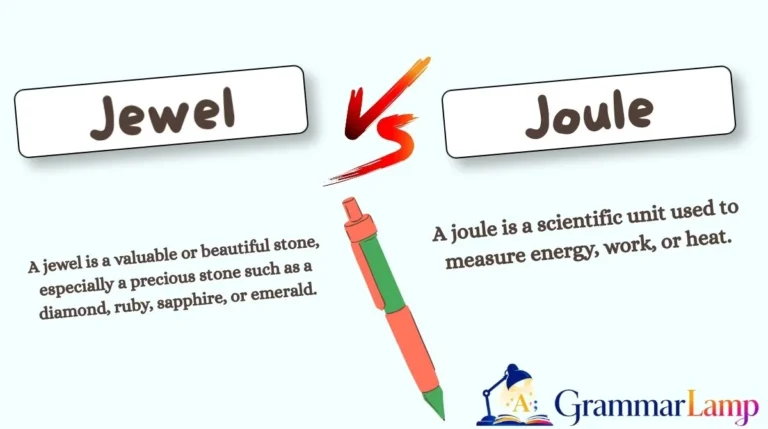
Jewel vs joule is a common word confusion for English learners because the two words look similar and have almost the same pronunciation.
When someone says them quickly, they can be difficult to tell apart. However, their meanings are completely different.
Jewel is a word connected with precious stones, valuable objects, or beautiful pieces of jewelry. For example, you can say, “The ring has a beautiful jewel in it.”
Joule, on the other hand, is a scientific unit of energy or work. It is mainly used in physics, engineering, electricity, and other scientific subjects. For example, “The machine uses 500 joules of energy.”
The confusion becomes stronger because both words begin with the same j sound and contain the sound /dʒuː/. However, jewel usually has an extra vowel sound at the end, while joule is pronounced as one syllable.
Knowing the difference is useful when you are reading science lessons, writing about jewelry, speaking English, or studying for an exam. A simple spelling mistake can change the meaning of a sentence completely.
By the end of this guide, you will know exactly when to use jewel and when to use joule, how they are pronounced, how they work in sentences, and how to remember the difference without memorizing complicated rules.
Jewel vs Joule: Meaning, Difference, Examples & Easy Rules (2026)
Foul or Fowl: Meaning, Difference, Examples & Easy Rules for 2026
Dialog vs Dialogue: What’s the Difference? A Simple English Guide for 2026
Learned vs Learnt: What’s the Difference? A Simple Guide for 2026
What Does “Jewel” Mean?
A jewel is a valuable or beautiful stone, especially a precious stone such as a diamond, ruby, sapphire, or emerald.
The word can also refer to a valuable or beautiful object or person. In everyday English, however, its most common meaning is related to precious stones and jewelry.
Simple definition
Jewel = a precious or valuable stone, or something that is very beautiful or valuable.
For example:
She wore a necklace with a large blue jewel.
Here, jewel means the precious stone set in the necklace.
A jewel is not always the same thing as jewelry. Jewelry means objects such as rings, necklaces, bracelets, and earrings. A jewel is usually the precious stone itself.
For example:
- The ring is jewelry.
- The diamond in the ring is a jewel.
That small difference can help you choose the correct word.
When should you use “jewel”?
Use jewel when you are talking about:
- A precious stone
- A valuable decoration
- A beautiful object
- Something or someone especially valuable or admired
The word is normally used as a noun.
Example sentences with “jewel”
- The queen wore a beautiful jewel on her crown.
- This necklace contains several small jewels.
- The jeweler showed us a rare blue jewel.
- She found a valuable jewel inside the old box.
- The diamond is the most expensive jewel in the collection.
- The museum has many ancient jewels on display.
- The little island is considered a jewel of the region.
- Her grandmother gave her a family jewel.
Notice that jewel is usually something you can see, touch, own, buy, or describe as beautiful.
Jewel can have a figurative meaning
English speakers sometimes use jewel to describe something that is not actually a precious stone.
For example:
This small village is a jewel of the countryside.
The village is not a diamond or ruby. The speaker means that it is beautiful, special, or valuable.
You might also hear:
He is a jewel of a person.
This means that the person is considered especially kind, helpful, or valuable.
Common learner confusion with “jewel”
Some students think jewel and jewelry are interchangeable. They are not always interchangeable.
Compare:
She bought beautiful jewelry.
This means she bought one or more decorative items.
She bought a beautiful jewel.
This usually suggests that she bought a precious stone or a particularly valuable object.
Also remember that jewel is not connected to energy or physics. If you are talking about energy, you need joule, not jewel.
What Does “Joule” Mean?
A joule is a scientific unit used to measure energy, work, or heat.
It is named after the English physicist James Prescott Joule, whose work helped scientists understand the relationship between heat, energy, and mechanical work.
In simple terms, a joule tells us how much energy is involved.
For beginners, you can remember:
Joule = a unit of energy.
The word is especially common in:
- Physics
- Chemistry
- Engineering
- Electricity
- Nutrition and science
- Technical writing
When should you use “joule”?
Use joule when you are talking about an amount of energy or work.
For example:
The battery stores 1,000 joules of energy.
Here, joules tells us the amount of energy stored.
The abbreviation or symbol for joule is J.
For example:
- 1 joule = 1 J
- 50 joules = 50 J
- 1,000 joules = 1,000 J
The plural form is normally joules when you write the full word.
Example sentences with “joule”
- The device uses 500 joules of energy.
- The experiment produced 100 joules of heat.
- The battery can store thousands of joules.
- The student calculated the amount of energy in joules.
- The machine did 200 joules of work.
- The electrical system transfers energy in joules.
- The answer to the physics problem is 75 joules.
- A joule is a standard unit of energy in the SI system.
In each sentence, joule has a scientific meaning. It has nothing to do with diamonds, necklaces, or precious stones.
What exactly does a joule measure?
You do not need advanced physics to understand the basic idea.
A joule is a measurement of energy or work. In physics, one joule can be described as the amount of work done when a force of one newton moves an object one metre in the direction of the force.
For beginners, though, the easiest idea is:
A joule measures energy.
You may see the word in school textbooks, science websites, electricity information, and technical documents.
Common learner confusion with “joule”
The biggest mistake is writing jewel when you mean the scientific unit.
For example:
❌ The battery stores 500 jewels.
This sounds as if the battery stores 500 precious stones!
Correct:
✅ The battery stores 500 joules.
Another common mistake is confusing the word with the symbol.
The machine uses 50 J of energy.
Here, J means joules.
Difference Between Jewel and Joule
The easiest way to understand jewel vs joule is to look at their meanings side by side.
| Word | Meaning | Main Use | Part of Speech | Example |
|---|---|---|---|---|
| jewel | A precious stone or valuable/beautiful thing | Jewelry and general English | Noun | She wore a beautiful jewel. |
| joule | A unit of energy or work | Science and physics | Noun | The machine used 200 joules. |
1. Their meanings are different
Jewel is about something valuable or beautiful.
The necklace has a red jewel.
Joule is about energy.
The machine produces 200 joules of energy.
Think about the subject of the sentence. If you are talking about a diamond, you probably need jewel. If you are talking about energy, you need joule.
2. Their grammar is different in practical use
Both words are nouns, but they appear in very different types of sentences.
Jewel can be used with articles and descriptive adjectives:
a beautiful jewel
an expensive jewel
the blue jewel
several jewels
Joule is usually used with a number when describing energy:
10 joules
50 joules
500 joules
1,000 joules
You can also use joule without a number when explaining the scientific unit:
The joule is a unit of energy.
3. Their pronunciation is slightly different
Jewel is commonly pronounced like “JOO-uhl” and usually has two syllables.
Joule is pronounced like “jool” and has one syllable.
The pronunciation can vary slightly depending on accent, but this distinction is useful for learners.
4. Their spelling gives you an important clue
Look carefully:
jewel → related to valuable stones
joule → related to energy
The unusual spelling of joule comes from the surname of physicist James Prescott Joule.
5. Their sentence structures are different
With jewel, you might say:
She bought a beautiful jewel.
With joule, you might say:
The experiment produced 500 joules of energy.
The first sentence describes an object. The second gives a measurement.
In the Same Day vs On the Same Day: Which Is Correct? A Simple Guide for 2026
Licence or License: Which Spelling Is Correct in 2026?
I’ve Added vs I Added: Easy Difference, Rules & Examples (2026)
This Is She or This Is Her? The Correct Choice in English in 2026
Grammar Rules You Must Remember
Rule 1: Use “jewel” for a precious stone or valuable thing
When you are talking about diamonds, rubies, emeralds, or another valuable stone, use jewel.
The crown contains several precious jewels.
Do not write joules in this situation.
Rule 2: Use “joule” for energy or work
When you are measuring energy or work in science, use joule.
The motor uses 300 joules of energy.
A quick test is to ask yourself:
“Am I talking about energy?”
If the answer is yes, choose joule.
Rule 3: “Joule” becomes “joules” after numbers greater than one
Like many countable measurement words, joule has a plural form.
The experiment used one joule of energy.
But:
The experiment used five joules of energy.
You will often see the abbreviation J instead:
The experiment used 5 J of energy.
The symbol stays J, even when the quantity is plural.
Rule 4: “J” is the symbol for joule, not jewel
In scientific writing, J represents the unit joule.
The answer is 250 J.
The symbol J does not mean a jewel.
This is especially important in physics exams. A sentence such as “The object has 250 J of energy” means the object has 250 joules of energy.
Common Mistakes Students Make
Many mistakes happen because jewel and joule look and sound so similar. Students may know the meanings but still choose the wrong spelling when writing quickly.
Mistake 1: Using “jewel” for energy
❌ The bulb uses 60 jewels of energy.
✅ The bulb uses 60 joules of energy.
Why does the mistake happen?
The words look almost identical, and jewel is more familiar to many English learners.
Easy tip:
If you can replace the word with “unit of energy,” use joule.
Mistake 2: Using “joule” for a precious stone
❌ She received a beautiful joule from her mother.
✅ She received a beautiful jewel from her mother.
Why?
The sentence is about a valuable object, not energy.
Easy tip:
If you can imagine a diamond, ruby, or emerald, think jewel.
Mistake 3: Confusing “jewel” with “jewelry”
❌ She bought a jewel set of earrings and a necklace.
A better sentence is:
✅ She bought a jewelry set containing earrings and a necklace.
If you are talking about the individual precious stones, jewels may be correct:
The necklace contains several small jewels.
Mistake 4: Forgetting the plural “s”
❌ The machine used 500 joule of energy.
✅ The machine used 500 joules of energy.
When you write the full unit after a number greater than one, use joules.
Remember that the symbol is different:
500 J
not:
500 Js
Mistake 5: Thinking the two words are simply different spellings
They are not two spellings of the same word.
Jewel and joule have different meanings and different uses.
You cannot replace one with the other just because they sound similar.
Easy Trick to Remember the Difference
Here is a simple classroom trick:
Jewel = Jewelry
Joule = Energy
Look at the spelling:
JEWEL → think JEWELRY
JOULE → think JOULE = J in physics
You can also use a picture in your mind.
Imagine a diamond ring.
That is a jewel.
Now imagine a physics book showing “500 J.”
That is a joule.
So remember:
💎 Jewel = something valuable or beautiful.
⚡ Joule = a measurement of energy.
There is another useful clue: joule is normally found in scientific sentences with numbers.
For example:
10 joules
50 joules
1,000 joules
If you see a number and the sentence is about energy, joule is almost certainly the word you need.
Daily Life Examples
You may not use the word joule in casual conversation every day, but you will often see it in science, technology, electricity, and educational material. Jewel is more common in ordinary English when discussing jewelry or valuable objects.
Here are some natural examples.
Example 1: Shopping
Customer: Is this ring made with a real diamond?
Shop assistant: Yes. The diamond is the main jewel in the ring.
Example 2: Talking about family jewelry
My grandmother gave me a beautiful jewel for my birthday.
Here, the word refers to something valuable.
Example 3: A science class
Teacher: What unit do we use to measure energy?
Student: We use the joule.
Example 4: A physics problem
The machine performs 800 joules of work.
This is a scientific measurement.
Example 5: Describing a place
The old town is a hidden jewel.
Here, jewel is being used figuratively to mean something special and beautiful.
Example 6: Reading an electricity report
The device consumed 2,000 joules of energy.
The subject is energy, so joules is correct.
Example 7: Talking about a necklace
The necklace has three small green jewels.
The word refers to precious stones.
Example 8: Studying for an exam
Student: What does J mean in this formula?
Teacher: It is the symbol for the joule, a unit of energy.
Example 9: Describing something valuable
That painting is a real jewel of the museum.
The painting is not a physical gemstone. It is being described as something especially valuable or beautiful.
Example 10: Comparing two ideas
A jewel can be worn as part of jewelry, while a joule is used to measure energy.
This sentence gives you the whole difference in one line.
Practice Section
Choose the correct word: jewel or joule. Use the correct plural form when necessary.
1. The necklace has a large blue ______ in the center.
2. The machine used 500 ______ of energy.
3. The scientist measured the energy in ______.
4. She received a beautiful ______ from her grandmother.
5. The physics answer was 75 ______.
Answers
1. jewel
The sentence is about a precious stone.
2. joules
The sentence is about energy.
3. joules
Energy is measured in joules.
4. jewel
The sentence describes a valuable object.
5. joules
The number 75 requires the plural form joules.
Quick challenge
Try this without looking back:
The crown has five ______, while the battery contains enough energy to produce 500 ______.
The answer is:
The crown has five jewels, while the battery contains enough energy to produce 500 joules.
The two words may sound similar, but their meanings are worlds apart.
Alternative of vs Alternative for vs Alternative to: Which Is Correct? 2026 Guide
Realise or Realize: Which Spelling Is Correct in 2026?
Berth vs Birth: Meaning, Difference, Examples & Easy Rules for 2026
Insight vs Incite: What’s the Difference? Easy Guide for 2026
FAQs
1. What is the difference between jewel and joule?
Jewel means a precious stone or something valuable and beautiful. Joule is a scientific unit used to measure energy or work. For example, a diamond can be a jewel, while 100 J means 100 joules of energy.
2. Can “joule” be used in questions?
Yes. Joule can be used in both questions and statements.
For example:
How many joules of energy does the machine use?
You can also ask:
What is a joule?
The word works normally in scientific questions.
3. Is “jewel” formal or informal?
Jewel is a normal English noun and can be used in both everyday and formal English. It is common when talking about precious stones. It can also be used figuratively in more descriptive writing, such as “a jewel of a city.”
4. Is “joule” only used in science?
Mostly, yes. Joule is a technical word used mainly in physics, engineering, electricity, and other scientific subjects. You may also see it in technical information about energy and machines.
5. Are jewel and joule pronounced the same?
They are very similar, but they are not normally pronounced exactly the same. Joule is usually one syllable, sounding like “jool.” Jewel is commonly pronounced “JOO-uhl,” with two syllables. Accents can make the difference less noticeable.
6. Why is the symbol for joule “J”?
The symbol J comes from the word joule, which was named after the English physicist James Prescott Joule. In the International System of Units, the joule is written with the capital letter J. The full unit name is normally written as joule with a lowercase j.
Conclusion
Understanding jewel vs joule becomes easy once you connect each word with its main meaning.
Jewel is connected with precious stones, jewelry, beauty, and value. You might see a jewel in a ring, necklace, crown, or other valuable object. The word can also describe something special or beautiful in a figurative way.
Joule belongs to the world of science and energy. It is a unit used to measure energy or work, and its symbol is J. When you see numbers such as 10, 50, or 500 followed by a unit of energy, you will usually need joules.
The easiest memory trick is simple:
Jewel → jewelry 💎
Joule → energy ⚡
When you read or hear these words, think about the subject first. Are you talking about a precious stone? Choose jewel. Are you measuring energy? Choose joule.
A few minutes of practice will make this distinction feel natural. Once you connect each spelling with its meaning, you are much less likely to confuse them again.

Liam Derren is a language writer at GrammarLamp, creating simple, helpful content about grammar, words, and everyday English. He makes language learning clear, practical, and easy to understand.
3 thoughts on “Jewel vs Joule: Meaning, Difference, Examples & Easy Rules (2026)”