
Choosing the right preposition can be difficult even when you know the meaning of every word in a sentence. Alternative of, alternative for, and alternative to look very similar, but they do not work in the same way.
The good news is that there is a simple pattern to remember. When alternative is a noun and you mean “something that can be used instead of something else,” the most natural and standard choice is usually alternative to.
For example, we say, “This is an alternative to traditional medicine.” Major learner dictionaries also give examples such as “an alternative to coffee” and “an alternative to chocolate.”
But what about alternative for? It can be correct in certain sentences, especially when the focus is on something being suitable or intended for a person, group, purpose, or situation. However, it does not normally replace alternative to.
And what about alternative of? This combination is uncommon when you mean “a substitute for something.” It is usually better to rewrite the sentence.
What Does “Alternative To” Mean?
Simple definition
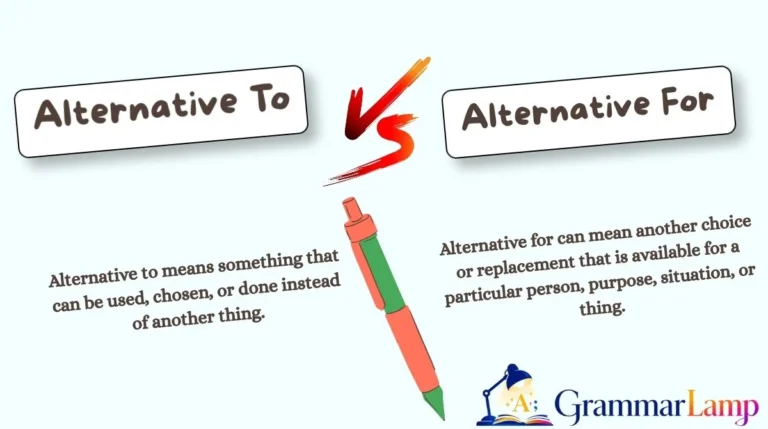
Alternative to means something that can be used, chosen, or done instead of another thing.
This is by far the most important pattern to remember.
For example:
Coffee is an alternative to tea.
This means coffee can be chosen instead of tea.
Cambridge Dictionary defines an alternative as something different from another thing that gives you a possible choice. Its examples regularly use the pattern alternative to + noun.
When should you use “alternative to”?
Use alternative to when you are comparing two choices, methods, products, actions, ideas, or situations.
The basic structure is:
alternative to + noun/pronoun
For example:
- an alternative to sugar
- an alternative to driving
- an alternative to this method
- an alternative to traditional education
- an alternative to plastic
- an alternative to the original plan
You can also use a gerund after to because here to is a preposition:
Walking is a good alternative to driving.
Notice that driving is an -ing form, not drive.
Examples of “alternative to”
- Honey is a natural alternative to sugar.
- We need an alternative to this expensive system.
- Cycling is a healthy alternative to driving.
- Is there an alternative to this medicine?
- Solar energy is an alternative to fossil fuels.
- This website offers an alternative to traditional classroom learning.
- We need to find an alternative to the current plan.
- She suggested an alternative to taking the train.
In every example, the thing after to is the thing that the alternative can replace.
A useful test
Ask yourself:
“What can this replace?”
If the answer is clear, alternative to will usually be the correct choice.
For example:
Walking is an alternative to driving.
Ask:
What does walking replace?
Answer:
Driving.
So:
alternative to driving ✅
Not:
alternative of driving ❌
Common learner confusion
Many learners see to and automatically think about the infinitive:
to go
to eat
to study
But in alternative to, the word to is a preposition.
That means a noun or an -ing form can follow it:
an alternative to coffee
an alternative to driving
an alternative to working late
So this sentence is correct:
Walking is an alternative to driving.
Not:
Walking is an alternative to drive. ❌
What Does “Alternative For” Mean?
Simple definition
Alternative for can mean another choice or replacement that is available for a particular person, purpose, situation, or thing.
However, it is less common than alternative to when you are simply comparing one thing with another.
This distinction is important.
Compare:
Tea is an alternative to coffee.
Here, tea replaces or competes with coffee as a choice.
But:
We need an alternative for John.
Here, the meaning may be that we need someone or something to take John’s place.
The focus is different.
When can “alternative for” be used?
For often introduces the person, purpose, or situation that something is intended for or associated with. Oxford’s explanation of for includes uses involving something intended for or used by someone or something.
For example:
We need an alternative for the manager while she is away.
The meaning is roughly:
We need someone or something to take the manager’s place.
Another example:
This is an alternative for people who cannot afford the original product.
Here, the alternative is suitable for a particular group of people.
Examples of “alternative for”
- We need an alternative for the team leader while he is on vacation.
- This product is a cheaper alternative for students on a budget.
- We need an alternative for customers who cannot use the online system.
- The company is looking for an alternative for its current supplier.
- Is there an alternative for people with limited internet access?
- The teacher provided an alternative for students who missed the test.
- We need an alternative for this damaged machine.
- The program offers an alternative for families who cannot attend during the day.
These examples show why for can sometimes be natural.
But be careful
A very common mistake is using alternative for simply because the learner wants to say “a substitute for something.”
For example:
This is an alternative for coffee.
Many speakers would naturally say:
This is an alternative to coffee. ✅
Likewise:
We need an alternative to the current system. ✅
The general rule is simple:
If you mean “instead of X,” prefer “alternative to X.”
Common learner confusion
Learners sometimes think:
“If something is a replacement for something, I should use for.”
That logic is understandable because other expressions use for:
a replacement for the old machine
a substitute for sugar
a solution for the problem
But alternative has its own common pattern:
an alternative to sugar
So do not choose the preposition only by translating from another expression.
What Does “Alternative Of” Mean?
Simple definition
Alternative of is generally not the normal choice when you want to say that one thing can replace another.
For example, this sounds unnatural:
This is an alternative of coffee. ❌
The natural sentence is:
This is an alternative to coffee. ✅
Likewise:
We need an alternative of this method. ❌
Better:
We need an alternative to this method. ✅
Why is “alternative of” confusing?
The preposition of has many important uses in English. It can show relationships such as belonging, connection, composition, or description. Oxford gives examples such as “the lid of the box,” “the director of the company,” and “the result of the debate.”
Because of is so common, learners sometimes insert it between two nouns.
But English does not choose prepositions simply because two nouns are connected.
We say:
the result of the test
but:
an alternative to the test
The preposition depends on the particular word and meaning.
Examples
Instead of:
Is there an alternative of this plan? ❌
Say:
Is there an alternative to this plan? ✅
Instead of:
We need an alternative of plastic. ❌
Say:
We need an alternative to plastic. ✅
Instead of:
Solar energy is an alternative of coal. ❌
Say:
Solar energy is an alternative to coal. ✅
Is “alternative of” ever possible?
You may occasionally see alternative of in unusual, technical, translated, or context-specific writing. It can also appear when alternative is being used in a different grammatical construction.
However, for everyday English learners, there is no useful general rule that says:
use alternative of to mean a replacement.
For that meaning, alternative to is the safe and natural choice.
Difference Between Alternative of, Alternative for, and Alternative to
The three expressions are not equally common.
| Expression | Main use | Example | Naturalness |
|---|---|---|---|
| alternative to | Something used instead of another thing | Tea is an alternative to coffee. | ⭐⭐⭐⭐⭐ |
| alternative for | A replacement/suitable choice for a person, purpose, or situation | We need an alternative for the manager. | ⭐⭐⭐ |
| alternative of | Not normally used for “replacement” | An alternative of coffee | ⭐ |
1. Alternative to = instead of
This is the main pattern.
Walking is an alternative to driving.
The two choices are walking and driving.
You are saying that walking can be chosen instead of driving.
2. Alternative for = suitable replacement or option for someone/something
Here, for can identify the person, group, purpose, or situation involved.
We need an alternative for the manager.
The meaning can be:
We need someone to take the manager’s place.
Another example:
The school needs an alternative for students who cannot attend in person.
The alternative is designed or provided for those students.
3. Alternative of = usually avoid it
If you mean:
“another thing that can be used instead of X”
use:
alternative to X
not:
alternative of X
Compare these sentences
Tea is an alternative to coffee.
Tea can be chosen instead of coffee.
We need an alternative for the manager.
We need a replacement or another arrangement concerning the manager.
Tea is an alternative of coffee.
This is not the normal English construction.
Grammar Rules You Must Remember
Rule 1: Use “alternative to” for the thing being replaced
This is the most important rule.
Pattern:
alternative to + noun
Examples:
This is an alternative to plastic.
We need an alternative to the old system.
Walking is an alternative to driving.
Think:
A instead of B = A is an alternative to B.
Rule 2: “To” can be followed by an -ing form
Because to in alternative to is a preposition, an -ing form can follow it.
Correct:
Cycling is an alternative to driving.
Correct:
Working from home is an alternative to commuting.
Correct:
Cooking at home is an alternative to eating out.
Incorrect:
Cycling is an alternative to drive. ❌
This is a useful rule because learners often confuse the preposition to with the infinitive marker to.
Rule 3: Use “alternative for” when the focus is on the person, purpose, or situation
For can introduce the person or group for whom something is suitable.
For example:
The school created an alternative for students who could not attend the exam.
Here, the alternative is provided for students.
Another example:
We need an alternative for the person who normally handles this job.
The focus is on replacing or helping a particular person.
Still, if you simply mean “instead of,” to is usually better.
Rule 4: Do not use “alternative of” simply to mean “alternative to”
This is one of the easiest mistakes to fix.
❌ This is an alternative of sugar.
✅ This is an alternative to sugar.
❌ We need an alternative of this plan.
✅ We need an alternative to this plan.
❌ Is there an alternative of plastic?
✅ Is there an alternative to plastic?
When you see the meaning “instead of,” your first choice should be:
alternative to
Common Mistakes Students Make
Mistake 1: “Alternative of” instead of “alternative to”
A learner may write:
Solar power is an alternative of coal.
The problem is the preposition.
Better:
Solar power is an alternative to coal.
The word coal is the thing that solar power can replace.
Easy correction
Whenever you can insert the words “instead of”, use alternative to.
Solar power can be used instead of coal.
Therefore:
Solar power is an alternative to coal.
Mistake 2: Using “alternative for” when “alternative to” is needed
Incorrect or less natural:
We need an alternative for this method.
If you mean another method that can replace it, say:
We need an alternative to this method.
The second sentence clearly presents one method as a replacement for another.
Mistake 3: Confusing “alternative to” with “alternative for”
Look at these:
We need an alternative to the old computer system.
This means another system could replace the old system.
We need an alternative for the employee who is absent.
This means we need a replacement or another arrangement involving that employee.
The meaning changes because the preposition changes.
Mistake 4: Using an infinitive after “alternative to”
Incorrect:
Walking is an alternative to drive.
Correct:
Walking is an alternative to driving.
Why?
Because to is a preposition here, so a noun or gerund can follow it.
Mistake 5: Thinking every word uses “for” in the same way
English has many expressions with for:
a replacement for
a substitute for
a solution for
But that does not mean every related noun must use for.
We normally say:
an alternative to
This is a good example of why English learners should learn common word combinations rather than translate each word separately.
Easy Trick to Remember the Difference
Here is a simple classroom trick.
Think: “TO = the thing you move away from”
Imagine two roads.
You are currently using Road A, but you decide to use Road B instead.
You can say:
Road B is an alternative to Road A.
So:
alternative TO = another choice instead of something
Examples:
tea → alternative to coffee
walking → alternative to driving
solar power → alternative to fossil fuels
online learning → alternative to classroom learning
Think: “FOR = the person or purpose”
Now imagine a teacher is absent.
The school needs another teacher for the class.
You can say:
We need an alternative for the absent teacher.
Here, for points toward the person or situation that needs another arrangement.
And what about “OF”?
For this topic, remember:
OF is usually not your choice when you mean “instead of.”
So the quick memory rule is:
Alternative TO = instead of
Alternative FOR = replacement/suitable option for a person or purpose
Alternative OF = usually avoid
This three-part rule will prevent most mistakes.
Daily Life Examples
These examples show how the expressions work in natural English.
1. Food
A: I can’t drink regular milk.
B: Try almond milk. It’s an alternative to dairy milk.
Here, alternative to is natural because one drink can replace another.
2. Transportation
Cycling is a good alternative to taking the bus.
You can cycle instead of taking the bus.
3. Work
We need an alternative to the current software.
The company wants another software option.
4. School
The teacher offered an alternative to the final exam.
The alternative can replace the exam.
5. Employees
Sarah is sick, so we need an alternative for her today.
Here, the focus is on arranging someone or something to cover Sarah’s role.
6. Shopping
Is there a cheaper alternative to this phone?
You are asking about another phone that could be chosen instead.
7. Environment
Reusable bags are an alternative to single-use plastic bags.
Reusable bags can be used instead of disposable ones.
8. Exercise
Swimming is a good alternative to running if you want a different workout.
Swimming provides another choice instead of running.
9. Internet access
The school needs an alternative for students who do not have internet access at home.
The alternative is provided for a particular group of students.
10. Daily conversation
A: We can’t take this road. It’s closed.
B: Is there an alternative to this route?
This is a very natural use of alternative to.
Practice Section
Choose alternative to, alternative for, or alternative of.
1. Is there an ________ to this expensive treatment?
2. Walking is a healthy alternative ________ driving.
3. The school needs an alternative ________ students who cannot attend online.
4. Solar energy is an alternative ________ fossil fuels.
5. We need an alternative ________ the manager while she is away.
Answers
1. alternative to
Is there an alternative to this expensive treatment?
The treatment is the thing that another treatment could replace.
2. alternative to
Walking is a healthy alternative to driving.
Walking can be done instead of driving.
3. alternative for
The school needs an alternative for students who cannot attend online.
The alternative is intended for a particular group.
4. alternative to
Solar energy is an alternative to fossil fuels.
Solar energy can be used instead of fossil fuels.
5. alternative for
We need an alternative for the manager while she is away.
The sentence focuses on arranging a replacement for the manager’s role.
FAQs
1. What is the difference between “alternative to” and “alternative for”?
Alternative to usually means something that can be used instead of another thing.
Alternative for can focus on a replacement or option intended for a particular person, group, purpose, or situation.
For simple “instead of” meanings, alternative to is normally the better choice.
2. Is “alternative of” grammatically correct?
Alternative of is not the normal expression when you mean “a replacement for something.”
Instead, use alternative to:
This is an alternative to coffee.
We need an alternative to the current plan.
Using alternative of in these sentences sounds unnatural to most English speakers.
3. Can I say “an alternative for coffee”?
It is possible to understand the sentence, but an alternative to coffee is the normal and more natural expression when you mean something that can be consumed instead of coffee.
For example:
Tea is an alternative to coffee.
This is the standard pattern used in learner dictionaries.
4. Is “alternative to” formal or informal?
Alternative to is completely normal in both everyday and formal English.
You can use it in conversations:
Is there an alternative to this?
You can also use it in academic or professional writing:
Renewable energy is an alternative to fossil fuels.
It is a very useful expression in all types of English.
5. What comes after “alternative to”?
A noun, pronoun, or gerund can follow it.
Examples:
an alternative to coffee
an alternative to this
an alternative to driving
Because to is a preposition in this expression, -ing is correct when you use a verb.
6. Which is correct: “alternative to” or “alternative for”?
Both can be correct, but they normally express different relationships.
Use alternative to when one thing is another choice instead of something else:
Tea is an alternative to coffee.
Use alternative for when the focus is on a person, group, purpose, or situation that needs another arrangement:
We need an alternative for the absent teacher.
When you are unsure and mean simply “instead of,” choose alternative to.
Final Conclusion
The easiest way to understand these three expressions is to focus on the meaning, not just the preposition.
Alternative to is the main expression you need. Use it when one thing can be chosen, used, or done instead of another:
Walking is an alternative to driving.
Alternative for can also be correct, especially when you are talking about a replacement or option for a particular person, group, purpose, or situation:
We need an alternative for the absent teacher.
But alternative of is generally not the natural choice when you mean “something used instead of something else.” In that situation, use alternative to.
If you remember only one rule, remember this:
Instead of = alternative to
Once you start noticing this pattern in real English, the choice becomes much easier. Try making a few sentences about your daily life using alternative to and alternative for.
A little practice will help the difference become automatic.

Liam Derren is a language writer at GrammarLamp, creating simple, helpful content about grammar, words, and everyday English. He makes language learning clear, practical, and easy to understand.
6 thoughts on “Alternative of vs Alternative for vs Alternative to: Which Is Correct? 2026 Guide”