
Have you ever typed “spicey” and then stopped because you were not sure whether it looked right? You are not alone.
Many English learners get confused by spicy vs spicey because the word comes from the noun spice, which ends in the letter e. It can seem natural to add y and write “spicey.” However, standard English uses a different spelling.
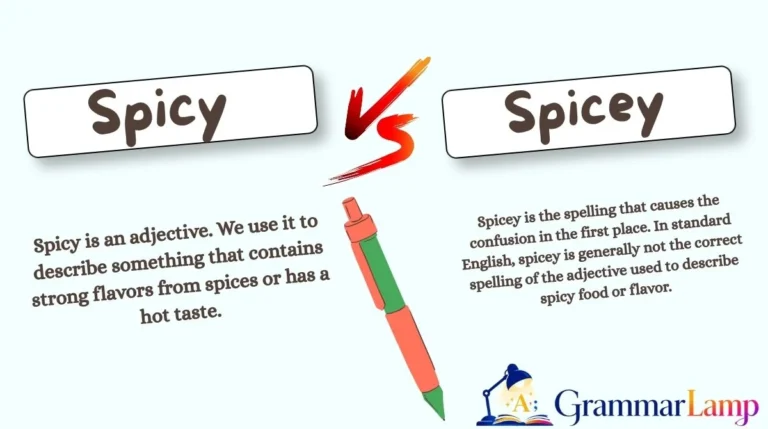
The correct spelling is spicy. Spicey is generally a misspelling when you are trying to describe food, flavor, or something with a hot or strong quality.
Major learner dictionaries, including Cambridge and Oxford, list spicy as the standard adjective.
This small spelling difference matters because spicy is a common word in everyday English. You may use it when talking about curry, noodles, chicken, sauce, snacks, or your favorite restaurant.
It can also have figurative meanings. For example, English speakers sometimes describe a story, comment, or situation as “spicy” when it is exciting, shocking, or a little surprising.
Once you understand the spelling pattern, the confusion becomes much easier. You will learn what spicy means, why spicey is usually incorrect, how to use the word naturally, and how to remember the spelling every time.
More Useful posts
Mine as Well or Might as Well? The Correct Phrase Explained in Simple English (2026)
Alternative of vs Alternative for vs Alternative to: Which Is Correct? 2026 Guide
Realise or Realize: Which Spelling Is Correct in 2026?
Berth vs Birth: Meaning, Difference, Examples & Easy Rules for 2026
What Does “Spicy” Mean?
Spicy is an adjective. We use it to describe something that contains strong flavors from spices or has a hot taste. Cambridge defines spicy as something containing strong flavors from spices, while Oxford uses it for food with a strong taste caused by spices.
The word is very common in everyday conversation. You can use it for food such as curry, soup, chicken, noodles, rice, salsa, wings, or sauce.
For example:
- This curry is very spicy.
- I ordered a spicy chicken sandwich.
- These noodles are too spicy for me.
- She loves spicy food.
- Can you make the soup less spicy?
- That sauce is much spicier than I expected.
- We had some spicy rice for dinner.
- He added a spicy sauce to his tacos.
Notice that spicy usually comes before a noun when it works as an adjective:
- spicy food
- spicy chicken
- spicy sauce
- spicy noodles
- spicy curry
It can also come after a linking verb:
- The soup is spicy.
- The curry was spicy.
- These noodles taste spicy.
The Grammar Rule for “Spicy”
The most important spelling rule here is simple:
spice + y = spicy
The final e in spice is dropped before y is added.
So:
- spice → spicy ✅
- spice → spicey ❌
This is one reason learners make the mistake. They see the word spice and think, “I only need to add y.” That would produce spicey, but standard English does not spell the adjective that way.
The spelling may look a little strange at first, but the pronunciation stays simple:
spicy = /ˈspaɪsi/
It sounds like “spai-see.” Cambridge and Oxford both give this pronunciation.
Spicy Can Have More Than One Meaning
Most learners first meet spicy in the context of food. That is the main everyday meaning.
However, the word can also be used in a figurative way.
For example:
The interview became spicy.
Here, it may suggest that the conversation became tense, exciting, or surprising.
Cambridge also records spicy for something exciting or shocking, such as a story with surprising or suggestive details. In informal speech, it can also describe a situation that becomes heated or argumentative.
So the meaning depends on context.
- Spicy curry = hot or strongly flavored food
- A spicy story = exciting or shocking story
- A spicy argument = a tense or heated situation
For beginners, though, the safest and most common use to learn first is the food meaning.
Common Confusion About “Spicy”
Some learners believe spicy only means “hot.” That is close, but not always exact.
A food can be full of spices without being extremely hot. For example, a dish may have a strong, rich, spicy flavor without making your mouth burn.
That is why spicy can describe flavor as well as heat.
Compare:
- This curry is spicy.
- This curry is extremely hot.
The first sentence tells us about the strong spicy quality. The second suggests a higher level of heat.
What Does “Spicey” Mean?
Spicey is the spelling that causes the confusion in the first place. In standard English, spicey is generally not the correct spelling of the adjective used to describe spicy food or flavor.
In other words, if you want to write:
This chicken is spicy.
do not write:
This chicken is spicey.
Major English learner dictionaries list spicy, not spicey, as the standard adjective. Cambridge and Oxford both give spicy as the correct headword.
Why Does “Spicey” Look Correct?
This is where the confusion makes perfect sense.
The base word is:
spice
It ends in e.
Then you want to make an adjective:
spice + y
Many learners expect the result to be:
spicey
But English spelling does not simply mean “keep every letter and add y.” In this word, the final e is removed:
spice → spicy
That is why spicey looks logical but is still the wrong spelling in standard English.
Examples of the Incorrect Spelling
Here are some sentences that contain the common mistake:
- ❌ This curry is very spicey.
- ❌ I don’t like spicey food.
- ❌ She made a spicey sauce.
- ❌ Those noodles are too spicey.
- ❌ He ordered a spicey burger.
- ❌ The chicken was really spicey.
- ❌ Do you enjoy spicey dishes?
- ❌ This soup isn’t spicey enough.
Now look at the standard versions:
- ✅ This curry is very spicy.
- ✅ I don’t like spicy food.
- ✅ She made a spicy sauce.
- ✅ Those noodles are too spicy.
- ✅ He ordered a spicy burger.
- ✅ The chicken was really spicy.
- ✅ Do you enjoy spicy dishes?
- ✅ This soup isn’t spicy enough.
The meaning has not changed. The problem is the spelling.
Difference Between Spicy and Spicey
The biggest point is that spicy and spicey are not two different English words with different meanings.
Usually, when people write spicey, they simply mean spicy. The difference is spelling.
| Word | Standard English? | Part of Speech | Meaning | Example |
|---|---|---|---|---|
| Spicy | Yes ✅ | Adjective | Having a strong or hot flavor from spices | This curry is spicy. |
| Spicey | No, generally ❌ | — | Usually a misspelling of “spicy” | Avoid “spicey” in standard writing. |
Usage Difference
There is no normal grammar rule that gives spicey a special meaning. You do not choose spicy for one type of food and spicey for another.
Always use spicy in standard English.
You can write:
I love spicy food.
You should not write:
I love spicey food.
The same rule applies to school assignments, emails, websites, recipes, restaurant reviews, business writing, and other standard forms of writing.
Grammar Logic
Spicy is an adjective.
It describes a noun:
- spicy food
- spicy meal
- spicy sauce
- spicy chicken
It can also describe a subject after a linking verb:
- The food is spicy.
- The soup looks spicy.
- The noodles smell spicy.
Spicey does not have a separate grammatical job. It is normally just an incorrect spelling of the same adjective.
Sentence Structure Difference
Because spicy is an adjective, it can appear in common adjective positions.
Before a noun:
She ordered a spicy pizza.
After a linking verb:
The pizza is spicy.
With an adverb:
The pizza is very spicy.
In a comparison:
This pizza is spicier than the other one.
In the highest degree:
That was the spiciest dish on the menu.
These forms are also important:
- spicy
- spicier
- spiciest
- spicily
- spiciness
The standard spelling keeps the same basic pattern. Cambridge lists spiciness as the noun for the quality or degree of being spicy.
Meaning Comparison
The meaning is simple:
Spicy = correct adjective
Spicey = usually an incorrect spelling of spicy
So this is not like a pair such as whole vs hole, where the two words have different meanings.
Instead, it is more like a spelling choice:
correct: spicy
incorrect: spicey
That makes this confusion easier once you learn the spelling rule.
Explore More Posts
Better Understand vs Understand Better: Meaning, Grammar, and Correct Usage (2026)
Hear vs Here: Meaning, Difference, Grammar Rules & Examples in 2026
Hasn’t vs Haven’t: Easy Grammar Rules, Examples & Differences in 2026
Smooth vs Smoothe: Which Spelling Is Correct? Complete Guide for 2026
Grammar Rules You Must Remember
Rule 1: Use “Spicy” for Food and Flavor
When you describe food with a strong or hot flavor from spices, use spicy.
Correct:
The curry is spicy.
Incorrect:
The curry is spicey.
Oxford and Cambridge both recognize spicy for food with strong flavor from spices.
Rule 2: Drop the Final “e” in “Spice”
Remember this spelling pattern:
spice + y → spicy
Do not keep the final e.
Think of it as a small spelling change:
SPICE → SPICY
That is the form you need to remember.
Rule 3: The Comparative Form Is “Spicier”
When comparing two things, use spicier, not “spiceyer.”
For example:
This soup is spicier than yesterday’s soup.
Another example:
The red sauce is spicier than the green sauce.
The correct spelling is:
spicy → spicier
Rule 4: The Superlative Form Is “Spiciest”
For the highest level, use spiciest.
For example:
This is the spiciest curry I’ve ever eaten.
And:
That restaurant serves the spiciest noodles in town.
Do not use forms such as spicey, spiceyer, or spiceyest in standard English.
Common Mistakes Students Make
The most common mistake is easy to understand. Students see spice and think about normal word-building patterns.
They may think:
spice + y = spicey
But the correct spelling is:
spice + y = spicy
That missing e is the main issue.
Mistake 1: Writing “Spicey Food”
❌ I don’t like spicey food.
✅ I don’t like spicy food.
The adjective comes before the noun food, and its standard spelling is spicy.
Mistake 2: Writing “Spicey Sauce”
❌ Can I have a spicey sauce?
✅ Can I have a spicy sauce?
This is a very common mistake because restaurant menus and online posts often contain informal spelling errors.
Mistake 3: Adding the Wrong Comparative Ending
❌ This curry is spiceyer.
✅ This curry is spicier.
The word changes from spicy to spicier.
Mistake 4: Assuming “Spicey” Is British or American English
Some learners think perhaps spicy is American English and spicey is British English.
That is not the case. The standard spelling is spicy in both major varieties of English.
So you do not need to choose based on the country of your reader.
Easy Correction Tip
Every time you feel unsure, go back to the base word and remember this pair:
spice → spicy
Not:
spice → spicey
Writing the pair a few times can help your brain remember the pattern naturally.
Easy Trick to Remember the Difference
Here is a very simple memory trick:
Think: “SPICE loses its E before Y.”
Look at the two words:
SPICE
SPICY
The E disappears.
You can even say it to yourself:
“Spice without E becomes spicy.”
Another useful trick is to connect the spelling with pronunciation.
The word is pronounced:
spai-see
Not “spai-see-y.”
So when you write it, remember the short form:
SPICY
Real-Life Memory Trick
Imagine you are writing a restaurant review.
You want to say:
The chicken was very spicy.
Now picture yourself typing the word.
Do not think:
spice + y = spicey
Instead, think:
spice → spicy
This small mental step can prevent the spelling error.
One-Line Rule
When you forget everything else, remember:
Spicy is correct. Spicey is not the standard spelling.
That one sentence will solve the problem in most everyday situations.
Daily Life Examples
The word spicy is common in conversations about food, cooking, restaurants, and personal taste.
Here are some natural examples you might hear or use in real life.
1. At a Restaurant
Customer: Is the chicken spicy?
Waiter: Yes, it has a little heat.
Customer: Okay, I’ll try it.
2. Talking About Curry
Ali: How was the curry?
Sara: It was delicious, but very spicy.
Ali: I love spicy food!
3. Ordering Food
Customer: Can I get the spicy noodles?
Server: Sure. Do you want them extra spicy?
Customer: No, regular spicy is fine.
4. Asking About a Sauce
A: Is this sauce spicy?
B: A little.
A: That’s perfect for me.
5. Comparing Two Dishes
A: Which one is spicier?
B: The red curry is spicier than the green curry.
6. Talking About Your Taste
A: Do you like spicy food?
B: Yes, but I don’t like extremely hot food.
7. At Home
Mom: Is the soup okay?
Son: Yes, but it’s a little spicy.
Mom: I’ll add some more yogurt.
8. Talking About a Snack
A: Try these chips.
B: Are they spicy?
A: Yes, but not too spicy.
9. Describing a Restaurant
A: How is the food there?
B: It’s good, but most of the dishes are pretty spicy.
10. Talking About a Story
A: Did you hear the latest story about the actor?
B: Yes. It’s pretty spicy.
In the last example, spicy does not describe food. It is being used informally to suggest that the story is exciting, surprising, or a little shocking. This figurative use is recognized by major dictionaries as well.
Practice: Spicy or Spicey?
Choose the correct word in each sentence.
1. This chicken is very ______.
A. spicy
B. spicey
2. I don’t enjoy ______ food.
A. spicy
B. spicey
3. Which curry is ______?
A. spicier
B. spiceyer
4. This is the ______ sauce on the menu.
A. spiciest
B. spiceyest
5. Can you make the soup less ______?
A. spicy
B. spicey
Answers
- A — spicy
- A — spicy
- A — spicier
- A — spiciest
- A — spicy
A useful habit is to look at the whole word, not just the letters near the end. The correct family is:
spice → spicy → spicier → spiciest → spiciness
Once this group becomes familiar, the spelling becomes much easier.
More Helpful posts
In the Morning vs On the Morning: Complete Grammar Guide for 2026
Inside of vs Inside: The Easy Difference Explained in 2026
Attend vs Tend: Meaning, Differences, Grammar Rules & Examples (2026)
Better Understand vs Understand Better: Meaning, Grammar, and Correct Usage (2026)
FAQs
What is the difference between spicy and spicey?
Spicy is the standard English spelling. It is an adjective used mainly for food or flavors with strong spices or heat. Spicey is generally a misspelling of spicy, not a separate word with a different meaning.
Is spicey a correct word?
For standard English writing, use spicy, not spicey. Major English learner dictionaries list spicy as the standard adjective for food and flavor. You may see “spicey” online, but seeing a spelling on the internet does not automatically make it standard.
Can I use spicy in a question?
Yes. Spicy works naturally in questions.
For example:
Is this curry spicy?
You can also ask:
How spicy is the sauce?
Do you like spicy food?
These are common everyday questions.
Is spicy formal or informal?
Spicy is a normal standard English adjective and can be used in both everyday and formal writing when the meaning is appropriate.
For food, it is completely normal in menus, recipes, school writing, reviews, and conversation. It also has some informal figurative meanings, such as describing an exciting or surprising story.
Why do people spell spicy as spicey?
The confusion happens because the base noun is spice, which ends with e. Learners often expect to keep the whole base word and simply add y.
However, the standard spelling changes spice to spicy:
spice → spicy
That is why the extra e should not appear.
Is spicy the same as hot?
Not always. Spicy can describe food with a strong flavor from spices, and it often suggests heat. Hot can refer more directly to heat in taste, but it can also mean high temperature.
For example, hot soup may mean the soup has a high temperature, while spicy soup describes its flavor. Context tells you which meaning is intended. Cambridge and Oxford both connect spicy with strong flavor from spices.
Conclusion
The spicy vs spicey confusion is easy to solve once you remember one simple spelling rule.
Spicy is the correct standard spelling, while spicey is generally a misspelling when you want to describe food, flavor, or something with a strong spicy quality.
The key pattern is:
spice → spicy
The final e disappears before y is added. The same word can also change form:
spicy → spicier → spiciest
You can use spicy before a noun, as in spicy food, or after a linking verb, as in The food is spicy.
In informal English, the word may also describe an exciting, surprising, or heated story or situation.
The best way to remember the correct spelling is to practice it in real sentences. Write spicy food, spicy sauce, and spicy chicken a few times, and the correct form will soon feel natural.

Liam Derren is a language writer at GrammarLamp, creating simple, helpful content about grammar, words, and everyday English. He makes language learning clear, practical, and easy to understand.