
English learners often hear phrases that sound almost the same but have very different meanings. “Mine as well” and “might as well” are a good example.
When people speak quickly, might can sound soft, and learners may hear it as mine. This can lead to a common spelling mistake: writing “mine as well” when the speaker actually means “might as well.”
The confusion is easy to understand. Mine is a real English word, and might is also a real English word.
Both are pronounced with an m sound at the beginning. However, they do not work in the same way.
If you want to say that doing something is a sensible choice because there is no better option, the correct expression is “might as well.”
For example:
It’s already raining, so we might as well stay home.
This small difference matters in everyday English because might as well is common in conversations, movies, messages, and informal writing.
Once you understand the meaning and sentence pattern, the choice becomes much easier.
By the end of this guide, you will know why “mine as well” is usually incorrect, how “might as well” works, when to use it, and how to avoid this mistake when speaking and writing.
What Does “Mine” Mean?
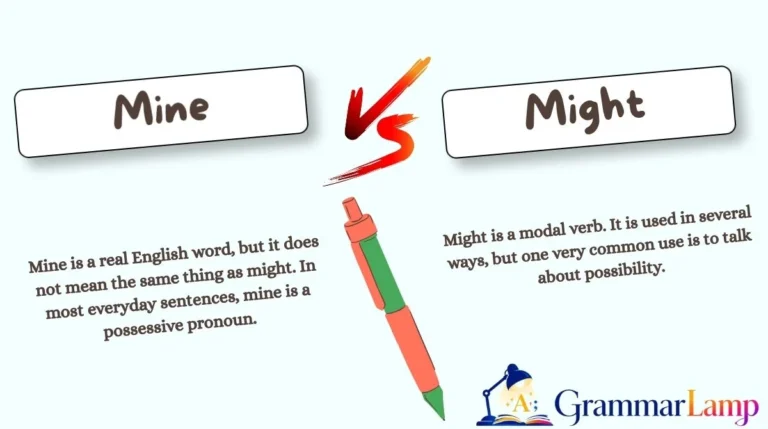
Mine is a real English word, but it does not mean the same thing as might. In most everyday sentences, mine is a possessive pronoun.
A possessive pronoun tells us who something belongs to.
For example:
- This book is mine.
- That phone is mine.
- The blue car is mine.
- This seat is mine.
In these sentences, mine means “belonging to me.”
When do we use “mine”?
We use mine when we want to show possession without repeating the noun.
Compare these sentences:
This is my book.
and:
This book is mine.
Both sentences tell us that the book belongs to me.
The important grammar difference is that my usually comes before a noun, while mine normally stands alone.
- my + noun → my phone
- mine → The phone is mine.
Examples with “mine”
- That laptop is mine.
- This jacket is mine.
- The red bicycle is mine.
- Is this pen mine or yours?
- That room is mine.
- The mistake was mine.
- This seat is mine, but you can use it for a few minutes.
- I think that umbrella is mine.
Notice that none of these sentences use mine to mean “it is a good idea to do something.”
“Mine” can also be a noun
There is another meaning of mine. A mine can be a place where people take valuable materials such as coal, gold, or other minerals from the ground.
For example:
His father worked in a coal mine.
We can also use mine as a verb:
They mine gold in this area.
However, this meaning has nothing to do with the expression might as well.
Can we say “mine as well”?
You may sometimes see or hear “mine as well,” but it is generally not the phrase you want when you mean “we should do it” or “there is no reason not to do it.”
For example, if you want to say:
There is no point in waiting. We should leave now.
You should say:
We might as well leave now.
Not:
We mine as well leave now.
The second sentence is a spelling mistake caused by confusing mine with might.
Why does this mistake happen?
The main reason is pronunciation.
In fast speech, might as well can sound different from how it looks on the page. A learner may hear:
“We might as well go.”
and think the speaker said:
“We mine as well go.”
This is especially common for people who have learned English mainly through listening.
A useful point to remember is this:
“Mine” can show ownership, but it does not normally introduce the idea of doing something because it seems reasonable.
What Does “Might” Mean?
Might is a modal verb. It is used in several ways, but one very common use is to talk about possibility.
For example:
It might rain tonight.
This means there is a possibility of rain.
We can also use might when talking about something that is uncertain:
- She might come later.
- He might be busy.
- They might know the answer.
- I might call you tomorrow.
But might has another very useful function when it appears in the expression “might as well.”
What does “might as well” mean?
Might as well means that something is a reasonable choice because there is no strong reason not to do it, or because another option does not seem better.
For example:
The movie starts in five minutes. We might as well wait here.
The speaker is saying that waiting here is the sensible thing to do because the movie is about to start.
Another example:
You are already at the store, so you might as well buy some milk.
The person is already at the store, so buying milk is an easy and sensible choice.
The basic grammar rule
The normal structure is:
subject + might as well + base verb
For example:
I might as well go.
We might as well stay.
She might as well ask.
They might as well wait.
The verb after might as well stays in its base form.
Correct:
We might as well leave.
Incorrect:
We might as well leaves.
Incorrect:
We might as well to leave.
8 examples with “might as well”
- It is getting late, so we might as well go home.
- You are already here, so you might as well stay for dinner.
- The bus is delayed, so we might as well walk.
- Nobody is using this room, so we might as well sit here.
- I have already started the book, so I might as well finish it.
- We have an hour before the meeting, so we might as well get some coffee.
- If you are going to the supermarket, I might as well come with you.
- There is nothing else to do, so we might as well watch a movie.
In each example, the speaker sees the action as a practical or reasonable choice.
Difference Between “Mine as Well” and “Might as Well”
The most important thing to understand is that these expressions are not two equal choices.
If you are trying to express the common phrase meaning “there is no better reason not to do it,” use:
might as well
Mine as well is usually a mistake in this context.
Quick comparison
| Expression | Meaning | Common use | Example |
|---|---|---|---|
| mine | belonging to me | Showing possession | This bag is mine. |
| mine as well | Usually not the intended expression | Usually a spelling mistake for might as well | ❌ We mine as well leave. |
| might | possibility or other modal meanings | Talking about possibility | She might come. |
| might as well | a reasonable choice when there is little reason not to | Everyday decisions | We might as well leave. |
The meaning is completely different
Consider:
This phone is mine.
Here, mine tells us who owns the phone.
Now compare:
We might as well leave.
Here, might as well tells us that leaving seems like the best or most practical choice under the circumstances.
These two words cannot simply replace each other.
“Might as well” often suggests a practical decision
Suppose you arrive at a restaurant, but your friend is ten minutes late.
You might say:
We might as well order some drinks while we wait.
You are not saying that ordering drinks is certain or required. You are saying that, given the situation, it seems reasonable.
Another example:
The weather is terrible, so we might as well stay inside.
The bad weather makes staying inside seem like a sensible option.
It can sometimes express resignation
Might as well does not always sound enthusiastic.
For example:
The computer is already broken, so I might as well try to fix it myself.
The speaker may not really want to fix it. They simply feel there is little to lose by trying.
Similarly:
We missed the last bus, so we might as well walk home.
Walking may not be the speaker’s first choice. It is simply the remaining practical choice.
This idea of “there is no better option” is very important.
Grammar Rules You Must Remember
Rule 1: Use “might as well,” not “mine as well,” for this expression
When you mean “it would be reasonable to do this”, the expression is:
might as well
For example:
We might as well start now.
Not:
We mine as well start now.
The incorrect version comes from confusing the spelling of might with mine.
Rule 2: Use the base form of the verb after “might as well”
The pattern is:
might as well + base verb
Examples:
- might as well go
- might as well wait
- might as well eat
- might as well ask
- might as well try
Do not add -s, -ed, or to after might as well.
Incorrect:
She might as well goes.
Correct:
She might as well go.
Incorrect:
We might as well to wait.
Correct:
We might as well wait.
Rule 3: “Might as well” does not mean “definitely”
The word might can make learners think that might as well means something is simply possible.
But the expression has a special meaning.
Compare:
It might rain.
This means rain is possible.
But:
We might as well stay home.
This means staying home seems like a reasonable choice.
The two sentences use might differently.
Rule 4: “Mine” normally shows possession
When mine is used as a possessive pronoun, it tells us that something belongs to the speaker.
Examples:
This notebook is mine.
That car is mine.
The blue jacket is mine.
A simple test is to replace mine with my + noun.
This is mine.
→ This is my book.
That bag is mine.
→ That is my bag.
This test helps you recognize the possessive meaning of mine.
Common Mistakes Students Make
English learners often make this mistake because they learn expressions by sound before they learn the spelling.
Here are some common examples.
Mistake 1: Writing “mine as well”
❌ We mine as well go now.
✅ We might as well go now.
The speaker means that going now is a reasonable choice.
Mistake 2: Adding “to” after “might as well”
❌ We might as well to leave.
✅ We might as well leave.
Modal verbs such as might are followed by the base form of the verb. We do not use to here.
Mistake 3: Adding “-s” to the verb
❌ She might as well goes home.
✅ She might as well go home.
The subject she does not change the verb after might.
Mistake 4: Thinking “might as well” always means “want to”
Consider:
We might as well take a taxi.
This does not necessarily mean:
“We really want to take a taxi.”
It means taking a taxi seems like a reasonable option in the situation.
Mistake 5: Confusing “might as well” with “may as well”
You may also hear:
We may as well leave now.
This is also correct.
May as well and might as well can often express the same idea.
For many everyday situations, might as well is especially common in informal conversation.
Easy correction tip
Whenever you want to write “mine as well”, stop and ask yourself:
Am I talking about ownership?
If the answer is no, you probably mean:
might as well
For example:
“There is no point waiting. We ___ leave.”
You are not talking about ownership. Therefore:
We might as well leave.
Easy Trick to Remember the Difference
Here is a simple memory trick:
Mine = belongs to me
Might as well = reasonable choice
Think about these two sentences:
This pen is mine.
The pen belongs to me.
I might as well use this pen.
Using the pen is a practical choice.
You can also remember mine by thinking of the question:
Whose is it?
If the answer is “mine,” you are talking about ownership.
For example:
Whose bag is this?
It is mine.
But if you are deciding what to do, think:
What is the sensible thing to do now?
That is where might as well can be useful.
For example:
The shop is closing in ten minutes.
We might as well buy the things now.
A second memory trick
Think of might as well as:
“There is no good reason not to.”
This is not a perfect translation in every situation, but it is a very useful way for beginners to understand the idea.
For example:
We are already at the beach, so we might as well swim.
The meaning is close to:
We are already here, so there is no strong reason not to swim.
Another:
I have already opened the email, so I might as well read it.
The action seems sensible because the speaker has already started the process.
Daily Life Examples
The expression might as well is very common in normal conversations. Here are some natural examples you may hear at home, at school, at work, or while traveling.
1. At home
A: What should we do tonight?
B: There is nothing good on TV. We might as well watch a movie.
Here, watching a movie is suggested as a reasonable choice.
2. Waiting for a friend
A: Sara is going to be twenty minutes late.
B: We might as well get some coffee while we wait.
The speakers have time to use, so getting coffee makes sense.
3. At work
A: The meeting doesn’t start for another hour.
B: We might as well finish this report first.
The person suggests using the available time productively.
4. At the supermarket
A: We’re almost out of milk.
B: Since we’re already here, we might as well buy some.
They are already at the store, so buying milk is convenient.
5. During a trip
A: The next bus comes in two hours.
B: We might as well walk.
Walking may not be perfect, but waiting two hours is not attractive.
6. At school
A: We have ten minutes before class starts.
B: We might as well review our notes.
Reviewing notes is a useful way to spend the extra time.
7. When plans change
A: The football game was canceled.
B: Well, we might as well go home.
Since the original plan cannot happen, going home is a reasonable alternative.
8. While cooking
A: I’m making pasta. Do you want some?
B: Sure. You might as well make enough for both of us.
The second person suggests making more because the cooking is already happening.
9. After missing a bus
A: We missed the last bus.
B: We might as well call a taxi.
A taxi is now a practical option.
10. When there is nothing else to do
A: I’ve finished all my homework.
B: You might as well clean your room.
The speaker suggests another useful activity because the homework is already finished.
Practice Section
Choose the correct option: mine or might.
1. This laptop is ___.
2. We ___ as well leave before it gets dark.
3. That blue jacket is ___.
4. There are only five minutes left, so we ___ as well start now.
5. Since you are already going to the store, you ___ as well buy some bread.
Answers
1. mine
This laptop is mine.
The sentence talks about ownership.
2. might
We might as well leave before it gets dark.
This means leaving is a reasonable choice.
3. mine
That blue jacket is mine.
Again, the sentence talks about possession.
4. might
We might as well start now.
Starting now seems sensible because there is very little time.
5. might
You might as well buy some bread.
The person is already going to the store, so buying bread is convenient.
Try one more test
Ask yourself what the sentence means:
This umbrella is mine.
Ownership? Yes → mine.
It is raining, so we might as well stay inside.
Reasonable choice? Yes → might as well.
That simple test can prevent many mistakes.
FAQs
1. What is the difference between “mine as well” and “might as well”?
Might as well is the correct expression when you mean that something is a reasonable choice or that there is little reason not to do it.
Mine is normally a possessive pronoun meaning “belonging to me.” Therefore, “mine as well” is usually a mistake when someone intends to write “might as well.”
2. Is “mine as well” grammatically correct?
It can appear in unusual sentences where mine has its normal meaning, but it is not the standard phrase people mean when they say might as well.
For example, learners should not write:
❌ We mine as well go.
The correct sentence is:
✅ We might as well go.
3. What does “might as well” mean?
Might as well means that something seems like a sensible or practical choice, especially when there is no better option or no strong reason not to do it.
For example:
The store is closing soon, so we might as well go now.
It can also express mild resignation.
4. Can we use “might as well” in questions?
Yes. It can be used in questions, although the exact structure depends on what you want to ask.
For example:
Might as well go now?
This is possible in very informal speech, but a more natural question is often:
Should we go now?
You can also ask:
Why don’t we just go now? We might as well.
The expression is particularly common in statements and suggestions.
5. Is “might as well” formal or informal?
Might as well is common in everyday English and is especially natural in conversation. It is not an incorrect or slang expression, but it often has a relaxed, conversational feeling.
You can use it in many normal situations, although a more formal sentence may use words such as “it would be reasonable to” when a very formal style is needed.
6. Is “may as well” also correct?
Yes. May as well is also a correct expression and can have the same basic meaning as might as well.
For example:
We may as well leave now.
and:
We might as well leave now.
Both can mean that leaving now is a sensible choice. Might as well is very common in everyday English.
Conclusion
The difference between “mine as well” and “might as well” becomes much easier when you focus on meaning instead of sound.
Mine is usually a possessive pronoun. It means that something belongs to you:
This phone is mine.
Might as well, on the other hand, is a common English expression used when an action seems reasonable, practical, or worth doing because there is no better option:
We might as well go home.
If you catch yourself writing “mine as well” in a sentence about making a decision, check it carefully. In most cases, you need “might as well.”
Remember the simple rule:
Mine = belongs to me.
Might as well = there is little reason not to do it.
Once you start noticing this phrase in conversations, movies, and everyday English, its meaning will become natural.
A little practice with real sentences is usually enough to make the correct form stick.

Liam Derren is a language writer at GrammarLamp, creating simple, helpful content about grammar, words, and everyday English. He makes language learning clear, practical, and easy to understand.
2 thoughts on “Mine as Well or Might as Well? The Correct Phrase Explained in Simple English (2026)”