
Have you ever felt confused after waking up in an unfamiliar place? Perhaps you entered a large building and could not remember which way to go.
You might say, “I feel disoriented.” But what if someone says, “I feel disorientated”? Is that sentence wrong, or are both words correct?
This is a common question for English learners. The two words look almost the same, and they share the same basic meaning. However, their spelling and use can make students wonder which form they should choose, especially when writing an email, completing an English test, or speaking with someone from another country.
The good news is that you do not need to learn two completely different meanings. Disoriented and disorientated both describe a person who feels confused, loses their sense of direction, or struggles to understand where they are or what is happening. Both forms are accepted in English.
The main difference is a matter of word form and regional preference. Disoriented is especially common in American English, while disorientated is often associated with British English.
However, these preferences are not strict rules, and you may see either form in different English-speaking countries.
By the end of this guide, you will understand the meaning of both words, know how to use them in sentences, recognize common mistakes, and choose the form that best suits your writing. You will also learn a few simple grammar rules and practice using both words in everyday conversations.
More Useful posts
Emaculate vs Immaculate 2026: Which Spelling Is Correct?
Fit vs Fitted: What’s the Difference? Easy Grammar Guide for 2026
Shudder vs Shutter: Meaning, Difference, Examples, and Grammar Rules in 2026
Message vs messege: Correct Spelling, Meaning & Usage in 2026
What Does “Disoriented” Mean?
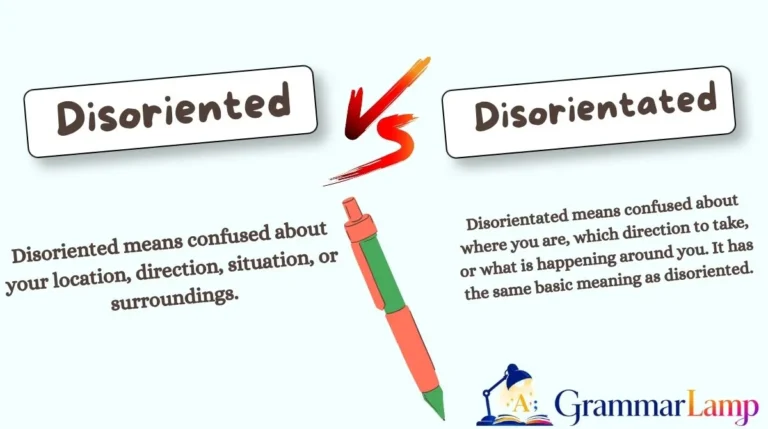
Disoriented means confused about your location, direction, situation, or surroundings. A disoriented person may not know where they are, which way they should go, or what is happening around them.
For example, imagine that you wake up in a hotel room after a long flight. For a few seconds, you do not remember which city you are in. You might say, “I felt disoriented when I woke up.” The word describes your temporary confusion.
The word can also describe mental confusion. A person may feel disoriented after receiving unexpected news, experiencing a sudden change, or entering an unfamiliar environment.
When Should You Use “Disoriented”?
Use disoriented when someone has lost their sense of direction or feels mentally confused. It can describe a temporary feeling or a condition that lasts longer, depending on the situation.
Here are some common situations in which you might use it:
- After waking up: You may feel confused for a short time after sleeping deeply.
- In an unfamiliar place: You may struggle to find your way around a new city.
- After an unexpected event: Sudden news or a major change may leave you mentally confused.
- During travel: Jet lag, tiredness, or unfamiliar surroundings may make you feel disoriented.
- In a medical situation: A person may become disoriented because of an illness, injury, medication, or another medical cause.
The word is useful in everyday conversation, formal writing, stories, news reports, and medical descriptions. Its exact meaning depends on the context.
Grammar Rule for “Disoriented”
Disoriented is the past tense and past participle of the verb disorient. It is also commonly used as an adjective.
As an adjective, it often follows a linking verb such as feel, seem, look, be, or become.
Common sentence patterns:
- Subject + linking verb + disoriented
- Subject + have/has/had + become + disoriented
- Subject + be + disoriented + by something
For example:
- She felt disoriented after the long journey.
- The visitor seemed disoriented in the crowded station.
- He has become disoriented in the unfamiliar building.
- The sudden change left the team disoriented.
In these sentences, the word describes a state of confusion or the result of something that caused confusion.
Examples of “Disoriented” in Sentences
- I felt disoriented when I woke up from a deep sleep.
The speaker was confused for a short time after waking. - The tourist became disoriented while walking through the old city.
The tourist lost their sense of direction. - She looked disoriented after hearing the unexpected announcement.
The news seemed to leave her mentally confused. - He felt disoriented when he entered the huge shopping mall.
The unfamiliar surroundings made it difficult for him to find his way. - The patient appeared disoriented during the medical examination.
The patient seemed confused about their surroundings or situation. - After moving to a new country, I felt disoriented for several days.
The speaker needed time to adjust to a different environment. - The sudden change in plans left everyone disoriented.
People were unsure what to do next. - Without a map, the hikers became disoriented in the forest.
They lost their sense of direction.
Common Learner Confusion
Some learners believe disoriented must refer only to physical direction. That is not true. It can also describe mental confusion or difficulty understanding a situation.
For example, “I felt disoriented after the meeting” may mean that the speaker was confused about what had been discussed or what should happen next. It does not necessarily mean that the speaker got lost.
Another common misunderstanding is that disoriented is the only correct spelling. It is a standard and widely used form, but disorientated is also correct. The choice between them is usually about regional usage and personal preference, not a difference in meaning.
What Does “Disorientated” Mean?
Disorientated means confused about where you are, which direction to take, or what is happening around you. It has the same basic meaning as disoriented.
For example, someone who enters an unfamiliar hospital and cannot find the correct department may say, “I felt disorientated.” The sentence is correct. Another person might express the same experience by saying, “I felt disoriented.”
The extra syllable in disorientated does not create a separate meaning. Both words describe a loss of direction, awareness, or understanding.
The form disorientated is often associated with British English and is familiar to many speakers in the United Kingdom and other regions influenced by British usage. However, it is not exclusive to those places, and speakers do not always follow the same preference.
When Should You Use “Disorientated”?
Use disorientated in the same situations in which you would use disoriented. It works when describing confusion caused by an unfamiliar place, an unexpected event, a change in routine, or difficulty understanding a situation.
For example, you could say:
- “I became disorientated after getting off the wrong train.”
- “The visitor seemed disorientated in the unfamiliar building.”
- “She felt disorientated after the sudden change in her schedule.”
All three sentences are grammatically acceptable.
If you are writing for a British English audience, disorientated may feel like a natural choice. If you are writing for an American audience, disoriented is generally the more familiar option. When writing for an international audience, either form can work, but consistency is helpful.
Grammar Rule for “Disorientated”
Disorientated is the past tense and past participle of the verb disorientate. Like disoriented, it can also function as an adjective.
It follows the same common sentence patterns:
- Subject + linking verb + disorientated
- Subject + have/has/had + become + disorientated
- Subject + be + disorientated + by something
For example:
- I felt disorientated after the long flight.
- She seemed disorientated by the sudden noise.
- They have become disorientated in the new office.
- The unfamiliar route left us disorientated.
Notice that the sentence structure does not change when you replace disorientated with disoriented. The grammar remains the same.
Examples of “Disorientated” in Sentences
- I felt disorientated when I arrived at the new airport.
The speaker was confused by the unfamiliar surroundings. - The child became disorientated after leaving the crowded park.
The child was unsure where to go. - She seemed disorientated by all the changes at work.
The changes made it difficult for her to understand the situation. - He was disorientated when he woke up in an unfamiliar room.
He did not immediately recognize where he was. - The visitors felt disorientated inside the enormous museum.
They found it difficult to understand the layout or find their way. - After the journey, we were tired and disorientated.
The travelers were both exhausted and confused. - The new timetable left several students disorientated.
The students were unsure about their classes or schedules. - She became disorientated while trying to follow the complicated directions.
The directions made it difficult for her to know which way to go.
Common Learner Confusion
The most common mistake is thinking that disorientated is incorrect because it has more letters. English contains many words with different accepted forms, and a longer spelling is not automatically wrong.
Learners may also think the two words describe different levels of confusion. There is no general rule saying that disorientated is stronger, more serious, or more formal than disoriented. Both can describe mild confusion or a serious loss of awareness, depending on the context.
Remember that spelling preference and meaning are two different things. Regional usage may help you decide which form to write, but it does not give the two words different definitions.
Difference Between Disoriented and Disorientated (Detailed)
The main difference between these words is their spelling and regional preference. Both are accepted forms with the same basic meaning, and both can be used as adjectives or as past forms of their related verbs.
If you are unsure which one to choose, consider your audience. American English generally favors disoriented, while British English often uses disorientated. Neither form is universally required in every situation.
Comparison Table
| Feature | Disoriented | Disorientated |
|---|---|---|
| Basic meaning | Confused or lacking direction | Confused or lacking direction |
| Related verb | Disorient | Disorientate |
| Grammar | Adjective, past tense, past participle | Adjective, past tense, past participle |
| American English | Generally more common | Less common |
| British English | Also used | Often associated with British usage |
| Sentence pattern | She felt disoriented. | She felt disorientated. |
| Formal writing | Correct | Correct |
| Meaning difference | No general difference | No general difference |
1. Usage Difference
The clearest difference is the form that speakers tend to prefer in different varieties of English.
In American English, disoriented is the more common choice. You are likely to encounter it in everyday conversation, news writing, books, and professional communication.
In British English, disorientated is also widely familiar and often preferred. However, British speakers use disoriented too. It would be incorrect to claim that one form belongs only to one country.
Consider these sentences:
- American-style preference: “I felt disoriented after the flight.”
- British-style preference: “I felt disorientated after the flight.”
Both sentences express the same idea. Neither changes the experience being described.
2. Grammar Logic
The two forms follow the same grammatical logic, even though they come from related verbs with different forms.
The verb disorient can mean to make someone lose their sense of direction or understanding. Its past form is disoriented, and its past participle is also disoriented.
The verb disorientate has the past form disorientated and the past participle disorientated.
Compare the forms:
- Present: The confusing signs disorient me.
- Past: The confusing signs disoriented me.
- Present perfect: The confusing signs have disoriented me.
Now compare the other verb:
- Present: The confusing signs disorientate me.
- Past: The confusing signs disorientated me.
- Present perfect: The confusing signs have disorientated me.
Both sets are grammatically possible. The choice depends on the verb form you prefer and the variety of English you are using.
3. Sentence Structure Difference
There is no special sentence structure for one word that does not work with the other. Both can follow linking verbs, appear after forms of be, and be used in perfect tenses.
For example:
With a linking verb
- I feel disoriented.
- I feel disorientated.
With the verb “be”
- He was disoriented by the sudden change.
- He was disorientated by the sudden change.
With the present perfect
- She has become disoriented.
- She has become disorientated.
The sentences are built in the same way. You do not need to change the subject, tense, or other words just because you choose the longer form.
4. Meaning Comparison
Both words can describe physical confusion, such as getting lost in a building, and mental confusion, such as struggling to understand a sudden change.
For example, a traveler who cannot find the correct platform may be described as disoriented or disorientated. Similarly, a person who feels overwhelmed by an unexpected situation may be described using either form.
The context tells the reader what kind of confusion is involved. The spelling alone does not tell the reader whether the person is mildly confused, badly lost, or struggling to understand important information.
The easiest rule is this: the meaning stays the same; the preferred spelling may change.
5. Which Word Is Better for SEO and Website Writing?
If you are writing an English-learning article for readers in different countries, it is useful to explain both forms. Many learners search for the exact phrase they have seen or heard, so a clear comparison can answer their question.
For an American English audience, disoriented is usually the safer main form. For a British English audience, disorientated may be a natural choice. If your website serves an international audience, use the form that fits your main style and explain the alternative early in the article.
Avoid using the two forms randomly throughout the same piece. Although both are correct, consistent spelling makes an article easier to read and gives it a more polished appearance.
Explore More Posts
Manuel vs Manual: Meaning, Difference & Correct Usage in 2026
Scarry vs Scary in 2026: Which Spelling Is Correct and What Is the Difference?
Cleverer vs More Clever: Which One Is Correct in 2026?
Wear vs Were vs We’re vs Where: Easy Difference Guide for 2026
Grammar Rules You Must Remember
Understanding the meaning is important, but a few grammar rules will help you use both forms naturally. These rules are simple and apply to everyday speaking as well as formal writing.
Rule 1: Both Words Can Work as Adjectives
An adjective describes a person, place, thing, or state. Both words can describe someone who feels confused or has lost their sense of direction.
Examples:
- The disoriented traveler asked for help.
- The disorientated traveler asked for help.
- She looked disoriented after the meeting.
- She looked disorientated after the meeting.
In each sentence, the word describes a state or condition. You can place it before a noun or after a linking verb such as look, feel, or seem.
Rule 2: Match the Form to the Verb Tense
When you use the words as verbs, remember which form belongs to the tense.
With disorient:
- Present: The strange layout disorients visitors.
- Past: The strange layout disoriented visitors.
- Present perfect: The strange layout has disoriented visitors.
With disorientate:
- Present: The strange layout disorientates visitors.
- Past: The strange layout disorientated visitors.
- Present perfect: The strange layout has disorientated visitors.
Do not use the base form after has or have in these perfect-tense patterns. Use the correct past participle instead.
Rule 3: Use “Feel,” “Become,” and “Seem” Naturally
Both adjectives commonly appear after linking verbs.
Examples:
- I feel disoriented in this building.
- I feel disorientated in this building.
- He became disoriented after the sudden change.
- He became disorientated after the sudden change.
These verbs help describe a person’s condition. Use feel when talking about someone’s experience, become when the condition develops, and seem when describing how the person appears to others.
Rule 4: Keep Your Regional Style Consistent
Choose a form that suits your audience and use it consistently in the same piece of writing.
Examples:
- For a mainly American audience: “The driver felt disoriented.”
- For a mainly British audience: “The driver felt disorientated.”
This is a style preference, not a strict grammar rule. You will find both forms across English-speaking regions, so do not mark the alternative as automatically incorrect.
Common Mistakes Students Make
Even though these words are easy to understand, learners sometimes use them incorrectly or avoid them because they are unsure which spelling is right.
Mistake 1: Thinking “Disorientated” Is Always Wrong
Incorrect claim: “Disorientated is not a real English word.”
Correct explanation: Both disoriented and disorientated are accepted English forms.
The confusion often comes from learning American English first, where disoriented is generally more common. When students later see the other spelling, they may assume it is a mistake. Instead, remember that English has regional differences.
Correction tip: Learn the two forms together, along with their shared meaning.
Mistake 2: Giving the Words Different Meanings
Incorrect claim: “Disoriented means slightly confused, but disorientated means completely lost.”
Correct explanation: There is no standard rule that gives these words different levels of confusion.
For example, both “I felt disoriented after waking up” and “I felt disorientated after waking up” can describe temporary confusion. The situation determines how serious the confusion is.
Correction tip: Focus on the context, not the number of letters.
Mistake 3: Using the Wrong Verb Form
Incorrect: She has disorient the visitors.
Correct: She has disoriented the visitors.
Also correct: She has disorientated the visitors.
After has or have, a present-perfect sentence needs a past participle. The correct participle depends on which verb you choose.
Correction tip: Remember the two sets: disorient, disoriented, disoriented and disorientate, disorientated, disorientated.
Mistake 4: Assuming the Word Always Means Getting Lost
Incorrect claim: “I can use these words only when someone cannot find a road.”
Correct explanation: The words can describe physical confusion and mental confusion.
For example, “The new rules left me disoriented” means the speaker struggled to understand the rules or what to do next. The person does not have to be physically lost.
Correction tip: Ask yourself whether the person has lost their direction or feels confused about a situation. Either meaning may fit.
Mistake 5: Changing the Whole Sentence Unnecessarily
Some learners think they must change the sentence structure when switching from one form to the other.
Original: The patient seemed disoriented.
Alternative: The patient seemed disorientated.
Both are correct. The rest of the sentence does not need to change.
Correction tip: When replacing one form with the other, check the meaning and grammar, then leave the sentence structure alone if it still works.
Mistake 6: Mixing Regional Spellings Without a Reason
Using both words in one article is not automatically a grammar error. However, switching between them without a clear reason may make the writing feel inconsistent.
For example, you might write disoriented in one paragraph and disorientated in the next, even though your article follows American English spelling elsewhere.
Correction tip: Pick a main form for your audience. Use the alternative when discussing the difference between the words or when quoting someone.
Easy Trick to Remember the Difference
Here is a simple way to remember these words: think of “disoriented” as the shorter form and “disorientated” as the longer form, but remember that both mean confused or lacking direction.
The spelling can help you remember regional preferences. Disoriented is generally more common in American English, while disorientated is often associated with British English. This is a useful guide, although it is not a rule that every speaker follows.
Imagine that you are visiting a large airport for the first time. You walk through several corridors and suddenly realize that you cannot find your departure gate. You could say either:
- “I am completely disoriented.”
- “I am completely disorientated.”
Both sentences communicate your confusion. The listener does not need to know which spelling you chose to understand your problem.
You can also use a simple memory question: “Am I choosing a spelling, or am I choosing a meaning?” If you are choosing a meaning, there is usually no difference to worry about. If you are choosing a spelling, think about your audience and the style of English you want to follow.
For everyday use, you do not need to memorize separate definitions. Learn one meaning and two accepted forms. That will make the choice much easier.
Daily Life Examples: Disoriented vs Disorientated
The best way to learn a word is to see how people use it in ordinary situations. The following conversations show that both forms can fit naturally into everyday English.
1. After Waking Up
Ali: Why are you looking around like that?
Sam: I just woke up, and I feel disoriented.
Ali: You probably need a few minutes to wake up properly.
The speaker uses the word to describe temporary confusion after sleeping.
2. At the Airport
Maya: Have you found your departure gate?
Sara: Not yet. I feel disorientated in this airport.
Maya: Check the signs near the information desk.
The word describes difficulty finding the right direction in an unfamiliar place.
3. After Moving House
Ahmed: How is life in your new house?
Bilal: Good, but I still feel disoriented because everything is in a different place.
Ahmed: You will get used to it soon.
Here, the speaker is adjusting to a new environment.
4. During a Work Meeting
Manager: Is everything clear about the new schedule?
Employee: To be honest, I feel a little disoriented by all the changes.
Manager: No problem. I will explain the new plan again.
The word describes mental confusion rather than physical direction.
5. In a Shopping Mall
Friend 1: Where are you? We have been looking for you.
Friend 2: I got disoriented and ended up on the wrong floor.
Friend 1: Stay there. We will come and find you.
The speaker has lost their sense of direction.
6. After a Long Journey
Nadia: You look tired. Are you okay?
Hina: Yes, just a bit disorientated after that long journey.
Nadia: Get some rest before we go out again.
The word describes a feeling after travel and tiredness.
7. When Plans Change
Teacher: Why have you not started the assignment?
Student: I got disoriented when the instructions changed.
Teacher: Read the updated instructions, and ask me if anything is unclear.
The speaker is confused about what to do next.
8. In an Unfamiliar Building
Visitor: Excuse me, could you help me?
Receptionist: Of course. What are you looking for?
Visitor: I am a little disoriented. I cannot find the conference room.
The visitor uses the word politely to explain why they need help.
9. After Unexpected News
Friend 1: You have been quiet since the announcement.
Friend 2: I feel disoriented. I did not expect this to happen.
Friend 1: I understand. Take some time to think about it.
The word describes an emotional or mental reaction to unexpected information.
10. While Hiking
Hiker 1: Do you know which path leads back to the campsite?
Hiker 2: No. I think we have become disoriented.
Hiker 1: Let’s stop and check the map before moving.
The hikers have lost their sense of direction. In a real situation, they should stop somewhere safe and use reliable navigation or seek help if needed.
These conversations show that the two forms can be used in the same types of situations. You can change the spelling without changing the basic message.
Practice Section
Test your understanding with these five questions. Choose the option that best completes each sentence.
1. I felt ______ after waking up in an unfamiliar hotel room.
- A. disoriented
- B. disorienting
2. The confusing directions left us ______.
- A. disorientate
- B. disorientated
3. She has become ______ since entering the unfamiliar building.
- A. disoriented
- B. disorient
4. Which statement about disoriented and disorientated is correct?
- A. They always have different meanings.
- B. They share the same basic meaning.
5. Which form is generally more common in American English?
- A. Disoriented
- B. Disorientated
Answers and Explanations
1. A — disoriented. This form is correct after felt. The sentence describes a person’s state of confusion. Disorientated would also be correct here.
2. B — disorientated. The sentence needs an adjective or past participle describing the result of the confusing directions. Disoriented would also work.
3. A — disoriented. The phrase has become is followed by an adjective describing the person’s condition. Disorientated is also acceptable.
4. B — They share the same basic meaning. Both forms describe confusion or a loss of direction.
5. A — Disoriented. This is generally the more common form in American English, although both forms are used.
The main lesson from this exercise is that both spellings can be correct. Pay attention to the sentence structure, and choose a form that suits your writing style.
More Helpful posts
Disenroll vs Unenroll: Which Word Is Correct in 2026?
Listen to Music vs Listen to the Music: Difference, Rules & Examples (2026)
Girlie vs Girly: What’s the Difference and Which One Should You Use in 2026?
I Would Appreciate vs I Will Appreciate: Clear Difference Explained in 2026
FAQs
1. What is the difference between disoriented and disorientated?
Both words mean confused about your location, direction, or situation. Disoriented is generally more common in American English, while disorientated is often associated with British English. Neither form is automatically wrong.
2. Is disorientated a correct English word?
Yes, disorientated is a correct English word. It is the past tense and past participle of disorientate, and it can also work as an adjective. It has the same basic meaning as disoriented.
3. Is disoriented American or British English?
Disoriented is especially common in American English, but British speakers also use it. The word is not limited to one country. Both forms appear across English-speaking regions, although preferences may differ.
4. Can I use disoriented in a formal sentence?
Yes, disoriented is suitable for formal writing, including reports, articles, and professional communication. You can also use disorientated in formal writing. Choose the form that fits your intended audience and remain consistent.
5. Can disoriented and disorientated be used in the same sentence?
Yes, they can both appear in the same sentence if you are discussing the words themselves. However, using one form consistently in ordinary writing usually makes the text easier to follow. There is no need to switch between them without a reason.
6. Does disoriented mean mentally confused or physically lost?
It can mean either, depending on the situation. Someone who cannot find their way in a building may be disoriented, and someone who struggles to understand a sudden change may also feel disoriented. The context tells you which meaning is intended.
Conclusion
The difference between disoriented and disorientated is much simpler than it may first appear. Both are accepted English forms, and both describe a person who feels confused, loses their sense of direction, or struggles to understand their surroundings.
You do not need to learn two separate meanings or memorize different grammar rules for them.
The main thing to remember is regional preference. Disoriented is generally more common in American English, while disorientated is often associated with British English. However, both forms are used in different English-speaking countries, so neither should be treated as universally incorrect.
When speaking, choose the form that feels natural to you. When writing, consider your audience and follow one form consistently throughout your work. Both words can function as adjectives and as past forms of their related verbs, so the same basic sentence patterns apply.
Keep practicing with real-life examples, such as feeling confused in an airport or struggling to understand a sudden change.
The more you use these words, the easier they will become to remember. English becomes clearer when you focus on meaning, context, and correct usage rather than spelling alone.

Liam Derren is a language writer at GrammarLamp, creating simple, helpful content about grammar, words, and everyday English. He makes language learning clear, practical, and easy to understand.