
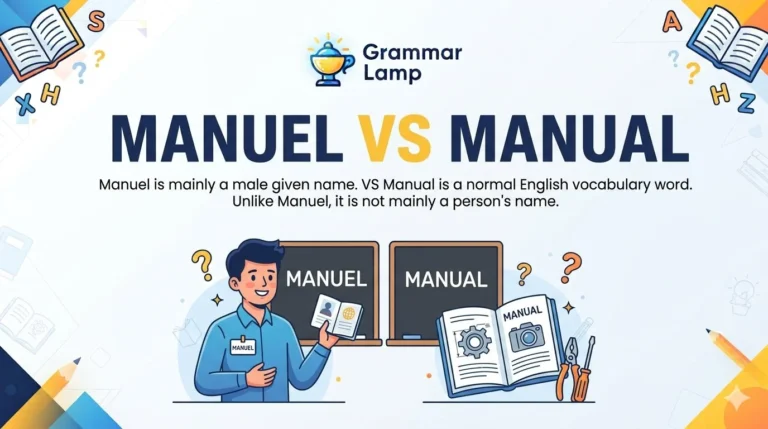
English learners often get confused by words that look almost the same. Manuel and manual are a good example.
They differ by only one letter, so it is easy to type one when you mean the other. The confusion can become even stronger because the two words can sound very similar in some accents.
However, Manuel and manual do not normally have the same job in English. Manuel is mainly a male personal name, while manual is an English word that can work as both an adjective and a noun.
A manual can describe something done by hand, a physical type of work, a hand-operated system, or a book that gives instructions. Cambridge and other major dictionaries list these uses separately.
There is also an interesting reason for the spelling confusion. Manuel comes from a personal name used in Spanish and Portuguese, while manual has a long history connected to the Latin word manus, meaning “hand.”
Once you understand their meanings and grammar, the difference becomes much easier. You will know when to write a person’s name as Manuel and when to use manual for work, machines, instructions, cars, and other situations.
More Useful posts
If There Is Any vs If There Are Any: Meaning, Difference, and Examples (2026)
Also Have or Have Also: Which Is Correct? Complete Grammar Guide 2026
Sneaked vs Snuck: What Is the Difference? 2026 Guide
Wether vs Weather vs Whether: What’s the Difference? 2026 Guide
What Does “Manuel” Mean?
Manuel is mainly a male given name. In English writing, it is treated as a proper noun, which means it is the name of a particular person and normally begins with a capital letter.
The name is especially associated with Spanish and Portuguese usage. Name references describe Manuel as a Spanish and Portuguese form of Emmanuel. The name Emmanuel comes from a Hebrew name traditionally understood as meaning “God is with us.”
So, when you see Manuel in a sentence such as “Manuel is my neighbor,” you are not looking at an adjective or an ordinary English vocabulary word. You are seeing a person’s name.
When Should You Use Manuel?
Use Manuel when you are referring to a person who has that name.
For example:
- Manuel is coming to the office today.
- I met Manuel at the airport.
- Manuel lives near my school.
- Did Manuel call you last night?
- Please give this letter to Manuel.
- Manuel’s phone is on the table.
- I studied with Manuel for three years.
- Have you seen Manuel today?
Notice the capital M in every example. That capitalization is important because names of people are proper nouns.
Grammar Rule for Manuel
The basic rule is simple:
Manuel is a proper noun used as a person’s name, so it normally starts with a capital letter.
You can use it as the subject, object, or possessive form in a sentence.
Subject:
Manuel works here.
Object:
I called Manuel.
Possessive:
Manuel’s laptop is new.
You can also use Manuel in questions:
Is Manuel at home?
Why did Manuel leave early?
When will Manuel arrive?
The word does not become an ordinary noun just because it appears in a question. It is still a person’s name.
A Common Learner Confusion
The biggest problem happens when someone types manuel when they mean manual.
For example:
❌ Please read the manuel before using the machine.
✅ Please read the manual before using the machine.
Here, the writer is talking about an instruction book, not a person named Manuel.
But this sentence is completely correct:
✅ Manuel is reading the book.
The meaning comes from the context. One refers to a person, and the other refers to a thing or quality.
Pronunciation Can Add to the Confusion
The two forms may sound close in some varieties of English. Cambridge gives the English pronunciation of Manuel as /ˈmæn.ju.el/, while manual is pronounced /ˈmæn.ju.əl/.
Because the sounds are so close, especially for learners listening quickly, spelling can become a problem. This is one reason it helps to connect each spelling with its meaning instead of relying only on sound.
What Does “Manual” Mean?
Manual is a normal English vocabulary word. Unlike Manuel, it is not mainly a person’s name.
It has several common uses, and this is where learners sometimes get confused. Manual can be an adjective or a noun. Cambridge defines the adjective as describing something done with the hands or involving physical work, and it also uses the word for a vehicle or system that is operated by hand rather than automatically. As a noun, it can mean a book of instructions or, in transport, a vehicle with gears changed by the driver.
Manual as an Adjective
An adjective describes a noun.
When manual is an adjective, it commonly means:
- done by hand
- operated by hand
- involving physical work
- not automatic
- relating to a vehicle that requires the driver to change gears
Examples:
- The workers still use manual tools.
- This is a manual process.
- He does manual labor on a farm.
- We need manual control of the machine.
- She learned how to drive a manual car.
- The company replaced the manual system with an automated one.
- Manual work can be physically demanding.
- The printer has a manual feed option.
In manual labor, the word describes physical work rather than mainly mental or desk-based work. Cambridge specifically uses manual labour or manual labor for physical work.
Manual as a Noun
Manual can also be a noun. In this use, it often means a book that explains how to use something or how to do something.
Examples:
- Please read the manual first.
- The machine came with a detailed manual.
- I lost the instruction manual.
- You can find the answer in the repair manual.
- The employee training manual is on the desk.
- According to the manual, this button resets the system.
- She bought a manual for basic home repairs.
Oxford describes this noun use as a book that tells you how to do or operate something, especially a book supplied with a machine.
Manual as a Vehicle Noun
There is another very common use, especially in conversations about cars.
A manual can mean a vehicle with a manual transmission. In such a vehicle, the driver changes gears rather than the transmission doing it automatically. Cambridge and Oxford both record this use.
For example:
- Do you drive a manual?
- I learned to drive a manual last year.
- She prefers a manual to an automatic.
Here, manual is a noun. It means a manual vehicle, not an instruction book.
Grammar Rule for Manual
The grammar depends on the role of the word.
As an adjective, it normally describes a noun:
manual work
manual system
manual control
manual transmission
As a noun, it refers to a thing:
a manual
the manual
two manuals
This difference is important because the word changes its grammatical job without changing its spelling.
Difference Between Manuel and Manual
The easiest way to understand the difference is to remember that one is normally a name, while the other is an English vocabulary word.
| Feature | Manuel | manual |
|---|---|---|
| Main use | Personal name | Common English word |
| Part of speech | Proper noun | Adjective and noun |
| Capitalization | Normally capitalized | Usually lowercase |
| Meaning | A male given name | Done by hand, physical, non-automatic, or an instruction book |
| Example | Manuel is here. | Read the manual. |
| Possessive | Manuel’s car | the manual’s instructions |
| Plural | Usually names are not pluralized | manuals |
| Common context | People and names | Work, machines, cars, instructions |
Usage Difference
Use Manuel when you are naming a person.
Manuel called me yesterday.
Use manual when you are describing something or referring to an instruction book.
The manual explains how to fix the machine.
The difference is not simply about spelling. It is about meaning and grammar.
Grammar Logic
Think about the first word as a label attached to a particular person.
Manuel = someone’s name.
The second word describes or names a type of thing.
manual = done by hand, not automatic, or an instruction book.
That is why the grammar is different.
You can say:
Manuel is my friend.
But you would not say:
❌ Manual is my friend.
You can say:
I need the manual.
But you would not normally say:
❌ I need the Manuel.
The second sentence only makes sense if “Manuel” is actually the name of a person being discussed in some unusual context.
Sentence Structure Difference
When Manuel is a name, it can stand alone as the subject or object:
Manuel arrived early.
I called Manuel.
When manual is an adjective, it normally appears with a noun:
manual work
manual control
manual transmission
When manual is a noun, it can also stand alone:
I read the manual.
This is a useful test. Ask yourself:
Am I talking about a person named Manuel, or am I talking about a thing, process, job, machine, or book?
Meaning Comparison
Consider these three sentences:
Manuel fixed the machine.
Here, Manuel is the person.
The machine uses manual controls.
Here, manual describes the type of controls.
I read the manual before fixing the machine.
Here, manual is a book of instructions.
All three sentences can appear in the same real-life situation, but the word has a different function in each sentence.
Explore More Posts
Instructions on vs Instructions for: Meaning, Difference, and Correct Usage in 2026
Role vs Roll: Meaning, Difference, Rules & Examples (2026)
John and I or John and Me? The Easy Grammar Guide for 2026
Formal vs Informal Usage: Complete Guide to English in 2026
Grammar Rules You Must Remember
Rule 1: Use a Capital Letter for Manuel
Because Manuel is a personal name, it normally starts with a capital letter.
✅ Manuel is my cousin.
❌ manuel is my cousin.
Proper nouns such as people’s names are normally capitalized in English.
Rule 2: Use Lowercase Manual in Normal English Sentences
The common word manual is usually lowercase unless it begins a sentence or appears in a title.
✅ Please read the manual.
✅ This machine has manual controls.
❌ Please read the Manuel.
Do not capitalize manual simply because it looks similar to a person’s name.
Rule 3: Manual Can Be an Adjective or a Noun
Look at what the word is doing.
Adjective:
She prefers a manual car.
Here, manual describes the car.
Noun:
She bought a manual.
Here, manual names the vehicle or, depending on context, an instruction book.
Context tells you which meaning is intended.
Rule 4: Check the Context Before You Spell
When you hear a word that sounds like “manuel/manual,” stop and ask what the sentence is about.
If the sentence is about:
a person → Manuel
If it is about:
instructions, physical work, hand operation, or a non-automatic system → manual
For example:
Where is Manuel?
The sentence asks about a person.
Where is the manual?
The sentence asks about a book or, in another context, a manual vehicle.
One letter changes the spelling, but the meaning changes completely.
Common Mistakes Students Make
Mistake 1: Writing Manuel for a Book of Instructions
This is probably the most common spelling mistake.
❌ I need the manuel for this printer.
✅ I need the manual for this printer.
A manual is an instruction book. Oxford and Cambridge both give this as a standard noun use.
Easy tip:
When you can put instruction before the word, use manual.
instruction manual
Mistake 2: Writing Manual When Talking About a Person
❌ I spoke to manual yesterday.
✅ I spoke to Manuel yesterday.
Here, the sentence is about someone’s name, so the correct spelling is Manuel.
Mistake 3: Capitalizing Manual for No Reason
❌ The Manual explains everything.
✅ The manual explains everything.
Unless it begins a sentence or is part of a proper title, the common noun manual should normally stay lowercase.
Mistake 4: Thinking the Two Words Have the Same Grammar
Learners sometimes assume that because the words look alike, they work alike.
They do not.
Manuel is a person’s name:
Manuel is waiting outside.
Manual can describe something:
The machine has a manual setting.
Or it can be a thing:
I read the manual.
Mistake 5: Trusting Sound More Than Context
This can be a problem in fast speech. Cambridge lists very similar English pronunciations for Manuel and manual, which helps explain why listeners may confuse them.
Try to understand the sentence first.
If someone says:
“Please check the manual.”
They are almost certainly talking about instructions, not a person.
If someone says:
“Manuel will call you later.”
They are talking about a person’s name.
Easy Trick to Remember the Difference
Here is a simple memory trick:
Manuel = a Man’s name
Manual = something done by the hands or a book for your hands-on task
The first trick is especially useful because Manuel is a male name.
Think:
Manuel → person
Manual → thing, work, machine, or instructions
You can also connect manual with the word hand. The history of manual goes back through Old French to Latin manualis, which is related to manus, meaning “hand.”
So:
manual work → work done with your hands
manual control → control done by hand
manual car → a car in which the driver changes gears
manual → a book you use to learn how to operate something
Now the spelling has a logical connection.
Imagine that you are using a new washing machine. You open the manual to learn how to use it. Later, your coworker Manuel asks whether you need help.
You have both words in one situation:
Manuel helped me read the manual.
That is a great sentence to remember the difference.
Daily Life Examples
Here are some natural examples you might hear in everyday English.
1. Talking About a Person
A: Who is coming to the meeting?
B: Manuel is coming at ten.
2. Asking for Instructions
A: Do you know how to install this printer?
B: Not really. Check the manual.
3. Talking About a Manual Car
A: Is your new car automatic?
B: No, it’s a manual.
4. Talking About Physical Work
A: Is the job mostly computer work?
B: No, there’s a lot of manual work.
5. Asking About a Person
A: Did Manuel send the email?
B: Yes, he sent it this morning.
6. Talking About a Machine
A: Why isn’t the automatic setting working?
B: You can use manual control for now.
7. Talking About an Instruction Book
A: Where did you put the user manual?
B: It’s next to the computer.
8. Talking About Driving
A: Can you drive a manual?
B: Yes. I learned when I was seventeen.
9. Using Both Words Together
A: Who helped you fix the printer?
B: Manuel did. He also showed me the manual.
10. Another Everyday Example
A: Should I call Manuel about the problem?
B: Yes, but read the manual first. It might have the answer.
These examples show why context matters. The spelling becomes much easier when you know whether the conversation is about a person or about work, machines, cars, or instructions.
Practice Section
Choose the correct option: Manuel or manual.
1.
Please read the ______ before using the oven.
Answer: manual
The word refers to an instruction book.
2.
______ works with me at the local office.
Answer: Manuel
This is a person’s name.
3.
My father prefers a ______ car.
Answer: manual
Here, manual describes a car with a driver-operated transmission.
4.
Did ______ call you this morning?
Answer: Manuel
The sentence is asking about a person.
5.
The workers still use ______ methods in some parts of the process.
Answer: manual
Here, the word describes work or a process done by people rather than automatically.
Quick Score
If you got all five right, you understand the main difference very well.
If you made a mistake, remember the simple question:
Is this a person’s name? Use Manuel.
Is it about hands, physical work, a machine, a car, or instructions? Use manual.
More Helpful posts
Please Advise or Please Advice? The Correct Usage Explained (2026)
See vs Look vs Watch: Easy English Grammar Guide for 2026
Recommend to vs recommend for 2026: Clear Grammar Rules, Examples, and Common Mistakes
Wreckless or Reckless? Which Spelling Is Correct in 2026?
FAQs
What is the difference between Manuel and manual?
Manuel is mainly a male personal name and is normally written with a capital M. Manual is an English word that can be an adjective or a noun. It can describe hand-operated or physical work, or it can mean a book of instructions.
Can we use Manuel in questions?
Yes. Manuel can be used in questions just like any other person’s name.
For example: Is Manuel at home? or Did Manuel call you? The word remains a proper noun because it is still the person’s name.
Is manual formal or informal?
Manual is a normal standard English word and can be used in both everyday and formal English. You will see it in conversations about work, cars, machines, systems, training, and instruction books.
Is “manuel” a correct English word?
Usually, manuel in lowercase is not the spelling you want when you mean the common English word manual. Manuel with a capital M is a person’s name. Interestingly, historical English records show older forms related to manuel, but modern standard English uses manual for the common word.
Why do Manuel and manual look so similar?
Their similarity comes from spelling and sound, but they have different histories and functions in modern English. Manuel is a name related to Emmanuel, while manual comes from a Latin word connected with the hand.
Can manual be a noun?
Yes. As a noun, manual often means an instruction book, such as a computer manual or repair manual. It can also refer to a vehicle with a manual transmission, as in “I drive a manual.”
Conclusion
The difference between Manuel and manual is much easier once you focus on meaning instead of spelling alone.
Manuel is normally a person’s name. Because it is a proper noun, it begins with a capital letter. For example, Manuel is my friend.
Manual is a common English word. It can be an adjective meaning something done by hand, involving physical work, or operated without automation. It can also be a noun meaning an instruction book or a vehicle with a manual transmission.
The best way to remember the pair is simple: Manuel = person; manual = work, machine, car, or instructions.
When you are writing, stop for one second and look at the meaning of the sentence. That small habit will help you avoid this spelling mistake again and again.
A little practice with real sentences will make the difference feel natural.

Liam Derren is a language writer at GrammarLamp, creating simple, helpful content about grammar, words, and everyday English. He makes language learning clear, practical, and easy to understand.
1 thought on “Manuel vs Manual: Meaning, Difference & Correct Usage in 2026”