
English learners often get confused when they want to use the words also and have in the same sentence. They may wonder: Should I say “I also have a car” or “I have also a car”? Should it be “I have also finished” or “I also have finished”?
The good news is that the answer is not as difficult as it first seems. Both also have and have also can be correct, but they are used in different sentence structures.
The word also means “in addition,” “too,” or “as well.” The word have can work as a main verb, or it can work as an auxiliary verb in some tenses.
Because also changes position depending on the role of have, learners sometimes put it in the wrong place.
This small difference matters in everyday English. You will see these structures in conversations, emails, school writing, work messages, and normal spoken English.
Once you understand where also normally goes, these sentences become much easier. You will know why we say “I also have a question” but usually say “I have also completed the task.”
This guide explains both patterns with simple grammar rules, examples, common mistakes, daily conversations, and practice questions.
More Useful posts
Afterward or Afterwards? Meaning, Difference, and Correct Usage in 2026
A MA or an MA Degree? The Correct Grammar Rule in 2026
A or an: Easy Rules, Examples, and Common Mistakes in 2026
From My End or From My Side? Which Is Correct in English? (2026 Guide)
What Does “Also Have” Mean?
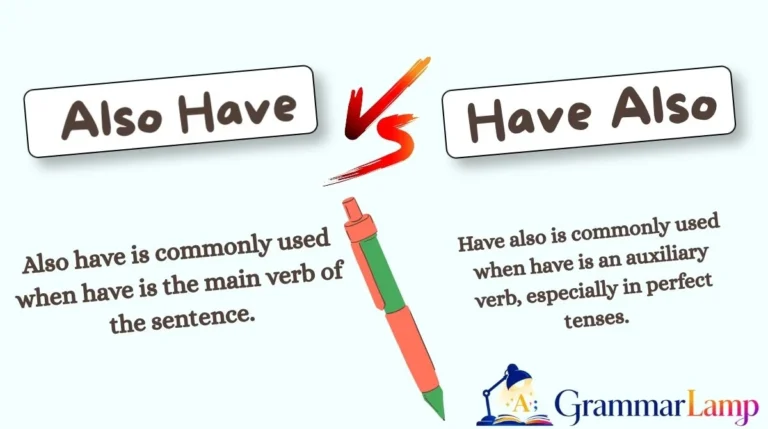
Also have is commonly used when have is the main verb of the sentence.
Here, have usually expresses possession, relationships, experiences, conditions, or something that a person possesses or needs.
For example:
- I also have a car.
- She also has a sister.
- We also have a meeting today.
- They also have some questions.
In these sentences, have is the main verb. The word also normally comes before the main verb.
The basic pattern
The common structure is:
Subject + also + have/has + object
For example:
I also have a question.
Here:
- I = subject
- also = adverb
- have = main verb
- a question = object
The sentence means that the speaker has a question in addition to something already mentioned.
When do we use “also have”?
We commonly use also have when talking about:
- Possession
- Things someone owns
- Family members
- Problems
- Questions
- Meetings
- Responsibilities
- Features
- Needs
- Experiences
Examples of “also have”
- I also have a new phone.
This means I have a new phone in addition to something else being discussed.
- She also has a car.
Someone else has a car, and she has one too.
- We also have a meeting tomorrow.
There may already be another plan, but there is an additional meeting tomorrow.
- They also have two children.
They have two children in addition to whatever information was already given.
- I also have a question.
This is very common in conversations.
- He also has some experience in marketing.
The person has marketing experience as well.
- You also have the right to ask questions.
The sentence adds another fact about the person.
- My brother also has a laptop.
The speaker’s brother has a laptop too.
Why do learners get confused?
Many learners know that also can come before a verb, but they may remember sentences such as:
I have also finished my work.
Then they try to use the same order everywhere:
I have also a car.
This sounds unnatural in standard modern English when have means possession.
For possession, English normally prefers:
I also have a car.
Not:
I have also a car.
So, the important thing is to look at the job of have in the sentence.
If have is the main verb meaning possession, also usually comes before it.
What Does “Have Also” Mean?
Have also is commonly used when have is an auxiliary verb, especially in perfect tenses.
For example:
I have also finished my work.
Here, have is not showing possession. It is helping to form the present perfect tense.
The main verb is finished.
The basic pattern is:
Subject + have/has + also + past participle
Examples include:
- I have also finished.
- She has also arrived.
- We have also seen it.
- They have also completed the work.
In these sentences, also normally comes after the auxiliary verb and before the main verb.
When do we use “have also”?
We often use have also with perfect tenses.
For example:
I have also visited London.
Here, have helps form the present perfect tense.
Another example:
She has also completed the project.
The word has is the auxiliary, while completed is the main verb.
Examples of “have also”
- I have also finished my homework.
This means I finished my homework in addition to another action already mentioned.
- We have also visited that restaurant.
The speaker is saying that they have visited the restaurant too.
- They have also completed the project.
They completed it in addition to another person or group.
- You have also made the same mistake.
The sentence says that the listener made the same mistake too.
- I have also seen this movie.
The speaker has seen the movie as well.
- She has also joined the meeting.
She joined the meeting in addition to other people.
- He has also learned Spanish.
He learned Spanish as another achievement or experience.
- We have also received your message.
The speaker confirms that they received the message too.
“Have also” is not only used with the present perfect
You can also see similar placement with other auxiliary verbs and modal structures.
For example:
I will also have finished the work by Friday.
Here, will is the first auxiliary, and have is another auxiliary. The position of also can change depending on what the speaker wants to emphasize.
However, for beginners, the most useful pattern to remember is:
have + also + past participle
For example:
I have also completed the form.
She has also called the manager.
They have also agreed to the plan.
Difference Between “Also Have” and “Have Also”
The biggest difference is the grammatical role of have.
When have is the main verb, also normally comes before it:
I also have a car.
When have is an auxiliary verb, also normally comes after it:
I have also finished the work.
This is the key idea.
Comparison Table
| Structure | Common use | Example |
|---|---|---|
| also have | Have is the main verb | I also have a question. |
| have also | Have is an auxiliary verb | I have also finished the task. |
| also has | Has is the main verb | She also has a car. |
| has also | Has is an auxiliary verb | She has also finished the task. |
1. “Also have” for possession
Consider this sentence:
I also have a laptop.
Here, have means “possess” or “own.”
The structure is:
I + also + have + a laptop.
We normally do not say:
I have also a laptop.
The first version is natural and common.
2. “Have also” with a perfect tense
Now look at this:
I have also bought a laptop.
Here, have does not mean possession. It helps create the present perfect tense.
The main action is bought.
The structure is:
I + have + also + bought + a laptop.
That is why have also is natural here.
The meaning can change completely
Compare:
I also have a new phone.
This means I possess a new phone too.
Now compare:
I have also bought a new phone.
This means buying a new phone is another action or experience that has happened.
The two sentences are grammatically different and communicate different ideas.
Sentence structure matters
A simple way to understand the difference is to ask:
Is “have” the main action, or is “have” helping another verb?
If have is the main verb:
I also have…
If have is helping another verb:
I have also + past participle…
For example:
I also have some money.
But:
I have also saved some money.
In the first sentence, have means possess.
In the second sentence, have helps form the present perfect, while saved carries the main meaning.
Explore More Posts
To Discuss or Discuss About: Which Is Correct? | Easy Grammar Guide 2026
Upmost vs Utmost: Meaning, Difference, and Correct Usage in 2026
Seam vs Seem: Difference, Meaning, Examples & Grammar Rules (2026)
All the Time vs Every Time: Meaning, Difference, Rules & Examples (2026)
Grammar Rules You Must Remember
Rule 1: Put “also” before “have” when “have” is the main verb
When have means possession, relationships, or something someone has, use:
Subject + also + have/has
Examples:
I also have a question.
She also has a brother.
We also have a problem.
He also has a new job.
This is one of the most important rules for beginners.
Rule 2: Put “also” after “have” when “have” is an auxiliary
When have helps form a perfect tense, use:
Subject + have/has + also + past participle
Examples:
I have also finished my work.
She has also called me.
We have also visited that place.
They have also completed the project.
Here, finished, called, visited, and completed are the main verbs.
Rule 3: Do not automatically put “also” after “have”
A common mistake is thinking that because we can say:
I have also finished.
we can always say:
I have also a car.
That does not work naturally in normal modern English when have means possession.
Say:
I also have a car.
The position of also depends on the grammar of the sentence, not simply on the word have.
Rule 4: “Also” can move when the sentence has other auxiliaries
When a sentence has another auxiliary, also often comes after the first auxiliary.
For example:
I will also have a meeting tomorrow.
Here, will is the auxiliary and have is the main verb.
Another example:
She has also been working hard.
Here, has is an auxiliary, been is part of the verb phrase, and working carries the main action.
For everyday English, focus first on identifying the main verb and auxiliary. This makes the position of also much easier to understand.
Common Mistakes Students Make
Many learners make mistakes with also have and have also because they translate directly from their first language.
English word order is not always the same as word order in other languages. Even when the meaning is clear, the sentence may sound unnatural.
Mistake 1: Using “have also” for possession
❌ I have also a car.
Better:
✅ I also have a car.
Why?
Because have is the main verb and means possession.
Mistake 2: Using “also have” with a perfect tense
A learner may say:
❌ I also have finished my homework.
This sentence can sometimes be heard, especially when the speaker is adding strong emphasis, but the normal neutral word order is:
✅ I have also finished my homework.
The second version is the usual choice when have is the auxiliary of the present perfect.
Mistake 3: Confusing “have” and “have got”
Learners may also see:
I have a car.
and:
I have got a car.
Both can express possession.
With have got, the word order can be different:
I have also got a car.
Here, have is part of the have got construction, not simply the same structure as I have a car.
For beginners, it is useful to learn these as separate patterns rather than trying to force one rule onto every sentence.
Mistake 4: Forgetting “has”
Remember that he, she, and it normally use has, not have, in the present tense.
Correct:
She also has a dog.
Not:
She also have a dog.
With a perfect tense:
She has also finished her work.
Not:
She have also finished her work.
Easy correction tip
When you are unsure, ask yourself:
Does “have” mean “possess”?
If yes, use:
also have/has
Example:
I also have a car.
If have is helping another verb, use:
have/has also + main verb
Example:
I have also bought a car.
This small question can solve many common mistakes.
Easy Trick to Remember the Difference
Here is a simple memory trick:
Main verb? Put ALSO before HAVE.
Helping verb? Put ALSO after HAVE.
Think about these two sentences:
I also have a book.
I have also read the book.
In the first sentence, have is the main verb. It tells us what the person possesses.
In the second sentence, have is helping the verb read. That is why also comes between have and read.
You can remember it like this:
Have something → also have
I also have a phone.
Have done something → have also done
I have also called him.
This is not a rule for every possible English sentence, but it is an excellent starting point for everyday English.
Daily Life Examples
The best way to understand grammar is to see it in normal conversations.
Example 1: Talking about possessions
Ali: Do you have a laptop?
Ahmed: Yes, I also have a tablet.
Here, have means possession, so also comes before have.
Example 2: Talking about a question
Sara: I have one question.
Mina: I also have a question.
The second speaker has a question too.
Example 3: Talking about completed work
Manager: Have you finished the report?
Employee: Yes, I have also sent it to the client.
Here, have is an auxiliary, so also comes after have.
Example 4: Talking about family
Tom: I have two brothers.
John: I also have two brothers.
Here, have is the main verb.
Example 5: Talking about travel
A: Have you visited Dubai?
B: Yes, I have also visited Abu Dhabi.
The word have helps form the present perfect.
Example 6: Talking about a problem
A: We have a problem with the computer.
B: We also have a problem with the printer.
Here, have means that the problem exists or is being experienced.
Example 7: Talking about experience
A: Have you worked with children before?
B: Yes, I have also worked with children.
The speaker is talking about a past experience connected to the present.
Example 8: Talking about a meeting
A: We have a meeting at 10 a.m.
B: We also have another meeting at 2 p.m.
Here, have is the main verb.
Example 9: Talking about recent actions
A: I have already emailed the manager.
B: I have also emailed him.
Both people have completed the action.
Example 10: Talking about learning
Teacher: Have you learned these words?
Student: Yes, I have also practiced them at home.
Again, have is helping the main verb practiced, so also comes after have.
Practice Section
Choose the correct option in each sentence.
1. I ______ a new computer.
A. have also
B. also have
2. She ______ finished her homework.
A. also has
B. has also
3. We ______ some questions.
A. also have
B. have also
4. They ______ visited that museum.
A. also have
B. have also
5. He ______ a problem with his car.
A. also has
B. has also
Answers
1. B — also have
I also have a new computer.
2. B — has also
She has also finished her homework.
3. A — also have
We also have some questions.
4. B — have also
They have also visited that museum.
5. A — also has
He also has a problem with his car.
Notice the pattern. When have/has is the main verb, also normally comes before it. When have/has helps another verb in a perfect construction, also normally comes after it.
More Helpful posts
Crews vs Cruise (2026): What’s the Difference? Easy Grammar Guide with Examples
Everything vs Every Thing: Easy Difference, Rules, Examples & Practice (2026)
All Is vs All Are: Which One Is Correct? Complete Grammar Guide for 2026
At the Weekend or On the Weekend? 2026 Guide to British and American English
FAQs
What is the difference between “also have” and “have also”?
Also have is normally used when have is the main verb.
I also have a car.
Have also is commonly used when have is an auxiliary verb.
I have also bought a car.
The position of also depends on the grammatical role of have.
Can we use “also have” in a question?
Yes. The exact position depends on the question structure.
For example:
Do you also have a car?
Here, have is the main verb, so also comes before it.
With a present perfect question:
Have you also visited London?
Here, have is the auxiliary, and also comes after the subject.
These are both natural English structures.
Is “have also” formal or informal?
Have also is not simply formal or informal. It is a normal grammatical structure.
For example:
I have also completed the form.
This can be used in everyday speech, emails, school writing, and professional communication.
The important point is not formality. It is the grammatical role of have.
Is “I have also a car” correct?
It is understandable, but it is not the normal word order in modern everyday English when have means possession.
A natural sentence is:
I also have a car.
In some older, literary, or unusual styles, different word orders may appear, but learners should use I also have a car in normal English.
Is “I also have finished” correct?
The normal neutral form is:
I have also finished.
Because have is acting as an auxiliary and finished is the main verb.
However, English can move adverbs for emphasis in certain contexts, so you may occasionally hear different patterns. For standard everyday grammar, have also + past participle is the useful pattern to remember.
Which is correct: “I also have” or “I have also”?
Both can be correct, but they usually belong to different sentence structures.
I also have a phone.
Here, have is the main verb.
I have also bought a phone.
Here, have is an auxiliary.
So neither phrase is automatically right or wrong. The rest of the sentence tells you which structure you need.
Conclusion
The difference between also have and have also becomes much easier when you stop looking at the two words separately and look at the whole verb structure.
Use also have when have is the main verb:
I also have a question.
She also has a car.
Use have also when have is helping another verb, especially in a perfect tense:
I have also finished my work.
They have also visited the city.
The easiest rule to remember is simple: main verb → also before have; helping verb → also after have.
Do not worry if this feels confusing at first. English word order takes practice, especially when one word such as have can do different jobs.
Read the examples aloud, make a few sentences about your own daily life, and compare the two structures. After using them several times, the correct position of also will start to feel natural.

Liam Derren is a language writer at GrammarLamp, creating simple, helpful content about grammar, words, and everyday English. He makes language learning clear, practical, and easy to understand.