
English has many small word choices that can cause big confusion. Everything vs every thing is one of them. At first, the difference looks tiny because the two forms contain exactly the same words.
The only change is the space. But that small space can change the grammar and, in some sentences, the meaning.
For most everyday situations, everything is the form you need. It is a pronoun that means “all things” or “all the things in a situation.” We use it when we talk about a complete group of things without naming each item separately.
For example, we say, “Everything is ready,” not “Every thing is ready.” Major learner dictionaries define everything as a pronoun meaning all things, and Oxford specifically notes that it takes a singular verb.
Every thing, written as two words, is different. Here, every is a determiner and thing is a noun. Cambridge explains that every is used with a singular noun to refer to each member of a complete group.
After reading this guide, you will know when to write everything, when every thing can be correct, which grammar rules matter, and how to avoid the most common mistakes.
What Does “Everything” Mean?
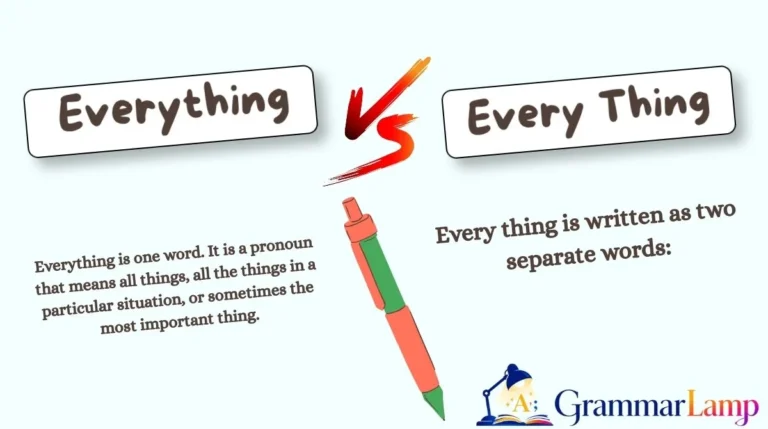
Everything is one word. It is a pronoun that means all things, all the things in a particular situation, or sometimes the most important thing.
Cambridge gives the basic meaning as “all things,” while Merriam-Webster defines it in similar ways, including everything that exists or everything related to a particular subject.
The easiest way to understand it is this:
Everything = all things
You normally use everything when you do not want to name the individual things one by one.
When should you use “everything”?
Use everything when you are speaking about a whole group of things.
For example:
- Everything is ready.
- I packed everything.
- She knows everything about computers.
- Everything looks good.
- He told me everything.
- Did you eat everything?
- Everything in the room was clean.
- We checked everything before leaving.
Notice something important: everything can stand alone.
You do not need to put a noun directly after it.
You can say:
I bought everything.
You do not need to say:
I bought everything things.
That would be incorrect.
“Everything” normally takes a singular verb
This is one of the most important grammar rules for learners.
We say:
Everything is fine.
Not:
Everything are fine.
We say:
Everything was ready.
Not:
Everything were ready.
Oxford marks everything as a pronoun that is used with a singular verb.
Why? Although everything refers to many things, grammatically it behaves as a singular pronoun.
Think of it this way:
Everything = one grammatical unit referring to all things.
More examples
Everything is on the table.
All the things are on the table.
I cleaned everything.
I cleaned all the things.
Everything changed after the meeting.
All the relevant things changed.
She lost everything in the move.
She lost all her possessions or important things.
Everything was working perfectly.
All the relevant things or systems were working well.
Is everything okay?
Is the whole situation okay?
He means everything to me.
He is extremely important to me.
We did everything we could.
We did all the things that were possible.
This last type of sentence is very common in everyday English.
A common learner confusion
Many students think that because everything refers to many things, they should use a plural verb.
That is not how English works here.
Compare:
All the books are on the desk.
but:
Everything is on the desk.
The first sentence has the plural noun books, so it takes are.
The second uses the pronoun everything, so it takes is.
That difference is worth remembering.
What Does “Every Thing” Mean?
Every thing is written as two separate words:
every + thing
Here, every is a determiner and thing is the noun.
Cambridge explains that every + singular noun refers to each member of a complete group.
So the basic structure is:
every + singular countable noun
Examples include:
- every student
- every book
- every room
- every question
- every problem
- every thing
Because thing is the noun here, every thing follows the normal grammar of every + singular noun.
What does “every thing” mean?
It means each individual thing or each thing separately.
This form is less common than everything, because English normally uses the established pronoun everything when the meaning is simply “all things.”
However, there are situations where the two-word form can be useful, especially when you want to emphasize the individual items.
For example:
Every thing in the box had to be checked carefully.
Here, the speaker is focusing on each individual thing in the box.
You could often rewrite that sentence more naturally as:
Every single thing in the box had to be checked carefully.
That extra word single makes the individual meaning very clear.
Examples of “every thing”
Here are some examples where the two-word form can make grammatical sense:
Every thing in the room had a purpose.
Every thing on the list must be checked.
She examined every thing one by one.
Every thing he owned was carefully organized.
The inspector looked at every thing inside the machine.
Every thing on the shelf was labeled.
He wanted every thing to be perfect.
These sentences emphasize individual objects rather than simply treating them as one general group.
Still, native speakers often prefer everything or every single thing, depending on the meaning.
For example:
I checked everything.
is normal.
I checked every thing.
sounds unusual to most readers unless there is a special reason to separate the words.
A more natural emphatic sentence is:
I checked every single thing.
Why do learners get confused?
The confusion happens because thing appears in both forms.
Students often learn:
everything = all things
Then they see every thing and assume the words can always be separated.
They cannot.
You should not add a space just because the meaning seems logical. Everything is an established one-word pronoun in English. Cambridge and Oxford both list it as a single word.
Difference Between “Everything” and “Every Thing”
The main difference is grammatical.
| Form | Grammar | Basic meaning | Common use |
|---|---|---|---|
| everything | Pronoun | all things | Very common |
| every thing | Determiner + noun | each individual thing | Less common, usually for emphasis or special focus |
1. “Everything” can stand alone
You can say:
Everything is ready.
There is no noun after everything.
The word itself is the pronoun.
But every normally needs a noun or another suitable word after it.
For example:
Every student
Every book
Every room
So:
Every thing
contains a real noun: thing.
2. The meaning can be slightly different
Compare these:
Everything was checked.
This gives the general meaning that all relevant things were checked.
Now compare:
Every thing was checked separately.
This emphasizes the individual items. The speaker is thinking about each thing one by one.
The difference can be small, and in many situations you would simply use everything.
3. “Everything” is much more common in normal English
In everyday speech, these are natural:
I packed everything.
Everything is fine.
Did you hear everything?
She told me everything.
You will hear and read these kinds of sentences constantly.
The two-word every thing is much less common. When a speaker really wants to emphasize individual objects, every single thing is often more natural.
4. Grammar logic
Think of the forms like this:
Everything
one pronoun
Every thing
every + noun
That is the clearest grammar test.
If thing is acting as the noun, you have two words.
If you mean the pronoun “all things,” use one word:
everything
5. Sentence structure
Look at the difference:
Everything is clean.
Here, everything is the subject.
Now:
Every thing in the kitchen is clean.
Here, every modifies the noun thing.
You can also add words after the noun:
Every thing in the kitchen was clean.
That structure makes the noun role easy to see.
Grammar Rules You Must Remember
Rule 1: Use “everything” as a pronoun for all things
When you mean all things, use the one-word form.
Everything is ready.
Everything was expensive.
I remembered everything.
A simple question to ask yourself is:
Do I mean “all things”?
If yes, everything is usually the right choice.
Rule 2: “Everything” takes a singular verb
Even though it refers to many things, everything is grammatically singular.
Correct:
Everything is okay.
Everything looks beautiful.
Everything was clean.
Incorrect:
Everything are okay.
Everything look beautiful.
Everything were clean.
Oxford specifically identifies everything as being used with a singular verb.
Rule 3: “Every” normally comes before a singular noun
Cambridge states that every is a determiner and is used with a singular noun when referring to members of a complete group.
So we say:
every student
every question
every day
every thing
Not:
every students
every questions
every things
This rule explains why every thing can be grammatically possible: thing is a singular countable noun.
Rule 4: Use “every single thing” when you want strong emphasis
In ordinary writing, everything is usually the best choice.
When you want to stress each individual thing, use:
every single thing
For example:
I remember every single thing you told me.
She checked every single thing in the bag.
He complained about every single thing.
This is often more natural than writing every thing.
Common Mistakes Students Make
Mistake 1: Writing “every thing” when they mean “all things”
A learner may write:
I packed every thing.
The sentence can be understood, but in normal modern English, everything is the natural choice.
Better:
I packed everything.
Why?
Because everything is the standard pronoun meaning “all things.”
Mistake 2: Using a plural verb after “everything”
Incorrect:
Everything are ready.
Correct:
Everything is ready.
Remember the singular verb rule.
Mistake 3: Treating “every” like “all”
Students sometimes think:
every things
should mean “all things.”
It does not.
Every is normally followed by a singular noun:
every thing
not:
every things
If you want the pronoun meaning “all things,” use:
everything
Mistake 4: Using two words because “every” and “thing” have separate meanings
This is a common spelling problem.
English has many compounds that have become single words. Everything is one of them.
British Council groups everything with other one-word indefinite pronouns such as something, anything, and nothing.
So learn this group together:
something
anything
everything
nothing
Easy correction tip
Before writing, replace the word with all things.
If the sentence still makes sense, everything is often the correct choice.
For example:
I cleaned all things.
That tells you:
I cleaned everything.
But if you are deliberately talking about each individual thing, especially with words such as single, one by one, or a detailed description, a noun phrase such as every single thing may be better.
Easy Trick to Remember the Difference
Here is a simple classroom trick:
Think: “All” = everything
If you can replace the word with all things, use:
everything
Example:
I know everything.
Think:
I know all things.
So everything works.
Think: “Each” = every + noun
When you mean each individual member, think about every + singular noun.
For example:
every student = each student
every book = each book
every thing = each thing
This gives you a simple mental formula:
Everything = all things
Every thing = each thing
In real English, the second form is much less common. For strong emphasis, every single thing is often the clearest choice.
Another useful trick is to ask:
Can the word stand alone?
Everything is ready. ✅
Does “every” need a noun after it?
Every thing is ready. ✅ grammatically possible, but unusual without context.
That little test can prevent many spelling mistakes.
Daily Life Examples
Here are some natural examples you may hear in real conversations.
Example 1: Getting ready for a trip
A: Are you packed?
B: Yes, I packed everything.
Here, everything means all the things needed for the trip.
Example 2: Checking homework
Teacher: Did you answer everything?
Student: Yes, I answered every question.
Notice the useful contrast.
Everything = all the answers/tasks.
Every question = each individual question.
Example 3: Cleaning the house
I cleaned everything before the guests arrived.
This means all the relevant areas or things were cleaned.
Example 4: Talking about food
A: Did you eat everything?
B: Yes. I was really hungry.
Again, everything means all the food that was there or available.
Example 5: Asking about a person’s situation
A: How is everything?
B: Everything is fine.
This is a very common conversational use. Cambridge and Oxford both give this type of meaning for everything, including the general situation or life at the moment.
Example 6: Checking a list
We checked every single thing on the list.
Here, the speaker wants to stress that each item was checked individually.
Example 7: Organizing a room
Everything is in its place.
This means all the relevant objects are where they should be.
Example 8: Talking about a difficult experience
She told me everything about the problem.
This means she told me all the important details connected to the problem.
Example 9: Strong emphasis
I remember every single thing he said.
The speaker is emphasizing each individual detail.
Example 10: Preparing for an event
We need to make sure everything is ready before the guests arrive.
This is a normal everyday use of everything.
Practice Section
Choose the correct option: everything or every thing.
1. ______ is ready for the meeting.
2. I checked ______ in the bag one by one.
3. Did you remember ______ you needed?
4. She wanted ______ on the desk to be perfectly organized.
5. ______ was working well yesterday.
Answers
1. Everything
Everything is ready for the meeting.
This means all the necessary things are ready.
2. Every thing
I checked every thing in the bag one by one.
The sentence focuses on each individual thing. In natural modern English, every single thing would often sound better:
I checked every single thing in the bag one by one.
3. Everything
Did you remember everything you needed?
This means all the things you needed.
4. Every thing
She wanted every thing on the desk to be perfectly organized.
Again, the two-word form treats thing as a noun. A more natural emphatic version would be:
She wanted every single thing on the desk to be perfectly organized.
5. Everything
Everything was working well yesterday.
Here, everything is the pronoun and takes the singular verb was.
FAQs
What is the difference between everything and every thing?
Everything is one word and is a pronoun meaning “all things.” Every thing is two words: every modifies the noun thing. The one-word form is much more common in normal English.
Can “everything” be used in questions?
Yes. It is very common in questions.
For example:
Did you pack everything?
Is everything okay?
Did she tell you everything?
When asking about a complete situation or all relevant things, everything is natural.
Is “everything” formal or informal?
Everything is neutral. You can use it in casual conversations, school writing, emails, and formal writing. It is a standard English pronoun and is not limited to one level of formality.
Is “every thing” wrong?
Not always. It can be grammatically correct when every modifies the noun thing, especially when the sentence focuses on individual items. However, it is much less common than everything. In many everyday sentences, every single thing sounds more natural and clearer.
Which is correct: “Everything are” or “Everything is”?
The correct form is everything is because everything takes a singular verb.
Correct:
Everything is fine.
Incorrect:
Everything are fine.
Oxford explicitly lists everything as a pronoun used with a singular verb.
Is “every thing” the same as “everything”?
They can overlap in meaning, but grammatically they are different. Everything is a single pronoun meaning all things. Every thing is a phrase made from a determiner and a noun, with more focus on each individual thing.
Conclusion
The difference between everything and every thing is small in spelling but important in grammar.
Everything is the form you will use most of the time. It is one word, and it works as a pronoun meaning all things or all the things connected with a situation. It can stand by itself, and it normally takes a singular verb:
Everything is ready.
Every thing, on the other hand, contains the determiner every and the noun thing.
It can be used when you are focusing on individual things, although this form is much less common in everyday English.
In many cases, every single thing sounds more natural when strong emphasis is needed.
The easiest rule is simple: think “all things” → everything and “each thing” → every thing.
Once you start noticing the difference in real conversations, books, and everyday writing, the choice becomes much easier. Practice a few sentences each day, and soon you will stop thinking about the space altogether.

Liam Derren is a language writer at GrammarLamp, creating simple, helpful content about grammar, words, and everyday English. He makes language learning clear, practical, and easy to understand.