
English has many small grammar rules that can confuse even people who speak the language every day. One common problem is knowing whether to use this information or these information.
Both expressions may sound possible to English learners, especially when they want to talk about several facts, details, or pieces of news.
Imagine that your teacher gives you some useful details about an exam. You want to tell your friend, “These information is important.” Does that sentence sound correct? Not quite. The correct sentence is “This information is important.”
Why? The answer is connected to an important grammar rule: countable and uncountable nouns.
In English, some nouns can be counted one by one, while others are treated as a whole. The word information belongs to the second group. We do not normally say one information, two informations, or these information. Instead, we use this information or these pieces of information, depending on what we want to express.
This small difference matters in emails, school assignments, office conversations, online messages, and everyday speaking. Using the right expression can make your English sound more natural and clear.
By understanding this grammar rule, you will learn when to use this and these, why information does not take a plural form, and how to talk about several facts correctly. You will also learn common mistakes and easy ways to avoid them.
More Useful posts
Couple of Hours vs Couple Hours: Which Is Correct in 2026?
Canceled vs Cancelled: Which Spelling Is Correct in 2026?
Ambiance vs Ambience: Meaning, Difference, Usage & Examples in 2026
Compared To vs As Compared To (2026): Meaning, Difference & Correct Usage
What Does “This Information” Mean?
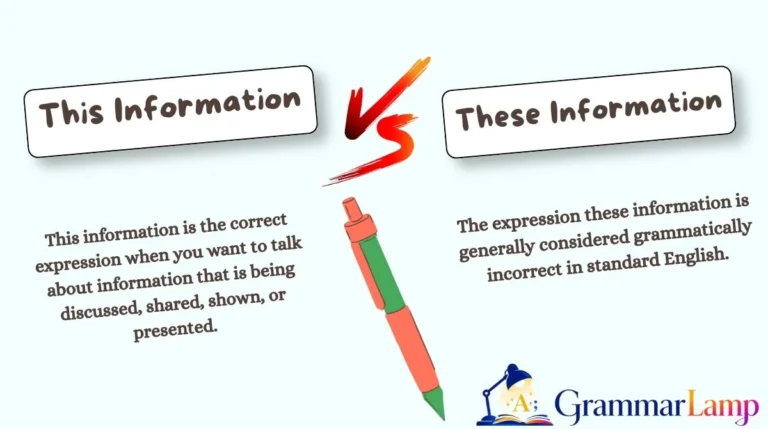
This information is the correct expression when you want to talk about information that is being discussed, shared, shown, or presented.
The word this is a demonstrative word. We use it to point to something or show which thing we mean. It can refer to something close to us, something we have just mentioned, or something that is clear from the conversation.
The word information means facts, details, knowledge, or news about a person, place, subject, or situation.
When we put these two words together, this information means the particular knowledge or details we are talking about.
Why Is “This Information” Correct?
The main reason is that information is an uncountable noun.
An uncountable noun is a noun that we do not normally count as separate individual items. For example:
- Water
- Milk
- Advice
- Furniture
- Equipment
- Knowledge
- Information
We can count bottles of water, pieces of furniture, or items of equipment. However, we do not normally count these nouns directly.
The same rule applies to information.
We say:
- This information is useful.
- This information is correct.
- This information helps me.
- This information was shared yesterday.
We do not use these directly before information because these is used with plural countable nouns.
When Should You Use “This Information”?
Use this expression when you are talking about information as a whole.
It is especially common when discussing something that someone has shared with you, something written in a document, or details that you have found online.
For example, if your friend sends you a message containing several useful facts, you can say:
“Thank you for this information.”
You do not need to say “Thank you for these information.”
Here, the information may contain many separate facts, but English treats the word information as an uncountable noun.
8 Examples of “This Information”
- This information is very helpful.
You are saying that the knowledge or details are useful. - I need this information for my school project.
You need the particular details for your assignment. - This information is not correct.
You believe that the information contains an error. - Thank you for sharing this information with me.
You are thanking someone for giving you useful details. - This information comes from a reliable source.
You are talking about information from a source you trust. - Can you explain this information again?
You want someone to explain the details more clearly. - This information will help us make a decision.
The knowledge will help you choose what to do. - I found this information on the internet.
You discovered these details online.
Common Learner Confusion
Many learners think that this information must be wrong because information can contain many facts.
However, grammar does not always depend on how many facts are included. It depends on whether the noun is countable or uncountable.
For example, a report can contain 20 facts, but you can still call the complete collection information.
That is why we say:
“This information is important.”
The word information remains uncountable even when it refers to several facts.
What Does “These Information” Mean?
The expression these information is generally considered grammatically incorrect in standard English.
You may hear it in conversations with English learners or see it in messages written by people who are still learning English. However, it is not the correct form in standard written or spoken English.
To understand the problem, you first need to understand the word these.
These is a demonstrative word used to point to two or more countable things. It is the plural form of this.
For example:
- This book is interesting.
- These books are interesting.
- This student is hardworking.
- These students are hardworking.
- This question is difficult.
- These questions are difficult.
Notice that the nouns become plural when we use these.
However, the word information does not normally have a plural form. We cannot simply add an -s to make it informations in standard English.
Therefore, combining these with information creates a grammar problem.
Why Is “These Information” Incorrect?
The problem comes from the difference between countable and uncountable nouns.
These needs a plural countable noun after it. But information is an uncountable noun.
For this reason, the following sentences are incorrect in standard English:
- These information are useful.
- These information is important.
- I need these information.
- These information are from my teacher.
The correct versions are:
- This information is useful.
- This information is important.
- I need this information.
- This information is from my teacher.
There is another important point to remember. Even if information contains many different details, the noun itself does not become plural.
Can “These” Ever Be Used When Talking About Information?
Yes! You can use these when you add a suitable countable noun.
For example:
- These pieces of information are useful.
- These facts are important.
- These details are correct.
- These items of information are helpful.
In these sentences, pieces, facts, details, and items are countable plural nouns.
The word these describes those nouns, not the uncountable noun information.
This is the correct way to talk about several separate pieces of information.
8 Examples of the Incorrect Expression and Its Corrections
The following examples show how learners sometimes use the wrong expression and how to correct it.
- Incorrect: These information is helpful.
Correct: This information is helpful. - Incorrect: These information are important.
Correct: This information is important. - Incorrect: I need these information for my exam.
Correct: I need this information for my exam. - Incorrect: These information came from my teacher.
Correct: This information came from my teacher. - Incorrect: Can you send me these information?
Correct: Can you send me this information? - Incorrect: These information are available online.
Correct: This information is available online. - Incorrect: These information helped me understand the lesson.
Correct: This information helped me understand the lesson. - Incorrect: I have collected these information from different websites.
Correct: I have collected this information from different websites.
Common Learner Confusion
A common mistake happens when learners translate sentences directly from their first language.
In some languages, the word for information may be treated differently. It may have a plural form or be used with a plural demonstrative.
However, English follows its own grammar rules.
You should not choose these simply because you are talking about many facts. Instead, look at the noun that comes after the demonstrative word.
If the noun is information, use this.
If you want to use these, change the sentence to something like “these details” or “these pieces of information.”
Difference Between “This Information” and “These Information”
The most important difference is grammatical correctness.
This information is correct because information is an uncountable noun. These information is incorrect because these is used with plural countable nouns.
Both expressions may be used by learners when they want to talk about several facts, but only one follows standard English grammar.
Comparison Table
| Feature | This Information | These Information |
|---|---|---|
| Grammar | Correct | Incorrect |
| Noun type | Uncountable | Uncountable |
| Demonstrative | This | These |
| Meaning | Particular information | Intended to mean several details |
| Standard English | Yes | No |
| Example | This information is useful. | These information are useful. |
1. Usage Difference
The correct expression is used in everyday English, academic writing, business communication, and formal documents.
For example:
“This information is necessary for the application.”
You can use it when talking about a collection of facts, instructions, research findings, or knowledge.
The incorrect expression usually appears when someone does not know that information is uncountable.
If you want to describe several separate details, use a plural countable noun instead.
For example:
“These details are necessary for the application.”
Both correct sentences communicate a similar idea, but their grammatical structures are different.
2. Grammar Logic
The grammar rule becomes easier when you understand the two types of nouns.
Countable nouns are things that we can count individually.
Examples:
- One book, two books
- One apple, three apples
- One student, five students
- One question, four questions
We can use this with one countable item and these with two or more countable items.
Uncountable nouns are things that we do not normally count individually.
Examples:
- Water
- Rice
- Advice
- Furniture
- Information
We generally use singular verbs and singular demonstratives with these nouns.
For example:
- This water is cold.
- This advice is useful.
- This furniture is expensive.
- This information is correct.
The word information follows the same pattern.
3. Sentence Structure Difference
The structure of a sentence can help you identify the correct expression.
With this information, the basic structure is:
This + uncountable noun + singular verb
Examples:
- This information is useful.
- This information looks correct.
- This information helps students.
If you want to use these, you need a plural countable noun:
These + plural countable noun + plural verb
Examples:
- These facts are useful.
- These details look correct.
- These documents help students.
You can also use a countable unit with information:
- These pieces of information are useful.
- These items of information are important.
Here, pieces and items are plural, so the verb are is correct.
4. Meaning Comparison
The expression this information refers to information as a whole.
It does not matter whether that information contains one fact or hundreds of facts.
For example:
“This information contains five important points.”
The noun information is still uncountable.
On the other hand, these information is not a standard way to express several facts.
If you want to focus on separate facts, say:
“These five facts are important.”
If you want to focus on separate pieces of information, say:
“These five pieces of information are important.”
The meaning is clear, and the grammar is correct.
Explore More Posts
Gone to Soon vs Gone Too Soon: Which Is Correct? (2026 Guide)
Stayed vs Staid: Meaning, Difference, Examples & Easy Rules in 2026
Newfound vs New-Found: Which Is Correct in 2026?
Over Time vs Overtime: Meaning, Difference, Examples & Rules in 2026
Grammar Rules You Must Remember
Understanding a few basic rules will help you avoid this mistake in almost every situation.
Rule 1: Always Treat “Information” as an Uncountable Noun
In standard English, information is an uncountable noun.
It does not normally take a plural -s.
Correct:
- This information is useful.
- The information is correct.
- Some information is missing.
Incorrect:
- These informations are useful.
- The information are correct.
- An information is missing.
Remember that information does not become countable just because it contains many facts.
Rule 2: Use “This” With Uncountable Nouns
The word this can be used with singular countable nouns and uncountable nouns.
For example:
- This book is new.
- This water is clean.
- This advice is helpful.
- This information is important.
The noun after this determines the correct verb form.
When you use this information, the verb is normally singular.
For example:
“This information has helped me.”
Not:
“These information have helped me.”
Rule 3: Use “These” With Plural Countable Nouns
Use these when you are talking about two or more countable things.
For example:
- These books are expensive.
- These questions are difficult.
- These students are hardworking.
- These facts are important.
If you want to talk about several pieces of information, use a countable expression.
For example:
“These pieces of information are useful.”
This sentence is correct because pieces is a plural countable noun.
Rule 4: Use “Piece of Information” When You Want to Count It
Although you cannot normally count information directly, you can count pieces of information.
The correct forms are:
- One piece of information
- Two pieces of information
- Three pieces of information
- Several pieces of information
- Many pieces of information
Examples:
“I received one piece of information yesterday.”
“She gave me three pieces of information about the meeting.”
“These two pieces of information are very important.”
This is one of the most useful grammar tricks for everyday English.
Common Mistakes Students Make
Many English learners understand the meaning of a sentence but still make mistakes with its grammar.
This often happens because they focus on the number of facts instead of the type of noun.
Let’s look at some common mistakes.
Mistake 1: Using “These” Before Information
Incorrect: These information are useful.
Correct: This information is useful.
Why?
The noun information is uncountable, so we use this instead of these.
Mistake 2: Adding -S to Information
Incorrect: I collected many informations.
Correct: I collected a lot of information.
Why?
The word information does not normally have a plural form in standard English.
You can also say:
“I collected many pieces of information.”
Mistake 3: Using “Are” With Information
Incorrect: This information are important.
Correct: This information is important.
Why?
Information is treated as a singular uncountable noun. Therefore, it normally takes a singular verb.
Mistake 4: Saying “An Information”
Incorrect: Can you give me an information?
Correct: Can you give me some information?
Another correct option is:
“Can you give me a piece of information?”
Why?
We use a or an with singular countable nouns. Information is uncountable, so it does not normally take an indefinite article directly.
Mistake 5: Thinking That Several Facts Need “These Information”
Incorrect: These information helped me pass the exam.
Correct: This information helped me pass the exam.
Another correct sentence:
“These facts helped me pass the exam.”
Why?
You can use this information for the whole collection or these facts for separate facts.
Easy Correction Tips
Here are some simple ways to correct your mistakes:
- Whenever you write information, remember that it is uncountable.
- Use this information instead of these information.
- Use is or was when information is the subject of a sentence.
- Avoid adding -s to information.
- Use pieces of information when you want to count separate details.
If you remember these five tips, you will avoid most common mistakes related to this word.
Easy Trick to Remember the Difference
Here is a simple trick that can help you remember the correct expression.
Think of information like water.
You would normally say:
- This water is cold.
- This information is useful.
You would not normally say:
- These water is cold.
- These information is useful.
Why? Because both water and information are uncountable nouns.
This simple comparison makes the grammar rule easier to remember.
The “This and These” Memory Trick
Remember this easy formula:
THIS = Singular or uncountable
THESE = Plural countable
Examples:
| This | These |
|---|---|
| This book | These books |
| This apple | These apples |
| This question | These questions |
| This information | These facts |
| This advice | These suggestions |
Notice that the last two examples use different nouns.
We say this information, but we can say these facts or these suggestions.
Real-Life Logic
Imagine that your friend sends you a long message with five useful facts about a job interview.
You want to thank your friend.
You can say:
“Thank you for this information.”
You are talking about the complete message or collection of details.
However, if you want to discuss the five facts separately, you can say:
“These five facts are very useful.”
The meaning changes slightly, but both sentences are correct.
The easiest way to remember the rule is to stop counting the facts and start looking at the noun you are using.
Daily Life Examples (Very Important)
Grammar becomes easier when you see how people use it in normal conversations.
The following examples show how to use this information and other correct expressions in daily situations.
Example 1: Talking to a Friend
Ali: Did you find the address of the new restaurant?
Ahmed: Yes, this information is from their official website.
Here, Ahmed uses this information because he is talking about the details as a whole.
Example 2: At School
Student: Sir, is this information important for the exam?
Teacher: Yes, you should remember it.
The student correctly uses this information when asking about study material.
Example 3: In the Office
Manager: Have you checked the report?
Employee: Yes, this information is correct.
The employee uses the correct expression when discussing details in a report.
Example 4: Asking for Help
Ali: Can you explain this information to me?
Hamza: Of course. I will explain it again.
This is a natural way to ask someone to explain something.
Example 5: Sending an Email
“Dear Sir, thank you for providing this information. It has helped me understand the process.”
This is a polite and professional way to thank someone.
Example 6: Talking About Research
“I found this information while researching my school project.”
The sentence is correct because information remains uncountable.
Example 7: Sharing Important Details
“Please read this information carefully before signing the document.”
This sentence is useful in formal and everyday situations.
Example 8: Talking About a Job
“Could you please send me this information about the job opening?”
You can use this sentence when asking someone to share job details.
Example 9: Discussing Separate Facts
“These three facts are important for our presentation.”
Here, these is correct because facts is a plural countable noun.
Example 10: Counting Information
“I received three pieces of information about the new course.”
This sentence is also correct because pieces is the countable unit.
These examples show that you do not need complicated vocabulary to use this grammar rule correctly. A little attention to the noun is enough.
Practice Section: Test Your Knowledge
Now it is time to check what you have learned.
Choose the correct option in each sentence. Read the complete sentence before selecting your answer.
Question 1
_____ information is very helpful.
A. These
B. This
Question 2
I need _____ pieces of information for my assignment.
A. this
B. these
Question 3
_____ information is available on the website.
A. This
B. These
Question 4
_____ facts are important for the exam.
A. This
B. These
Question 5
Thank you for sharing _____ information with me.
A. these
B. this
Answers and Explanations
1. B — This
Information is an uncountable noun, so this is correct.
2. B — These
The noun pieces is plural and countable. Therefore, we use these.
3. A — This
Information is uncountable, so we use this information.
4. B — These
Facts is a plural countable noun, so these facts is correct.
5. B — This
The correct expression is this information because information is uncountable.
If you answered all five questions correctly, you have understood the main grammar rule. If you made a mistake, read the four grammar rules again and try the exercise one more time.
More Helpful posts
Year Old or Years Old? Easy Grammar Guide for 2026
Lieu vs Loo: Meaning, Difference, Usage, and Examples in 2026
Is It Worth It vs Does It Worth It? 2026 Grammar Guide
Good for Me vs Good to Me: Meaning, Difference, and Examples (2026)
FAQs
1. Which Is Correct: This Information or These Information?
This information is correct in standard English.
Information is an uncountable noun, so we use the singular demonstrative this before it. We do not normally use these directly with information.
For example: “This information is useful.”
2. Can We Say “These Information” in English?
No, these information is generally grammatically incorrect in standard English.
The word these needs a plural countable noun. Information is uncountable, so the correct expression is this information.
You can also say these pieces of information.
3. Is Information Singular or Plural?
Information is an uncountable noun in standard English.
It does not normally have a plural form, and we do not add -s to make informations. It usually takes singular verbs such as is, was, and has.
For example: “The information is correct.”
4. Can We Use “These” With Pieces of Information?
Yes, absolutely!
The word pieces is a plural countable noun, so using these is grammatically correct.
For example: “These pieces of information are important.”
Remember that these describes pieces, not the word information.
5. Should I Say “This Information Is” or “This Information Are”?
You should say “This information is.”
Information is an uncountable noun and normally takes a singular verb. Therefore, is is correct, while are is incorrect in this sentence.
For example: “This information is very useful.”
6. How Can I Say “Several Information” Correctly?
You should say several pieces of information instead of several information.
Other correct expressions include a lot of information, some information, and many details.
For example: “The teacher gave us several pieces of information about the exam.”
Conclusion
The difference between this information and these information is simple once you understand the rule about uncountable nouns.
This information is the correct expression because information is an uncountable noun in standard English. We do not normally use these directly before it or add -s to make it plural.
If you want to talk about several separate facts or details, you can say these facts, these details, or these pieces of information. These expressions are grammatically correct and sound natural in everyday conversations.
Remember the simple trick: use this with information, just as you use this with water, advice, and furniture. Use these with plural countable nouns, such as books, questions, and facts.
Do not worry if you have made this mistake before. Learning English takes practice, and understanding small grammar rules can make a big difference.
Try using the correct expression in your daily conversations, schoolwork, and emails. With regular practice, you will remember it naturally.

Liam Derren is a language writer at GrammarLamp, creating simple, helpful content about grammar, words, and everyday English. He makes language learning clear, practical, and easy to understand.