“Good for me” and “good to me” look almost the same, so it is easy to mix them up. Both expressions are correct English, but they do not mean the same thing.
The small change from for to to changes the relationship between the adjective good and the person.
You may hear these expressions in everyday conversations. Someone might say, “Walking every morning is good for me.”
Another person might say, “My teacher is always good to me.” The first sentence talks about a benefit. The second talks about how someone treats another person.
This difference is important because for and to often create different meanings after words such as good. If you choose the wrong preposition, your sentence may sound strange or may give a different meaning from what you intended.
The good news is that the rule is quite simple once you understand the basic idea. Good for me usually means something has a helpful, healthy, or useful effect on me.
Good to me usually describes kind, friendly, fair, or caring treatment toward me.
By the end of this guide, you will know when to use each expression, how their sentence structures work, what common mistakes to avoid, and how native speakers use them in everyday English.
More Useful posts
Complaint vs Complain: Meaning, Difference, Grammar Rules & Examples (2026)
Differential vs Deferential: Meaning, Difference, Examples, and Grammar Rules (2026)
Feel vs Felt: Complete Grammar Guide With Examples (2026)
Role Call or Roll Call? The Correct Spelling and Meaning in 2026
What Does “Good for Me” Mean?
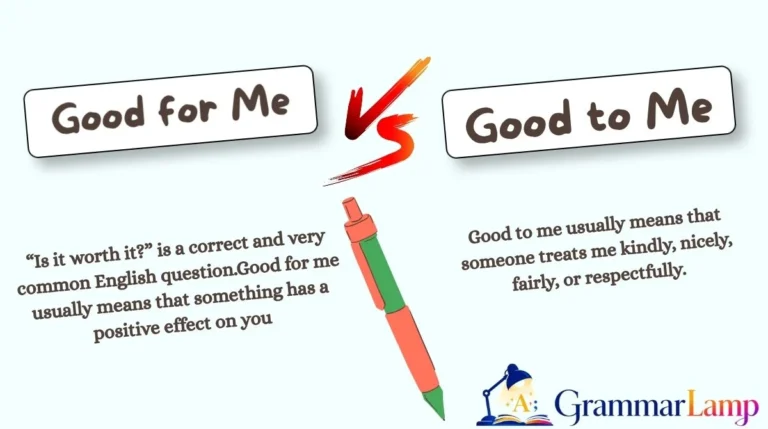
Good for me usually means that something has a positive effect on you. It may improve your health, help you learn something, make your life better, or be useful in some other way.
The key idea is benefit.
For example:
Exercise is good for me.
This means exercise has a positive effect on my health or body.
You can also use good for when talking about food, habits, activities, decisions, experiences, or situations.
When do we use “good for me”?
Use good for me when something benefits you or is helpful to you.
It can describe:
- Health
- Education
- Personal growth
- Habits
- Money or work
- Mental or physical well-being
- General benefits
For example, if you eat vegetables regularly, you might say:
Vegetables are good for me.
If you spend less time on your phone, you might say:
Taking a break from social media is good for me.
The expression does not always mean something is enjoyable. Something can be difficult but still be good for you.
For example:
Studying every day is hard, but it is good for me.
The studying may not be fun, but it helps you improve.
Grammar rule for “good for me”
The common structure is:
Subject + be + good for + person/thing
Examples:
This medicine is good for me.
Fresh fruit is good for me.
Reading books is good for me.
You can also change the subject and pronoun:
Walking is good for him.
This job is good for her.
Exercise is good for them.
The new schedule is good for us.
The important point is that for connects the thing or activity with the person who receives the benefit.
8 examples of “good for me”
- Drinking enough water is good for me.
It has a positive effect on my health. - This new job is good for me.
The job benefits my career, life, or situation. - Reading English books is good for me.
Reading helps me improve my English. - Going to bed early is good for me.
It helps me get enough rest. - This exercise is good for me.
The exercise has a positive effect on my body. - Learning from my mistakes is good for me.
It helps me grow and improve. - Taking a short break is good for me.
The break helps me feel better or work better. - Saving money is good for me.
It helps me financially.
A common learner confusion
Many learners see the word good and automatically use to because they think they are talking about a person.
But the real question is not simply:
“Am I talking about a person?”
Instead, ask:
Is this thing benefiting me?
If the answer is yes, good for me is usually the right expression.
For example:
Exercise is good for me.
Exercise is not treating me kindly. It is benefiting me. That is why we use for.
What Does “Good to Me” Mean?
Good to me usually means that someone treats me kindly, nicely, fairly, or respectfully.
The key idea is treatment.
For example:
My parents are good to me.
This means my parents treat me well. They may care for me, support me, help me, or behave kindly toward me.
The expression is commonly used for people, although it can sometimes be used with organizations, animals, or other things when we describe how they behave toward us.
When do we use “good to me”?
Use good to me when you are talking about someone’s behavior or treatment toward you.
It often describes:
- Kindness
- Care
- Respect
- Support
- Friendly behavior
- Fair treatment
- A positive relationship
For example:
She has always been good to me.
This means she has always treated me well.
You might also say:
My boss is good to me.
This could mean the boss treats you fairly, respects you, helps you, or behaves kindly toward you.
Grammar rule for “good to me”
The common structure is:
Subject + be + good to + person
Examples:
He is good to me.
She is good to me.
My friends are good to me.
My teacher has been good to me.
The person after to is the person receiving the treatment.
8 examples of “good to me”
- My mother is always good to me.
She treats me with care and kindness. - My friends are good to me.
They treat me well and support me. - My teacher has been good to me.
My teacher has treated me kindly and fairly. - My boss is good to me.
My boss treats me well at work. - She was very good to me when I was younger.
She treated me kindly during that time. - You have always been good to me.
You have consistently treated me well. - Our neighbors are good to us.
They behave kindly toward us. - The dog has always been good to me.
The dog behaves well and is friendly toward me.
A common learner confusion
Learners sometimes use good to when they really mean that something provides a benefit.
For example:
❌ Exercise is good to me.
If you mean exercise benefits your health, this is not the normal choice.
Say:
✅ Exercise is good for me.
On the other hand, if you mean someone treats you kindly, use to:
✅ My brother is good to me.
So, the difference is mainly about benefit versus treatment.
Difference Between “Good for Me” and “Good to Me”
The easiest way to understand the difference is to focus on what happens to the person.
Good for me means something benefits me.
Good to me means someone treats me well.
Here is a simple comparison:
| Expression | Main meaning | Main idea | Example |
|---|---|---|---|
| Good for me | Helpful or beneficial | Benefit | Exercise is good for me. |
| Good to me | Kind or nice toward me | Treatment | My sister is good to me. |
1. “Good for me” focuses on the result
When you say:
This food is good for me.
You are talking about its effect on you. Perhaps it is healthy or nutritious.
When you say:
Learning English is good for me.
You mean learning English benefits you.
The focus is not on how the thing behaves. The focus is on the positive effect.
2. “Good to me” focuses on behavior
When you say:
My friend is good to me.
You are describing your friend’s behavior toward you.
Your friend may help you, listen to you, respect you, or support you.
The focus is on how the person treats you.
3. The grammar logic
Think of the prepositions this way:
good for + person = benefit
good to + person = treatment
For example:
Exercise is good for me.
Exercise gives me a benefit.
My coach is good to me.
My coach treats me well.
4. The subject can help you choose
Look at the subject of the sentence.
If the subject is something that can benefit you, good for is often appropriate.
Sleep is good for me.
Water is good for me.
Practice is good for me.
If the subject is a person or animal that can treat you in a certain way, good to is often appropriate.
My father is good to me.
My teacher is good to me.
My dog is good to me.
This is not an absolute rule, because context matters, but it is a very useful guide for beginners.
5. One person can be both
Interestingly, you can use both expressions when talking about the same person, but the meaning changes.
Compare:
My teacher is good to me.
This means the teacher treats me well.
My teacher is good for me.
This means having this teacher is beneficial for me.
The second sentence might mean the teacher helps me learn, motivates me, or supports my development.
So, changing to to for can change the entire idea.
Explore More Posts
No Thank You vs No, Thank You: Which Is Correct in 2026?
Creek vs Creak: Meaning, Difference, Examples & Easy Rules (2026)
Ardor vs Ardour: Meaning, Difference, Spelling & Examples (2026)
Fillet vs Filet: What’s the Difference? Meaning, Spelling, and Examples in 2026
Grammar Rules You Must Remember
Rule 1: Use “good for” for benefits
Use good for when something has a positive effect on a person, body, mind, career, life, or situation.
Exercise is good for me.
Here, exercise benefits the speaker.
Another example:
Learning new words is good for your English.
Learning new words helps improve your English.
Rule 2: Use “good to” for kind or fair treatment
Use good to when someone behaves kindly or positively toward another person.
My parents are good to me.
The sentence talks about how the parents treat the speaker.
Another example:
She has always been good to her employees.
This describes her treatment of her employees.
Rule 3: “Good for me” does not always mean enjoyable
Something can be difficult, boring, or uncomfortable but still be beneficial.
Going to the gym is hard, but it is good for me.
The speaker may not enjoy every workout, but exercise provides a benefit.
Similarly:
Studying for exams is stressful, but it is good for me.
The focus is on the positive result.
Rule 4: “Good to me” usually describes a relationship or behavior
When you use good to, you are usually describing how one person or living thing behaves toward another.
My uncle is very good to me.
She has been good to her children.
Our neighbors are good to us.
The expression often has a warm, personal feeling because it talks about someone’s treatment and care.
Common Mistakes Students Make
These mistakes happen because good for and good to both sound natural in English, and both can be followed by a person.
The best way to avoid them is to focus on the meaning.
Mistake 1: Using “good to” for health benefits
❌ Drinking water is good to me.
If you mean water benefits your health, say:
✅ Drinking water is good for me.
Why? Because water is not treating you kindly. It is benefiting you.
Mistake 2: Using “good for” when talking about someone’s behavior
❌ My father is good for me.
This sentence can be grammatically possible in a special context, but it does not normally mean “My father treats me well.”
If that is your meaning, say:
✅ My father is good to me.
Mistake 3: Confusing “good for” with “good at”
There is another common expression:
good at
This means someone has a skill.
For example:
She is good at English.
He is good at football.
Do not confuse this with:
She is good to me.
That sentence talks about treatment, not ability.
Mistake 4: Thinking “to” always means movement
Beginners often learn to as a word showing movement:
I went to school.
But to has many other uses.
In:
He is good to me.
to shows the person toward whom the behavior is directed.
Easy correction tip
Whenever you are unsure, ask yourself one question:
“Does it benefit me, or does someone treat me well?”
If it benefits you, use:
good for me
If someone treats you well, use:
good to me
This simple question will solve most everyday situations.
Easy Trick to Remember the Difference
Here is a quick memory trick:
FOR = Benefit
Think:
Good for me = helps me.
For example:
Walking is good for me.
Walking helps my health.
Reading is good for me.
Reading helps my knowledge.
TO = Treatment
Think:
Good to me = treats me well.
For example:
My sister is good to me.
She treats me kindly.
My teacher is good to me.
The teacher treats me well.
You can remember it with two simple words:
FOR → Benefit
TO → Treatment
Imagine two questions:
What is good for me?
“What helps me?”
Who is good to me?
“Who treats me well?”
That distinction is useful in real conversations.
There is also a helpful way to think about the direction.
With good for, the benefit comes to you from the thing:
Exercise → benefit → me
With good to, the behavior goes toward you:
My friend → kind treatment → me
Once you start thinking about the meaning instead of memorizing isolated sentences, the difference becomes much easier.
Daily Life Examples
These expressions appear naturally in conversations about health, family, school, work, friendship, and everyday decisions.
Example 1: Talking about exercise
Ali: I started walking every morning.
Hamza: That’s great. Walking is good for you.
Ali: Yes, I feel healthier now.
Here, good for you means walking benefits your health.
Example 2: Talking about a parent
Sara: Do you have a good relationship with your father?
Mina: Yes. He is always good to me.
Sara: That’s nice.
Here, good to me describes the father’s kind treatment.
Example 3: Talking about food
A: Why are you eating more vegetables?
B: My doctor told me they are good for me.
The vegetables provide a health benefit.
Example 4: Talking about a teacher
A: Do you like your new teacher?
B: Yes. She is very good to me.
The speaker means the teacher treats them kindly.
Example 5: Talking about a job
A: Are you going to leave your job?
B: I’m not sure. This job is actually good for me.
Here, the job benefits the speaker in some way, perhaps financially or professionally.
Example 6: Talking about a friend
A: Why do you trust Ahmed so much?
B: Because he has always been good to me.
The speaker trusts Ahmed because of his kind behavior.
Example 7: Talking about sleep
A: Why are you going to bed so early?
B: I need more sleep. It’s good for me.
The speaker believes sleep has a positive effect on health or well-being.
Example 8: Talking about a relationship
A: How is your new manager?
B: She’s been very good to me.
The manager treats the speaker well.
Example 9: Talking about learning
A: Why do you practice English every day?
B: Because regular practice is good for me.
The practice helps the speaker improve.
Example 10: Talking about someone who helped you
A: Your uncle really supported you.
B: Yes. He was very good to me when I was in school.
The phrase describes his kind and supportive treatment.
Practice Section
Choose the correct option: good for or good to.
1. Fresh vegetables are ______ me.
A. good for
B. good to
2. My grandmother is always ______ me.
A. good for
B. good to
3. Reading every day is ______ your English.
A. good for
B. good to
4. My new manager has been very ______ me.
A. good for
B. good to
5. Getting enough sleep is ______ your body.
A. good for
B. good to
Answers
1. A — good for
Fresh vegetables benefit your health.
2. B — good to
Your grandmother treats you kindly.
3. A — good for
Reading helps improve your English.
4. B — good to
The sentence describes the manager’s treatment of you.
5. A — good for
Sleep has a positive effect on your body.
More Helpful posts
Breath vs Breathe: Easy Difference, Meaning, Examples & Rules in 2026
No Longer Exist vs No Longer Exists: Which Is Correct? (2026 Guide)
Favourite vs Favorite: Meaning, Difference, Spelling & Usage Guide 2026
By Which vs In Which: Easy Difference, Rules, Examples & Practice (2026)
FAQs
What is the difference between “good for me” and “good to me”?
Good for me means something benefits me or has a positive effect on me. Good to me means someone treats me kindly, fairly, or well. For example, “Exercise is good for me” talks about a benefit, while “My brother is good to me” talks about treatment.
Can we use “good for me” in questions?
Yes. You can ask:
Is this good for me?
This is a common question when talking about food, exercise, medicine, habits, choices, or other things that may affect you.
For example:
Is drinking coffee good for me?
Can we use “good to me” in questions?
Yes. For example:
Has your new boss been good to you?
This asks about the boss’s behavior or treatment.
You can also ask:
Is your teacher good to you?
Here, the question is about how the teacher treats you.
Is “good to me” formal or informal?
Good to me is natural in both everyday and standard English. It is especially common when people talk about family members, friends, teachers, bosses, partners, or other people who treat them well.
Can a person be “good for me” and “good to me”?
Yes, and the meanings are different.
My friend is good to me.
This means the friend treats me well.
My friend is good for me.
This means the friendship or the person has a positive effect on my life.
Context tells us which meaning is intended.
Is “good for” always about health?
No. Health is a common use, but good for has a much wider meaning.
You can say:
This job is good for me.
Practice is good for me.
Traveling is good for me.
The expression can describe anything that provides a useful or positive benefit.
Conclusion
The difference between good for me and good to me is small in form but important in meaning.
Use good for me when something benefits you or has a positive effect on you. This is common when talking about health, habits, learning, work, money, and personal growth.
Exercise is good for me.
Use good to me when a person or another living thing treats you kindly, fairly, or well.
My parents are good to me.
A simple way to remember the difference is:
Good for = benefit
Good to = treatment
When you hear these expressions in real conversations, try to notice what the speaker means rather than only looking at the preposition. With a little practice, the difference will start to feel natural.
Try making five sentences with good for and five with good to. Use examples from your own life. That small exercise can make this grammar point much easier to remember.

Liam Derren is a language writer at GrammarLamp, creating simple, helpful content about grammar, words, and everyday English. He makes language learning clear, practical, and easy to understand.
1 thought on “Good for Me vs Good to Me: Meaning, Difference, and Examples (2026)”