
Differential and deferential look and sound very similar, so it is easy to mix them up. Both words contain the same letters in the middle, and both are often used as adjectives. However, their meanings are completely different.
This confusion is especially common for English learners because the two words are pronounced in a similar way.
A learner may know that both words describe something, but still be unsure which one fits a sentence. The problem becomes bigger when speaking or writing quickly.
The good news is that the difference is actually simple once you connect each word with its main idea.
Differential is usually connected with a difference, distinction, or different treatment. Deferential, on the other hand, is connected with respect, politeness, and showing respect toward another person.
You may see these words in newspapers, academic writing, business English, mathematics, and everyday conversations.
Knowing the difference can help you avoid awkward mistakes and make your writing more accurate.
By the end, you will know what each word means, how it works grammatically, where it is used, and how to remember the difference easily.
You will also see practical examples that show how these words sound in real English.
What Does “Differential” Mean?
Differential is mainly used as an adjective or noun. As an adjective, it describes something that involves a difference or distinction between two or more things.
A simple way to understand it is:
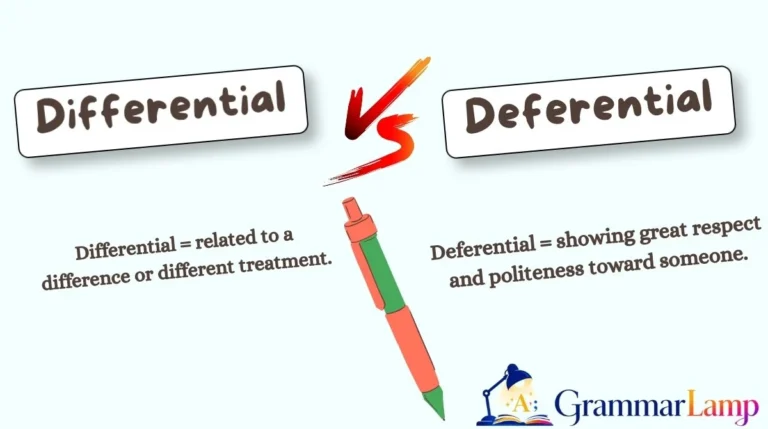
Differential = related to a difference or different treatment.
For example:
- The company offers differential prices to different customers.
- There is a differential effect on young and older people.
- The government introduced differential tax rates.
In these examples, the word points to a difference between groups, things, or situations.
When should you use “differential”?
Use differential when you are talking about differences, especially when one thing is treated, measured, paid, affected, or changed differently from another.
It is common in formal English, business, economics, science, medicine, and mathematics.
For example, a company might give workers different amounts of pay depending on their experience. This can be called a differential pay system.
You may also hear differential treatment, which means treating people or groups differently.
Grammar rule for “differential”
As an adjective, differential normally comes before a noun.
Pattern:
differential + noun
Examples include:
- differential treatment
- differential pricing
- differential effect
- differential pressure
- differential rates
- differential diagnosis
It can also be used as a noun in certain contexts.
For example:
There is a large differential between the two salaries.
Here, differential means a difference or gap.
The word also has a special meaning in mathematics. A differential can refer to a very small change in a quantity, especially in calculus.
Examples of “differential”
- The company uses differential pricing for different customers.
- The study found a differential effect on men and women.
- Workers receive differential pay for night shifts.
- The two groups experienced differential treatment.
- There is a significant differential between the two salaries.
- The doctor considered a differential diagnosis before deciding on the condition.
- The machine measures differential pressure between two points.
- In calculus, students learn about differential changes.
Common learner confusion with “differential”
The biggest mistake is thinking that differential means “respectful.”
It does not.
For example:
❌ The student was differential toward his teacher.
This is incorrect if you mean that the student showed respect.
The correct word is:
✅ The student was deferential toward his teacher.
Remember that differential has the idea of difference, not respect.
Another common problem is using differential when the simple word different would be more natural.
For example:
The two groups received differential treatment.
This is correct, but it is more formal than:
The two groups were treated differently.
So, differential is useful, but it should not replace different or differently in every sentence.
Feel vs Felt: Complete Grammar Guide With Examples (2026)
Role Call or Roll Call? The Correct Spelling and Meaning in 2026
Into or Onto: Complete Difference, Rules, and Examples for 2026
Sole vs Soul: What’s the Difference? Easy Guide With Examples 2026
What Does “Deferential” Mean?
Deferential is an adjective that means showing respect toward someone, especially someone who is older, more important, more experienced, or in a higher position.
A simple definition is:
Deferential = showing great respect and politeness toward someone.
For example:
The young employee was deferential to her manager.
This means she behaved respectfully toward her manager.
The word is often used when someone carefully respects another person’s authority, experience, position, or wishes.
When should you use “deferential”?
Use deferential when describing a person’s attitude, behavior, voice, manner, or actions toward another person.
It is especially useful when someone is being very respectful.
You might use it to describe:
- a student speaking to a teacher
- an employee speaking to a senior manager
- a child speaking to an if possible person
- a junior officer speaking to a senior officer
- someone speaking to a respected leader
The word is usually more formal than respectful or polite.
Grammar rule for “deferential”
Deferential is an adjective.
It often appears after the verb be:
subject + be + deferential
For example:
She was deferential toward her professor.
It can also come before a noun:
His deferential manner impressed the guests.
The common prepositions are to and toward/towards, depending on the sentence and intended style.
Examples:
He was deferential to his boss.
She was deferential toward the older man.
The phrase deferential to is especially common.
Examples of “deferential”
- The young lawyer was deferential to the senior judge.
- He spoke in a deferential tone to his manager.
- The student was very deferential toward her professor.
- She remained deferential to her parents.
- His deferential manner showed that he respected the older man.
- The assistant was polite and deferential to the director.
- The new employee was naturally deferential to experienced workers.
- He gave a deferential nod when the leader entered the room.
Common learner confusion with “deferential”
Learners sometimes confuse deferential with different, mainly because the spelling is similar to differential.
But deferential has nothing to do with being different.
Consider these two sentences:
The company uses differential pricing.
The employee was deferential to the manager.
The first sentence is about difference.
The second sentence is about respect.
Another important point is that deferential does not simply mean “friendly.”
A person can be friendly without being deferential. Deferential behavior usually suggests that the person is giving special respect to someone else’s position, authority, age, or experience.
Difference Between Differential and Deferential
The easiest way to understand the difference is to focus on the central idea behind each word.
Differential → difference
Deferential → respect
Although they look alike, they describe completely different things.
Comparison Table
| Feature | Differential | Deferential |
|---|---|---|
| Main meaning | Related to a difference | Showing respect |
| Part of speech | Adjective; sometimes noun | Adjective |
| Main idea | Difference or distinction | Respect and politeness |
| Common use | Business, science, economics, mathematics | Social behavior and relationships |
| Common phrase | Differential treatment | Deferential attitude |
| Usually describes | Systems, effects, rates, treatment, changes | People, behavior, tone, manner |
| Simple memory word | Difference | Respect |
Usage difference
Differential is often used when comparing two things.
For example:
The company has a differential pay system.
This tells us that different workers may receive different pay.
Deferential is normally used when describing how one person behaves toward another.
For example:
The employee was deferential to the manager.
This tells us about the employee’s respectful behavior.
Grammar logic
The two words also behave differently in normal sentences.
With differential, you will often see a noun immediately after it:
differential treatment
differential rates
differential pressure
differential effect
With deferential, you are more likely to see a person or their behavior being described:
a deferential student
a deferential attitude
a deferential tone
a deferential manner
You can also say:
He was deferential to his teacher.
Meaning comparison
Compare these examples:
The school has differential fees for local and international students.
The word describes a difference in fees.
Now compare:
The student was deferential to his teacher.
The word describes respectful behavior.
These meanings are not interchangeable.
A useful sentence pair
Think about this pair:
Differential = “There is a difference.”
Deferential = “There is respect.”
That small distinction will solve most mistakes.
Ardor vs Ardour: Meaning, Difference, Spelling & Examples (2026)
Fillet vs Filet: What’s the Difference? Meaning, Spelling, and Examples in 2026
Complaint vs Complain: Meaning, Difference, Grammar Rules & Examples (2026)
Differential vs Deferential: Meaning, Difference, Examples, and Grammar Rules (2026)
Grammar Rules You Must Remember
Rule 1: Use “differential” for differences
When the sentence is about different rates, treatment, effects, prices, or measurements, differential may be the correct adjective.
The company introduced differential pricing for different regions.
The key idea is that the prices are not the same.
Rule 2: Use “deferential” for respectful behavior
When you are describing someone’s respectful behavior toward another person, use deferential.
The assistant was deferential to the director.
The key idea is respect.
Rule 3: “Deferential” commonly describes people or their behavior
You can describe a person’s attitude, manner, voice, or tone as deferential.
She used a deferential tone when speaking to the judge.
His deferential manner made it clear that he respected his supervisor.
Do not use it to describe ordinary differences.
Rule 4: “Differential” often appears before a noun
A common structure is:
differential + noun
Examples:
differential treatment
differential rates
differential pricing
differential pressure
differential impact
If you are talking about respectful behavior, this structure does not work with differential.
For example:
❌ He showed differential respect for his teacher.
If you mean that he showed special respect toward the teacher, deferential is a better choice:
✅ He was deferential to his teacher.
Common Mistakes Students Make
These words cause mistakes because they have similar spelling and pronunciation. Learners may remember the shape of the word rather than its meaning.
Mistake 1: Using “differential” for respect
❌ The boy was differential toward his grandfather.
✅ The boy was deferential toward his grandfather.
The boy is showing respect, so deferential is correct.
Correction tip: Ask yourself, “Am I talking about a difference or respect?”
If the answer is respect, choose deferential.
Mistake 2: Using “deferential” for different treatment
❌ The company has deferential prices for different customers.
✅ The company has differential pricing for different customers.
The sentence is about prices being different, not about respect.
Correction tip: Look for words such as prices, rates, treatment, effects, or levels. These often point toward differential.
Mistake 3: Thinking “deferential” means simply “different”
A learner may see the first few letters and guess:
Deferential = different
That is not correct.
The two words come from different ideas.
Differential is connected with difference.
Deferential is connected with deference, which means showing respect or giving way to another person’s judgment or authority.
Mistake 4: Using “differential” when “different” is better
Not every sentence containing the idea of difference needs differential.
For example:
The two plans are different.
This is natural.
You would not normally say:
The two plans are differential.
However, differential works well in more specific expressions:
The company offers differential rates.
Correction tip: Use different for ordinary descriptions. Use differential when you are describing a difference within a system, comparison, measurement, or formal process.
Mistake 5: Forgetting the preposition after “deferential”
A natural sentence is:
She was deferential to her teacher.
Not:
❌ She was deferential her teacher.
The word often needs to when you identify the person receiving the respect.
Easy Trick to Remember the Difference
Here is the simplest memory trick:
Differential has “difference” inside its meaning.
Think:
DIFFERential → DIFFERence
The beginning of differential reminds you of different.
So:
Differential = difference
Now remember:
Deferential is connected to “deference.”
Deference means respect for another person’s wishes, position, or authority.
So:
Deferential = respectful
Imagine a student standing in front of a respected teacher.
The student speaks politely and listens carefully.
That student is being deferential.
Now imagine two employees receiving different salaries.
That is a differential in pay.
One picture is about people and respect.
The other is about things and differences.
This mental picture makes the words much easier to remember.
Daily Life Examples
Here are examples that sound natural in everyday or workplace English.
1. At school
Teacher: Why was Ali so quiet during the meeting?
Student: He was being deferential to the senior teacher.
The idea is respect.
2. At work
The new employee was very deferential to her manager.
She behaved with respect toward her manager.
3. Talking about salaries
The company has differential pay for day and night shifts.
The pay is different depending on the shift.
4. Talking about prices
The store uses differential pricing during busy seasons.
Different prices are used in different situations.
5. Talking about someone’s voice
He spoke in a deferential tone when talking to the director.
His tone showed respect.
6. Talking about treatment
The report looked at differential treatment of customers.
The report examined whether different customers were treated differently.
7. In a family conversation
The child was deferential to his grandmother.
The child showed her special respect.
8. In business English
The company offers differential rates to large customers.
The rates are different for different customers.
9. In a formal meeting
She gave a deferential nod to the chairman.
The nod showed respect.
10. In science or technical English
The instrument measures differential pressure.
Here, differential refers to a difference between two pressure measurements.
Practice Section
Choose differential or deferential to complete each sentence.
1.
The young employee was very ______ to her supervisor.
2.
The company introduced ______ pricing for large customers.
3.
He spoke in a ______ tone to the if possible guest.
4.
The study examined the ______ effects of the new policy.
5.
The student was ______ toward his professor.
Answers
1. deferential
The employee is showing respect to her supervisor.
2. differential
The prices are different for different customers.
3. deferential
The tone shows respect.
4. differential
The effects are different between groups or situations.
5. deferential
The student is showing respect toward the professor.
A quick test is to replace the word with respectful or different.
If respectful works, you probably need deferential.
If different or difference-related works, differential may be correct.
Favourite vs Favorite: Meaning, Difference, Spelling & Usage Guide 2026
No Thank You vs No, Thank You: Which Is Correct in 2026?
Creek vs Creak: Meaning, Difference, Examples & Easy Rules (2026)
Ardor vs Ardour: Meaning, Difference, Spelling & Examples (2026)
FAQs
What is the difference between differential and deferential?
Differential is connected with a difference, distinction, or different treatment. Deferential means showing respect toward another person, especially someone with greater authority, age, or experience.
A simple memory rule is: differential = difference; deferential = respect.
Can we use “deferential” in questions?
Yes. Deferential can be used in questions just like any other adjective.
For example:
Was the employee deferential to her manager?
Why was he so deferential toward the professor?
The word describes a respectful attitude or manner.
Is “deferential” formal or informal?
Deferential is generally a formal word. In everyday conversation, people often use respectful, polite, or courteous instead.
For example, “She was respectful to her teacher” is more common in simple everyday English than “She was deferential to her teacher.”
Is “differential” the same as “different”?
No. They are related, but they are not interchangeable.
Different is a common adjective used to say that two things are not the same. Differential is more specialized and often describes differences within a system, such as differential pricing, differential treatment, or differential rates.
Is it correct to say “differential respect”?
Usually, that is not the natural way to express the idea of someone showing respectful behavior.
If you mean that someone shows respect toward another person, deferential is usually the better word:
She was deferential to her supervisor.
Use differential when the main idea is a difference.
What is the easiest way to remember differential vs deferential?
Connect each word with one simple idea.
Differential → difference
Deferential → deference → respect
If you can remember those two connections, you will be able to choose the correct word in most situations.
Conclusion
Differential and deferential may look almost the same, but their meanings are very different. The easiest way to keep them apart is to focus on their main ideas.
Differential is about a difference. It is often used with words such as pricing, treatment, rates, effects, and pressure. It is common in business, science, economics, and technical writing.
Deferential is about respect. It describes a person’s attitude, manner, tone, or behavior toward someone they respect. It is especially useful when talking about authority, age, experience, or social position.
When you are unsure, stop and ask yourself one question:
“Am I talking about a difference or respect?”
If you mean a difference, choose differential. If you mean respectful behavior, choose deferential.
Try making your own sentences with both words. A few minutes of practice can make this confusing pair much easier to remember.
Once the connection becomes automatic, you will be much less likely to confuse them in speaking or writing.

Liam Derren is a language writer at GrammarLamp, creating simple, helpful content about grammar, words, and everyday English. He makes language learning clear, practical, and easy to understand.
3 thoughts on “Differential vs Deferential: Meaning, Difference, Examples, and Grammar Rules (2026)”