
Ardor vs ardour is a common spelling question for English learners. At first, the two words look different, so it is natural to think they may have different meanings or different grammar rules.
The good news is simple: ardor and ardour mean exactly the same thing. They are two spellings of the same noun. The main difference is where the spelling is used.
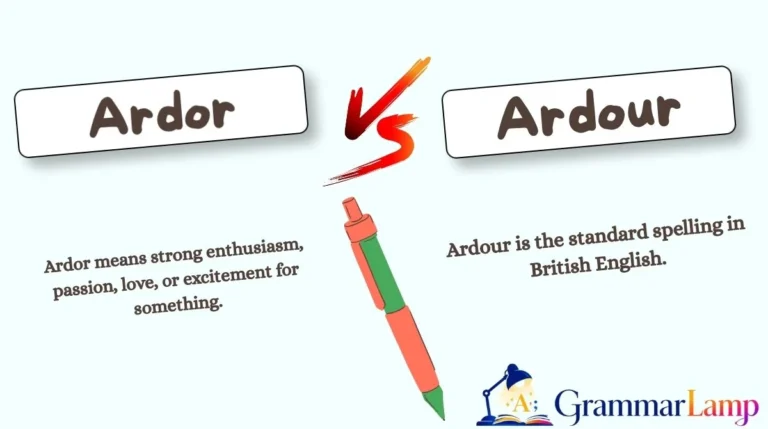
Ardor is the usual spelling in American English, while ardour is the usual spelling in British English and in many other varieties of English influenced by British spelling.
Both words describe strong passion, enthusiasm, love, or excitement about something. For example, if someone works with great passion and energy, you can say that they work with ardor or ardour.
This word is not very common in casual conversation. You are more likely to see it in books, essays, news writing, literature, or formal English.
Still, understanding it is useful because it can appear in reading tests, academic writing, and vocabulary questions.
By the end of this guide, you will know exactly when to use ardor and ardour, which spelling to choose, how to use the word in a sentence, and how to avoid common spelling mistakes.
Most importantly, you will learn an easy way to remember that there is no difference in meaning.
In the Morning vs On the Morning: Complete Grammar Guide for 2026
Inside of vs Inside: The Easy Difference Explained in 2026
Attend vs Tend: Meaning, Differences, Grammar Rules & Examples (2026)
Better Understand vs Understand Better: Meaning, Grammar, and Correct Usage (2026)
What Does “Ardor” Mean?
Ardor means strong enthusiasm, passion, love, or excitement for something.
For example:
She studied with great ardor because she wanted to become a doctor.
Here, ardor means strong enthusiasm and determination.
When should you use “ardor”?
Use ardor when you want to describe powerful feelings or enthusiasm. It is especially useful when someone is deeply interested in a cause, activity, career, belief, or relationship.
It is a fairly formal or literary word, so it may sound unusual in everyday conversation.
Instead of saying:
I have a lot of ardor for football.
A person would normally say:
I am very passionate about football.
However, ardor works well in formal writing:
His ardor for scientific research impressed his teachers.
Grammar rule for “ardor”
Ardor is a noun.
It normally refers to a strong feeling of enthusiasm or passion.
Common structures include:
- with ardor
- great ardor
- passionate ardor
- ardor for + noun
- ardor in + activity
Examples:
She defended her ideas with ardor.
His ardor for learning never disappeared.
The young artist worked with great ardor.
Her ardor for music was clear to everyone.
8 examples with “ardor”
- He spoke about his work with great ardor.
- Maria has a deep ardor for classical music.
- The students approached the project with ardor.
- His ardor for reading helped him improve his English.
- She defended the idea with remarkable ardor.
- The athlete trained with ardor every morning.
- His ardor for teaching inspired many young students.
- The writer described her first love with youthful ardor.
A common learner confusion
Some learners think ardor is a verb because it describes an action or strong feeling.
It is not a verb.
You cannot normally say:
❌ She ardored the project.
Instead, use the noun correctly:
✅ She worked on the project with ardor.
You can also use related words such as ardent, which is an adjective:
He is an ardent supporter of the team.
So remember:
- ardor = noun
- ardent = adjective
What Does “Ardour” Mean?
Ardour has the same meaning as ardor.
It means strong passion, enthusiasm, love, or excitement.
The only important difference is the spelling.
Ardour is the standard spelling in British English.
For example:
She worked with great ardour.
This means exactly the same as:
She worked with great ardor.
The meaning has not changed. Only the spelling has changed.
When should you use “ardour”?
Use ardour when you are following British English spelling conventions.
This is especially useful if you are writing for readers in the United Kingdom or using British English in school, exams, publishing, or professional writing.
British spelling often keeps the letter u in words that have a different spelling in American English.
For example:
- colour → color
- honour → honor
- favour → favor
- labour → labor
- ardour → ardor
So ardour follows the same general spelling pattern.
Grammar rule for “ardour”
Ardour is a noun, just like ardor.
It can be used in expressions such as:
- with ardour
- great ardour
- ardour for something
- ardour in doing something
Examples:
He pursued his dream with ardour.
Her ardour for education was obvious.
The teacher spoke with great ardour.
They worked with ardour and determination.
8 examples with “ardour”
- She spoke about education with great ardour.
- His ardour for photography grew every year.
- The students studied with unusual ardour.
- He pursued his dream with ardour.
- Her ardour for literature made her an excellent reader.
- The coach admired the player’s ardour and determination.
- They worked with ardour to complete the project.
- The author wrote about his homeland with deep ardour.
A common learner confusion
The biggest mistake is thinking that ardour and ardor are two different words with different meanings.
They are not.
Think of them as the same word wearing two different spelling styles.
If you write American English, choose ardor.
If you write British English, choose ardour.
Difference Between Ardor and Ardour
The most important point is this:
Ardor and ardour have the same meaning, pronunciation, and grammatical function. The difference is mainly spelling and regional English.
Comparison table
| Feature | Ardor | Ardour |
|---|---|---|
| Meaning | Strong passion or enthusiasm | Strong passion or enthusiasm |
| Part of speech | Noun | Noun |
| Main spelling | American English | British English |
| Pronunciation | Essentially the same | Essentially the same |
| Formality | Formal/literary | Formal/literary |
| Example | He worked with ardor. | He worked with ardour. |
| Meaning difference | None | None |
Usage difference
The choice depends mainly on the type of English you are using.
If your writing follows American English, use:
ardor
If your writing follows British English, use:
ardour
For example:
American English:
She showed great ardor for the project.
British English:
She showed great ardour for the project.
Both sentences mean the same thing.
Grammar logic
There is no special grammar rule that separates the two forms.
Both are nouns. Both can describe a strong feeling of passion or enthusiasm.
You can use either form after words such as great, deep, or with:
He worked with great ardor.
He worked with great ardour.
You can also use the word with for:
Her ardor for teaching was obvious.
Her ardour for teaching was obvious.
Sentence structure
The sentence structure does not change.
with + ardor/ardour
She spoke with ardor.
She spoke with ardour.
ardor/ardour + for + noun
His ardor for science was impressive.
His ardour for science was impressive.
great/deep + ardor/ardour
They showed great ardor.
They showed great ardour.
The only change is the letter u.
Meaning comparison
Both words can express:
- strong enthusiasm
- deep passion
- intense interest
- powerful emotion
- strong love or devotion
- energetic support for something
The exact meaning depends on the sentence.
For example:
He has great ardor for his work.
Here, the word means strong enthusiasm and passion.
In a romantic context:
The novel describes their youthful ardor.
Here, it can suggest strong romantic passion or emotion.
I’m vs I Am: Complete Difference, Rules, Examples & Usage Guide 2026
Sun vs Son: Meaning, Difference, Rules, and Examples (2026)
A Majority of vs The Majority of: Easy Grammar Guide for 2026
Tomatoes or Tomatos: Which Spelling Is Correct? [2026]
Grammar Rules You Must Remember
Rule 1: Ardor and ardour are nouns
Neither spelling is a verb.
✅ She worked with ardor.
✅ She worked with ardour.
❌ She ardored very hard.
When you need an adjective, use ardent.
He is an ardent supporter of the club.
Rule 2: Use “ardor” for American English
If your writing follows American spelling, leave out the u.
American: He showed great ardor.
This is the spelling you will normally find in American newspapers, books, websites, and educational materials.
Rule 3: Use “ardour” for British English
If you are following British spelling, keep the u.
British: He showed great ardour.
The same pattern appears in words such as:
colour, honour, favour, labour, ardour
American English generally uses:
color, honor, favor, labor, ardor
Rule 4: “Ardor/ardour for” is a useful sentence pattern
When you want to say that someone has strong passion for something, for is commonly used.
She has great ardor for music.
He has great ardour for learning.
You can also use with when describing how someone performs an action:
She defended her opinion with ardor.
He worked with ardour.
Common Mistakes Students Make
Mistake 1: Thinking the words have different meanings
Some learners see the different spelling and assume there must be a difference in meaning.
❌ Ardor means enthusiasm, but ardour means something else.
That is incorrect.
Correction: Both words mean the same thing.
Mistake 2: Mixing spelling styles in formal writing
A learner may write:
The colour of the building was beautiful, and the teacher praised his ardor.
This is not necessarily grammatically wrong, but it mixes British spelling (colour) with American spelling (ardor).
If you are following British English, a more consistent version is:
The colour of the building was beautiful, and the teacher praised his ardour.
If you are following American English:
The color of the building was beautiful, and the teacher praised his ardor.
Consistency is the useful rule.
Mistake 3: Treating “ardor” as an adjective
❌ She is an ardor supporter.
The correct adjective is ardent:
✅ She is an ardent supporter.
Compare:
- ardor = noun
- ardent = adjective
Mistake 4: Using it in every casual situation
Although ardor is correct English, it can sound formal.
For example:
I have ardor for pizza.
This sounds unnatural in normal conversation.
A natural speaker would probably say:
I really love pizza.
Or:
I am very passionate about cooking.
Ardor/ardour is better when the context is serious, formal, literary, or descriptive.
Mistake 5: Assuming “ardour” is pronounced differently
The spelling is different, but the pronunciation is essentially the same.
The u in ardour does not create a separate pronunciation.
So you do not need to learn two different vocabulary words.
Easy Trick to Remember the Difference
Here is the easiest memory trick:
American English = ardor
British English = ardour
Think about the word colour.
British English:
colour
American English:
color
Now apply the same idea:
British English:
ardour
American English:
ardor
The extra u belongs to the British spelling.
A simple visual trick
Think:
British → extra U → ardour
American → no U → ardor
This is not a rule for every English word, but it works perfectly for this pair.
And remember one more thing:
Different spelling does not mean different meaning.
That single idea will solve most confusion about ardor vs ardour.
Daily Life Examples
The word is more formal than everyday words such as passion, excitement, or enthusiasm. Still, you may see it in conversations, books, essays, and descriptions.
Here are some natural examples.
1. Talking about study
Student: Why does Sarah study so much?
Teacher: She has a real ardor for learning.
Here, ardor means strong enthusiasm.
2. Talking about sports
The fans supported their team with great ardor.
They showed strong excitement and passion.
3. Talking about a career
He chose teaching because of his ardour for helping children.
The British spelling is used here.
4. Talking about music
She plays the piano with remarkable ardor.
The sentence describes the passion and energy she puts into playing.
5. Talking about a hobby
His ardour for photography began when he was a teenager.
He has a strong interest and passion for photography.
6. Talking about a goal
She pursued her dream with ardor and determination.
She worked toward her dream with strong passion.
7. Talking about a cause
The young activist spoke with ardor about protecting the environment.
The word shows strong feeling and commitment.
8. Talking about literature
The poet wrote about love with great ardour.
This use sounds natural in literary writing.
9. Talking about work
He approaches every new project with ardor.
It means he works with strong enthusiasm.
10. Talking about a person
She is an ardent supporter of the school.
Notice that ardent, not ardor, is used because an adjective is needed.
Practice Section
Choose the correct option. Remember that the choice may depend on whether the sentence follows American or British English.
1. She worked with great ______ to achieve her goal.
A. ardor
B. ardour
C. Both A and B
2. In British English, which spelling is preferred?
A. ardor
B. ardour
3. Which sentence uses the word as a noun?
A. He is ardent about the project.
B. He worked with great ardor.
C. He ardored the project.
4. Complete the sentence:
Her ______ for literature was obvious.
A. ardor
B. ardour
C. Both A and B
5. Which statement is correct?
A. Ardor and ardour have different meanings.
B. Ardor is a noun, while ardour is a verb.
C. Ardor and ardour are different spellings of the same word.
Answers
1. C — Both A and B
Both spellings are grammatically correct. Choose according to your variety of English.
2. B — ardour
British English normally uses ardour.
3. B — He worked with great ardor.
Ardor is a noun. Ardent is the adjective.
4. C — Both A and B
Both spellings work in the sentence.
5. C — Ardor and ardour are different spellings of the same word.
Honor or Honour: What Is the Difference? A Simple Guide for 2026
Collaborate vs Corroborate: Meaning, Difference, and Examples in 2026
Sleeve vs Sleave: Which Is Correct? Meaning, Difference, and Examples in 2026
Time off vs time-off: The Complete Grammar Guide for 2026
FAQs
What is the difference between ardor and ardour?
There is no difference in meaning between ardor and ardour. Both mean strong passion, enthusiasm, or intense feeling. Ardor is mainly the American spelling, while ardour is mainly the British spelling.
Can we use ardor or ardour in questions?
Yes, you can use either spelling in a question.
For example:
Does he have a real ardor for music?
Or in British English:
Does he have a real ardour for music?
However, the word is formal, so everyday speakers may choose passion or enthusiasm instead.
Is ardor formal or informal?
Ardor is generally formal or literary. It is correct English, but it is not one of the most common words in casual conversation. In everyday speech, people often use words such as passion, enthusiasm, excitement, or love.
Is ardour British or American?
Ardour is mainly the British English spelling. It is also found in other varieties of English that generally follow British spelling conventions. American English normally drops the u and uses ardor.
Are ardor and ardour pronounced the same?
Yes. The two spellings normally have essentially the same pronunciation. The extra u in ardour is a spelling difference, not a reason to pronounce the word as a completely different word.
Is ardor the same as passion?
They are very close in meaning, but they are not always interchangeable. Ardor can mean strong passion, enthusiasm, or intense feeling. Passion is much more common and has a wider range of meanings. In everyday English, passion will usually sound more natural.
Conclusion
The difference between ardor and ardour is much easier than it first appears. They are two spellings of the same English word, and both describe strong passion, enthusiasm, love, or intense feeling.
The main rule is simple: ardor is the standard American English spelling, while ardour is the standard British English spelling. The meaning, grammar, and pronunciation are essentially the same.
Both forms are nouns, and common structures include with ardor/ardour and ardor/ardour for something. Remember that ardent is the related adjective, so you should not use ardor when an adjective is required.
You also do not need to use this word in every conversation. It is somewhat formal and is often better suited to essays, books, formal writing, and descriptions of strong passion.
The easiest memory rule is: British English keeps the “u” — ardour; American English removes it — ardor. Once you remember that, choosing the correct spelling becomes easy.

Liam Derren is a language writer at GrammarLamp, creating simple, helpful content about grammar, words, and everyday English. He makes language learning clear, practical, and easy to understand.
4 thoughts on “Ardor vs Ardour: Meaning, Difference, Spelling & Examples (2026)”