
English learners often get confused about “in the morning” and “on the morning.” Both phrases talk about morning time, so it may seem that they can be used in the same way. However, they do not usually have the same meaning or grammar pattern.
The good news is that the difference is quite simple once you understand one important idea: “in the morning” usually talks about morning as a general time, while “on the morning” usually points to a particular morning.
For example, we say:
- I usually drink tea in the morning.
- I met him on the morning of June 5.
The first sentence talks about a normal daily habit. The second sentence talks about one specific morning.
This small difference matters in everyday English. You will hear these expressions in conversations, emails, stories, school writing, news reports, and instructions. Choosing the right preposition can make your English sound much more natural.
You will also see simple examples from daily life so you can use the rules naturally rather than simply memorizing them.
What Does “In the Morning” Mean?
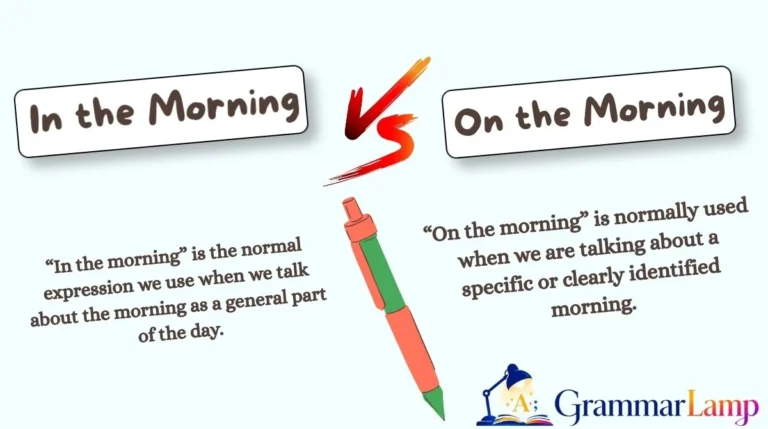
“In the morning” is the normal expression we use when we talk about the morning as a general part of the day.
We use in with larger or general periods of time, such as:
- in the morning
- in the afternoon
- in the evening
The phrase usually means during the morning hours, without focusing on one particular morning.
Grammar rule
Use:
in + the morning
when you are talking about morning in a general way, a usual routine, or a morning that is not being identified as a specific event.
For example:
- I go for a walk in the morning.
- She usually studies in the morning.
- We have breakfast in the morning.
- I feel more energetic in the morning.
- He works better in the morning.
- Please call me in the morning.
- They arrived in the morning.
- I like to read in the morning.
Notice that these sentences do not identify one special morning with a date or event.
“In the morning” for daily routines
This phrase is especially common when talking about habits.
I exercise in the morning.
This means exercising is part of your normal routine.
My father reads the newspaper in the morning.
Again, the sentence describes a regular activity.
You could do this every morning, or simply describe what normally happens during the morning.
“In the morning” for the next morning
We can also use in the morning when the listener already understands which morning we mean, especially when talking about the future.
For example:
I’ll call you in the morning.
Here, “the morning” usually means the next morning or the morning of the day being discussed.
Another example:
Don’t wake me up tonight. I’ll see you in the morning.
The phrase is not identifying the morning with a date. The context makes the meaning clear.
A common learner confusion
Some learners think that because morning is a specific time of day, they should always use on with it.
That is not correct.
We normally say:
I wake up early in the morning.
Not:
I wake up early on the morning.
However, on becomes possible when we identify a particular morning.
Compare:
I went to work in the morning.
with:
I went to work on the morning of Monday, July 6.
The first is general. The second identifies a particular morning.
What Does “On the Morning” Mean?
“On the morning” is normally used when we are talking about a specific or clearly identified morning.
The word on is commonly used for particular days and dates:
- on Monday
- on Friday morning
- on the morning of July 10
- on that morning
- on the morning when we left
The important point is that “on the morning” usually needs more information. Saying only “on the morning” can sound incomplete.
For example:
On the morning of the wedding, it started raining.
Here, “the morning” is specific because we know it is the morning of the wedding.
Grammar rule
A common structure is:
on + the morning + of + specific day/event
Examples:
- We left on the morning of June 12.
- It rained on the morning of the wedding.
- She called me on the morning of her birthday.
- They arrived on the morning of the exam.
- He felt nervous on the morning of the interview.
- The accident happened on the morning of Monday, March 3.
- We visited the museum on the morning of our last day.
- I received the news on the morning of the election.
The morning is clearly identified in each sentence.
“On the morning when…”
You can also use on the morning when to identify a particular morning through an event or situation.
For example:
I remember the morning when we first met.
With on, you could say:
On the morning when we first met, I was very nervous.
The phrase tells us exactly which morning you mean.
“On that morning”
Another common expression is on that morning.
Here, that makes the morning specific.
On that morning, everyone was excited.
We left early on that morning.
She received the letter on that morning.
Without a word such as that, a date, an event, or a relative clause, “on the morning” can sound unnatural.
For example:
❌ I exercise on the morning.
A natural sentence is:
✅ I exercise in the morning.
Or, if you mean a particular morning:
✅ I exercised on the morning of the race.
Difference Between “In the Morning” and “On the Morning”
The main difference is general time versus a specific morning.
| Expression | Main use | Example |
|---|---|---|
| in the morning | General morning time | I study in the morning. |
| on the morning of… | A specific morning connected to an event/date | I studied on the morning of the exam. |
| on that morning | A particular morning already mentioned | On that morning, I felt nervous. |
| on Monday morning | A particular day + morning | We met on Monday morning. |
| in the mornings | Regular morning habit | I run in the mornings. |
Usage difference
Think about whether you are answering the question “When generally?” or “Which morning?”
If you mean when generally, use in:
I work in the morning.
If you mean which particular morning, use on:
I worked on the morning of the conference.
This is the easiest way to understand the difference.
Grammar logic
English often uses in for periods of time:
- in the morning
- in the afternoon
- in the evening
- in January
- in 2026
- in summer
English often uses on for specific days or dates:
- on Monday
- on July 4
- on my birthday
- on Monday morning
- on the morning of July 4
So when morning is treated as part of a particular day, on can be used.
For example:
I saw Sarah in the morning.
This simply tells us the time.
But:
I saw Sarah on Monday morning.
Now the morning is attached to a specific day.
And:
I saw Sarah on the morning of the meeting.
Now we have an even more specific morning.
Sentence structure
Common structures include:
Subject + verb + in the morning
I study in the morning.
Subject + verb + on + day + morning
I study on Monday morning.
Subject + verb + on the morning of + event/date
I studied on the morning of the exam.
On + specific morning, + subject + verb
On the morning of the exam, I woke up early.
Grammar Rules You Must Remember
Rule 1: Use “in the morning” for general morning time
When you are talking about morning as a normal part of the day, use in.
I usually drink coffee in the morning.
She goes jogging in the morning.
This is the most common use.
Rule 2: Use “on” when the morning is connected to a specific day or event
When you identify a particular morning, on is often the correct choice.
We arrived on the morning of the wedding.
He called me on Monday morning.
The words “the wedding” and “Monday” identify the morning.
Rule 3: “On the morning” usually needs something that identifies the morning
Do not normally use on the morning by itself when you mean morning in general.
❌ I exercise on the morning.
✅ I exercise in the morning.
But this is correct:
✅ I exercised on the morning of the race.
You can also say:
✅ On that morning, I exercised before breakfast.
The word that makes the morning specific.
Rule 4: “In the morning” can refer to the next morning
You do not always need a specific date when using in the morning.
I’ll talk to you in the morning.
This is perfectly natural.
The context usually tells us which morning is meant.
For example:
A: Can I call you tonight?
B: I’m busy tonight. Call me in the morning.
Here, “in the morning” naturally means the next morning.
Common Mistakes Students Make
Learners often make these mistakes because many languages use different prepositions for time. English time expressions have to be learned as common patterns, not translated word for word.
Mistake 1: Using “on” for every morning
❌ I wake up early on the morning.
✅ I wake up early in the morning.
Why? The sentence describes a normal daily routine. It does not identify a special morning.
Easy tip: If you could add “usually,” in the morning is probably the right choice.
I usually wake up early in the morning.
Mistake 2: Using “in” with a specific day
❌ We met in Monday morning.
✅ We met on Monday morning.
“Monday” is a specific day, so use on.
The same pattern works with other days:
- on Tuesday morning
- on Wednesday morning
- on Friday morning
- on Sunday morning
Mistake 3: Saying “on the morning” without context
❌ I always read on the morning.
✅ I always read in the morning.
But:
✅ I read the report on the morning of the meeting.
The second sentence identifies a particular morning.
Mistake 4: Thinking “on the morning” is always wrong
This is the opposite problem.
Some students learn that in the morning is correct and then use it everywhere.
But this sentence is natural:
On the morning of the test, I felt sick.
Using in here would change the natural grammar:
❌ In the morning of the test, I felt sick.
The standard expression is on the morning of the test.
A quick correction test
Ask yourself:
“Am I talking about morning generally?”
If yes, use in.
I read in the morning.
Or ask:
“Am I identifying one particular morning?”
If yes, on is often appropriate.
I read on the morning of the exam.
Easy Trick to Remember the Difference
Here is a simple trick that works well for beginners:
IN = a general part of the day
Think of morning as a time period.
in the morning
You are inside that general period of time.
ON = a particular day
Think of on as sitting on a specific point on the calendar.
on Monday
on Monday morning
on the morning of the exam
So remember:
General morning → IN
Specific morning → ON
Try this pair:
I study in the morning.
This sounds like a habit.
I studied on the morning of my exam.
This describes one particular morning.
There is another useful clue. If you can add a specific word such as Monday, my birthday, the wedding, the exam, that day, or July 10, on becomes much more likely.
Daily Life Examples
The following examples show how these expressions sound in real conversations.
1. Talking about a routine
A: When do you usually exercise?
B: I exercise in the morning.
This is a regular habit, so in is correct.
2. Talking about tomorrow
A: When should I call you?
B: Call me in the morning.
The context makes it clear that the speaker probably means tomorrow morning.
3. Talking about Monday
A: When did you meet your teacher?
B: I met her on Monday morning.
Monday is a specific day, so on is used.
4. Talking about an exam
I was very nervous on the morning of my English exam.
The speaker means one particular morning.
5. Talking about a wedding
It started raining on the morning of the wedding.
The wedding identifies the morning.
6. Talking about a normal feeling
I don’t like talking to people early in the morning.
This is a general statement.
7. Talking about a specific event
On the morning of the interview, I woke up at 5 a.m.
This refers to one specific interview morning.
8. Talking about a daily routine
My brother checks his phone in the morning.
This sounds like something he normally does.
9. Talking about a particular day
We left the hotel on Saturday morning.
Saturday identifies the morning.
10. Telling a story
On the morning of our trip, we discovered that the car had a flat tire.
This is a particular morning connected with a particular event.
Practice Section
Choose in or on to complete each sentence.
1.
I usually go for a walk ___ the morning.
2.
We left the house ___ Monday morning.
3.
She felt nervous ___ the morning of her interview.
4.
I’ll send you the details ___ the morning.
5.
He likes to study ___ the morning.
Answers
1. in
I usually go for a walk in the morning.
2. on
We left the house on Monday morning.
3. on
She felt nervous on the morning of her interview.
4. in
I’ll send you the details in the morning.
5. in
He likes to study in the morning.
A useful pattern appears again and again: general or routine → in, while specific day or identified morning → on.
FAQs
What is the difference between “in the morning” and “on the morning”?
In the morning usually refers to morning as a general time or part of your daily routine. On the morning is normally used when a particular morning is identified, such as on Monday morning or on the morning of the exam.
Can we use “in the morning” in questions?
Yes. It is very common.
What do you usually do in the morning?
Can I call you in the morning?
Are you free in the morning?
These questions usually refer to general morning time or a morning understood from context.
Is “in the morning” formal or informal?
In the morning is completely normal in both spoken and written English. It is not especially formal or informal. You can use it in everyday conversation, school writing, emails, and professional communication.
Is “on the morning” grammatically correct?
Yes, but it usually needs more information. For example, on the morning of the exam, on Monday morning, and on that morning are natural. Simply saying on the morning without context often sounds incomplete.
Should I say “in Monday morning” or “on Monday morning”?
Say on Monday morning.
We use on with specific days:
on Monday
And when we add morning:
on Monday morning
Do not say in Monday morning in standard English.
Can I say “on the morning of my birthday”?
Yes. This is a correct and natural expression.
I received many messages on the morning of my birthday.
The phrase refers to one particular morning: the morning belonging to your birthday.
Conclusion
The difference between in the morning and on the morning is mainly about whether you mean a general morning or a specific morning.
Use in the morning when talking about normal routines, general morning time, or a morning understood from the context:
I study in the morning.
Use on when the morning is connected to a specific day, date, event, or clearly identified situation:
I studied on the morning of the exam.
You can also remember the simple rule:
IN → general time
ON → specific day or identified morning
Once you start noticing this pattern in conversations, books, movies, and English lessons, the choice will become much easier.
Try making a few sentences about your own morning routine, then make a few sentences about a specific morning in your life. A little practice will make this grammar point feel natural.

Liam Derren is a language writer at GrammarLamp, creating simple, helpful content about grammar, words, and everyday English. He makes language learning clear, practical, and easy to understand.
4 thoughts on “In the Morning vs On the Morning: Complete Grammar Guide for 2026”