
Many English learners see ax and axe and wonder whether they are two different words.
At first glance, the spelling looks different enough to suggest that each word has its own meaning. The good news is that the difference is much simpler than it seems.
Ax and axe normally mean the same thing. Both can describe a tool with a sharp metal blade used for cutting wood. Both can also be used as verbs.
In another meaning, the word can describe removing a job, service, plan, or activity. Cambridge lists axe as the main British spelling and gives ax as the US form, while Oxford notes that American English usually uses ax.
The main issue, then, is not really meaning. It is spelling preference and regional English.
For example, an American writer may write, “He picked up an ax,” while a British writer may write, “He picked up an axe.” The pronunciation is the same: /æks/.
Once you understand this point, the choice becomes easy. You will also see why dictionaries use phrases such as “US also ax” and “US English usually ax.”
By the end, you will know how to use both forms naturally, what happens when the word is used as a verb, which spelling fits American or British English, and which common mistakes to avoid.
More Useful posts
In the Morning vs On the Morning: Complete Grammar Guide for 2026
Inside of vs Inside: The Easy Difference Explained in 2026
Attend vs Tend: Meaning, Differences, Grammar Rules & Examples (2026)
Better Understand vs Understand Better: Meaning, Grammar, and Correct Usage (2026)
What Does “Ax” Mean?
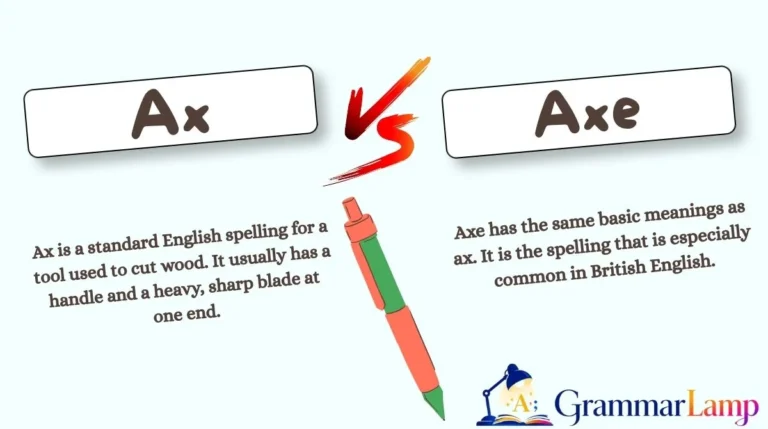
Ax is a standard English spelling for a tool used to cut wood. It usually has a handle and a heavy, sharp blade at one end. The word can also be used as a verb, especially in American English. Oxford’s American dictionary lists ax as a verb meaning to remove a service, system, person, or similar thing, and it also gives axe as an alternative spelling.
When you use ax as a noun, you are usually talking about the physical tool.
For example:
- He carried an ax into the forest.
- The ax was hanging in the shed.
- She used an ax to cut the thick branch.
- Be careful when you lift that ax.
- The farmer bought a new ax.
- There was an old ax beside the wood pile.
- He sharpened the ax before cutting the logs.
Notice that ax is a countable noun. You can say an ax, the ax, or two axes.
The word can also work as a verb:
- The company decided to ax several expensive programs.
- The network axed the show after one season.
- The manager axed the plan because it was too costly.
This verb meaning is common when talking about cutting jobs, services, projects, or other things. Cambridge also gives ax as the US form of the verb axe.
A common learner mistake is thinking that ax is an incorrect short form of axe. That is not the case. In American English, ax is a normal standard spelling, not a spelling mistake. Oxford specifically identifies it as the usual American form.
Another important point is pronunciation. The final x gives the sound /ks/, so ax is pronounced just like axe. You do not pronounce one differently because it has an extra e.
What Does “Axe” Mean?
Axe has the same basic meanings as ax. It is the spelling that is especially common in British English. Cambridge lists axe as the main British form and says that ax is also used in US English.
As a noun, axe refers to the same cutting tool:
- The worker picked up an axe.
- He used an axe to cut the wood.
- There is an axe in the garage.
- The old axe needs a sharper blade.
- She put the axe back after using it.
- The axe had a long wooden handle.
- They bought an axe for the camping trip.
The spelling axe is especially natural for British English users. Oxford gives axe as the main entry and notes that American English usually uses ax.
Just like ax, axe can also be a verb. It can mean to remove something suddenly, especially jobs, services, plans, or activities.
For example:
- The company will axe 300 jobs.
- The channel axed the program.
- The council decided to axe the project.
- The airline axed several flights.
Cambridge describes this verb as reducing or getting rid of services, jobs, payments, or similar things.
There is also a familiar expression, have an axe to grind. It means having a strong personal opinion or reason for supporting a particular point of view. American English can also write have an ax to grind. Cambridge includes both spellings.
So, just like with ax, do not assume that axe has a special meaning. In most everyday situations, the two spellings point to the same word.
Difference Between Ax and Axe (Detailed)
The biggest difference between ax and axe is regional spelling, not meaning.
Here is a simple comparison:
| Feature | Ax | Axe |
|---|---|---|
| Basic meaning | Cutting tool | Cutting tool |
| Pronunciation | /æks/ | /æks/ |
| Noun | Yes | Yes |
| Verb | Yes | Yes |
| American English | Common / usually preferred | Also understood and used |
| British English | Understood, less usual | Common / preferred |
| Meaning changes? | Usually no | Usually no |
| Main difference | Spelling preference | Spelling preference |
The important word here is usually. English is used by millions of people across many countries, so spelling habits are not always perfectly separated by borders. Still, dictionaries clearly show a general pattern: American English favors ax, while British English favors axe.
Usage Difference
Imagine two sentences:
American English:
The workers used an ax to cut the tree.
British English:
The workers used an axe to cut the tree.
The meaning is exactly the same. The reader is not supposed to understand a different kind of tool.
The same thing happens with the verb:
American English:
The company axed the project.
British English:
The company axed the project.
Interestingly, the past form does not always make the visual difference as obvious. Both forms commonly use axed. Cambridge lists axed as the past simple and past participle of axe, while Oxford’s American entry gives the forms axed and axing for the verb ax.
Grammar Logic
There is no special grammar rule saying that one spelling must be used in a certain sentence type.
Both can be:
Nouns
- I bought an ax.
- I bought an axe.
Verbs
- They will ax the plan.
- They will axe the plan.
The grammar stays the same. Only the spelling changes.
Sentence Structure Difference
Because both words can function as nouns and verbs, they can appear in the same sentence patterns.
As a noun:
Subject + verb + object
- The man lifted the ax.
- The man lifted the axe.
As a verb:
Subject + verb + object
- The company axed the jobs.
- The company axed the jobs.
There is no special sentence structure for one version.
Meaning Comparison
In the ordinary tool meaning, both words refer to essentially the same object. In the figurative sense, both can mean cutting or removing something.
For example:
The project got the ax.
The project got the axe.
Both mean that the project was stopped or removed.
Oxford describes the axe as an informal expression often used for someone losing a job or for a project or institution being closed or stopped, usually because of financial problems.
That means the choice between ax and axe usually depends on the style of English you are writing, not on what you want the sentence to mean.
Explore More Posts
Better Understand vs Understand Better: Meaning, Grammar, and Correct Usage (2026)
Hear vs Here: Meaning, Difference, Grammar Rules & Examples in 2026
Hasn’t vs Haven’t: Easy Grammar Rules, Examples & Differences in 2026
Grammar Rules You Must Remember
Rule 1: Ax and axe are spelling variants
The safest rule is simple: ax and axe are normally two spellings of the same word.
Example:
He bought an ax.
He bought an axe.
Both sentences describe the same action and the same tool.
Rule 2: American English commonly uses “ax”
When writing for an American audience, ax is often the natural choice. Oxford specifically identifies ax as the usual American spelling.
Example:
The carpenter used an ax to cut the wood.
American dictionaries and English-language resources can still recognize axe, so seeing the longer form does not automatically mean it is wrong.
Rule 3: British English commonly uses “axe”
For British English, axe is the standard spelling you will commonly see.
Example:
The gardener used an axe to cut the branch.
Cambridge marks axe as the British form and gives ax as the US form.
Rule 4: Keep your spelling consistent
The most useful writing habit is consistency.
Suppose you are writing a school assignment in American English. You may choose:
ax, axes, axed, axing
For British English, you may choose:
axe, axes, axed, axing
Your main goal is to follow the variety of English required by your school, workplace, publication, or audience.
Do not switch between regional styles for no reason. Consistent spelling makes your writing look more polished.
Common Mistakes Students Make
One of the most common mistakes is believing that ax is a shortened or incomplete spelling of axe.
That is not correct.
Mistake 1: Calling “ax” wrong
Wrong idea:
“Ax is incorrect. It must always be axe.”
Better understanding:
Ax is a standard spelling, especially in American English.
Mistake 2: Thinking the pronunciation changes
Some learners think:
- ax = one pronunciation
- axe = another pronunciation
But both are pronounced /æks/.
So the extra e does not create a new sound.
Mistake 3: Thinking the meaning changes
Compare:
He picked up an ax.
He picked up an axe.
There is no important meaning difference here.
The same is true with:
The company axed the program.
The company axed the program.
The spelling may reflect regional English, but the meaning stays the same.
Mistake 4: Using “axes” incorrectly
The plural of ax/axe is commonly axes.
Example:
The store sells several axes.
This can look confusing because axes is also the plural of axis. The pronunciation and meaning tell you which word is intended.
Easy Correction Tip
Whenever you see ax vs axe, ask yourself:
“Am I choosing a meaning, or am I choosing a spelling style?”
For this word, the answer is usually spelling style.
Easy Trick to Remember the Difference
Here is an easy memory trick:
Ax = American preference
Axe = British preference
The shortest spelling, ax, is easy to connect with American English.
The longer spelling, axe, is the one you will commonly see in British English.
Now imagine two students writing the same sentence:
Student A, using American English:
“I bought an ax.”
Student B, using British English:
“I bought an axe.”
Neither student has changed the meaning. They have simply followed different spelling traditions.
A second trick is even easier:
Extra E = British English
This is only a memory aid, not a grammar rule for every English word. But for ax/axe, it can help beginners remember the common regional pattern.
The most important thing is not to panic when you see the other spelling. An American reader can understand axe, and a British reader can understand ax.
Daily Life Examples
These examples show how the words can appear in ordinary conversations.
Example 1
A: What are you looking for?
B: I need an ax to cut this wood.
Example 2
A: Do you have an axe in the garage?
B: Yes. It is beside the old toolbox.
Example 3
A: Why did the show disappear?
B: The network axed it after one season.
Example 4
A: Are these jobs safe?
B: I heard some positions may get the axe.
Example 5
A: Did you bring an ax for the camping trip?
B: Yes, it is in the car.
Example 6
A: Why was the project axed?
B: The company could no longer afford it.
Example 7
A: Be careful with that axe.
B: Don’t worry. I know how to use it.
Example 8
A: The city is planning to axe the old service.
B: Really? Why?
Example 9
A: Does “ax to grind” mean literally carrying an ax?
B: No. It is an expression about having a personal opinion or reason.
Example 10
A: Which spelling should I use in my American English assignment?
B: Ax is the usual American choice, although axe is recognized too.
These conversations also show an important point: the word does not become more formal or less formal just because you add the e. The regional spelling is the main difference.
Practice Section
Choose the better spelling for each sentence based on the variety of English mentioned.
1. American English
The farmer picked up an ___.
a) axe
b) ax
2. British English
He used an ___ to cut the branch.
a) ax
b) axe
3. American English
The company decided to ___ the expensive program.
a) axe
b) ax
4. British English
The television channel ___ the show last month.
a) axed
b) Both can be understood
5. General English
Which statement is true?
a) Ax and axe have completely different meanings.
b) Ax and axe are usually spelling variants of the same word.
Answers
- b) ax
- b) axe
- b) ax
- b) Both can be understood
- b) Ax and axe are usually spelling variants of the same word.
The purpose of this exercise is not to memorize two separate words. It is to recognize how spelling changes between varieties of English.
More Helpful posts
Mine as Well or Might as Well? The Correct Phrase Explained in Simple English (2026)
Alternative of vs Alternative for vs Alternative to: Which Is Correct? 2026 Guide
Realise or Realize: Which Spelling Is Correct in 2026?
Berth vs Birth: Meaning, Difference, Examples & Easy Rules for 2026
FAQs
What is the difference between ax and axe?
Ax and axe usually have the same meaning and pronunciation. Both can refer to a cutting tool and can also be used as verbs meaning to remove or cut something. The main difference is regional spelling: ax is commonly associated with American English, while axe is common in British English.
Is ax correct English?
Yes. Ax is a correct standard English spelling. It is especially common in American English. Oxford’s American dictionary lists ax as the main form and gives axe as an alternative.
Is axe the British spelling of ax?
Yes, axe is the spelling commonly used in British English. Cambridge presents axe as the British form and notes ax as the US form.
Can “ax” be used as a verb?
Yes. Ax can be a verb meaning to remove or stop something, such as a service, project, job, or program. This use is especially common in American English. For example, The company axed the project.
Are ax and axe pronounced the same?
Yes. Both are normally pronounced /æks/. The extra e in axe does not create a different pronunciation.
Is axe more formal than ax?
Not really. The difference is mainly connected to regional spelling rather than formality. Ax is a standard American spelling, while axe is especially common in British English. Choose the form that matches the English variety you are using.
Conclusion
The difference between ax vs axe is much easier than it first appears. In modern English, both words normally have the same meaning.
They can describe the tool used for cutting wood, and they can also work as verbs when talking about removing jobs, services, projects, or similar things.
The main difference is spelling preference. Ax is commonly used in American English, while axe is commonly used in British English. Major dictionaries recognize this regional pattern, and both forms are understood widely.
So, do not treat one spelling as “right” and the other as “wrong.” Instead, think about your audience and the type of English you are writing.
Once you remember ax = common American spelling and axe = common British spelling, this confusing pair becomes simple.
Keep practicing, notice the spelling used in the English you read, and soon you will choose the right form without stopping to think about it.

Liam Derren is a language writer at GrammarLamp, creating simple, helpful content about grammar, words, and everyday English. He makes language learning clear, practical, and easy to understand.