
If you have ever written realise in one sentence and realize in another, you may have wondered which spelling is correct.
The good news is that both are correct. The difference is mainly about British English and American English.
These two spellings have the same meaning, the same pronunciation, and the same grammatical use.
They both mean to understand something clearly, become aware of something, or make something happen in some contexts. The only major difference is the spelling style used in different varieties of English.
For example, a British English speaker may write:
I suddenly realised that I had forgotten my keys.
I suddenly realized that I had forgotten my keys.
Neither sentence is wrong.
This difference matters because English learners often read books, websites, emails, and social media posts from different countries.
You may see realise in a British textbook and realize on an American website. This can make the two forms look like different words.
Once you understand where each spelling is normally used, the choice becomes simple.
You will also learn how the spelling changes in forms such as realised/realized, realising/realizing, and realisation/realization, so you can write more confidently in both British and American English.
What Does “Realise” Mean?
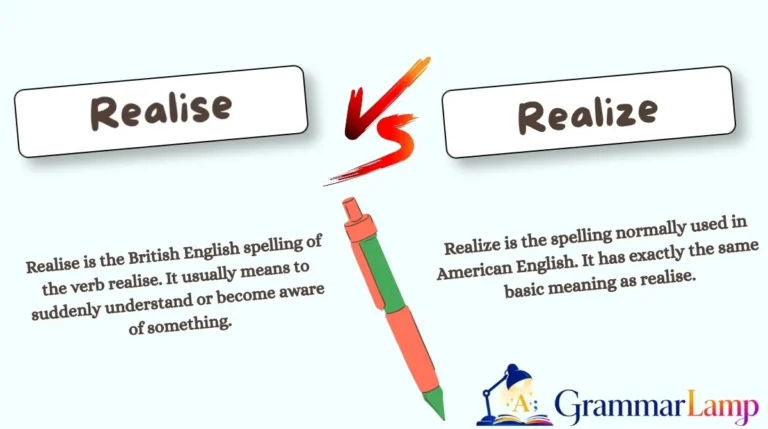
Realise is the British English spelling of the verb realise. It usually means to suddenly understand or become aware of something.
For example:
I didn’t realise how late it was.
This means the person did not know or notice how late it was before.
The verb can also mean to understand a fact or situation after thinking about it. Sometimes the understanding happens suddenly.
When Do We Use “Realise”?
British English normally uses realise in everyday writing and speech when someone becomes aware of something.
You can use it when:
- you understand something that you did not understand before
- you notice a fact
- you become aware of a situation
- you understand the importance of something
- you recognize a mistake or problem
The spelling realise is especially common in British English and is also used in many other varieties of English that follow British spelling.
Grammar Rule for “Realise”
Realise is a regular verb.
Its common forms are:
- Present: realise
- Third-person singular: realises
- Past: realised
- Present participle: realising
- Past participle: realised
Notice that the s and ed forms keep the same British spelling pattern.
Examples with “Realise”
- I didn’t realise that you were waiting for me.
- She began to realise how difficult the job was.
- He realised that he had made a mistake.
- Do you realise how important this decision is?
- We didn’t realise that the shop was already closed.
- She suddenly realised that she had left her phone at home.
- They are beginning to realise the value of good communication.
- I only realised the truth after I spoke to him.
A Common Learner Confusion
Many learners think realise is a completely different word from realize. It is not.
The meaning is the same. The pronunciation is also generally the same. The main difference is the spelling convention.
Think of it like:
- colour — British English
- color — American English
and:
- realise — British English
- realize — American English
There is one extra detail worth knowing: the -ise spelling is strongly associated with British English, but British English also allows -ize in many style systems. The Oxford English Dictionary and Oxford University Press traditionally use -ize spellings in words such as realize. However, -ise is extremely common in British English and is the spelling many learners are taught.
So, if you are following a particular school, exam, publisher, or style guide, follow its preferred spelling consistently.
What Does “Realize” Mean?
Realize is the spelling normally used in American English. It has exactly the same basic meaning as realise.
It can mean to understand something, become aware of something, or recognize something that was not clear before.
For example:
I didn’t realize that you were here.
The speaker did not know that the other person was there until later.
When Do We Use “Realize”?
American English uses realize in many situations.
You can use it when someone:
- becomes aware of a fact
- understands something
- notices a mistake
- understands the importance of something
- discovers something about a situation
It is a very common verb in everyday American English.
Grammar Rule for “Realize”
Like realise, realize is a regular verb.
Its common forms are:
- Present: realize
- Third-person singular: realizes
- Past: realized
- Present participle: realizing
- Past participle: realized
The z remains in these forms.
Examples with “Realize”
- I didn’t realize that the meeting had started.
- She realized that she had lost her wallet.
- Do you realize how much time we have?
- He suddenly realized what the message meant.
- We didn’t realize that the road was closed.
- They are beginning to realize how serious the problem is.
- I realized that I had forgotten my password.
- She didn’t realize how difficult the exam would be.
A Common Learner Confusion
Some students believe that realize is an American word and realise is a British word with different meanings. That is not correct.
They are simply two spelling forms of the same verb.
If you are writing for an American audience, realize is the safer choice.
If you are writing for a British audience and your style guide uses -ise, use realise.
Difference Between Realise and Realize
The easiest answer is this:
Realise and realize have the same meaning and pronunciation. The difference is mainly spelling and regional style.
| Feature | Realise | Realize |
|---|---|---|
| Main spelling tradition | British English | American English |
| Meaning | Become aware or understand | Become aware or understand |
| Pronunciation | Same | Same |
| Present form | realise | realize |
| Past form | realised | realized |
| -ing form | realising | realizing |
| Common in American English | Less common | Very common |
| Common in British English | Very common | Also accepted in some style systems |
1. Usage Difference
The biggest difference is regional preference.
American writers generally use:
I didn’t realize my mistake.
British writers who follow the common -ise convention generally use:
I didn’t realise my mistake.
The reader understands both sentences.
2. Grammar Logic
There is no important grammar difference between the two.
You do not choose realise because the sentence has one particular tense and realize because it has another tense.
For example, you can say:
I realise the problem now.
or:
I realize the problem now.
The choice depends on the spelling system you are following, not the tense.
3. Sentence Structure
The sentence structure remains the same.
You can use both forms before a clause beginning with that:
I realised that I was wrong.
I realized that I was wrong.
You can also use them before a question word:
She realised what had happened.
She realized what had happened.
You can use them with how:
He realised how serious the situation was.
He realized how serious the situation was.
The grammar does not change.
4. Meaning Comparison
Both words can express the idea of becoming aware of something.
Compare:
I realised I had left my bag at home.
and:
I realized I had left my bag at home.
The meaning is identical.
The only visible difference is the letter s versus z.
5. Be Consistent
The most important writing tip is to choose one spelling system and stay consistent.
For example, if your website mainly uses British English, you might write:
- realise
- realised
- realising
- organisation
- recognise
- apologise
If you are writing in American English, you would normally write:
- realize
- realized
- realizing
- organization
- recognize
- apologize
Consistency makes your writing look polished and professional.
Grammar Rules You Must Remember
Rule 1: Both Spellings Are Correct
Do not think that one form is simply a spelling mistake.
Both realise and realize are established English spellings.
Example:
I suddenly realised what she meant.
I suddenly realized what she meant.
Both sentences are correct.
Rule 2: American English Normally Uses “Realize”
If you are writing in standard American English, realize is the normal choice.
Example:
I didn’t realize that today was your birthday.
You will see this spelling in American newspapers, books, websites, schools, and business writing.
Rule 3: British English Commonly Uses “Realise”
British English commonly uses realise, especially in style systems that prefer -ise endings.
Example:
I didn’t realise that today was your birthday.
However, remember that -ize spellings are also used in British English, particularly by publishers and dictionaries that follow the Oxford style.
Rule 4: Keep the Same Pattern in Related Forms
Do not mix the spellings unnecessarily.
If you choose realise, use:
realised
realising
If you choose realize, use:
realized
realizing
For example, this is inconsistent:
I realized that I had forgotten my keys, but I realised my mistake later.
It is understandable, but it mixes spelling conventions.
A cleaner version would be:
I realized that I had forgotten my keys, but I realized my mistake later.
Or, in the -ise style:
I realised that I had forgotten my keys, but I realised my mistake later.
Common Mistakes Students Make
Mistake 1: Thinking “Realise” Is Wrong
Some learners see realise and assume it should be realize because they learned American English.
That is not necessarily true.
Wrong idea:
“Realise is incorrect English.”
Better understanding:
“Realise is a standard spelling used especially in British English.”
The important thing is to understand the spelling system being used.
Mistake 2: Mixing British and American Spellings
Students sometimes mix forms without noticing.
For example:
I realized that I had forgotten my colour pencil.
This is not a grammar error, but it mixes American realized with British colour.
In informal writing, this may not matter. In formal writing, especially for school or professional work, consistent spelling is better.
Mistake 3: Writing “Realise” and “Realize” as Different Tenses
This is a common misunderstanding.
Some learners think:
realise = present
realize = past
That is completely incorrect.
The past forms are:
realise → realised
realize → realized
For example:
I realise the problem now.
I realised the problem yesterday.
Or:
I realize the problem now.
I realized the problem yesterday.
The tense changes through -d/-ed, not through s versus z.
Mistake 4: Changing the Spelling in the -ing Form
Another common mistake is mixing forms.
British-style:
realising
American-style:
realizing
Avoid forms such as:
❌ realizinge
❌ realiseing
The correct spelling removes the final e before adding -ing.
Mistake 5: Thinking Pronunciation Changes
For most speakers, realise and realize are pronounced the same way.
The spelling difference does not normally create a different pronunciation.
So you do not need to learn two different pronunciations just because you see s in one version and z in the other.
Easy Trick to Remember the Difference
Here is a simple memory trick:
S = British-style spelling
Z = American-style spelling
So remember:
realise → British English
realize → American English
You can connect this with other common spelling differences.
British English often uses:
organise
recognise
apologise
realise
American English commonly uses:
organize
recognize
apologize
realize
There is one important caution: British English is not limited to -ise. Some British publishers and dictionaries prefer -ize. So the trick is useful for remembering the common regional preference, not as an absolute rule.
Think About Your Reader
A very practical way to choose is to ask:
Who am I writing for?
If you are writing for an American school or American website, realize is usually the natural choice.
If you are writing for a British audience and following a style that uses -ise, choose realise.
If you are writing for an international audience, either can work. Just avoid switching between the two styles without a reason.
Daily Life Examples
These examples show how the word appears naturally in everyday English. The sentences work with either spelling.
1. Realizing You Forgot Something
“Oh no! I just realized I left my phone at home.”
British spelling:
“Oh no! I just realised I left my phone at home.”
2. Understanding a Mistake
“I realized that I had sent the email to the wrong person.”
3. Discovering the Time
“I didn’t realize it was already midnight.”
4. Understanding Someone’s Feelings
“She finally realized that he was upset.”
5. Understanding a Problem
“We realized that we needed more time.”
6. Noticing Something Important
“Did you realize that your keys were on the table?”
7. Understanding a Lesson
“I realized that learning ten words every day was easier for me.”
8. A Conversation Between Friends
“When did you realize you wanted to study English?”
“I realized it when I started speaking with international students.”
9. A Work Situation
“I realized that I had made a small mistake in the report.”
10. A Sudden Discovery
“She looked at the clock and realized she was late.”
If you are using British -ise spelling, simply change these to realised and realise where needed.
Practice Section
Choose the correct spelling for the English style mentioned.
1. American English
I didn’t ______ that the store closed at six.
- a) realise
- b) realize
2. British English using the common -ise style
She suddenly ______ that she had lost her wallet.
- a) realised
- b) realized
3. American English
Did you ______ how important this test is?
- a) realise
- b) realize
4. British English using the -ise style
We are beginning to ______ how difficult the task will be.
- a) realise
- b) realize
5. American English
He ______ that he had made the wrong decision.
- a) realised
- b) realized
Answers
- realize
- realised
- realize
- realise
- realized
The key is not to memorize two different meanings. There is only one basic meaning here. You are choosing the spelling that matches your preferred variety of English.
FAQs
1. What is the difference between realise and realize?
There is no major difference in meaning or grammar. Both mean to become aware of, understand, or recognize something. Realise is especially common in British English, while realize is standard in American English. Some British style guides also use realize.
2. Is “realise” British English?
Yes, realise is a very common British English spelling. It is also used in other varieties that follow British spelling conventions. However, British English can also use realize, particularly in Oxford-style writing.
3. Is “realize” American English?
Yes. Realize is the normal spelling in American English. You will commonly see it in American books, websites, newspapers, schools, and professional writing.
4. Can I use “realise” in American English?
People will understand you, and it is not an unknown word in the United States. However, realize is the normal American spelling. If you are writing for an American audience, it is better to use the standard American form.
5. Are realise and realize pronounced the same?
Generally, yes. The spelling difference does not normally mean that the two forms have different pronunciation. The main difference is written rather than grammatical or semantic.
6. Which spelling should I use in an English exam?
Follow the variety of English required by your exam, school, or teacher. If the exam follows British English and uses -ise spellings, write realise. If it follows American English, write realize. Most importantly, be consistent throughout your writing.
Conclusion
Realise and realize are two spellings of the same English verb. They have the same basic meaning, pronunciation, grammar, and sentence structure.
The main difference is the spelling convention used by different varieties of English.
Realise is especially common in British English, while realize is the normal spelling in American English. However, British English also accepts -ize spellings in some respected style systems, so the difference is not as strict as “British always uses -ise and American always uses -ize.”
The easiest way to avoid confusion is to think about your audience. If you are writing American English, choose realize.
If you are following a British style that uses -ise, choose realise. Then keep the same pattern in words such as realised/realized and realising/realizing.
Once you understand this small spelling difference, you will no longer need to stop and wonder which form is correct. Both are correct—the important thing is choosing the right style and using it consistently.

Liam Derren is a language writer at GrammarLamp, creating simple, helpful content about grammar, words, and everyday English. He makes language learning clear, practical, and easy to understand.
5 thoughts on “Realise or Realize: Which Spelling Is Correct in 2026?”