
If you have ever wondered whether to say “at the weekend” or “on the weekend,” you are not alone. Both expressions are correct, but they are used differently depending mainly on the variety of English you are speaking or writing.
This small difference can be confusing because English learners often learn that we use on with days, such as “on Monday” or “on Saturday.”
So, it seems logical to say “on the weekend.” At the same time, many British English speakers naturally say “at the weekend,” which can make learners question whether one form is wrong.
The good news is that you do not need to memorize a complicated grammar rule. The main point is simple: “at the weekend” is especially common in British English, while “on the weekend” is especially common in American English.
Both expressions usually mean during the weekend. The difference is mostly about regional English rather than a difference in basic meaning.
Understanding this distinction is useful for everyday conversations, school writing, emails, travel, and English exams. It can also help you understand native speakers from different countries.
By the end, you will know when to use each expression, why the prepositions are different, which form sounds natural in British and American English, and how to avoid common mistakes.
Alternative of vs Alternative for vs Alternative to: Which Is Correct? 2026 Guide
Realise or Realize: Which Spelling Is Correct in 2026?
Berth vs Birth: Meaning, Difference, Examples & Easy Rules for 2026
Insight vs Incite: What’s the Difference? Easy Guide for 2026
What Does “At the Weekend” Mean?
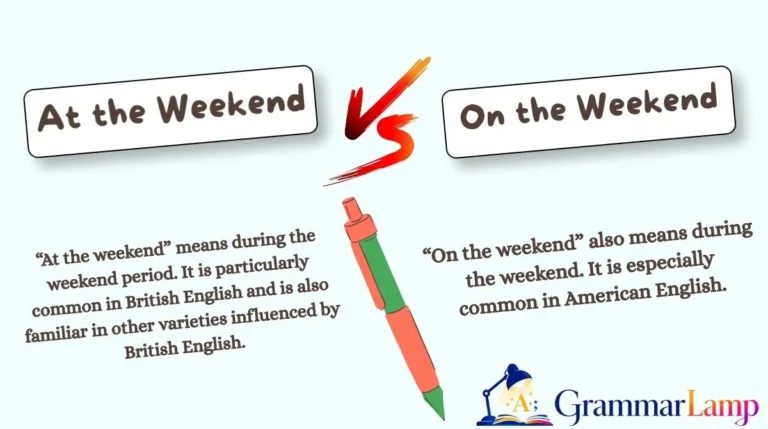
“At the weekend” means during the weekend period. It is particularly common in British English and is also familiar in other varieties influenced by British English.
For example:
I usually relax at the weekend.
This means that relaxing is something the speaker usually does during Saturday and Sunday.
The expression uses the preposition at, followed by the weekend:
at + the + weekend
It is normally used when talking about activities, plans, habits, or events that happen during the weekend.
When should you use “at the weekend”?
Use “at the weekend” when you are following British English usage and want to talk about something happening during the weekend.
Here are some examples:
- I visit my parents at the weekend.
- We usually go shopping at the weekend.
- What are you doing at the weekend?
- I have a football match at the weekend.
- She works at the weekend sometimes.
- They went to London at the weekend.
- Do you study at the weekend?
- We often watch movies at the weekend.
Notice that the phrase does not necessarily point to one particular day. It can refer to the weekend period generally.
The grammar rule
The basic structure is:
Subject + verb + at the weekend
For example:
I play tennis at the weekend.
You can also use it in questions:
What do you usually do at the weekend?
And in negative sentences:
I don’t usually work at the weekend.
The word the is important in the standard expression “at the weekend.”
For example:
I usually relax at the weekend.
This sounds natural in British English.
A learner may sometimes remove the and say:
I relax at weekend.
That is generally not the normal form in standard everyday English. Use “at the weekend.”
A common learner confusion
Many learners think at must refer to a very specific point in time, such as:
at 5 o’clock
or:
at noon
But English prepositions do not always work in such a simple way. Fixed expressions sometimes use particular prepositions because that is how the language has developed.
So, do not try to translate “at the weekend” word by word. Learn it as a common British English expression meaning during the weekend.
What Does “On the Weekend than” Mean?
“On the weekend” also means during the weekend. It is especially common in American English.
For example:
I usually play basketball on the weekend.
The sentence means that the speaker usually plays basketball during the weekend.
The structure is:
on + the + weekend
This follows the familiar idea that on is often used with days and dates:
- on Monday
- on Friday
- on Saturday
- on the weekend
When should you use “on the weekend”?
Use “on the weekend” when speaking or writing American English. It is natural and standard in the United States and is widely understood elsewhere too.
Here are some examples:
- I usually sleep late on the weekend.
- We are going to the beach on the weekend.
- What are you doing on the weekend?
- She works on the weekend.
- They visited us on the weekend.
- I like watching movies on the weekend.
- Do you study on the weekend?
- He plays golf on the weekend.
Just like “at the weekend,” this expression normally refers to the weekend as a period of time.
The grammar rule
The basic structure is:
Subject + verb + on the weekend
For example:
We usually eat out on the weekend.
You can use it in questions:
What do you do on the weekend?
You can also use it with future plans:
We’re going to visit our grandparents on the weekend.
And with past events:
We went hiking on the weekend.
Why does American English use “on”?
One useful way to understand the expression is to remember that on is commonly associated with days and particular calendar periods.
For example:
on Monday
on Saturday
on my birthday
on the weekend
This does not mean that every time period must use on. English has many fixed preposition patterns. However, this connection can make “on the weekend” easier to remember for American English.
The important thing is not to worry about whether at or on is logically better. Native speakers learn these combinations through regular use.
Difference Between “At the Weekend” and “On the Weekend” — Detailed Comparison
The biggest difference between these two expressions is regional preference, not meaning.
Both normally mean during the weekend.
| Expression | Main variety | Basic meaning | Example |
|---|---|---|---|
| at the weekend | British English | during the weekend | I relax at the weekend. |
| on the weekend | American English | during the weekend | I relax on the weekend. |
1. British English usually prefers “at the weekend”
If you are using British English, “at the weekend” is the natural choice.
For example:
What are you doing at the weekend?
A British speaker may also say:
We are going to visit them at the weekend.
This sounds completely normal in British English.
2. American English usually prefers “on the weekend”
In American English, “on the weekend” is very common.
For example:
What are you doing on the weekend?
An American speaker might say:
We’re going to visit them on the weekend.
This is standard American English.
3. The meaning is almost the same
Compare these sentences:
I usually work at the weekend.
I usually work on the weekend.
There is no important difference in the basic meaning. Both tell us that the person usually works during the weekend.
The difference is mainly the speaker’s regional variety of English.
4. Sentence structure is the same
The only major change is the preposition:
British English:
Subject + verb + at the weekend
American English:
Subject + verb + on the weekend
For example:
She visits her family at the weekend.
She visits her family on the weekend.
5. Both forms can be used in questions
British:
Are you working at the weekend?
American:
Are you working on the weekend?
Both questions are grammatically correct.
6. Both forms can describe past, present, or future situations
Past:
We went shopping at the weekend.
We went shopping on the weekend.
Present habit:
I usually study at the weekend.
I usually study on the weekend.
Future plan:
We’re going hiking at the weekend.
We’re going hiking on the weekend.
So, the tense does not decide which preposition you should use. Your preferred variety of English does.
Grammar Rules You Must Remember
Rule 1 — Use “at the weekend” in British English
If your target is British English, “at the weekend” is the safest and most natural choice.
Example:
I usually meet my friends at the weekend.
This is especially useful if you are studying British English at school or following British English learning materials.
Rule 2 — Use “on the weekend” in American English
If you are using American English, “on the weekend” is the normal choice.
Example:
I usually meet my friends on the weekend.
This form is very common in American conversations, books, websites, and everyday writing.
Rule 3 — Do not confuse “the weekend” with “this weekend”
When you use this weekend, you normally do not need at or on.
Say:
I’m going shopping this weekend.
Not:
I’m going shopping at this weekend.
And not:
I’m going shopping on this weekend.
The same idea applies to next weekend and last weekend:
We’re visiting them next weekend.
We visited them last weekend.
This is an important point because learners sometimes add a preposition simply because they have learned at the weekend or on the weekend.
Rule 4 — “Weekend” and “weekends” can be used differently
When talking about a general habit, you can also use at weekends in British English and on weekends in American English.
British English:
I often work at weekends.
American English:
I often work on weekends.
You may also hear:
I usually stay home on the weekends.
The article the can appear in American English when talking about weekends as a general period.
The safest approach is to follow the variety of English you are learning rather than mixing patterns randomly.
Better Understand vs Understand Better: Meaning, Grammar, and Correct Usage (2026)
Hasn’t vs Haven’t: Easy Grammar Rules, Examples & Differences in 2026
Smooth vs Smoothe: Which Spelling Is Correct? Complete Guide for 2026
Mine as Well or Might as Well? The Correct Phrase Explained in Simple English (2026)
Common Mistakes Students Make
These expressions cause mistakes because learners often try to apply one preposition rule to every situation.
Mistake 1: Thinking one form is always wrong
A student may see:
I usually relax on the weekend.
and think it must be incorrect because they learned “at the weekend.”
That is not true.
“On the weekend” is standard, especially in American English.
Similarly, an American English learner may see:
I relax at the weekend.
and think it is wrong.
It is not wrong. It is especially common in British English.
Mistake 2: Saying “at weekend”
Incorrect or unnatural in standard everyday English:
I play football at weekend.
Better:
I play football at the weekend.
Or, in American English:
I play football on the weekend.
Mistake 3: Saying “on this weekend”
Usually unnecessary:
We are going to the park on this weekend.
Better:
We are going to the park this weekend.
The word this already identifies the weekend.
Mistake 4: Mixing regional patterns without knowing why
You might write:
I will visit my family at the weekend.
and later write:
I will go shopping on the weekend.
Neither sentence is necessarily grammatically wrong, but if you are writing formal English for a specific audience, consistency is better.
If your writing follows British English, use at the weekend.
If it follows American English, use on the weekend.
Easy correction tip
Ask yourself one question:
“Which variety of English am I using?”
If the answer is British English, choose at the weekend.
If the answer is American English, choose on the weekend.
That one habit will solve most problems.
Easy Trick to Remember the Difference — British “At,” American “On”
Here is a simple memory trick.
Think:
British = AT the weekend
American = ON the weekend
You can remember the two as a pair:
UK → at the weekend
US → on the weekend
Another helpful idea is to connect on with days:
on Monday
on Saturday
on Sunday
on the weekend
This can help you remember why on the weekend feels natural in American English.
For British English, simply treat at the weekend as a fixed expression.
There is no need to search for a complicated logical reason every time you speak.
Think of it like learning:
good at
interested in
afraid of
Prepositions often form natural combinations that learners simply need to become familiar with.
The most important thing is to remember that both expressions are correct. Your choice usually tells the listener which variety of English you are using.
Daily Life Examples
The best way to learn the difference is to see it in normal conversations.
Example 1: Asking about plans
British English
A: What are you doing at the weekend?
B: I’m going to see my cousin.
American English
A: What are you doing on the weekend?
B: I’m going to see my cousin.
Both conversations sound natural in their respective varieties.
Example 2: Talking about work
A: Do you work at the weekend?
B: Yes, sometimes.
American English:
A: Do you work on the weekend?
B: Yes, sometimes.
Example 3: Talking about a habit
I usually clean my house at the weekend.
American English:
I usually clean my house on the weekend.
Example 4: Making a plan
We’re going to the cinema at the weekend.
Or:
We’re going to the movies on the weekend.
The preposition changes according to the variety of English. The activity can change too, depending on regional vocabulary.
Example 5: Talking about family
We normally visit our grandparents at the weekend.
American English:
We normally visit our grandparents on the weekend.
Example 6: Talking about school
I have a lot of homework at the weekend.
American English:
I have a lot of homework on the weekend.
Example 7: Talking about sports
Our team usually plays at the weekend.
American English:
Our team usually plays on the weekend.
Example 8: Talking about relaxation
I like to sleep late at the weekend.
American English:
I like to sleep late on the weekend.
Example 9: Talking about a past event
We went to Manchester at the weekend.
American English:
We went to Chicago on the weekend.
Example 10: Talking about next weekend
Notice the difference here:
I’m visiting my friend next weekend.
You do not need at or on before next weekend.
This is one of the most useful patterns to remember in everyday English.
Practice Section
Choose at the weekend, on the weekend, or this weekend.
1. I usually go shopping ______.
a) at the weekend
b) on the weekend
c) Both can be correct depending on the variety of English
2. What are you doing ______?
a) at this weekend
b) this weekend
c) on this weekend
3. In British English, which sentence sounds more natural?
a) I work at the weekend.
b) I work on the weekend.
4. In American English, which sentence is more common?
a) I work at the weekend.
b) I work on the weekend.
5. Which sentence is correct?
a) We visited them last weekend.
b) We visited them on last weekend.
Answers
1. c) Both can be correct depending on the variety of English.
British English commonly uses at the weekend, while American English commonly uses on the weekend.
2. b) this weekend
We normally say this weekend without a preposition.
3. a) I work at the weekend.
This is the usual British English form.
4. b) I work on the weekend.
This is the usual American English form.
5. a) We visited them last weekend.
Use last weekend without on.
In the Morning vs On the Morning: Complete Grammar Guide for 2026
Inside of vs Inside: The Easy Difference Explained in 2026
Attend vs Tend: Meaning, Differences, Grammar Rules & Examples (2026)
Hear vs Here: Meaning, Difference, Grammar Rules & Examples in 2026
FAQs
What is the difference between “at the weekend” and “on the weekend”?
Both expressions usually mean during the weekend. The main difference is regional usage. “At the weekend” is especially common in British English, while “on the weekend” is especially common in American English.
Is “at the weekend” grammatically correct?
Yes. “At the weekend” is completely correct and very common in British English. For example, “I usually visit my family at the weekend.” It is a normal expression for talking about activities during the weekend.
Is “on the weekend” grammatically correct?
Yes. “On the weekend” is correct and especially common in American English. For example, “We usually go hiking on the weekend.” It is widely understood by English speakers around the world.
Can I use “at the weekend” in American English?
You can, and people will understand you, but “on the weekend” is generally more natural in American English. If you are trying to sound consistently American, use on the weekend.
Can I use “on the weekend” in British English?
Yes, it can be understood and is not meaningless or impossible, but “at the weekend” is the traditional and very common British English choice. If you are learning British English, at the weekend is a good form to use.
Do we say “at this weekend” or “on this weekend”?
Usually, neither is needed. Say “this weekend.” For example, “I’m visiting my friend this weekend.” The same rule applies to last weekend and next weekend: “I saw him last weekend” and “I’ll call him next weekend.”
Conclusion
So, at the weekend or on the weekend? The answer is simple: both are correct, but they belong mainly to different varieties of English.
Use “at the weekend” if you are following British English. Use “on the weekend” if you are following American English. Both normally mean during the weekend, so the basic meaning does not change.
The most important thing is to avoid thinking that one expression is right and the other is wrong. English has many regional differences, and prepositions are one area where British and American English often use slightly different patterns.
Also remember that we normally say this weekend, last weekend, and next weekend without adding at or on.
If you are learning English, choose one variety and try to stay consistent. Then practice these expressions in simple sentences about your own life.
Talk about what you do at the weekend, what you did last weekend, or what you are planning for next weekend.
With a little practice, choosing the right expression will become automatic.

Liam Derren is a language writer at GrammarLamp, creating simple, helpful content about grammar, words, and everyday English. He makes language learning clear, practical, and easy to understand.