Tweek and tweak look almost the same, so it is easy to mix them up. They have similar sounds, but they do not have the same use in standard English.
If you have ever written one of these words and wondered whether you spelled it correctly, you are not alone.
The important thing to remember is that tweak is the standard English word. It can be used as both a verb and a noun. It means to make a small change, adjust something, or improve it slightly. For example, you might tweak a photo, tweak a sentence, or tweak the settings on your phone.
On the other hand, tweek is generally considered a misspelling of tweak when you want to express this meaning. You may sometimes see it used as a name, nickname, or informal spelling, but it is not the standard spelling for making a small adjustment.
This difference matters in everyday writing, schoolwork, emails, social media posts, and professional communication. One small spelling mistake can make a sentence look less clear.
By understanding their meanings, grammar, and correct uses, you can choose the right spelling with confidence.
More Useful posts
Shudder vs Shutter: Meaning, Difference, Examples, and Grammar Rules in 2026
Message vs messege: Correct Spelling, Meaning & Usage in 2026
Manuel vs Manual: Meaning, Difference & Correct Usage in 2026
Scarry vs Scary in 2026: Which Spelling Is Correct and What Is the Difference?
What Does “Tweek” Mean?
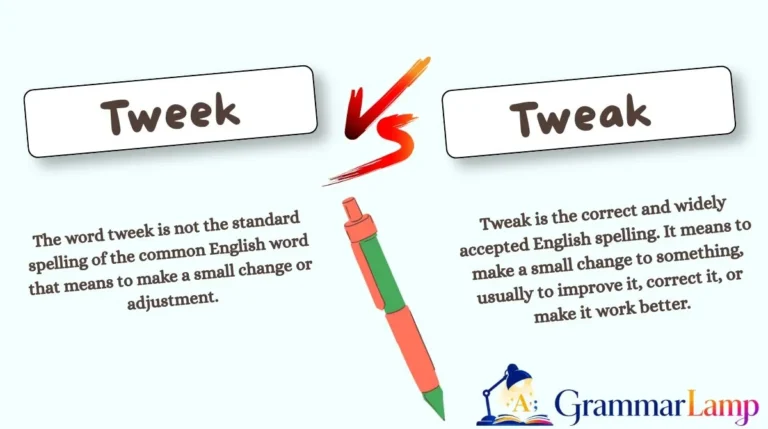
The word tweek is not the standard spelling of the common English word that means to make a small change or adjustment. In everyday writing, people often use it by mistake when they actually mean tweak.
For example, someone might write:
- I need to tweek my website.
- Can you tweek this photo?
- She wants to tweek the recipe.
These sentences are understandable, but the spelling is incorrect for the intended meaning. The correct spelling in all three examples is tweak.
Is Tweek a Real English Word?
There is a little more to this spelling than simply calling it a spelling mistake.
In some special situations, tweek can appear as a name, nickname, or unusual technical term. It has also appeared in certain slang uses. For example, Tweek is the name of a fictional character in the television series South Park.
However, these special uses do not make tweek a standard alternative spelling of tweak.
If you are writing a school assignment, business email, article, message, or everyday sentence, you should normally avoid tweek when you mean a small adjustment.
When Do People Use Tweek Incorrectly?
People usually make this mistake because the spelling looks natural to them. They know that several English words use the letters ee to represent a long E sound.
For example:
- Week
- Sweet
- Sleep
- Green
- Street
Because tweak and tweek have a similar appearance and pronunciation, learners sometimes add an extra letter without realizing that they have changed the standard spelling.
7 Examples of Tweek and Their Corrections
Here are some examples that show how this spelling mistake happens.
1. Incorrect: I need to tweek my computer settings.
Correct: I need to tweak my computer settings.
2. Incorrect: Can you tweek this picture for me?
Correct: Can you tweak this picture for me?
3. Incorrect: He wants to tweek his English essay.
Correct: He wants to tweak his English essay.
4. Incorrect: We should tweek the plan before the meeting.
Correct: We should tweak the plan before the meeting.
5. Incorrect: She made a small tweek to the design.
Correct: She made a small tweak to the design.
6. Incorrect: I have to tweek the video before uploading it.
Correct: I have to tweak the video before uploading it.
7. Incorrect: The teacher asked me to tweek my answer.
Correct: The teacher asked me to tweak my answer.
The examples above use tweek to mean a small adjustment. In standard English, tweak is the correct spelling in every case.
Remember: Do not treat tweek as a normal alternative spelling of tweak. Use it only when you are referring to a specific name or an established special use.
What Does “Tweak” Mean?
Tweak is the correct and widely accepted English spelling. It means to make a small change to something, usually to improve it, correct it, or make it work better.
You do not completely change something when you tweak it. Instead, you make a small adjustment while keeping most of the original thing the same.
For example, imagine that you have written an English essay. The essay is already good, but one paragraph needs a little improvement. You change a few words and correct a sentence. You have tweaked your essay.
The word is useful in daily conversations, education, technology, business, photography, cooking, and many other areas.
When Should You Use Tweak?
Use tweak when you want to talk about making a small adjustment.
Here are some common situations:
1. Editing writing
You can tweak a sentence, paragraph, article, or essay to make it clearer.
Example: I need to tweak the introduction before publishing the article.
2. Changing a photograph
You can tweak brightness, contrast, color, or other photo settings.
Example: Can you tweak the brightness of this picture?
3. Adjusting technology
You can tweak a computer, phone, application, or software setting.
Example: He tweaked the settings on his laptop.
4. Improving a plan
You can tweak a plan without changing the whole idea.
Example: We need to tweak our plan before starting the project.
5. Changing a recipe
You can tweak a recipe by adding a little more salt or changing an ingredient.
Example: My mother tweaked the recipe to make the food tastier.
Tweak as a Verb
A verb describes an action. When tweak is a verb, it describes the action of making a small change or adjustment.
The basic verb forms are:
| Verb form | Word |
|---|---|
| Base form | Tweak |
| Third-person singular | Tweaks |
| Past tense | Tweaked |
| Past participle | Tweaked |
| -ing form | Tweaking |
Examples:
- I want to tweak my website.
- She tweaks her photos before sharing them.
- He tweaked the computer settings yesterday.
- They are tweaking the new design.
- We have tweaked the original plan.
Notice that the past tense is tweaked, not tweeked.
Tweak as a Noun
Tweak can also be a noun. As a noun, it means a small change or adjustment.
Examples:
- I made a small tweak to my essay.
- The website needs a few tweaks.
- This recipe needs one final tweak.
- The new phone has some useful tweaks.
- A little tweak made the design look better.
- We made two tweaks to the original plan.
- The teacher suggested a small tweak to my sentence.
When you use tweak as a noun, you can often replace it with small change or minor adjustment.
For example:
- Original: I made a small tweak to the design.
- Simple meaning: I made a small change to the design.
Both sentences communicate almost the same idea.
Another Meaning of Tweak
Although small adjustments are the most common meaning in modern everyday writing, tweak has another meaning.
It can also mean to pull, pinch, or twist something quickly.
For example:
- The little boy tweaked his father’s nose.
- She gently tweaked a strand of hair into place.
- My brother playfully tweaked my ear.
This meaning is also accepted in standard dictionaries. However, the adjustment meaning is especially common in conversations about writing, computers, plans, and designs. definition in the Cambridge English Dictionary+2
Difference Between Tweek and Tweak (Detailed)
The main difference between these spellings is their acceptance and use in standard English.
Tweak is the correct spelling when you mean a small change or adjustment. Tweek is generally a spelling error when used with that meaning.
The two spellings may look similar, but you should not use them interchangeably.
Tweek vs Tweak: Comparison Table
| Feature | Tweek | Tweak |
|---|---|---|
| Standard spelling | No, for this meaning | Yes |
| Main meaning | No standard adjustment meaning | A small change |
| Part of speech | Special or unusual uses | Verb and noun |
| Common in writing | Usually an error | Widely accepted |
| Past tense | Not standard for this meaning | Tweaked |
| -ing form | Not standard for this meaning | Tweaking |
| Professional writing | Avoid for this meaning | Correct choice |
| Example | Incorrect: tweek a photo | Correct: tweak a photo |
1. Difference in Meaning
The word tweak has a clear meaning in everyday English. It describes a small change made to improve or adjust something.
For example:
I need to tweak the settings on my phone.
This means that you want to change one or two settings, not replace your phone or make a completely new one.
Tweek, on the other hand, does not normally carry this meaning in standard English.
2. Difference in Usage
You can use tweak in many everyday situations.
For example:
- Tweak a photograph.
- Tweak a sentence.
- Tweak a website.
- Tweak a recipe.
- Tweak a business plan.
- Tweak a computer setting.
These expressions are natural and correct.
Writing tweek in these expressions is not standard English.
3. Difference in Grammar
Tweak can function as both a verb and a noun.
As a verb:
She wants to tweak the design.
As a noun:
She made a small tweak to the design.
The grammar changes depending on how the word is used, but its spelling remains the same.
Tweek should not replace either form when you mean an adjustment.
4. Difference in Sentence Structure
The word tweak can appear in different sentence structures.
As a verb:
Subject + tweak + object
- I tweak my photos.
- She tweaks her writing.
- They tweak the settings.
As a noun:
Subject + make + a tweak + to + something
- I made a tweak to the design.
- He made a small tweak to his essay.
- They made several tweaks to the plan.
These patterns are useful for beginners because they show how to use the word naturally.
5. Difference in Formal and Informal English
Tweak is often described as informal when it means making a small adjustment. However, it is widely used in everyday speech, business communication, technology, and professional writing.
For example:
The manager suggested a few tweaks to the report.
This is a natural sentence in a workplace.
Tweek is not a standard replacement, whether the situation is formal or informal.
The safest choice is to use tweak whenever you mean a small adjustment.
Explore More Posts
Cleverer vs More Clever: Which One Is Correct in 2026?
Wear vs Were vs We’re vs Where: Easy Difference Guide for 2026
Disenroll vs Unenroll: Which Word Is Correct in 2026?
Listen to Music vs Listen to the Music: Difference, Rules & Examples (2026)
Grammar Rules You Must Remember
Understanding a spelling difference is easier when you learn a few simple grammar rules. These four rules will help you use tweak correctly in everyday sentences.
Rule 1: Use Tweak for a Small Change
When you want to describe a small adjustment, use tweak.
You can tweak something to make it better, clearer, more useful, or more suitable.
Examples:
- I need to tweak my essay.
- She wants to tweak the recipe.
- We should tweak the design.
Remember: If you mean adjust slightly, choose tweak.
Rule 2: Use Tweaked for the Past Tense
Tweaked is the simple past form of tweak. Use it when an adjustment happened in the past.
Examples:
- I tweaked my photo yesterday.
- She tweaked her presentation last night.
- They tweaked the plan before the meeting.
You can also use tweaked with helping verbs.
Examples:
- I have tweaked the document.
- She had tweaked the settings.
- The design was tweaked by the team.
Do not write tweeked when you mean the past tense of tweak.
Rule 3: Use Tweaking for an Action in Progress
The word tweaking is the -ing form of tweak.
Use it when someone is making small changes.
Examples:
- I am tweaking my website.
- He is tweaking the camera settings.
- They are tweaking the final design.
- She enjoys tweaking her recipes.
The spelling is always tweaking, not tweeking, when you mean adjusting something.
Rule 4: Use Tweak as a Noun for a Small Adjustment
You can use tweak as a noun when talking about a small change.
Examples:
- I made a small tweak to my article.
- The website needs a few tweaks.
- One little tweak improved the picture.
- We made some final tweaks to the project.
Remember that the plural form is tweaks.
A useful sentence pattern is:
Make + a/some + tweak(s) + to + something.
For example:
We made a few tweaks to the presentation.
This structure is common in everyday and professional English.
Common Mistakes Students Make
English learners sometimes confuse these spellings because they sound alike. A person may know the correct meaning but still choose the wrong letters when writing.
This is especially common when someone learns English by listening to conversations rather than reading words.
Let’s look at some common mistakes and learn how to correct them.
Mistake 1: Writing Tweek Instead of Tweak
This is the most common mistake.
Incorrect: I want to tweek my photo.
Correct: I want to tweak my photo.
Why? The standard spelling of the word meaning to make a small change is tweak.
Correction tip: Remember the letters A and E in the correct order: T-W-E-A-K.
Mistake 2: Writing Tweeked Instead of Tweaked
Some learners add an extra E when making the past tense.
Incorrect: He tweeked the computer settings.
Correct: He tweaked the computer settings.
Why? The past tense of tweak is tweaked. You simply add -ed to the base word.
Correction tip: Learn the three important forms together: tweak, tweaked, tweaking.
Mistake 3: Writing Tweeking Instead of Tweaking
This mistake often happens when people try to write quickly.
Incorrect: She is tweeking the video.
Correct: She is tweaking the video.
Why? The -ing form is made by adding -ing to tweak.
Correction tip: Before writing, check the original word. It is tweak, so the correct form is tweaking.
Mistake 4: Thinking Both Spellings Are Acceptable
Some students believe that both spellings can be used because they look and sound almost the same.
However, they are not interchangeable in standard English.
Incorrect: I made a small tweek to the article.
Correct: I made a small tweak to the article.
Why? The noun meaning a small adjustment is spelled tweak.
Correction tip: Whenever you mean a minor change, use tweak as a noun or verb.
Mistake 5: Using Tweak When You Mean a Major Change
Another mistake is using tweak for a very large change.
For example:
Less suitable: We tweaked the entire building and rebuilt every room.
More suitable: We renovated the entire building and rebuilt every room.
Why? Tweak usually suggests a small adjustment, not a complete transformation.
Correction tip: Use tweak for small changes. Use words such as rebuild, replace, or redesign when the change is much bigger.
Easy Trick to Remember the Difference
Learning confusing spellings does not have to be difficult. A simple memory trick can help you remember which word to use.
Here is an easy way to remember the difference between these two spellings.
The Small Adjustment Trick
Connect the word tweak with the phrase small change.
Whenever you want to make a small change to something, remember to write tweak.
For example:
- A small change to a photo = a photo tweak.
- A small change to a sentence = a sentence tweak.
- A small change to a recipe = a recipe tweak.
- A small change to a plan = a plan tweak.
You can also remember this sentence:
“I tweak things when I want to make them better.”
This short sentence connects the correct spelling with its everyday meaning.
The Spelling Trick
Look carefully at the two spellings:
- Tweek
- Tweak
The correct spelling contains the letter combination EA, not EE.
You can connect it with other familiar words that contain EA, such as:
- Speak
- Break
- Clean
- Dream
- Teach
This does not mean all words with EA have the same sound. It simply gives you a helpful visual reminder.
Real-Life Logic
Imagine that you are editing a picture on your laptop.
The picture looks good, but you want to make the colors a little brighter. You change the brightness and contrast slightly.
What did you do?
You tweaked the picture.
You did not completely change it. You only made a small adjustment.
This is the main idea behind the word. Once you understand the meaning, remembering the spelling becomes much easier.
Daily Life Examples (Very Important)
The best way to learn a new English word is to see how people use it in real situations.
Tweak is especially useful when talking about computers, photographs, writing, food, work, and everyday plans.
Here are 10 simple examples that you can use in your daily conversations.
1. Talking About a Photograph
Person A: This picture looks a little dark.
Person B: I can tweak the brightness.
Here, tweak means making a small change to improve the photograph.
2. Talking About a Laptop
Person A: Your laptop is running slowly.
Person B: I need to tweak some settings.
The speaker wants to adjust a few computer settings.
3. Talking About an Essay
Person A: Have you finished your essay?
Person B: Almost. I just need to tweak the last paragraph.
The speaker needs to make a few small changes before finishing.
4. Talking About Cooking
Person A: This soup tastes good.
Person B: Thanks! I tweaked the recipe a little.
The speaker made a small change to the recipe.
5. Talking About a Website
Person A: Your website looks great.
Person B: Thank you. I still need to tweak the design.
The speaker wants to make a few improvements to the website.
6. Talking About a Work Project
Person A: Is the project ready?
Person B: We need to tweak a few details first.
The team needs to make some small changes before completing the project.
7. Talking About a Phone
Person A: Why is your screen so bright?
Person B: I tweaked the display settings.
The speaker changed the phone’s display settings.
8. Talking About a Presentation
Person A: Your presentation is almost perfect.
Person B: I know. I’ll make a few tweaks tonight.
The speaker plans to make some final improvements.
9. Talking About a Business Plan
Person A: Are you changing your business plan?
Person B: Yes, but I only need to tweak a few things.
The speaker wants minor changes rather than a completely new plan.
10. Talking About a Video
Person A: Is your video ready to upload?
Person B: Not yet. I’m tweaking the colors.
The speaker is making small changes to improve the video.
These examples show that tweak is a useful word in natural English. You can use it whenever you want to describe a small adjustment.
Practice Section: Choose the Correct Word
Now it is time to test what you have learned.
Read each sentence carefully and choose the correct spelling. Remember that tweak is the standard spelling when you mean a small change.
Question 1: I need to _____ my computer settings.
- A. Tweek
- B. Tweak
Question 2: She made a small _____ to her photograph.
- A. Tweek
- B. Tweak
Question 3: He _____ the design yesterday.
- A. Tweeked
- B. Tweaked
Question 4: We are _____ the final version of the article.
- A. Tweaking
- B. Tweeking
Question 5: The website needs a few small _____ before it is ready.
- A. Tweeks
- B. Tweaks
Correct Answers and Explanations
- B. Tweak — It is the correct verb for making a small adjustment.
- B. Tweak — It is the correct noun for a small change.
- B. Tweaked — This is the correct past-tense form.
- A. Tweaking — This is the correct -ing form.
- B. Tweaks — This is the correct plural noun.
If you answered all five questions correctly, you understand the basic difference. If you made a mistake, read the grammar rules once more and try again.
More Helpful posts
Girlie vs Girly: What’s the Difference and Which One Should You Use in 2026?
I Would Appreciate vs I Will Appreciate: Clear Difference Explained in 2026
Accept vs Except: Meaning, Difference, Rules, and Examples (2026)
Manor vs Manner vs Manir: Meaning, Difference & Correct Usage in 2026
FAQs
Here are answers to some common questions English learners ask about these spellings.
1. What Is the Difference Between Tweek and Tweak?
Tweak is the standard English spelling of a word that means to make a small adjustment or improvement. It works as both a noun and a verb.
Tweek is generally a misspelling when used with this meaning. Although it may appear in names or special contexts, it is not a standard alternative to tweak.
2. Is Tweek a Correct English Word?
Tweek can appear in some special English uses, including names and unusual technical or slang contexts. However, it is not the correct spelling when you want to describe a small adjustment.
For normal writing, use tweak. For example, write “I need to tweak my photo,” not “I need to tweek my photo.”
3. Can We Use Tweak as a Verb?
Yes, tweak is commonly used as a verb. It means to make a small change to something to improve it or make it more suitable.
For example, you can tweak a sentence, adjust a computer setting, or improve a recipe. It is a useful verb in both everyday and professional English.
4. Is Tweak a Noun or a Verb?
Tweak can be both a noun and a verb.
As a verb, it describes the action of making a small change. For example, “I want to tweak my website.”
As a noun, it describes the small change itself. For example, “I made a small tweak to my website.”
5. What Is the Past Tense of Tweak?
The past tense of tweak is tweaked. It follows the regular English pattern of adding -ed to the base verb.
For example, “I tweaked the picture yesterday.” The spelling tweeked is incorrect when you mean that you adjusted something.
6. Is Tweak Formal or Informal English?
Tweak is often considered an informal word, especially when it means making a minor adjustment. However, it is widely understood and commonly used in professional settings, business discussions, and technology-related writing.
For example, “We need to make a few tweaks to the report” is perfectly natural in a workplace.
Conclusion
Understanding the difference between tweek and tweak is simple once you learn the correct spelling and meaning. Although these two spellings look similar, they are not interchangeable in standard English.
Tweak is the correct word when you want to describe a small change, adjustment, or improvement. You can use it as both a noun and a verb. For example, you can tweak a photograph, tweak a sentence, or make a small tweak to your computer settings.
Tweek is generally a spelling mistake when used with this meaning. It may appear in special names or unusual contexts, but it should not replace tweak in normal writing.
Keep practicing these words in your everyday conversations and written sentences. Pay attention to their spelling, especially when using forms such as tweaked and tweaking.
The easiest rule to remember is this: When you mean a small adjustment, always write TWEAK.
With regular practice, you will remember the correct spelling and use it naturally.

Liam Derren is a language writer at GrammarLamp, creating simple, helpful content about grammar, words, and everyday English. He makes language learning clear, practical, and easy to understand.