
English learners often pause at sentences like “I would appreciate your help” and “I will appreciate your help.” They look almost identical, and both can talk about gratitude.
So why does English use would in one and will in the other?
The difference is the speaker’s purpose. Would often makes a request softer, more polite, and less direct. It is common in emails, workplace English, customer service, and respectful everyday requests.
Will, however, usually points to a future feeling, future result, or something the speaker expects to happen.
This small choice can change the tone of a sentence. Compare “I would appreciate your reply” with “I will appreciate your reply.”
The first is usually a polite request for a reply. The second sounds more like a statement about how the speaker will feel later.
The difference matters in real communication. A grammatically possible sentence may still sound less natural. Knowing each form helps you write better emails.
You will also see why “I would appreciate it if…” is so common, while “I will appreciate it if…” usually has a clearer future meaning.
More Useful posts
Brite vs Bright: Meaning, Difference, Spelling & Correct Usage in 2026
I Ordered vs I Have Ordered: What’s the Difference? Simple Grammar Guide (2026)
Timber vs Timbre (2026): Meaning, Differences, Grammar Rules, Examples, and Easy Guide
On a Call or In a Call (2026): What’s the Difference? Easy Grammar Guide with Examples
4. What Does “I Would Appreciate” Mean?
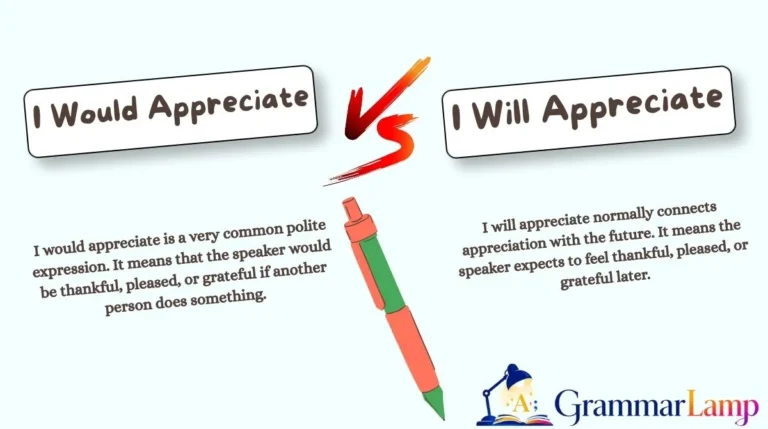
I would appreciate is a very common polite expression. It means that the speaker would be thankful, pleased, or grateful if another person does something.
The word would softens the request. Instead of directly telling someone what to do, the speaker explains how helpful their action would be.
I would appreciate your help.
The simple idea is: “Your help would be valuable to me, and I would be thankful.”
When to use “I would appreciate”
Use it mainly when making a polite request for help, information, a reply, advice, or another action.
You can use it before a noun:
I would appreciate your advice.
A very common longer pattern is:
I would appreciate it if you could send the file today.
You can also say:
I would appreciate hearing from you soon.
Grammar rule
Common patterns include:
I would appreciate + noun
- I would appreciate your help.
- I would appreciate your feedback.
- I would appreciate an early reply.
- I would appreciate your patience.
And:
I would appreciate it if + subject + could/would + verb
- I would appreciate it if you could call me later.
- I would appreciate it if you would check the report.
- I would appreciate it if you could keep this private.
Examples
- I would appreciate your support during this project.
- I would appreciate your opinion on this matter.
- I would appreciate it if you could arrive on time.
- I would appreciate it if you would send me the details.
- I would appreciate a quick response.
- I would appreciate hearing from you soon.
- I would appreciate your patience while we fix the problem.
- I would appreciate any suggestions you may have.
Common learner confusion
Many learners think would must mean something imaginary. That is not always true. English also uses would to soften requests.
I would appreciate your help.
This does not mean the speaker thinks the situation is unreal. It is simply a polite way to express the request.
Another common issue is leaving out it:
I would appreciate it if you could help me. ✅
This pattern is the safer choice in formal and careful writing. You may hear “I would appreciate if…”, but “I would appreciate it if…” is more standard.
5. What Does “I Will Appreciate” Mean?
I will appreciate normally connects appreciation with the future. It means the speaker expects to feel thankful, pleased, or grateful later.
I will appreciate your help.
This can mean, “When you help me, I will be thankful for what you did.”
When to use “I will appreciate”
Use it when you are talking about support, advice, or help that will happen later.
I will appreciate your support during the next few months.
You can also use it in a conditional sentence:
I will appreciate it if you can send the document tomorrow.
This is grammatical. It presents appreciation as a future result rather than the softer request formula with would.
Grammar rule
Common patterns are:
I will appreciate + noun
- I will appreciate your help.
- I will appreciate your support.
- I will appreciate your honesty.
- I will appreciate any advice you can give.
And:
I will appreciate it if + clause
- I will appreciate it if you call me tomorrow.
- I will appreciate it if you keep me informed.
- I will appreciate it if you give me more time.
Examples
- I will appreciate your help when the project starts.
- I will appreciate your support during the move.
- I will appreciate any advice you can give me.
- I will appreciate it if you keep me updated.
- I will appreciate your honesty in this matter.
- I will appreciate everything you do for the team.
- I will appreciate the opportunity to learn from you.
- I will appreciate it if you remember to call me tomorrow.
Common learner confusion
A common mistake is thinking will must be used just because the request concerns the future. When the main goal is politeness, would is often more natural.
I would appreciate it if you could send the file today.
This is a standard polite request.
I will appreciate it if you can send the file today.
This is possible, but it puts more attention on the speaker’s future appreciation. It may sound more definite or businesslike depending on the context.
Also remember the present form:
I appreciate your help.
This usually means you are thankful now. So the three forms can often be understood as:
- I appreciate… = gratitude now
- I would appreciate… = polite request or conditional appreciation
- I will appreciate… = future appreciation
6. Difference Between “I Would Appreciate” and “I Will Appreciate” (Detailed)
The best way to understand the difference is to ask what the speaker is trying to do.
| Expression | Main idea | Common use | Typical tone |
|---|---|---|---|
| I would appreciate | The action would make me thankful | Polite requests | Soft, respectful, indirect |
| I will appreciate | I expect to be thankful later | Future appreciation | More definite, future-focused |
| I appreciate | I am thankful now | Current gratitude | Direct and natural |
Usage difference
I would appreciate is very common when you want another person to do something.
I would appreciate your reply by Friday.
This is mainly a request.
I will appreciate is more focused on what the speaker will feel in the future.
I will appreciate your support during the next few months.
The focus changes from a polite request to future gratitude.
Grammar logic
Would can express a hypothetical result, but it is also widely used to make language more polite. Will commonly refers to future time or expectation, so it usually highlights what happens later.
Compare:
I would appreciate your help.
The speaker presents appreciation as the result that would follow from the listener’s help.
I will appreciate your help.
The speaker presents appreciation as something expected in the future.
Sentence structure
A common polite-request structure is:
I would appreciate + noun
I would appreciate your feedback.
Or:
I would appreciate it if + subject + could + verb
I would appreciate it if you could review this.
With will, you can use:
I will appreciate + noun
I will appreciate your feedback.
Or:
I will appreciate it if + subject + present verb
I will appreciate it if you review this.
Meaning comparison
Imagine you need a document from a colleague:
I would appreciate it if you could send me the document.
You are politely asking for the document.
Now imagine the colleague has agreed to send it tomorrow:
I will appreciate your help tomorrow.
You are talking about future gratitude.
Are both correct?
Both can be grammatically correct. Choose would for a polite request and will for future appreciation or a future result.
7. Grammar Rules You Must Remember
Rule 1: Use “would appreciate” for polite requests
When you are asking someone to do something, would appreciate is usually the natural choice.
I would appreciate it if you could send the invoice today.
It works well in emails, workplaces, and respectful requests.
Rule 2: Use “will appreciate” for future appreciation
When the appreciation belongs to a future situation, will appreciate can be a good fit.
I will appreciate your support during my first week at the new job.
The focus is on what the speaker will value later.
Rule 3: Use “I appreciate” for gratitude that exists now
I appreciate your help.
This is often the best choice after someone has helped you or is helping you now. It is simple, warm, and natural.
Rule 4: Remember the standard “would appreciate it if” pattern
For careful English, remember:
I would appreciate it if you could help me.
Another example:
I would appreciate it if you could let me know by Monday.
This pattern is polite and clear.
Explore More Posts
Any Way vs Anyway: What’s the Difference? Complete Guide for 2026
Choose vs Chose: Difference, Meaning, Rules & Examples (2026)
At the Weekend or On the Weekend then? Which Is Correct in 2026?
Similar to vs Similarly to: Meaning, Grammar, and Examples (2026)
Common Mistakes Students Make
Mistake 1: Thinking every future request needs “will”
Learners often think a later action requires will. That is not the rule for polite requests.
I would appreciate it if you could send the file.
is usually more natural as a polite request than:
I will appreciate it if you can send the file.
The second gives more attention to future appreciation.
Mistake 2: Thinking “would” always means unreal
Would is not only used for imaginary situations. It also softens requests.
I would like some water.
You are making a real request. The same idea appears in:
I would appreciate your help.
Mistake 3: Forgetting “it”
For formal writing, prefer:
I would appreciate it if you could call me.
rather than the shorter:
I would appreciate if you could call me.
The first pattern is more standard and safer for professional English.
Mistake 4: Using a future form for present thanks
When someone has already helped you:
I appreciate your help. ✅
This is usually more natural than:
I will appreciate your help.
The second sentence changes the time focus.
Mistake 5: Making a request sound more definite
I will appreciate your quick response.
This can sound like a firm expectation.
I would appreciate your quick response.
This more clearly sounds like a polite request.
Easy correction tip
Ask yourself one question:
Am I thanking someone now, politely asking for something, or talking about future gratitude?
Now choose:
Now → appreciate
Polite request → would appreciate
Future gratitude → will appreciate
9. Easy Trick to Remember the Difference
Use this simple memory trick:
Appreciate = now
Would appreciate = polite request
Will appreciate = future
Imagine three situations.
Your friend has just helped you:
I appreciate your help.
You are asking your friend to help you:
I would appreciate your help.
You are talking about help that will happen later:
I will appreciate your help tomorrow.
A request can be about the future and still use would. Do not choose will only because the action has not happened yet.
Think about a direct command:
Send me the document.
Now soften it:
I would appreciate it if you could send me the document.
The meaning is still a request, but the tone is more respectful.
10. Daily Life Examples (Very Important)
Example 1: Asking for a reply
Ali: Did you receive my email?
Sara: Yes, I did.
Ali: Great. I would appreciate a reply by Friday.
Here, would appreciate politely asks for a response.
Example 2: Future support
Manager: The new system starts next month.
Employee: I will appreciate your support while I learn it.
The support belongs to the future.
Example 3: Asking a friend for help
I would appreciate it if you could pick me up from the station.
This is a polite request.
Example 4: Thanking someone now
John: I fixed the printer for you.
Mike: Thanks. I appreciate your help.
The help has already happened.
Example 5: Business email
I would appreciate it if you could confirm the meeting time.
This is a common professional request.
Example 6: Future advice
I will appreciate any advice you can give me when I start the course.
The speaker is talking about future gratitude.
Example 7: Customer service
I would appreciate a refund for the damaged item.
This is polite but clear.
Example 8: Asking someone to wait
I would appreciate it if you could wait outside for a few minutes.
The expression softens the request.
Example 9: Future help
Sister: I can help you move on Saturday.
Brother: Thank you. I will appreciate that.
The appreciation is about a future action.
Example 10: Asking for an update
I would appreciate any update you can provide.
This is useful in professional emails.
11. Practice Section
Choose the better option.
1. You are politely asking your teacher to reply.
A. I will appreciate your reply.
B. I would appreciate your reply.
2. You are talking about help you expect next week.
A. I will appreciate your help next week.
B. I would appreciate your help next week.
3. Your friend has just helped you.
A. I appreciate your help.
B. I will appreciate your help.
4. You want to politely ask someone to check a document.
A. I would appreciate it if you could check the document.
B. I will appreciate it if you could check the document.
5. You are describing how thankful you will feel after future support.
A. I will appreciate your support.
B. I appreciate your support.
Answers
- B — It is a polite request.
- A — The focus is on future appreciation.
- A — The help has already happened, so present tense fits.
- A — This is a standard polite-request pattern.
- A — The feeling is connected to a future situation.
More Helpful posts
Is It Correct to Say “Repeat Again”? 2026 Grammar Guide
John and Me vs Me and John: Which Is Correct? 2026 Grammar Guide
As Soon As vs As Early As: Easy Difference, Rules & Examples in 2026
Imbalanced vs Disbalanced: What Is the Difference? (2026)
FAQs
What is the difference between “I would appreciate” and “I will appreciate”?
“I would appreciate” is commonly used for a polite, indirect request. “I will appreciate” usually focuses on appreciation that the speaker expects to feel in the future. The situation decides which one sounds better.
Can we use “I would appreciate” in questions?
Yes. It can appear in polite requests and related question forms. For example, you might say, “Would you mind sending the file? I would appreciate it.” The expression is especially common in polite statements.
Is “I would appreciate” formal or informal?
It is polite and often sounds somewhat formal or professional. It is common in emails, workplaces, customer service, and respectful requests. You can also use it with friends when you want to sound especially courteous.
Is “I will appreciate” grammatically correct?
Yes. It can be correct when you mean future gratitude. For example, “I will appreciate your help during the move.” It is not always the most natural choice for a simple polite request.
Should I say “I would appreciate it if” or “I would appreciate if”?
“I would appreciate it if…” is the safer and more standard pattern, especially in careful writing. For example: “I would appreciate it if you could send the report.” The word it completes the common structure.
Is “I appreciate your help” better than both?
It depends on the situation. “I appreciate your help” is natural for gratitude now. “I would appreciate…” suits a polite request, while “I will appreciate…” can focus on future gratitude.
Conclusion
The difference between I would appreciate and I will appreciate is small, but it can change the meaning and tone of your sentence.
I would appreciate is usually the better choice when you are making a polite request. It softens your words and is especially useful in professional emails, school communication, and respectful everyday English. Remember “I would appreciate it if you could…”
I will appreciate focuses more clearly on the future. It tells the listener that you expect to feel grateful or value something when a future action happens.
Also remember the simple present: I appreciate is often best when you are thankful now.
Remember: appreciate = now, would appreciate = polite request, will appreciate = future appreciation.
Practice these forms in short conversations and emails, and the difference will soon feel much more natural.

Liam Derren is a language writer at GrammarLamp, creating simple, helpful content about grammar, words, and everyday English. He makes language learning clear, practical, and easy to understand.
1 thought on “I Would Appreciate vs I Will Appreciate: Clear Difference Explained in 2026”