
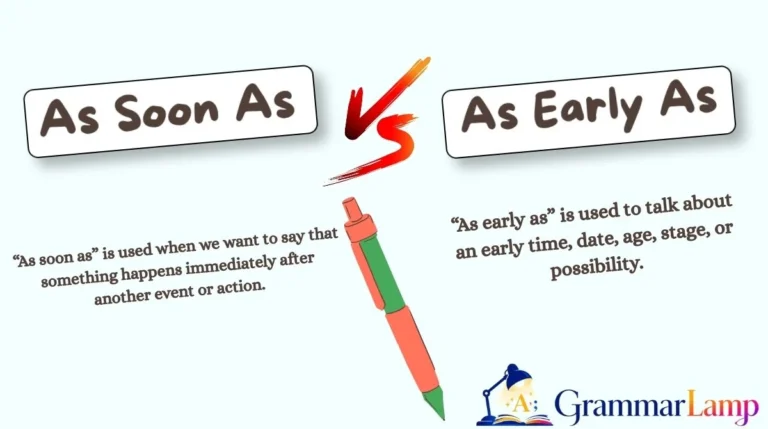
“As soon as” and “as early as” look very similar, so many English learners think they have the same meaning.
Both expressions talk about time, and both can be used when we want to explain when something happens. However, they focus on different ideas.
The expression “as soon as” is mainly about one event happening immediately after another event. It shows that there is little or no delay. For example, “I will call you as soon as I arrive” means I will call you immediately after I arrive.
On the other hand, “as early as” means at an earlier time than expected, planned, or usual. For example, “I can come as early as 7 a.m.” means 7 a.m. is an early possible time for me to come.
This small difference is very important in everyday English. You may hear these expressions at work, at school, while making plans, or during normal conversations with friends and family.
The good news is that the difference is easy to understand once you focus on the main idea. “As soon as” focuses on the time relationship between two events, while “as early as” focuses on an early time or an early possibility.
What Does “As Soon As” Mean?
“As soon as” is used when we want to say that something happens immediately after another event or action.
The word “soon” is connected with a short amount of time. So, when we say “as soon as,” we mean immediately after something happens or at the first possible moment after an event.
For example:
I will call you as soon as I get home.
This means:
I will get home first, and then I will call you without waiting.
The two actions are connected:
get home → call you
There may be a few seconds or minutes between them, but the speaker does not want to wait longer than necessary.
When Do We Use “As Soon As”?
We commonly use “as soon as” when talking about:
- Future plans
- Promises
- Instructions
- Immediate actions
- Two events that happen one after another
- Past events that happened one immediately after another
The basic structure is:
Subject + verb + as soon as + subject + verb
For example:
I will text you as soon as I arrive.
Another common structure is:
As soon as + subject + verb, subject + verb.
For example:
As soon as I finish work, I will go home.
Important Grammar Rule
When “as soon as” introduces a future time clause, we normally use the present simple after “as soon as,” not “will.”
Correct:
I will call you as soon as I arrive.
Incorrect:
I will call you as soon as I will arrive.
The main clause can use “will,” but the time clause normally uses the present simple.
Examples of “As Soon As”
- I will call you as soon as I reach home.
- She will tell us as soon as she knows the answer.
- As soon as the rain stops, we will go outside.
- Please send me the file as soon as you finish it.
- He went to sleep as soon as he got into bed.
- I will start cooking as soon as I get home.
- As soon as the teacher entered the room, everyone became quiet.
- Let me know as soon as you hear anything.
Common Learner Confusion
A common mistake is thinking that “as soon as” means “very early.” It does not.
For example:
I will arrive as soon as 7 a.m.
This sentence is not normally correct if you mean that 7 a.m. is an early possible arrival time.
You should say:
I can arrive as early as 7 a.m.
But:
I will call you as soon as I arrive.
Here, “as soon as” is correct because the meaning is immediately after arriving.
The easiest question to ask yourself is:
“Am I talking about something happening immediately after another event?”
If yes, “as soon as” is usually the right choice.
What Does “As Early As” Mean?
“As early as” is used to talk about an early time, date, age, stage, or possibility.
It means at an early time or at the earliest possible time mentioned.
For example:
You can come as early as 7 a.m.
This means 7 a.m. is an early time at which you can come. You may also be able to come later, but 7 a.m. is possible.
Another example:
The store opens as early as 6 a.m.
This tells us that 6 a.m. is an unusually or relatively early opening time.
When Do We Use “As Early As”?
We often use “as early as” when talking about:
- Early times
- Early dates
- Early ages
- Early stages
- The earliest possible option
- Something happening earlier than expected
The structure is often:
as early as + time/date/age/stage
For example:
We can meet as early as 8 a.m.
Or:
Some children start school as early as age four.
Or:
The product may arrive as early as Monday.
In these examples, “as early as” points to an early possibility.
Examples of “As Early As”
- I can meet you as early as 7 a.m.
- The train leaves as early as 5:30 a.m.
- We may finish the project as early as Friday.
- Some birds begin their migration as early as August.
- You can book your ticket as early as next month.
- She learned to read as early as age four.
- The doctor may see you as early as tomorrow morning.
- The shop can deliver your order as early as Monday.
Common Learner Confusion
Many learners confuse “as early as” with “as soon as” because both expressions contain “as.”
However, their meanings are different.
Compare these two sentences:
I will call you as soon as I arrive.
This means:
I will call you immediately after I arrive.
Now look at:
I can arrive as early as 7 a.m.
This means:
7 a.m. is an early time when I can arrive.
The first sentence connects two events.
The second sentence identifies an early time.
That is the main difference.
Difference Between “As Soon As” and “As Early As”
The easiest way to understand these expressions is to focus on what each one answers.
“As soon as” answers:
“When will this happen in relation to another event?”
“As early as” answers:
“What is the earliest time or possibility?”
Here is a simple comparison:
| Expression | Main Meaning | Main Focus | Common Structure | Example |
|---|---|---|---|---|
| As soon as | Immediately after | Relationship between events | as soon as + clause | I will call you as soon as I arrive. |
| As early as | At an early time | Early possibility/time | as early as + time/date/age | I can arrive as early as 7 a.m. |
1. Usage Difference
Use “as soon as” when one thing happens immediately after another thing.
I will eat as soon as I get home.
First, I get home.
Then, I eat.
There is little delay between the two actions.
Use “as early as” when you want to point out an early time.
I can eat breakfast as early as 6 a.m.
Here, you are not connecting breakfast to another event. You are saying that 6 a.m. is an early possible time for breakfast.
2. Grammar Logic
“As soon as” usually introduces a clause, which means it is followed by a subject and verb.
as soon as I arrive
as soon as she finishes
as soon as the movie ends
“As early as” is often followed by a time, date, age, or other expression showing an early point.
as early as 6 a.m.
as early as Monday
as early as age five
as early as next week
This difference in structure can help you choose the correct expression.
3. Sentence Structure Difference
Look at these examples:
I will leave as soon as the meeting ends.
Here, “the meeting ends” is a complete clause.
Now:
I can leave as early as 3 p.m.
Here, “3 p.m.” is simply a time.
You can also use “as early as” before a clause in some contexts, but its meaning remains connected to an early point or stage.
For example:
As early as the first week, we noticed a difference.
This means the difference was noticed at a very early stage.
4. Meaning Comparison
Consider this pair:
I will come as soon as you call me.
Meaning: When you call me, I will come immediately afterward.
I can come as early as 8 a.m.
Meaning: 8 a.m. is an early possible time for me to come.
These sentences may both be used when making plans, but they give different information.
The first tells us what happens after what.
The second tells us how early something can happen.
Grammar Rules You Must Remember
Rule 1: Use “As Soon As” for Immediate Sequence
Use “as soon as” when one event happens immediately after another.
I will message you as soon as I arrive.
The arrival happens first. The message comes immediately afterward.
Another example:
As soon as the class ends, I will go home.
The class ends first, and going home follows.
Rule 2: Use “As Early As” for an Early Time or Possibility
Use “as early as” when you want to say that a particular time, date, age, or stage is early.
We can start as early as 6 a.m.
Here, the focus is on 6 a.m. being an early possible starting time.
Another example:
You can apply as early as January.
The focus is on the early date.
Rule 3: Do Not Usually Use “Will” After “As Soon As” for Future Events
When talking about the future, use the present simple after “as soon as.”
Correct:
I will call you as soon as I get there.
Incorrect:
I will call you as soon as I will get there.
Correct:
We will leave as soon as the rain stops.
Incorrect:
We will leave as soon as the rain will stop.
This is an important rule for English learners.
Rule 4: Ask Yourself What You Mean
If you are unsure, ask yourself one simple question:
Am I talking about “immediately after,” or am I talking about “an early time”?
If you mean immediately after, use:
as soon as
If you mean an early possible time, use:
as early as
For example:
I will eat as soon as I finish work.
Here, eating happens immediately after work.
But:
I can eat as early as 5 p.m.
Here, 5 p.m. is an early possible time.
Common Mistakes Students Make
English learners often make mistakes with these expressions because both contain “as” and both relate to time.
Mistake 1: Using “As Early As” for Immediate Action
Wrong:
I will call you as early as I arrive.
Correct:
I will call you as soon as I arrive.
Why?
The meaning is “immediately after I arrive,” so “as soon as” is needed.
Mistake 2: Using “As Soon As” Before a Time
Wrong:
I can come as soon as 7 a.m.
If you mean that 7 a.m. is an early possible time, use:
I can come as early as 7 a.m.
The phrase “as soon as” normally needs an event or action to complete the meaning.
Mistake 3: Adding “Will” After “As Soon As”
Wrong:
I will tell you as soon as I will know.
Correct:
I will tell you as soon as I know.
The future meaning is already clear from “will tell.”
Mistake 4: Thinking “Soon” and “Early” Are the Same
They are not exactly the same.
Soon means after a short amount of time.
Early means before the expected, usual, or later time.
For example:
I will see you soon.
This means the meeting will happen in a short time.
But:
I will see you early.
This means the meeting will happen earlier than usual or expected.
That small difference becomes important when we add “as.”
Easy Trick to Remember the Difference
Here is a simple memory trick:
“SOON” = AFTER
Think:
As soon as = immediately after
I will call you as soon as I arrive.
You can mentally change this to:
I will call you immediately after I arrive.
If “immediately after” makes sense, use as soon as.
“EARLY” = EARLIEST TIME
Think:
As early as = at an early possible time
I can arrive as early as 7 a.m.
You can think:
7 a.m. is one of the earliest times I can arrive.
If you are talking about an early clock time, date, age, or stage, as early as is usually the right expression.
A Simple Real-Life Picture
Imagine your friend says:
“When can you call me?”
You say:
“I’ll call you as soon as I get home.”
Your focus is on what happens after you get home.
Now imagine your friend asks:
“What time can you come?”
You say:
“I can come as early as 7 a.m.”
Your focus is on the earliest possible time.
So remember:
AS SOON AS → immediately after something
AS EARLY AS → an early possible time
This one trick can help you avoid most mistakes.
Daily Life Examples
These expressions are very common in spoken English. Here are some natural conversations you may hear in everyday life.
Example 1: Calling a Friend
Ali: When will you call me?
Hamza: I’ll call you as soon as I get home.
Here, Hamza means he will call immediately after reaching home.
Example 2: Making an Appointment
Sara: What time can you come tomorrow?
Ayesha: I can come as early as 8 a.m.
Ayesha is talking about the earliest time she can come.
Example 3: At Work
Manager: When can you send me the report?
Employee: I’ll send it as soon as I finish it.
The report will be sent immediately after it is finished.
Example 4: Talking About a Delivery
Customer: When can I receive the package?
Worker: You may receive it as early as Monday.
Monday is an early possible delivery date.
Example 5: At Home
Mother: When will you clean your room?
Son: I’ll do it as soon as I finish my homework.
The cleaning will happen after the homework, with little delay.
Example 6: Morning Plans
Friend 1: What time should we leave?
Friend 2: We can leave as early as 6 a.m.
The speaker is saying that 6 a.m. is an early possible departure time.
Example 7: Waiting for News
A: Do you know the result?
B: No, but I’ll tell you as soon as I find out.
The speaker promises to tell A immediately after getting the information.
Example 8: School
Student: When can I submit my assignment?
Teacher: You can submit it as early as Monday.
Monday is an early date when submission is possible.
Example 9: Travel
A: When will you book the hotel?
B: I’ll book it as soon as I confirm my travel dates.
The booking will happen immediately after the dates are confirmed.
Example 10: Doctor’s Appointment
Patient: When can the doctor see me?
Receptionist: The doctor may see you as early as tomorrow morning.
Tomorrow morning is an early possible appointment time.
Practice Section
Choose the correct expression: as soon as or as early as.
1. I will call you ______ I reach the office.
A. as early as
B. as soon as
2. We can leave ______ 6 a.m.
A. as soon as
B. as early as
3. She will tell you ______ she knows the answer.
A. as soon as
B. as early as
4. The package may arrive ______ Monday.
A. as early as
B. as soon as
5. I will start cooking ______ I get home.
A. as soon as
B. as early as
Answers
1. B — as soon as
I will call you as soon as I reach the office.
The call happens immediately after reaching the office.
2. B — as early as
We can leave as early as 6 a.m.
Six o’clock is an early possible time.
3. A — as soon as
She will tell you as soon as she knows the answer.
She will tell you immediately after she gets the answer.
4. A — as early as
The package may arrive as early as Monday.
Monday is an early possible arrival date.
5. A — as soon as
I will start cooking as soon as I get home.
Cooking will begin immediately after getting home.
FAQs
What is the difference between “as soon as” and “as early as”?
“As soon as” means immediately after something happens. It connects two events or actions.
“As early as” means at an early or earliest possible time, date, age, or stage.
For example, “I’ll call you as soon as I arrive” and “I can arrive as early as 7 a.m.” have different meanings.
Can we use “as soon as” in questions?
Yes. “As soon as” can be used in questions when you are asking about an action that should happen immediately after another event.
For example:
Can you call me as soon as you arrive?
It is very common in everyday spoken English.
Can we use “as early as” in questions?
Yes. You can use “as early as” when asking about an early possible time.
For example:
How early can you come?
A natural answer could be:
I can come as early as 7 a.m.
It is useful when discussing schedules and plans.
Is “as soon as” formal or informal?
“As soon as” is used in both formal and informal English.
You can use it in conversations, emails, school writing, business communication, and professional situations.
For example: “Please contact us as soon as possible.”
Is “as early as” formal or informal?
“As early as” can also be used in both formal and informal English.
It is common when discussing dates, times, ages, schedules, and early stages.
For example: “Registration may open as early as next month.”
Can “as soon as” and “as early as” be used in the same sentence?
Yes, they can appear in the same sentence, but they perform different jobs.
For example:
I can arrive as early as 7 a.m., and I will call you as soon as I get there.
“As early as” tells us the early possible arrival time. “As soon as” tells us that the call will happen immediately after arrival.
Conclusion
“As soon as” and “as early as” are easy to confuse, but their meanings are quite different once you know what to look for.
Use “as soon as” when you mean immediately after something happens. It usually connects two actions or events.
I’ll call you as soon as I arrive.
Use “as early as” when you mean at an early or earliest possible time, date, age, or stage.
I can arrive as early as 7 a.m.
The easiest way to remember the difference is:
Soon = immediately after.
Early = an early possible time.
Try making your own sentences with both expressions. Think about real situations from your daily life, such as calling a friend, going to work, making an appointment, or planning a trip.
The more you use these phrases naturally, the easier the difference will become.

Liam Derren is a language writer at GrammarLamp, creating simple, helpful content about grammar, words, and everyday English. He makes language learning clear, practical, and easy to understand.
1 thought on “As Soon As vs As Early As: Easy Difference, Rules & Examples in 2026”