
English has many small phrases that look almost the same but work differently in a sentence. “If so” and “if yes” are two good examples.
Both phrases are used when we want to talk about a condition or ask someone to respond to something. Because they both contain the word “if,” many English learners think they can use them in the same way.
However, there is a small but important difference between them.
For example:
- Have you finished your homework? If so, you can go outside.
- Is your answer yes or no? If yes, please tell me why.
Both sentences are understandable, but they do not have exactly the same meaning or natural use.
The phrase “if so” is common in everyday conversations, emails, questions, and formal writing. It helps us avoid repeating information that has already been mentioned. On the other hand, “if yes” is more direct and is often used when someone is answering a yes-or-no question.
Knowing when to use these expressions can make your English sound clearer and more natural. It can also help you avoid awkward sentences in conversations, school assignments, professional emails, and daily communication.
By the end of this guide, you will understand the meaning of both expressions, their grammar rules, their differences, and the situations in which each one is appropriate. You will also learn from simple examples and practice sentences.
More Useful posts
Desert vs Dessert: Meaning, Difference, Examples & Easy Trick (2026)
Unsecure vs Insecure (2026): What Is the Difference and Which Word Is Correct?
Addicting vs Addictive: What’s the Difference? Easy Grammar Guide for 2026
Simpler vs More Simple: Which One Is Correct? (2026)
What Does “If So” Mean?
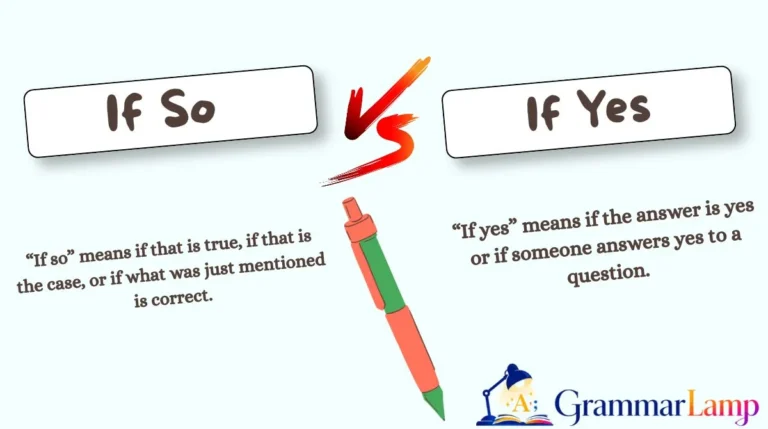
“If so” means if that is true, if that is the case, or if what was just mentioned is correct.
We use it when we want to talk about a possible situation that has already been mentioned or understood. Instead of repeating the whole condition, we simply use “if so.”
Look at this example:
Are you feeling tired? If so, you should get some rest.
The first sentence asks whether the person feels tired. The second sentence means:
If you are feeling tired, you should get some rest.
Notice that “if so” replaces the repeated idea. This makes the sentence shorter, smoother, and easier to understand.
When Should You Use “If So”?
You can use this expression in several situations.
1. When you want to avoid repeating information
Sometimes, repeating the same words makes your English sound unnatural. This expression helps you avoid that problem.
Example:
– Do you have a driving licence? If so, you can apply for this job.
Instead of saying, “If you have a driving licence,” we simply say “if so.”
2. When asking about a possible situation
You can also use it to ask someone whether something is true.
Example:
– Is the shop open today? If so, what time does it close?
Here, the speaker wants to know whether the shop is open. If it is open, the speaker also wants to know its closing time.
3. In formal and informal communication
“If so” works well in everyday speech, emails, reports, instructions, and professional writing.
Example:
– Have you received the documents? If so, please confirm by email.
4. When giving advice based on a condition
You can use it to give advice when something may be true.
Example:
– Are you having trouble with this lesson? If so, ask your teacher for help.
Grammar Rule for “If So”
The basic structure is:
Question or statement + If so + result or follow-up question.
For example:
- Are you busy? If so, I can call you later.
- Is this your bag? If so, please take it with you.
- Have you paid the bill? If so, keep the receipt.
The word “so” refers to the situation, fact, or idea mentioned earlier.
It does not mean “yes” by itself. Instead, it refers to the whole idea that may be true.
8 Example Sentences Using “If So”
Here are eight useful examples that show how this phrase works in everyday English.
1. Are you interested in learning English? If so, you should practise every day.
The speaker offers advice if the person is interested.
2. Have you visited London before? If so, what did you think of the city?
The second question depends on whether the person has visited London.
3. Is your brother coming to the party? If so, please bring him with you.
The speaker wants the brother to come if he is attending.
4. Do you need any help? If so, I am happy to help you.
The speaker offers help if it is needed.
5. Are you ready for the exam? If so, you can start now.
The second sentence depends on the person’s readiness.
6. Have you completed the project? If so, send it to your manager.
The speaker gives an instruction based on the completed project.
7. Is there a problem with your computer? If so, restart it first.
The advice applies if a problem exists.
8. Will you be staying here tonight? If so, I will book another room.
The speaker explains what will happen if the person stays.
Common Learner Confusion About “If So”
One common mistake is thinking that “so” always means “yes.”
That is not correct.
In this expression, “so” refers to an earlier idea or situation.
For example:
Do you speak English? If so, we can talk without a translator.
Here, “if so” means:
If you speak English, we can talk without a translator.
It does not simply replace the word “yes.” It refers to the complete idea of speaking English.
Another point to remember is that “if so” does not always need to follow a direct question. It can also follow a statement.
Example:
The weather may become cold tonight. If so, take a jacket with you.
The expression refers to the possibility that the weather will become cold.
What Does “If Yes” Mean?
“If yes” means if the answer is yes or if someone answers yes to a question.
It is used when we are talking directly about a positive answer to a yes-or-no question.
For example:
Did you complete the form? If yes, submit it today.
The second sentence means:
If your answer to the question is yes, submit the form today.
Unlike “if so,” which refers to an entire situation or idea, “if yes” focuses specifically on the answer.
When Should You Use “If Yes”?
There are several situations where this expression can be useful.
1. When discussing yes-or-no questions
Use it when the response to a question can be either yes or no.
Example:
– Do you have a passport? If yes, enter your passport number below.
The speaker is asking for a direct positive answer.
2. In forms and questionnaires
“If yes” is especially common in forms, surveys, applications, and questionnaires.
Example:
– Do you have any work experience? If yes, describe it below.
Here, the person only needs to provide more details if the answer is positive.
3. When giving instructions
You can use it to explain what someone should do after answering yes.
Example:
– Have you paid the registration fee? If yes, upload your payment receipt.
4. When comparing positive and negative answers
It is useful when both possible answers need different instructions.
Example:
– Do you own a car? If yes, provide its registration number. If no, skip this section.
This makes the instructions easy to follow.
Grammar Rule for “If Yes”
The basic structure is:
Yes-or-no question + If yes + result or instruction.
For example:
- Are you a student? If yes, write your school name.
- Do you have a bank account? If yes, enter your account details.
- Have you received the message? If yes, reply to it.
The expression focuses on a positive answer.
You can also use “if yes” with a question or statement that clearly introduces a yes-or-no response.
Example:
Your answer was yes. If yes, please explain your choice.
However, in ordinary conversation, people often prefer “if so” or “if that is the case,” depending on the context.
8 Example Sentences Using “If Yes”
Let’s look at some practical examples.
1. Are you available tomorrow? If yes, we can arrange a meeting.
The meeting will be arranged if the answer is positive.
2. Do you have a driving licence? If yes, please provide a copy.
The speaker asks for proof if the person has a licence.
3. Have you completed your application? If yes, click the submit button.
The instruction applies to people who have finished the application.
4. Are you interested in this job? If yes, send us your CV.
A positive answer leads to the next step.
5. Do you understand the question? If yes, write your answer below.
The person should write an answer if they understand.
6. Have you ever travelled abroad? If yes, mention the countries you visited.
The speaker wants additional information from people who answer positively.
7. Do you agree with this decision? If yes, please sign the document.
The signature is required if the person agrees.
8. Would you like to join our English class? If yes, register before Friday.
Registration is the next step for interested people.
Common Learner Confusion About “If Yes”
Many learners use “if yes” whenever they want to say “if that is true.”
Although the meaning may be understood, it does not always sound natural.
For example:
The weather forecast says it may rain tomorrow. If yes, take an umbrella.
This sentence is understandable, but it sounds less natural because the first sentence describes a possible situation rather than asking a direct yes-or-no question.
A better version is:
The weather forecast says it may rain tomorrow. If so, take an umbrella.
Why?
Because “if so” refers naturally to the possibility of rain.
Remember that “if yes” is most useful when the focus is on a positive answer, especially in forms, surveys, and direct questions.
Difference Between If So and If Yes (Detailed Explanation)
Both expressions introduce a condition, but they do not work in exactly the same way.
The main difference is simple:
- If so means if the situation or statement mentioned earlier is true.
- If yes means if the answer to a yes-or-no question is yes.
This small difference affects how naturally you can use each phrase.
Comparison Table
| Point | If So | If Yes |
|---|---|---|
| Basic meaning | If that is the case | If the answer is yes |
| Main focus | A situation or fact | A positive answer |
| Common use | Conversations and writing | Forms, surveys, instructions |
| Refers to | An earlier idea or statement | A yes-or-no answer |
| Formality | Neutral and widely used | Neutral, often direct |
| Everyday use | Very common | More limited |
| Repetition | Avoids repeating an idea | Identifies a positive response |
| Negative opposite | If not | If no |
1. Difference in Meaning
The most important difference is what each expression refers to.
“If so” points back to an earlier situation.
Example:
Is your father at home? If so, please ask him to call me.
The phrase refers to the situation of the father being at home.
“If yes” points to a positive answer.
Example:
Is your father at home? If yes, please ask him to call me.
This is also understandable. However, it sounds more focused on the answer to the question.
In many direct yes-or-no questions, both expressions can work. The difference is often one of emphasis and natural style rather than a completely different result.
2. Difference in Usage
Use “if so” when referring to a statement, possibility, or situation.
Examples:
- The road may be closed today. If so, we will take another route.
- You might need more practice. If so, spend ten minutes studying daily.
Use “if yes” when a positive answer is the main point.
Examples:
- Do you have a mobile phone? If yes, enter your number.
- Are you a member of this club? If yes, show your membership card.
This is why “if yes” appears frequently in forms and questionnaires.
3. Difference in Grammar Logic
Both expressions contain the word “if,” which introduces a condition.
However, the words “so” and “yes” perform different jobs.
In “if so,” the word “so” refers to an earlier statement or situation.
Example:
She may be waiting outside. If so, please open the door.
The word “so” refers to the possibility that she is waiting outside.
In “if yes,” the word “yes” represents a positive answer.
Example:
Is she waiting outside? If yes, please open the door.
The speaker is talking about a yes answer to the question.
4. Difference in Sentence Structure
Both expressions can appear at the beginning of a sentence or after a question.
Common structures include:
Structure A: Question + If so
– Are you hungry? If so, let’s order food.
Structure B: Question + If yes
– Are you hungry? If yes, let’s order food.
Structure C: Statement + If so
– The restaurant may be closed. If so, we will eat somewhere else.
Structure D: Statement + If yes
– Your answer to the question should be either yes or no. If yes, explain your choice.
Notice that “if so” is especially flexible because it can refer to a statement without an actual yes-or-no question.
5. Can You Replace One With the Other?
Sometimes you can replace one expression with the other without changing the basic message.
For example:
- Are you ready? If so, let’s leave.
- Are you ready? If yes, let’s leave.
Both are grammatically understandable.
However, the first sentence usually sounds smoother in normal conversation.
Now look at another example:
- It may snow tonight. If so, schools may close tomorrow.
- It may snow tonight. If yes, schools may close tomorrow.
The second sentence sounds awkward because the first sentence does not ask a yes-or-no question.
Therefore, the expressions are not always interchangeable.
Explore More Posts
Bored vs Board: Meaning, Difference, Examples & Grammar Rules in 2026
Sprang vs Sprung: What’s the Difference? Easy Grammar Guide 2026
Accessory vs Accessary 2026: Meaning, Difference, Spelling & Easy Examples
Swifty vs Swiftie: What’s the Difference? Meaning, Usage & Examples in 2026
Grammar Rules You Must Remember
Learning a few simple rules can help you choose the correct expression without thinking too much.
Rule 1: Use “If So” to Refer to an Earlier Situation
When you want to refer to something that may be true, use “if so.”
The phrase saves you from repeating the complete idea.
Example:
– Your computer may have a virus. If so, install reliable antivirus software.
Here, “if so” means if your computer has a virus.
This rule is useful in everyday conversations, emails, and written instructions.
Rule 2: Use “If Yes” for a Positive Answer
When you are discussing the answer to a yes-or-no question, “if yes” can be appropriate.
Example:
– Do you have any previous experience? If yes, describe it in your application.
The phrase means if your answer is yes.
It is particularly useful in surveys, forms, job applications, and questionnaires.
Rule 3: Use “If So” After Statements Too
You do not need to ask a question before using “if so.”
It can also follow a statement that describes a possibility or condition.
Example:
– The train might arrive late. If so, we will wait at the station.
The phrase refers to the possibility that the train will arrive late.
This is an important difference because “if yes” usually needs a clear yes-or-no answer to refer to.
Rule 4: Use “If Not” for a Negative Condition
Both expressions can be understood alongside negative alternatives.
You can use “if not” when you want to talk about the opposite condition.
Example:
– Are you free today? If so, come to my house. If not, we can meet tomorrow.
Here, “if so” means if you are free, while “if not” means if you are not free.
For a yes-or-no question, you can also say:
– Have you submitted the form? If yes, wait for confirmation. If no, submit it today.
Both patterns are useful, but choose the one that makes your meaning clearest.
Common Mistakes Students Make
English learners often confuse these phrases because both can follow questions and introduce a condition.
The good news is that most mistakes are easy to correct once you understand what each expression refers to.
Mistake 1: Using “If Yes” After Every Statement
Incorrect or unnatural
The weather may become cold tonight. If yes, wear a warm jacket.
Better
The weather may become cold tonight. If so, wear a warm jacket.
Why?
The first sentence describes a possible situation. It does not ask a yes-or-no question.
“If so” is the more natural choice because it refers to the possibility of cold weather.
Mistake 2: Thinking “If So” Only Works After Questions
Incorrect understanding
You cannot use “if so” after a statement.
Correct example
The manager may need more information. If so, send another email.
Why?
“If so” can refer to both questions and statements.
You should not limit its use to questions.
Mistake 3: Using “If Yes” When You Mean “If That Is True”
Less natural
This information may be correct. If yes, we should check it.
Better
This information may be correct. If so, we should check it.
Why?
The speaker is discussing whether information is correct, not asking for a direct yes-or-no response.
Mistake 4: Repeating the Whole Condition Unnecessarily
Unnecessarily repetitive
Are you coming to the meeting? If you are coming to the meeting, please arrive early.
Better
Are you coming to the meeting? If so, please arrive early.
Why?
“If so” makes the sentence shorter and avoids repeating the same information.
Mistake 5: Confusing “If Yes” With “Yes, If”
These two structures have different word orders.
Compare:
- If yes, please continue.
- Yes, if you have time, please continue.
In the first sentence, “if yes” introduces a condition based on a positive answer.
In the second sentence, “yes” is an answer, and “if you have time” introduces a condition.
Pay attention to punctuation and word order to make your meaning clear.
Easy Tips to Correct These Mistakes
- Ask yourself whether you are referring to a situation or an answer.
- Use “if so” when you mean “if that is the case.”
- Use “if yes” when you mean “if the answer is yes.”
- Do not repeat a long condition if a short expression can replace it.
- Read your sentence aloud to check whether it sounds natural.
Easy Trick to Remember the Difference
Here is a simple trick that can help you remember the difference for a long time.
Think of SO = SITUATION and YES = POSITIVE ANSWER.
Although this is a memory trick rather than a grammar definition, it is useful when you are speaking or writing.
Remember “If So”
Think:
If so = If that situation is true.
Example:
– It might rain tomorrow. If so, take an umbrella.
You are talking about the situation of rain.
Remember “If Yes”
Think:
If yes = If the answer is yes.
Example:
– Do you want some tea? If yes, I will make it for you.
You are talking about the positive answer to a question.
Real-Life Logic
Imagine that you are talking to a friend.
You ask:
Are you coming to my birthday party?
Your friend may answer yes or no.
You can say:
If yes, I will save you a seat.
This focuses on the positive answer.
Now imagine your friend tells you:
The party might start earlier than expected.
You can reply:
If so, I will arrive early.
This refers to the possible situation.
The easiest way to remember the difference is to ask yourself:
- Am I talking about a situation? Use “if so.”
- Am I talking about a yes answer? Use “if yes.”
Daily Life Examples (Very Important)
The best way to improve your English is to see how expressions work in real conversations.
Here are ten simple examples that you can use in your daily life.
1. Talking About School
Ali: Have you finished your homework?
Ahmed: Yes, I have.
Ali: If so, let’s play football.
The phrase refers to the fact that Ahmed has finished his homework.
2. Talking About Work
Manager: Are you available for a meeting tomorrow?
Employee: If yes, I can attend at 10 a.m.
The employee is referring to a positive answer about availability.
3. Talking About Shopping
Customer: Is this shirt available in black?
Shopkeeper: If so, I can show you another size.
The customer or shopkeeper is referring to the possibility that the shirt is available.
4. Talking About Travel
Friend: Will you travel to Lahore next week?
You: If so, I will visit my cousins too.
The phrase refers to the possibility of travelling to Lahore.
5. Talking About Food
Mother: Do you want some more rice?
Son: If yes, please give me a little more.
The son is talking about a positive answer to the question.
6. Talking About Health
Friend: Are you feeling better today?
You: If so, I will return to work tomorrow.
This example refers to the situation of feeling better.
7. Talking About a Job Application
Employer: Do you have previous work experience?
Applicant: If yes, I can provide my experience certificate.
The applicant is discussing a positive answer to a direct question.
8. Talking About a Mobile Phone
Friend: Is your phone working now?
You: If so, I will call you later.
The speaker refers to the possibility that the phone is working.
9. Talking About a Party
Friend: Are you joining us tonight?
You: If yes, I will get ready early.
The speaker is referring to a positive answer about joining the group.
10. Talking About English Classes
Teacher: Do you understand today’s lesson?
Student: If so, I can complete the exercise.
The student is referring to the possibility that the lesson has been understood.
These examples show that both expressions can be useful in daily English. The important thing is to understand what you are referring to before choosing one.
Practice Section: Test Your Understanding
Now it is time to check what you have learned.
Choose the correct expression, “if so” or “if yes,” for each sentence.
Try answering all five questions before checking the answers.
Question 1
It may rain this evening. ________, we will stay at home.
- A. If so
- B. If yes
Question 2
Do you have a valid passport? ________, enter your passport number.
- A. If so
- B. If yes
Question 3
The shop might be closed today. ________, we will visit another shop.
- A. If so
- B. If yes
Question 4
Have you completed your registration? ________, click the confirmation button.
- A. If so
- B. If yes
Question 5
You may need extra help with your homework. ________, ask your teacher.
- A. If so
- B. If yes
Answers and Explanations
- A. If so — It refers to the possibility of rain.
- B. If yes — It refers to a positive answer about having a passport.
- A. If so — It refers to the possibility that the shop is closed.
- B. If yes — It refers to a positive answer about completing registration.
- A. If so — It refers to the situation of needing extra help.
Well done!
If you got all five answers right, you have understood the main difference. If you made a mistake, read the memory trick again and try the exercise once more.
More Helpful posts
In the Books vs On the Books: Meaning, Difference & Examples (2026)
Promulgate vs Propagate: Meaning, Difference & Examples (2026 Guide)
Sneek vs Sneak: Which Spelling Is Correct in 2026?
In vs Into vs On vs Onto: Easy Grammar Rules and Examples in 2026
FAQs
1. What Is the Main Difference Between “If So” and “If Yes”?
“If so” means if the situation or statement mentioned earlier is true. “If yes” means if the answer to a yes-or-no question is yes.
Both expressions introduce conditions, but they focus on different things. “If so” is generally more flexible in everyday English.
2. Can We Use “If So” in Questions?
Yes. You can use “if so” when asking a follow-up question about a possible situation.
For example:
Are you moving to another city? If so, when are you leaving?
Here, the speaker wants more information if the person is moving.
3. Is “If Yes” Formal or Informal?
“If yes” is grammatically acceptable in both formal and informal situations.
However, it is particularly common in forms, surveys, applications, and instructions. In ordinary conversation, “if so” may sound more natural in many situations.
4. Is “If So” More Natural Than “If Yes”?
In many everyday situations, yes.
“If so” is widely used because it can refer to an entire situation or statement. “If yes” is more specific and is usually best when referring to a positive answer.
For example, “It may snow tomorrow. If so, stay indoors” sounds natural.
5. Can I Use “If Yes” After a Statement?
You can use it after a statement when that statement clearly establishes a yes-or-no answer.
For example:
Your answer should be either yes or no. If yes, explain your choice.
However, after a statement about a possibility, “if so” is usually the better choice.
6. What Is the Opposite of “If Yes” and “If So”?
The common negative alternatives are “if no” and “if not.”
“If no” refers to a negative answer to a yes-or-no question.
“If not” refers to a situation or condition that is not true.
For example:
Are you available? If not, we can meet tomorrow.
Both are useful expressions in everyday English.
Conclusion
Understanding the difference between “if so” and “if yes” is a small but useful step towards better English. Both expressions help you introduce conditions without making your sentences unnecessarily long. However, they have slightly different meanings and uses.
Remember that “if so” means if that is the case. It refers to an earlier situation, possibility, or statement. You can use it in everyday conversations, emails, questions, and formal writing.
On the other hand, “if yes” means if the answer is yes. It is especially useful in forms, surveys, applications, and instructions where someone needs to give a positive answer.
The easiest memory trick is to connect “so” with a situation and “yes” with a positive answer. Once you understand this simple rule, choosing between the two becomes much easier.
Keep practising with your own sentences. Read English conversations, notice how these expressions are used, and try them when speaking with others. Small improvements like this can make your English clearer, smoother, and more natural.

Liam Derren is a language writer at GrammarLamp, creating simple, helpful content about grammar, words, and everyday English. He makes language learning clear, practical, and easy to understand.