
English learners often get confused by unsecure vs insecure because both words seem to have the same basic idea: something is not secure.
The confusion becomes even stronger because English often uses the prefix un- to make the opposite of a word, such as happy → unhappy and clear → unclear. So,
it feels natural to think that secure → unsecure should be the normal form.
However, English does not always follow one simple pattern. Insecure is the established and much more common adjective in modern English.
It can describe a person who lacks confidence, but it can also describe something that is not safe, protected, stable, or certain. Major dictionaries such as Oxford and Cambridge list these meanings clearly.
Unsecure does exist, and some dictionaries recognize it as meaning “not secure” or “unprotected,” but it is much less common.
Dictionary.com lists it as an adjective, while historical dictionary evidence shows that insecure has generally been the more established choice.
By the end of this guide, you will understand when to use insecure, what unsecure means, why unsecured is often a better choice in some situations, and how to avoid common mistakes.
More Useful posts
It’s vs Its: Simple Difference, Rules, Examples & Practice (2026)
Enamor vs Enamour: What’s the Difference? Meaning, Usage & Examples in 2026
Breath vs Breathe: Easy Difference, Meaning, Examples & Rules in 2026
No Longer Exist vs No Longer Exists: Which Is Correct? (2026 Guide)
What Does “Unsecure” Mean?
Simple Definition of Unsecure
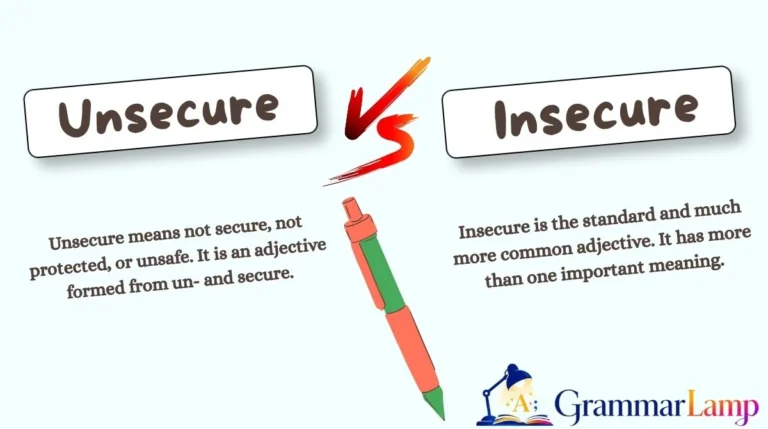
Unsecure means not secure, not protected, or unsafe. It is an adjective formed from un- and secure.
For example:
The gate was unsecure.
This means the gate was not properly secure or protected.
The important point is that unsecure is a real English word, but it is not common in everyday modern English. Dictionary.com defines it as “not secure; unprotected, unsafe.”
So, saying that unsecure is completely impossible would be too strong. It can be found in real English. However, when writing or speaking modern standard English, another word is often more natural.
When Is “Unsecure” Used?
Unsecure may be used when talking about something that is not properly protected, safe, or fixed.
For example, you might see it used for:
- a place that is not protected
- a network with weak security
- an object that is not safely fixed
- a location where something is exposed to risk
Here are some examples:
- The back door was left unsecure overnight.
- The workers found an unsecure section of the fence.
- The documents were kept in an unsecure place.
- The network was considered unsecure by the technician.
- The equipment looked unsecure on the truck.
- The room was unsecure, so anyone could enter.
- The website was connected through an unsecure network.
- The box seemed unsecure and could easily open.
These sentences can be understood, but many readers and speakers would choose insecure, unsecured, or not secure instead.
Why Does “Unsecure” Sound Unusual?
This is one of the biggest reasons learners ask about this word.
The form looks perfectly logical:
secure → unsecure
English has many examples where un- creates the opposite:
- safe → unsafe
- fair → unfair
- clear → unclear
- certain → uncertain
- happy → unhappy
But English has developed over many centuries, so not every opposite is formed in the same way. Insecure is the normal established adjective for several meanings connected with a lack of security, confidence, stability, or certainty. Oxford and Cambridge both list insecure with these meanings.
That is why you should not simply assume that unsecure is the normal opposite of secure in every sentence.
A Useful Tip About “Unsecure”
When you see unsecure, do not immediately think, “This word is completely wrong.”
Instead, ask:
Is there a more natural modern word for this meaning?
Very often, the answer will be insecure or unsecured.
For example:
The system is unsecure.
A more natural choice in most modern contexts is:
The system is insecure.
Or:
The system is not secure.
Now compare this sentence:
The package was left unsecure.
In many contexts, unsecured sounds more natural:
The package was left unsecured.
This small difference is very useful for learners.
What Does “Insecure” Mean?
Simple Definition of Insecure
Insecure is the standard and much more common adjective. It has more than one important meaning.
First, it can describe a person who lacks confidence or is unsure about their abilities, appearance, relationships, or place in a group.
Second, it can describe something that is not safe, protected, stable, or certain.
Oxford gives both the personal-confidence meaning and the safety/protection meaning. Cambridge does the same.
Insecure for People
When you use insecure for a person, it often means that the person does not feel confident.
For example:
She feels insecure about her English.
This means she does not feel confident about her English ability.
You can also say:
He is insecure about his appearance.
This means he worries that there is something wrong with the way he looks.
Here are more examples:
- I felt insecure when I spoke in front of the class.
- She is insecure about her English skills.
- He became insecure after making several mistakes.
- The new student felt insecure because he knew nobody.
- She is often insecure about her appearance.
- He seems insecure about his job performance.
- I used to be insecure when speaking English.
- The child felt insecure in the unfamiliar environment.
One common grammar pattern is:
insecure + about + noun or gerund
Examples:
- insecure about my English
- insecure about her appearance
- insecure about his ability
- insecure about speaking in public
Cambridge specifically gives examples of insecure about when talking about a lack of confidence.
Insecure for Things and Situations
Many learners think that insecure can only describe people. That is not true.
It can also describe a system, place, job, structure, network, position, or situation that is not safe or protected.
For example:
This website is insecure.
The meaning is that the website does not have adequate security.
You can also say:
The ladder is insecure.
Here, insecure means the ladder is not stable or safe.
More examples:
- The building has an insecure entrance.
- This network is insecure.
- The ladder looks insecure.
- Many workers have insecure jobs.
- The bridge became insecure after the storm.
- The system is insecure and needs stronger protection.
- The door was insecure because the lock was broken.
- They found an insecure connection during the test.
Oxford notes that insecure can describe things that are not safe or protected and can also describe something likely to move or fall.
The Key Idea
So, insecure has a wider use than unsecure.
It can mean:
lacking confidence
or
not safe, protected, stable, or certain
That wide range is one reason it is so common in modern English.
Difference Between Unsecure and Insecure
The easiest way to understand unsecure vs insecure is to look at their normal use.
| Word | Basic meaning | Common use | Modern usage |
|---|---|---|---|
| Insecure | Not confident, not safe, unstable, or not protected | People, systems, places, jobs, networks, structures | Very common |
| Unsecure | Not secure, unprotected, unsafe | Less common adjective for lack of security | Uncommon |
| Unsecured | Not secured, fastened, protected, or guaranteed | Doors, objects, documents, loans, property | Common and often more natural |
| Not secure | Clear way to say something lacks security | Almost any context | Very natural |
1. Usage Difference
Insecure is the normal adjective when you want to say that a person lacks confidence.
Maria feels insecure about her speaking skills.
You cannot normally replace this with unsecure.
Maria feels unsecure about her speaking skills.
This sounds unnatural in modern standard English.
For physical or technical security, insecure is also widely used:
The network is insecure.
The password is insecure.
The structure looks insecure.
Unsecure can carry the basic idea of “not secure,” but it is uncommon enough that it often sounds awkward.
2. Grammar Logic
Both unsecure and insecure can function as adjectives.
They can come after a linking verb:
The area is insecure.
The area is unsecure.
They can also come before a noun:
an insecure system
an unsecure system
But the fact that a sentence is grammatically possible does not mean both choices are equally natural.
This is an important lesson for English learners:
Grammar and natural word choice are not always the same thing.
A word may exist and still be uncommon.
3. Meaning Comparison
The meanings overlap, but insecure has several established uses.
For a person:
She is insecure about her abilities.
For a system:
The system is insecure.
For a job:
He has an insecure job.
For a physical object:
The ladder is insecure.
Unsecure mainly gives the simple idea of “not secure,” and it does not have the same strong everyday role that insecure has.
4. What About “Unsecured”?
This is where many learners find the answer that actually helps them.
Unsecured is often better than unsecure when you mean that something has not been secured.
For example:
The door was left unsecured.
This suggests that the door was not locked or properly secured.
The package was unsecured.
This suggests that it was not fastened or protected.
Cambridge lists unsecured for things that have not been made safe or protected, and it also uses the word in finance for loans that are not backed by specific collateral.
So these three forms should not be treated as exactly the same:
- insecure = lacking security, safety, stability, or confidence
- unsecure = not secure, but uncommon
- unsecured = not secured, fastened, protected, or guaranteed
Explore More Posts
Grammar Rules You Must Remember
Rule 1: Use “Insecure” for Lack of Confidence
When you are talking about someone’s feelings, confidence, or self-doubt, use insecure.
Correct:
She feels insecure about her English.
Incorrect or unnatural:
She feels unsecure about her English.
A useful pattern is:
feel + insecure + about + something
Example:
I feel insecure about speaking in meetings.
Rule 2: “Insecure” Can Also Describe Things
Do not think insecure is only for people.
It can describe a network, structure, job, place, system, or situation.
Examples:
The website is insecure.
The ladder is insecure.
The job is insecure.
The connection is insecure.
Oxford and Cambridge both recognize this meaning of insecure for things that are not safe or protected.
Rule 3: “Unsecure” Exists, but It Is Uncommon
Do not tell students that unsecure is never a word.
Some dictionaries recognize it as an adjective meaning “not secure” or “unprotected.”
However, in modern everyday English, insecure, unsecured, or not secure will usually sound more natural, depending on what you want to say.
For example:
The connection is not secure.
The connection is insecure.
Both are clear and natural.
Rule 4: Choose “Unsecured” When Something Has Not Been Secured
When the focus is on an action that was not completed, unsecured is often the natural word.
Examples:
The door was left unsecured.
The documents were stored unsecured.
The equipment was transported unsecured.
In finance, an unsecured loan is a loan that is not backed by specific property or collateral. Cambridge and Collins both recognize this specialized use.
Explore More Posts
Jewel vs Joule: Meaning, Difference, Examples & Easy Rules (2026)
Foul or Fowl: Meaning, Difference, Examples & Easy Rules for 2026
Dialog vs Dialogue: What’s the Difference? A Simple English Guide for 2026
Learned vs Learnt: What’s the Difference? A Simple Guide for 2026
Common Mistakes Students Make
Mistake 1: Thinking “Unsecure” Must Be the Normal Opposite of “Secure”
Students often learn:
secure → unsecure
because that pattern looks logical.
But the usual modern adjective is insecure.
Compare:
This network is insecure. ✅
This network is unsecure. ⚠️ Uncommon
The second sentence may be understood, but it is not normally the first choice for standard modern English.
Mistake 2: Using “Unsecure” for Personal Feelings
Do not use unsecure when talking about confidence.
Wrong:
I am unsecure about my English.
Better:
I am insecure about my English.
This is one of the clearest cases because insecure is the normal word for lack of confidence. Cambridge specifically defines it this way.
Mistake 3: Forgetting “Unsecured”
Another common problem is using insecure when the real meaning is “not properly fastened.”
For example:
The box was insecure.
This could mean the box was unsafe or not secure.
But if you want to stress that nobody fastened it properly, say:
The box was unsecured.
The word unsecured often focuses on the condition of something that was not secured.
Mistake 4: Thinking Every Rare Word Is Wrong
English contains old, rare, technical, and less common words.
That does not mean every unusual word is incorrect.
With unsecure, the better lesson is:
It exists, but it is uncommon.
This is more accurate than teaching learners that it is simply “wrong.” Dictionary.com recognizes the adjective, while older dictionary evidence also records it.
Easy Correction Tip
When you want to use unsecure, stop and ask yourself:
Would “insecure,” “unsecured,” or “not secure” sound more natural here?
That simple question will solve most problems.
Easy Trick to Remember the Difference
Here is a simple memory trick:
Think “INSECURE = a state”
Insecure often describes a condition or state.
A person can be insecure.
A network can be insecure.
A job can be insecure.
A ladder can be insecure.
So remember:
Insecure = lacking something important, such as confidence, safety, stability, or protection.
Think “UNSECURED = not done”
Unsecured often suggests that something was supposed to be secured, but it was not.
A door is unsecured.
A package is unsecured.
A document is unsecured.
A loan can be unsecured.
So remember:
Unsecured = not secured.
Where Does “Unsecure” Fit?
Think of unsecure as the less common form.
It can mean:
not secure
But modern English usually gives you a more natural choice.
For most learners, this three-word memory rule is enough:
Insecure → common adjective
Unsecured → not secured
Unsecure → uncommon
That rule will help you sound much more natural.
Daily Life Examples (Very Important)
Here are some simple conversations that show how native and fluent English speakers would normally use these words.
Example 1: Talking About Confidence
Ali: Why are you so quiet in class?
Hamza: I feel insecure about my English.
Ali: Don’t worry. Your English is getting better.
Here, insecure means a lack of confidence.
Example 2: Talking About a Door
Sara: Did you lock the back door?
Mom: I think so.
Sara: Please check again. It looks unsecured.
Here, unsecured means the door has not been properly secured.
Example 3: Talking About a Website
User: Why does this website seem dangerous?
Technician: The connection is insecure.
Here, insecure means the connection does not provide enough security.
Example 4: Talking About a Ladder
Worker 1: Can I use this ladder?
Worker 2: No. It looks insecure.
Worker 1: Okay. I’ll get another one.
Here, insecure means unstable or unsafe.
Example 5: Talking About a Job
Friend 1: Are you worried about your company?
Friend 2: Yes. My job feels insecure.
Here, insecure means uncertain or not stable.
Oxford gives job insecurity as an example of the wider meaning of the word.
Example 6: Talking About a Package
John: Why is the box open?
Mike: It was left unsecured during delivery.
Here, unsecured means it was not properly fastened or secured.
Example 7: Talking About Confidence Again
Teacher: You know the answer. Why don’t you speak?
Student: I’m insecure about making mistakes.
Teacher: Mistakes are part of learning.
Again, insecure refers to confidence.
Example 8: Talking About a Fence
Worker: Is the fence ready?
Manager: Not yet. One section is still unsecured.
The natural word here is unsecured because the section has not been properly secured.
Example 9: Talking About an Online Network
Friend 1: Are you using the café Wi-Fi?
Friend 2: Yes, but I don’t want to enter my banking information on an insecure network.
Here, insecure means the network is not adequately protected.
Example 10: Talking About a Simple Choice
Teacher: Should I write “unsecure” here?
Student: You can find that word, but “insecure” or “not secure” may sound more natural.
This is a good general rule for learners who are unsure about the word.
Practice Section
Choose the better option in each sentence.
1. She feels ______ about speaking English in public.
A. unsecure
B. insecure
2. The door was left ______ all night.
A. insecure
B. unsecured
3. The company has an ______ network.
A. insecure
B. unsecure
4. He is ______ about his appearance.
A. insecure
B. unsecured
5. The package was not properly ______.
A. insecure
B. unsecured
Answers
1. B — insecure
We use insecure for a lack of confidence.
2. B — unsecured
The door was not properly secured or locked.
3. A — insecure
Insecure network is the normal modern expression.
4. A — insecure
Insecure about is used when talking about personal confidence.
5. B — unsecured
The focus is on something that was not properly secured.
More Helpful posts
In the Same Day vs On the Same Day: Which Is Correct? A Simple Guide for 2026
Licence or License: Which Spelling Is Correct in 2026?
I’ve Added vs I Added: Easy Difference, Rules & Examples (2026)
This Is She or This Is Her? The Correct Choice in English in 2026
FAQs
What is the difference between unsecure and insecure?
Insecure is the common modern adjective. It can mean lacking confidence, unsafe, unstable, uncertain, or not adequately protected. Unsecure can also mean “not secure,” but it is uncommon.
For most everyday and formal writing, insecure or not secure is usually the safer choice.
Is “unsecure” a correct English word?
Yes, unsecure is recognized as an English adjective meaning “not secure” or “unprotected.” However, it is uncommon in modern English.
That means it is better to avoid treating it as the normal everyday opposite of secure. Dictionary.com lists the word, while historical dictionary evidence also records it.
Can “insecure” be used for things?
Yes. Insecure is not only used for people.
You can talk about an insecure network, insecure job, insecure structure, insecure door, or insecure connection. In these examples, the word refers to a lack of safety, protection, stability, or certainty.
Is “insecure” formal or informal?
Insecure is a normal standard English adjective and can be used in both everyday conversation and formal writing.
For example:
The system is insecure.
He feels insecure about his skills.
It is common in general English, education, business, technology, and many other contexts.
Should I say “unsecure” or “unsecured”?
In many situations, unsecured is the better choice when you mean something has not been secured, fastened, locked, or protected.
For example:
The door was left unsecured.
The package was unsecured.
For systems and general lack of security, insecure is often more natural:
The network is insecure.
The exact choice depends on the meaning you want to express. Cambridge also uses unsecured for things that have not been made safe or protected.
Is “unsecure network” correct?
You may find unsecure network in real-world writing, and unsecure is recognized by some dictionaries. However, insecure network or network that is not secure is generally a more natural modern choice for learners.
For clear, standard English, insecure network is the better pattern to learn.
Conclusion
The difference between unsecure vs insecure becomes much easier once you stop looking only at the prefixes.
Insecure is the common and established adjective. It can describe a person who lacks confidence, but it can also describe something that is unsafe, unstable, uncertain, or not adequately protected.
This is why you can say insecure person, insecure job, insecure network, and insecure structure.
Unsecure does exist, but it is much less common. It generally means “not secure” or “unprotected.” For modern English, insecure, unsecured, or not secure will often be more natural, depending on the sentence.
The easiest rule to remember is this: use insecure for a general lack of confidence or security, and use unsecured when something has not been properly secured or fastened.
Keep practicing these forms in real sentences. Once you see the difference in everyday examples, choosing the right word becomes much easier.

Liam Derren is a language writer at GrammarLamp, creating simple, helpful content about grammar, words, and everyday English. He makes language learning clear, practical, and easy to understand.
1 thought on “Unsecure vs Insecure (2026): What Is the Difference and Which Word Is Correct?”