
It’s vs its is one of the most common grammar problems in English. Even students who speak English quite well sometimes choose the wrong form. The reason is simple: both words sound exactly the same when we say them aloud.
However, it’s and its have completely different jobs in a sentence.
The word it’s is a short form of it is or it has. For example, “It’s cold today” means “It is cold today.” The word its, on the other hand, shows possession.
It tells us that something belongs to or is connected with a thing or animal. For example, “The dog wagged its tail.”
This small difference matters because these words appear everywhere in everyday English. You will see them in emails, text messages, school assignments, websites, books, conversations, and social media posts.
The good news is that the rule is much easier than it first seems. You do not need to memorize a long grammar lesson.
You mainly need to ask yourself one simple question: Can I replace “it’s” with “it is” or “it has”?
By the end of this guide, you will know when to use it’s and its, understand the grammar behind them, avoid common mistakes, and confidently choose the correct word in your own sentences.
Lets vs Let’s (2026): What’s the Difference? Easy Grammar Guide with Examples
Based Out of vs Based In (2026): What’s the Difference? Easy Grammar Guide with Examples
Crews vs Cruise (2026): What’s the Difference? Easy Grammar Guide with Examples
Everything vs Every Thing: Easy Difference, Rules, Examples & Practice (2026)
What Does “It’s” Mean?
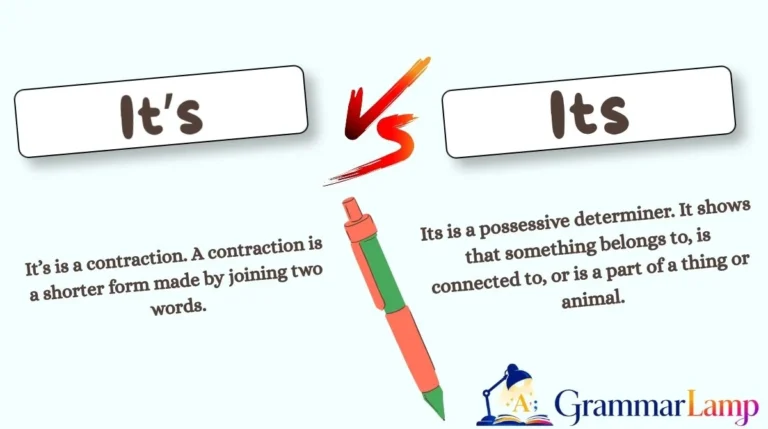
It’s is a contraction. A contraction is a shorter form made by joining two words.
In this case, it’s can mean:
- it is
- it has
The apostrophe (') is important because it shows that letters have been removed.
“It’s” = “It is”
When it’s means it is, it can describe a situation, condition, place, object, time, or event.
For example:
- It’s very hot today.
→ It is very hot today. - It’s a beautiful morning.
→ It is a beautiful morning. - It’s difficult to understand this question.
→ It is difficult to understand this question. - It’s my new phone.
→ It is my new phone. - It’s getting late.
→ It is getting late. - It’s under the table.
→ It is under the table. - It’s important to practice every day.
→ It is important to practice every day. - It’s raining outside.
→ It is raining outside.
Notice that replacing it’s with it is still gives us a correct sentence. That is one of the easiest ways to check your writing.
“It’s” = “It has”
It’s can also be short for it has, especially when has is used as an auxiliary verb in the present perfect tense.
For example:
- It’s been a long day.
→ It has been a long day. - It’s changed a lot.
→ It has changed a lot. - It’s already started.
→ It has already started.
Here, it’s does not mean possession. It means it has.
When Should You Use “It’s”?
Use it’s when you mean it is or it has.
A useful grammar check is:
If “it is” or “it has” works in the sentence, “it’s” is probably correct.
For example:
It’s cold.
→ It is cold. ✓
It’s been raining.
→ It has been raining. ✓
But:
The cat cleaned it’s paws.
→ The cat cleaned it is paws. ✗
That sentence does not make sense. We need its because the paws belong to the cat.
A Common Learner Confusion
Many learners think the apostrophe always means possession. That is not true.
An apostrophe can be used in contractions to show that letters have been left out.
For example:
- do not → don’t
- cannot → can’t
- she is → she’s
- they are → they’re
- it is → it’s
So, in it’s, the apostrophe does not show ownership. It shows that the word is a shortened form of it is or it has.
What Does “Its” Mean?
Its is a possessive determiner. It shows that something belongs to, is connected to, or is a part of a thing or animal.
For example:
The bird opened its wings.
The wings belong to the bird, so we use its.
Unlike it’s, its does not contain an apostrophe.
When Should You Use “Its”?
Use its when you want to show possession or a relationship involving it.
Here are some examples:
- The dog hurt its leg.
The leg belongs to the dog. - The company changed its logo.
The logo belongs to or is connected with the company. - The tree lost its leaves.
The leaves belong to the tree. - The car needs its engine checked.
The engine is part of the car. - The school opened its new library.
The library is connected with the school. - The cat is licking its paw.
The paw belongs to the cat. - The phone has lost its connection.
The connection is associated with the phone. - The country is proud of its culture.
The culture is associated with the country.
The Grammar Rule for “Its”
The basic pattern is:
noun + its + noun
For example:
- the dog + its + tail
- the company + its + employees
- the tree + its + branches
- the computer + its + screen
You can think of its as meaning something like “belonging to it” or “related to it.”
For example:
The dog wagged its tail.
You could understand this as:
The dog wagged the tail belonging to it.
We normally do not write the longer version. We simply use its.
Why Doesn’t “Its” Have an Apostrophe?
This is where English can feel a little strange.
Many possessive words use an apostrophe:
- the boy’s book
- Sarah’s bag
- the teacher’s desk
But possessive pronouns and possessive determiners do not always follow that pattern.
Compare:
- my
- your
- his
- her
- our
- their
- its
None of these needs an apostrophe to show possession.
That is why its is correct for possession.
Difference Between “It’s” and “Its” (Detailed)
The easiest way to understand the difference is to focus on their grammar jobs.
| Word | Meaning | Grammar use | Example |
|---|---|---|---|
| it’s | it is | Contraction | It’s cold today. |
| it’s | it has | Contraction | It’s been a busy week. |
| its | belonging to it | Possessive determiner | The dog wagged its tail. |
Usage Difference
It’s is used when you can expand it into it is or it has.
Its is used to show possession or connection.
Compare these two sentences:
It’s a small house.
Here, it’s = it is.
The house has its own garden.
Here, its shows that the garden belongs to or is connected with the house.
The words look almost identical, but their meanings are different.
Grammar Logic
Consider this sentence:
It’s broken.
Expand it:
It is broken.
The sentence makes sense, so it’s is correct.
Now consider:
The machine has lost its power.
Can we replace its with it is?
The machine has lost it is power. ✗
That does not work. The sentence needs a possessive word because the power is connected with the machine.
Sentence Structure Difference
It’s often appears before:
- an adjective: It’s easy.
- a noun phrase: It’s a problem.
- a place or situation: It’s at home.
- a verb phrase: It’s getting dark.
- a past participle: It’s been difficult.
Its normally appears before a noun:
- its name
- its color
- its owner
- its purpose
- its tail
- its price
- its meaning
This gives you another useful clue.
If a noun comes directly after the word, its may be the correct choice.
For example:
The company increased its prices.
Here, prices is a noun, and the prices belong to or are connected with the company.
Meaning Comparison
Look at these examples:
It’s beautiful.
= It is beautiful.
Its color is beautiful.
= The color belonging to it is beautiful.
Another pair:
It’s getting bigger.
= It is getting bigger.
The company is growing its business.
Here, its refers to something belonging to the company.
One small apostrophe changes the grammatical function of the word.
Grammar Rules You Must Remember
Rule 1: Use “it’s” for “it is”
If you can replace it’s with it is, use it’s.
It’s very cold today.
→ It is very cold today. ✓
It’s a good idea.
→ It is a good idea. ✓
This is the most useful test for beginners.
Rule 2: Use “it’s” for “it has”
When it’s means it has, it is also correct.
It’s been three hours.
→ It has been three hours. ✓
It’s already finished.
→ It has already finished. ✓
Be careful, though. It has does not always become it’s naturally. In some sentences, especially when has means possession, we normally keep has.
For example:
The company has a new office.
We would not normally say:
The company’s a new office.
So, think about the grammatical job of has.
Rule 3: Use “its” to show possession
When something belongs to, comes from, or is connected with it, use its.
The dog is eating its food.
The food is connected with the dog.
The phone has lost its signal.
The signal is associated with the phone.
The country is protecting its forests.
The forests belong to or are part of the country.
Rule 4: Never use “it’s” simply because you see possession
This is a very common mistake.
Some learners remember that apostrophes can show possession and then write it’s for ownership.
But it’s is not the possessive form of it.
Wrong:
The company changed it’s name. ✗
Correct:
The company changed its name. ✓
Why?
Because name belongs to or is connected with the company. We are showing possession.
A quick test confirms it:
The company changed it is name. ✗
That sounds wrong, so it’s cannot be used.
Compare to vs Compare with: Easy Grammar Guide for 2026
Apportion vs Portion vs Proportion: Meaning, Differences, and Easy Examples (2026)
Case in Point vs Case and Point: Which Is Correct? (2026)
Work Alongside You vs Work Alongside With You (2026): Which One Is Correct in English?
Common Mistakes Students Make
The biggest reason these mistakes happen is that it’s and its sound exactly the same in normal speech.
When speaking, you cannot hear the apostrophe. You have to understand the meaning from the sentence.
Mistake 1: Using “it’s” for possession
Wrong: The cat cleaned it’s paws.
Correct: The cat cleaned its paws.
Why?
The paws belong to the cat. Therefore, we need the possessive its.
Easy tip: If the word is followed by a noun that belongs to “it,” check whether its is needed.
Mistake 2: Writing “its” when you mean “it is”
Wrong: Its going to rain.
Correct: It’s going to rain.
Here, the full sentence is:
It is going to rain.
Because it is works, the contraction is it’s.
Mistake 3: Confusing “its” with plural possession
Some learners think its means “it is” because they see no apostrophe. Others think it’s must be possessive because it has an apostrophe.
Neither idea is correct.
Remember:
it’s = it is / it has
its = belonging to it
Mistake 4: Using “it’s” before a noun
Consider:
The dog moved it’s tail. ✗
The word tail is a noun. The sentence says that the tail belongs to the dog.
Correct:
The dog moved its tail. ✓
Compare:
It’s moving. ✓
= It is moving.
Its movement is fast. ✓
= The movement of it is fast.
Mistake 5: Forgetting to check the expanded sentence
When you are unsure, stop for two seconds.
Take:
I think its going to work.
Replace its with it is:
I think it is going to work.
That makes sense.
So the correct sentence is:
I think it’s going to work.
This little test can prevent many mistakes.
Easy Trick to Remember the Difference
Here is the simplest memory trick:
IT’S has an apostrophe because it is hiding letters. ITS has no apostrophe because it shows possession.
Think of it’s as a shortened sentence.
it’s → it is
The apostrophe replaces the missing space and letter arrangement in the contraction.
You can also use the “expand it” trick.
Whenever you see it’s, ask:
Can I say “it is” or “it has” here?
If yes, it’s is correct.
For example:
It’s wonderful.
→ It is wonderful. ✓
It’s been a long time.
→ It has been a long time. ✓
Now test its:
The dog lifted its head.
→ The dog lifted it is head. ✗
So its is correct.
Another useful idea is to connect its with words such as his, her, and their.
Compare:
- The boy washed his hands.
- The girl washed her hands.
- The children washed their hands.
- The dog washed its paws.
These words show possession.
You would never write he’s hands to mean “belonging to him.” In the same way, do not write it’s paws to mean “belonging to it.”
Daily Life Examples
These words appear constantly in normal conversation. Here are some examples you may hear or use every day.
1. Talking about the weather
“It’s really hot today.”
Here, it’s = it is.
You could say:
“It is really hot today.”
The meaning stays the same.
2. Talking about an animal
“The dog is playing with its ball.”
The ball belongs to the dog, so we use its.
3. Talking about a phone
“My phone is old, but its camera still works well.”
The camera is part of or connected with the phone.
4. Talking about time
“It’s almost midnight.”
This means:
“It is almost midnight.”
This is a very common use in spoken English.
5. Talking about a restaurant
“It’s a nice restaurant, and its food is excellent.”
The first it’s means it is.
The second its shows that the food is connected with the restaurant.
6. Talking about a car
“The car is beautiful, but its engine needs some work.”
The engine belongs to or is part of the car.
7. Talking about a school
“It’s a good school, and its teachers are very helpful.”
It’s = it is.
Its = belonging to the school.
8. Talking about a computer
“It’s working now, but its battery is almost empty.”
The first word means it is.
The second shows possession or connection.
9. Talking about a plan
“It’s a simple plan, but its results could be useful.”
The plan is simple.
The results are connected with the plan.
10. Talking about a new product
“It’s expensive, but its quality is very good.”
The first word means it is.
The second shows that the quality belongs to or is a feature of the product.
Practice Section
Choose it’s or its in each sentence.
1.
_____ very cold outside.
2.
The bird is sitting on _____ nest.
3.
I think _____ going to rain.
4.
The company changed _____ website.
5.
_____ been a busy week.
Try to answer without looking at the answers first.
Answers
1. It’s very cold outside.
→ It is very cold outside.
2. Its nest.
→ The nest belongs to the bird.
3. It’s going to rain.
→ It is going to rain.
4. Its website.
→ The website belongs to or is connected with the company.
5. It’s been a busy week.
→ It has been a busy week.
One More Challenge
Try this sentence:
The dog is happy because _____ owner has returned.
The answer is its.
Why?
The owner is connected with the dog.
Now try:
_____ happy because its owner has returned.
The answer is It’s.
Here, it’s = it is.
So one sentence can actually contain both forms:
It’s happy because its owner has returned.
This is a great sentence to remember because it shows the difference clearly.
In Development vs Under Development: Meaning, Differences, and Examples (2026)
Non-Restrictive Clauses: Meaning, Rules, Examples & Differences in 2026
Conform With vs Conform To (2026): What’s the Difference? Easy Grammar Guide for English Learners
Who’s vs Whose (2026): What’s the Difference? Easy Grammar Rules, Examples, and Common Mistakes
FAQs
1. What is the difference between “it’s” and “its”?
It’s is a contraction of it is or it has. Its is a possessive word that shows something belongs to or is connected with something. For example, “It’s cold” means “It is cold,” while “The dog wagged its tail” shows that the tail belongs to the dog.
2. Can we use “it’s” in questions?
Yes. It’s can appear in questions when it means it is. For example, “Is it’s” is generally not correct as a normal question structure because the auxiliary changes position. However, you can see it’s inside questions such as “Do you know if it’s ready?” Here, it’s = it is.
3. Is “it’s” formal or informal?
It’s is a normal contraction used in both everyday and many forms of written English. It is common in emails, conversations, websites, and general writing. In very formal writing, you may sometimes choose it is instead, but it’s is not grammatically incorrect.
4. Is “its” always used for animals?
No. Its can show possession for animals, objects, organizations, places, countries, and other things. For example: “The company changed its policy,” “The tree lost its leaves,” and “The machine has lost its power.”
5. Why does “its” not have an apostrophe?
Its is already the possessive form used with it, similar to his, her, and their. The apostrophe in it’s has a different purpose: it shows that it is or it has has been shortened.
6. What is an easy way to remember “it’s” vs “its”?
Try replacing it’s with it is or it has. If the sentence still makes sense, use it’s. If you are talking about something belonging to or connected with “it,” use its. For example, “It’s broken” → “It is broken,” but “The machine lost its power” shows possession.
Conclusion
The difference between it’s and its may look small, but learning it can make your English writing much clearer.
Remember the main rule:
It’s = it is or it has.
Its = belonging to it or connected with it.
When you are unsure about it’s, expand it. Try it is or it has. If the sentence works, it’s is probably the right choice.
When the word shows possession, choose its without an apostrophe.
For example:
It’s raining, and the dog is staying inside because its fur is wet.
The first it’s means it is. The second its shows that the fur belongs to the dog.
Do not worry if you make this mistake at first. Native speakers and experienced writers sometimes make it too, especially when typing quickly.
The key is to slow down and check the meaning. With a little practice, the difference will become automatic.

Liam Derren is a language writer at GrammarLamp, creating simple, helpful content about grammar, words, and everyday English. He makes language learning clear, practical, and easy to understand.
5 thoughts on “It’s vs Its: Simple Difference, Rules, Examples & Practice (2026)”