
Many English learners feel confused when they hear or read the phrases work alongside you and work alongside with you.
At first, both seem correct because they have almost the same words. Many people also hear native speakers use different sentence patterns, which makes the confusion even bigger.
The good news is that this grammar point is much easier than it looks. Once you understand how the word alongside works, you will know which expression sounds natural and which one should usually be avoided.
This topic is important because people often use these phrases in job interviews, business emails, workplace conversations, school projects, and everyday English.
If you use the wrong expression, native speakers will still understand you, but your English may sound unnatural or slightly incorrect.
By the end of this guide, you will understand the meaning of both expressions, the grammar behind them, the differences between them, common mistakes, useful memory tricks, and many real-life examples.
You will also get practice questions to test your understanding. Everything is explained in simple English so that beginners, students, and non-native speakers can learn with confidence.
What Does “Work Alongside You” Mean?
Simple Definition
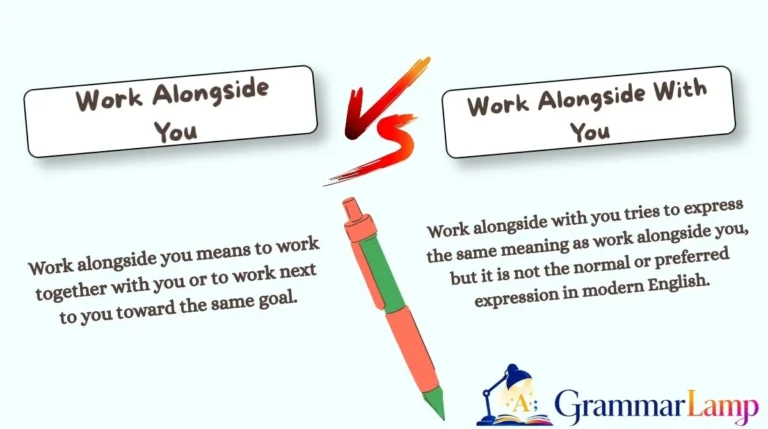
Work alongside you means to work together with you or to work next to you toward the same goal.
Here, alongside already means beside or together with. Because of this meaning, you do not need another preposition like with.
Simple Meaning
- Work together
- Cooperate
- Be on the same team
- Share the same task or workplace
When Do We Use It?
You can use work alongside you when talking about:
- Colleagues
- Classmates
- Business partners
- Volunteers
- Team members
- Professionals from different departments
It can describe physical teamwork or simply working toward the same goal.
Grammar Rule
The usual pattern is:
Subject + work + alongside + object
Examples:
- I work alongside you.
- She worked alongside her manager.
- They are working alongside doctors.
- We will work alongside local communities.
Notice that alongside is directly followed by the person or group.
Example Sentences
- I am excited to work alongside you.
- She works alongside experienced engineers.
- We worked alongside volunteers during the event.
- He wants to work alongside talented people.
- The teacher worked alongside the students.
- Our company works alongside local charities.
- I hope to work alongside you again.
- The nurses worked alongside the doctors all day.
These all sound natural and are commonly used by native English speakers.
Common Learner Confusion
Many learners think every sentence about doing something together needs with.
For example:
❌ I work alongside with you.
This happens because learners know these expressions:
- work with someone
- study with someone
- travel with someone
Since alongside already carries the meaning of with, adding another with becomes unnecessary.
What Does “Work Alongside With You” Mean?
Simple Definition
Work alongside with you tries to express the same meaning as work alongside you, but it is not the normal or preferred expression in modern English.
Most native speakers simply say:
Work alongside you.
When Is It Used?
Sometimes learners produce this phrase because they combine two correct expressions:
- work with you
- work alongside you
The result becomes:
work alongside with you
Although people may understand it, it usually sounds awkward.
Grammar Rule
Standard English does not normally place with after alongside in this situation.
Preferred structure:
✅ work alongside you
Not preferred:
❌ work alongside with you
Example Sentences
These show the preferred correction.
Wrong:
- I want to work alongside with you.
Correct:
- I want to work alongside you.
Wrong:
- She worked alongside with doctors.
Correct:
- She worked alongside doctors.
Wrong:
- We will work alongside with our clients.
Correct:
- We will work alongside our clients.
Wrong:
- They enjoy working alongside with experts.
Correct:
- They enjoy working alongside experts.
Wrong:
- He works alongside with his brother.
Correct:
- He works alongside his brother.
Wrong:
- I’d like to work alongside with you someday.
Correct:
- I’d like to work alongside you someday.
Common Learner Confusion
Students often think adding with makes the sentence stronger.
It does not.
Instead, it makes the sentence sound less natural because alongside already includes the idea of working together.
Difference Between Work Alongside You and Work Alongside With You
| Feature | Work Alongside You | Work Alongside With You |
|---|---|---|
| Natural English | ✅ Yes | ❌ Usually no |
| Common in speech | ✅ Very common | ❌ Rare |
| Preferred in writing | ✅ Yes | ❌ No |
| Grammar | Correct | Usually unnecessary |
| Sounds natural | Yes | No |
Usage Difference
Work alongside you is the standard expression.
Native speakers use it every day.
Work alongside with you is usually considered an unnecessary combination because alongside already expresses partnership.
Grammar Logic
Think about these words:
- beside
- alongside
- near
You normally say:
- sit beside me
- stand near me
- walk alongside me
You do not add with after them.
The same rule applies to work alongside you.
Sentence Structure Difference
Correct:
Subject + work + alongside + object
Example:
- We work alongside teachers.
Incorrect:
Subject + work + alongside + with + object
Example:
- We work alongside with teachers.
Meaning Comparison
Both expressions try to communicate the same idea:
- working together
- cooperating
- sharing responsibilities
However, only one follows standard English usage naturally.
Grammar Rules You Must Remember
Rule 1: Alongside already contains the idea of togetherness.
Correct:
- I work alongside my team.
Incorrect:
- I work alongside with my team.
Rule 2: Use “with” only after the verb “work.”
Correct:
- I work with you.
Also correct:
- I work alongside you.
Incorrect:
- I work alongside with you.
Rule 3: Alongside can describe physical or professional cooperation.
Example:
- Police worked alongside firefighters.
Example:
- Scientists worked alongside universities.
Rule 4: Keep the sentence simple.
Simple English often sounds more natural.
Instead of:
- I hope to work alongside with you.
Say:
- I hope to work alongside you.
Common Mistakes Students Make
Mistake 1: Adding Extra Words
Wrong:
- We work alongside with our manager.
Correct:
- We work alongside our manager.
Tip:
If you already use alongside, stop there.
Mistake 2: Mixing Two Correct Expressions
Students combine:
- work with you
- work alongside you
This creates:
❌ work alongside with you
Choose only one.
Mistake 3: Thinking Longer Means Better
Some learners believe extra words make English sound more advanced.
Actually, native speakers usually prefer shorter, cleaner sentences.
Mistake 4: Copying Incorrect English
Sometimes social media, blogs, or non-native speakers use incorrect grammar.
Always check reliable English sources or dictionaries.
Easy Trick to Remember the Difference
Imagine two friends walking together.
The word alongside already shows they are side by side.
Now imagine adding another person called with.
Nothing changes because they were already together.
So remember this simple sentence:
Alongside already brings “with” inside its meaning.
If you can remember that idea, you will almost never make this mistake again.
Another easy trick is this:
Think of these pairs.
Correct:
- beside me
- alongside me
- near me
Not:
- beside with me
- alongside with me
- near with me
The same grammar pattern applies every time.
Daily Life Examples
These examples sound natural in everyday English.
- I look forward to working alongside you.
- She works alongside her best friend.
- Our company works alongside local schools.
- We worked alongside each other for five years.
- I’d love to work alongside your team.
- He enjoys working alongside experienced designers.
- The volunteers worked alongside the rescue workers.
- We are proud to work alongside talented people.
- Students worked alongside their teacher during the science project.
- Our engineers work alongside international experts.
These are the kinds of sentences you may hear in offices, schools, interviews, and workplaces.
Practice Section
Choose the correct answer.
1.
I hope to work ________ you one day.
A. alongside
B. alongside with
2.
She worked ________ experienced nurses.
A. alongside
B. alongside with
3.
We enjoy working ________ our clients.
A. alongside
B. alongside with
4.
The students worked ________ their teacher.
A. alongside
B. alongside with
5.
Our company works ________ local businesses.
A. alongside
B. alongside with
Answers
- A
- A
- A
- A
- A
If you answered all five correctly, you have understood the rule well.
FAQs
What is the difference between work alongside you and work alongside with you?
Work alongside you is the natural and standard English expression. Work alongside with you is generally considered unnecessary because alongside already includes the meaning of working together.
Is “work alongside with you” grammatically wrong?
Many grammar experts consider it non-standard or awkward. Native speakers almost always prefer work alongside you.
Can I say “work with you” instead?
Yes. Work with you is completely correct. It is one of the most common ways to express cooperation.
Which expression sounds more professional?
Work alongside you sounds professional, natural, and suitable for business emails, interviews, and workplace communication.
Can I use “work alongside you” in formal writing?
Yes. It is widely accepted in formal reports, business communication, academic writing, and professional conversations.
Why do some people say “work alongside with you”?
Usually because they mix two correct phrases:
- work with you
- work alongside you
The combination sounds understandable but is not the preferred form in standard English.
Conclusion
The difference between work alongside you and work alongside with you is actually very simple once you understand the role of the word alongside.
Since alongside already means beside or together with, adding another with is usually unnecessary.
That is why native English speakers naturally say work alongside you instead of work alongside with you.
Remember that good English is not about using more words. It is about choosing the right words. Keeping your sentences simple often makes your English sound more fluent and confident.
Whenever you write an email, attend a job interview, speak with coworkers, or complete a class project, try using work alongside you.
Read authentic English books, listen to native speakers, and practice writing your own examples.
The more you see the correct pattern, the more natural it will become. Small grammar improvements like this can make a big difference in your spoken and written English.

Liam Derren is a language writer at GrammarLamp, creating simple, helpful content about grammar, words, and everyday English. He makes language learning clear, practical, and easy to understand.