
English has many words that look almost the same but are used in slightly different ways. Sometimes, even people who speak English every day are unsure which word is correct. Themselves vs themself is one such confusing pair.
Both words are reflexive pronouns. They are connected to the pronoun “they,” and both can refer to a person or people who perform an action and receive that same action. However, there is an important difference between their usual uses.
Themselves is the traditional and widely used reflexive pronoun for more than one person. For example, “The children made the sandwiches themselves.” Here, the word refers to several children.
Themself, on the other hand, is a singular reflexive pronoun. It is often used when “they” refers to one person rather than a group. For example, “Every student should believe in themself.” In this sentence, the word refers to each individual student.
This difference matters in everyday conversations, school assignments, emails, and professional writing. Choosing the right form can make your sentences clearer and more natural.
Another reason learners feel confused is that English now commonly uses singular “they” when talking about one person. This means that the correct reflexive form can depend on whether “they” refers to one individual or several people.
Understanding these two words will help you use singular and plural pronouns more confidently and avoid common grammar mistakes.
More Useful posts
Glueing vs Gluing: Which Spelling Is Correct in 2026?
Phenomenon vs Phenomena: What Is the Difference? (2026)
Nobody vs No One: What’s the Difference? A Simple 2026 Grammar Guide
Tinder vs Tender: Meaning, Difference, Examples, and Grammar Rules in 2026
What Does “Themselves” Mean?
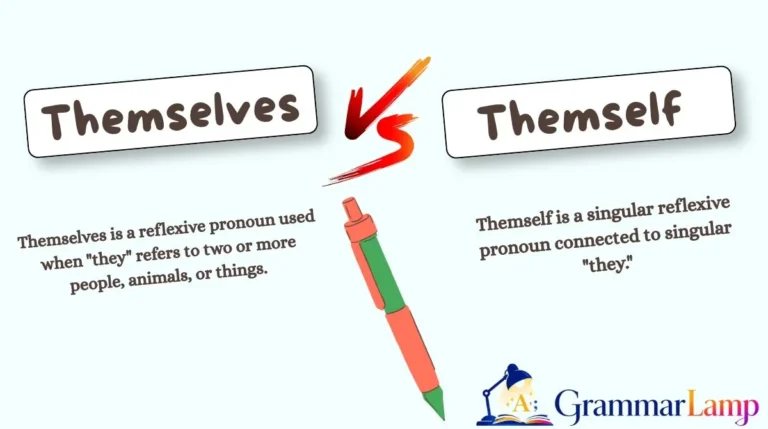
Themselves is a reflexive pronoun used when “they” refers to two or more people, animals, or things. It shows that the people or things performing an action are also receiving that action.
In simple words, when a group does something to itself, we can use “themselves.”
For example:
“The players prepared themselves for the match.”
This sentence means that the players prepared their own minds and bodies before the match. The people doing the preparation and receiving its effect are the same people.
The word can also be used to add emphasis. In that case, it shows that people did something without help from someone else.
For example:
“The students completed the project themselves.”
This means the students completed the project without anyone else doing the work for them.
When Should You Use Themselves?
You should normally use this word when the subject is plural and the pronoun “they” refers to more than one person.
It is common in conversations, stories, instructions, and formal writing.
Here are some situations where you can use it:
1. When people perform an action on themselves
- The children dressed themselves before breakfast.
- The players introduced themselves to the new coach.
2. When a group does something without help
- The workers repaired the machine themselves.
- The students organized the school event themselves.
3. When talking about people’s feelings or behavior
- They were proud of themselves after winning the competition.
- The friends enjoyed themselves at the party.
4. When adding emphasis
- The teachers themselves attended the meeting.
- The managers themselves checked the final report.
Grammar Rule for Themselves
The basic grammar pattern is:
Plural subject + themselves + verb or sentence ending
For example:
- They taught themselves how to cook.
- The boys blamed themselves for the mistake.
- The women introduced themselves to the guests.
You can also place the word after a verb or preposition:
- They looked after themselves.
- The children were talking among themselves.
- The players bought new shoes for themselves.
Remember that “themselves” is usually connected to a plural subject. It is the standard choice when “they” clearly refers to several people.
8 Example Sentences with Themselves
- The children made breakfast themselves.
- They enjoyed themselves during the school trip.
- The players prepared themselves for the final match.
- My friends introduced themselves to my family.
- The workers completed the task themselves.
- The students taught themselves English through online lessons.
- They should take care of themselves during the journey.
- The team members congratulated themselves after the victory.
Common Learner Confusion
Many learners think “themselves” can only refer to a group. This is generally its traditional use, but modern English also uses “themselves” with singular “they.”
For example:
“Someone left their phone. I hope they find themselves a way to contact us.”
The word “they” refers to one person whose identity is unknown. In this kind of sentence, “themselves” is an accepted form in standard English.
Therefore, do not assume that “themselves” is always plural. Look at the meaning of the sentence and the style you are following.
What Does “Themself” Mean?
Themself is a singular reflexive pronoun connected to singular “they.”
It is used when “they” refers to one person rather than a group. It is especially useful when the person’s gender is unknown, when their identity is not important, or when an individual uses “they” as their personal pronoun.
In simple words, use “themself” when you are talking about one person who is referred to as “they.”
For example:
“Alex wants to challenge themself.”
Here, Alex is one person. The word “themself” refers back to Alex.
Another example is:
“Every person should give themself enough time to learn.”
The sentence talks about each person individually, not a group acting together.
When Should You Use Themself?
This word is useful in modern English, especially when a singular person is represented by the pronoun “they.”
Here are some common situations.
1. When talking about one person whose gender is unknown
- Someone should remind themself to bring the documents.
- If a visitor forgets their password, they can reset it themself.
2. When someone uses they/them pronouns
- Jordan is proud of themself.
- Sam taught themself how to play the guitar.
3. When referring to each person individually
- Every student should prepare themself for the examination.
- Each person must decide for themself.
4. When emphasizing personal responsibility
- A person must learn to trust themself.
- Everyone should believe in themself.
Grammar Rule for Themself
The basic pattern is:
Singular they + themself
For example:
- They reminded themself to call the doctor.
- They bought themself a new laptop.
- They wanted to improve themself.
- They prepared themself for the interview.
Although “they” usually refers to more than one person, English also uses it for one person. This is called singular “they.”
When singular “they” refers to one person, “themself” can make the singular meaning especially clear.
It is worth remembering that “themself” is accepted in modern English, but not every teacher, editor, or style guide prefers it. Some traditional writing guides recommend “themselves” even when “they” refers to one person.
8 Example Sentences with Themself
- Alex taught themself how to use a computer.
- Every student should believe in themself.
- Someone should ask themself whether the decision is fair.
- Jordan prepared themself for the interview.
- Each person must make the choice for themself.
- The child wanted to dress themself without help.
- If a customer needs assistance, they can introduce themself to a staff member.
- Sam reminded themself to finish the homework.
Common Learner Confusion
The biggest confusion is that “themself” may look like a spelling mistake because the familiar word is “themselves.”
However, it is not simply a typing error. It is a recognized singular reflexive form used in modern English.
For example:
“Everyone should take care of themself.”
This sentence focuses on each person as an individual.
Some writers would instead write:
“Everyone should take care of themselves.”
That version is also widely accepted. The choice often depends on the writer’s preferred style and whether they want to emphasize the singular meaning.
Difference Between Themselves and Themself (Detailed)
The main difference is the number of people being referred to.
Themselves is traditionally used for plural subjects, while themself is used for singular “they” when it refers to one person.
Both words are reflexive pronouns, but they do not always fit the same sentence equally well.
Comparison Table
| Point | Themselves | Themself |
|---|---|---|
| Main use | Usually plural | Singular |
| Pronoun connection | They (plural) | They (singular) |
| Meaning | Those people or things | One individual |
| Grammar type | Reflexive pronoun | Reflexive pronoun |
| Common use | Traditional and modern English | Modern English |
| Formal writing | Widely accepted | Depends on style guide |
| Example | They helped themselves. | They helped themself. |
| Number | Usually more than one | One person |
1. Difference in Usage
The most important difference is how many people the word represents.
Consider these two sentences:
Sentence A: The boys introduced themselves to the teacher.
Sentence B: Jordan introduced themself to the teacher.
In Sentence A, the subject is “the boys.” It refers to several people, so “themselves” is the natural choice.
In Sentence B, Jordan is one person. If Jordan uses they/them pronouns, “themself” is a suitable singular reflexive form.
The difference becomes easier when you look at the subject instead of only looking at the reflexive pronoun.
2. Difference in Grammar Logic
English has different reflexive pronouns for different subjects.
For example:
- I → myself
- You → yourself
- He → himself
- She → herself
- We → ourselves
- They (plural) → themselves
- They (singular) → themself or themselves
Notice that singular “they” has two commonly encountered reflexive forms.
“Themself” clearly matches one individual, while “themselves” remains a widely accepted option, including with singular “they.”
For example:
“Every employee should introduce themself.”
This focuses on each employee separately.
“Every employee should introduce themselves.”
This is also common and follows the traditional preference for “themselves” with singular “they.”
Both forms can be correct, depending on the style being followed.
3. Difference in Sentence Structure
Both words usually appear after a verb or preposition when they refer back to the subject.
However, the subject determines which form is more suitable.
Using themselves:
- They prepared themselves for the exam.
- The girls enjoyed themselves at the festival.
- The workers organized themselves into groups.
Using themself:
- Taylor prepared themself for the exam.
- Alex enjoyed themself at the festival.
- Each worker organized themself into a group.
The first set uses plural subjects or a plural-style reference. The second set uses singular references.
4. Difference in Meaning
The words do not have completely different dictionary meanings. Both point back to the person or people mentioned earlier.
The difference is mainly about number.
For example:
“The children looked after themselves.”
This means several children looked after their own needs.
“Each child looked after themself.”
This means every child looked after their own needs individually.
Notice how “each” changes the focus. It talks about one child at a time, even though the sentence may refer to many children in total.
5. Which One Sounds More Natural?
In everyday English, “themselves” is more familiar and widely used.
If you are talking about several people, it is clearly the natural choice.
If you are talking about one person who uses singular “they,” “themself” can sound more precise because it makes the singular meaning clear.
For example:
“Riley taught themself to swim.”
This is a natural sentence when Riley uses they/them pronouns.
However, if you are writing for a school, workplace, or publication, it is sensible to follow its style guide. Some organizations prefer “themselves” in all singular-they situations.
Explore More Posts
Prophecy vs Prophesy: Meaning, Difference, Examples, and Grammar Rules in 2026
Made It Home Safe vs Made It Home Safely: Which Is Correct in 2026?
Ax vs Axe: Which Spelling Is Correct in 2026?
Married To vs Married With 2026: Which One Is Correct?
Grammar Rules You Must Remember
Understanding a few simple grammar rules will make it much easier to choose the correct word. You do not need to memorize complicated grammar terms. Just pay attention to the subject and the meaning of the sentence.
Rule 1: Use Themselves for More Than One Person
When “they” refers to two or more people, use “themselves.”
Examples:
- They completed the assignment themselves.
- The children cleaned themselves after playing.
- The players congratulated themselves.
Remember: A plural subject normally takes “themselves” as its reflexive pronoun.
Rule 2: Use Themself for One Person Referred to as They
When singular “they” refers to one person, “themself” is a suitable choice.
Examples:
- Alex taught themself English.
- Jordan prepared themself for the meeting.
- Sam wanted to improve themself.
Remember: One person can be referred to by “they,” and “themself” can show that the person is singular.
Rule 3: The Reflexive Pronoun Must Match Its Meaning
A reflexive pronoun normally refers back to the subject of the sentence.
For example:
- The children blamed themselves.
- Each child blamed themself.
The first sentence refers to children as a group. The second sentence focuses on each child individually.
Do not choose a reflexive pronoun simply because it sounds familiar. Check who is performing the action.
Rule 4: Follow the Required Writing Style
Different dictionaries and style guides may have different preferences for singular “they.”
Some accept both “themself” and “themselves” when talking about one person. Others prefer “themselves” as the standard form.
For example:
- Every student should prepare themself.
- Every student should prepare themselves.
Both forms appear in modern English. If your school or workplace has a writing guide, follow its recommendation.
Common Mistakes Students Make
Many English learners make mistakes with these words because they learn that “they” always means more than one person.
However, modern English also uses “they” for a single person. This creates some confusion when choosing the correct reflexive pronoun.
Here are some common mistakes and simple ways to correct them.
Mistake 1: Using Themself for a Group
Incorrect: The children enjoyed themself at the party.
Correct: The children enjoyed themselves at the party.
Why?
The subject “children” refers to several people. Therefore, the plural reflexive form is needed.
Easy tip: When the subject is clearly a group, use “themselves.”
Mistake 2: Thinking Themself Is Always Wrong
Incorrect idea: “Themself” is never correct English.
Correct understanding: “Themself” is a recognized singular reflexive pronoun.
Example:
“Jordan taught themself to drive.”
Why?
Jordan is one person, and singular “they” is being used. Therefore, “themself” is appropriate.
Easy tip: Do not treat every unfamiliar word as a spelling mistake. English changes over time, and some newer forms become accepted.
Mistake 3: Ignoring the Meaning of Each
Incorrect: Each student should introduce themselves if the writer specifically wants a singular form.
More precise: Each student should introduce themself.
Why?
“Each student” focuses on one student at a time. “Themself” clearly expresses that individual meaning.
However, the original sentence with “themselves” is also widely used and accepted in many styles.
Easy tip: Remember that “each” focuses on individuals, not the group as a whole.
Mistake 4: Using Themselves Only Because It Looks Familiar
Less precise: Taylor wanted to challenge themselves.
Singular-focused: Taylor wanted to challenge themself.
Why?
If Taylor uses they/them pronouns and the writer wants to emphasize one individual, “themself” is a clear option.
The first sentence is also accepted by many writers and style guides.
Easy tip: Check the person’s pronouns and your preferred writing style.
Mistake 5: Confusing Reflexive Pronouns with Personal Pronouns
Incorrect: The teacher gave the homework to themself students.
Correct: The teacher gave the homework to themselves.
Or, when referring to one teacher who uses singular they:
“The teacher gave the homework to themself.”
Why?
Reflexive pronouns are not used like ordinary describing words before a noun. They refer back to a person or people already mentioned.
Easy tip: Use these words to refer back to a subject, not to describe a noun directly.
Easy Trick to Remember the Difference
A simple memory trick can help you choose the right word without thinking too much about grammar.
Remember this:
Themself = One individual.
Themselves = Usually a group.
Think about a classroom with ten students.
If you say:
“The students prepared themselves for the test.”
You are talking about all the students together.
But if you say:
“Each student prepared themself for the test.”
You are focusing on one student at a time.
Another easy trick is to look for words such as “each,” “every person,” “someone,” and an individual’s name.
These expressions often point to one person, even when the sentence talks about a larger group.
For example:
- Everyone should respect themself.
- Each person should trust themself.
- Alex should believe in themself.
Now look for words such as “children,” “players,” “workers,” and “friends.” These usually refer to more than one person.
For example:
- The players enjoyed themselves.
- The children dressed themselves.
- The friends helped themselves.
One final point is worth remembering: “themselves” is also accepted with singular “they.” Therefore, this trick helps you understand the difference, but it does not mean that every sentence has only one possible correct form.
Daily Life Examples (Themselves vs Themself)
The best way to learn confusing grammar is to see how people use it in normal situations.
Here are ten simple examples from everyday life.
1. At School
Sentence: The students prepared themselves for the English examination.
Meaning: Several students studied and got ready for the examination.
2. Talking About a Friend
Sentence: Jordan bought themself a new mobile phone.
Meaning: Jordan bought a phone for their own use. Jordan is one person.
3. At a Birthday Party
Sentence: The children enjoyed themselves at the birthday party.
Meaning: All the children had a good time.
4. In the Workplace
Sentence: Every employee should remind themself about the meeting.
Meaning: Each employee should remember the meeting individually.
5. During a Sports Match
Sentence: The players encouraged themselves before the final match.
Meaning: The players gave each other and themselves confidence.
6. Learning a New Skill
Sentence: Sam taught themself how to edit videos on a laptop.
Meaning: Sam learned video editing without needing someone to teach them.
7. Talking About Personal Care
Sentence: People should take care of themselves.
Meaning: People should look after their own health and needs.
8. Giving Advice
Sentence: Everyone should believe in themself.
Meaning: Every individual should have confidence in their own abilities.
9. Meeting New People
Sentence: The guests introduced themselves when they entered the room.
Meaning: Several guests told others who they were.
10. Making a Personal Decision
Sentence: Each person must decide for themself.
Meaning: Every individual should make their own decision.
These examples show that the choice depends on the number and meaning of the people being discussed. Reading sentences aloud and making your own examples can help you remember the difference.
Practice Section: Test Your Understanding
Now it is time to check what you have learned. Read each sentence carefully and choose the correct option.
Remember that some sentences may allow more than one accepted form in modern English. These questions focus on the clearest choice for the intended meaning.
Choose the Correct Answer
1. The children enjoyed ______ at the park.
a) themself
b) themselves
2. Jordan taught ______ how to play the guitar.
a) themself
b) themselves
3. The players prepared ______ for the final match.
a) themself
b) themselves
4. Each student should ask ______ whether the answer is correct.
a) themself
b) themselves
5. Sam bought ______ a new laptop.
a) themself
b) themselves
Answers and Explanations
1. Answer: b) themselves
“Children” refers to more than one person, so “themselves” is the natural choice.
2. Answer: a) themself
Jordan is one person, and singular “they” is being used.
3. Answer: b) themselves
“Players” is a plural noun, so “themselves” is correct.
4. Answer: a) themself
“Each student” focuses on one student individually, making “themself” a precise choice.
5. Answer: a) themself
Sam is one person. If Sam uses they/them pronouns, “themself” is suitable.
If you answered all five correctly, you have understood the basic difference. If you made a mistake, read the grammar rules again and try writing a few sentences of your own.
More Helpful posts
Seel vs Seal: Meaning, Difference, and Correct Usage in 2026
Lies Ahead vs Lays Ahead: Which Is Correct? (2026 Guide)
Grisly vs Grizzly: Meaning, Difference, and Examples You Need in 2026
Emaculate vs Immaculate 2026: Which Spelling Is Correct?
FAQs
1. What Is the Main Difference Between Themselves and Themself?
The main difference is the number of people being referred to. “Themselves” is traditionally used for more than one person, while “themself” is used when singular “they” refers to one individual. Both are reflexive pronouns, and both can appear in modern English with singular “they,” depending on the writing style.
2. Is Themself a Real Word?
Yes, “themself” is a recognized English word. It is a singular reflexive pronoun connected to singular “they.” It is used when talking about one person who is referred to as “they.” Although some traditional style guides prefer “themselves,” “themself” is not simply a spelling mistake.
3. Can I Use Themself in Formal Writing?
Yes, you can use “themself” in formal writing when it fits the meaning and follows the required style guide. It is particularly useful when referring to one person who uses they/them pronouns. However, some publishers and schools prefer “themselves” for singular “they.” Always check the writing rules of your organization.
4. Is Themselves Correct for One Person?
Yes. “Themselves” is widely accepted when singular “they” refers to one person. For example, “Every student should prepare themselves for the exam.” This form is especially common in traditional writing. However, “themself” is another accepted option when the writer wants to make the singular meaning clear.
5. Should I Use Themself or Themselves After Everyone?
Both forms are used after “everyone.” For example, “Everyone should take care of themself” and “Everyone should take care of themselves” are both found in modern English. “Themself” highlights each individual, while “themselves” follows a widely established traditional convention.
6. Is Themself Singular or Plural?
“Themself” is singular. It refers to one person who is represented by the pronoun “they.” In contrast, “themselves” is traditionally plural, although it is also widely used with singular “they.” Understanding this difference will help you write clearer sentences.
Conclusion
Understanding themselves vs themself becomes much easier when you pay attention to the person or people being discussed.
“Themselves” is the traditional reflexive pronoun for plural subjects. For example, “The children prepared themselves for school.” It is also widely accepted when singular “they” refers to one person.
“Themself” is a singular reflexive pronoun used when “they” refers to one individual. For example, “Alex prepared themself for school.”
Both forms have a place in modern English. The best choice depends on the meaning, the context, and the writing style you are following.
If you are learning English, start by remembering that “themself” usually highlights one individual, while “themselves” is the familiar choice for a group.
Try using both words in your own sentences, read English regularly, and pay attention to how other writers use singular “they.”
With a little practice, choosing between these two words will become much easier. Keep learning, keep practicing, and do not be afraid of making small grammar mistakes along the way.

Liam Derren is a language writer at GrammarLamp, creating simple, helpful content about grammar, words, and everyday English. He makes language learning clear, practical, and easy to understand.