
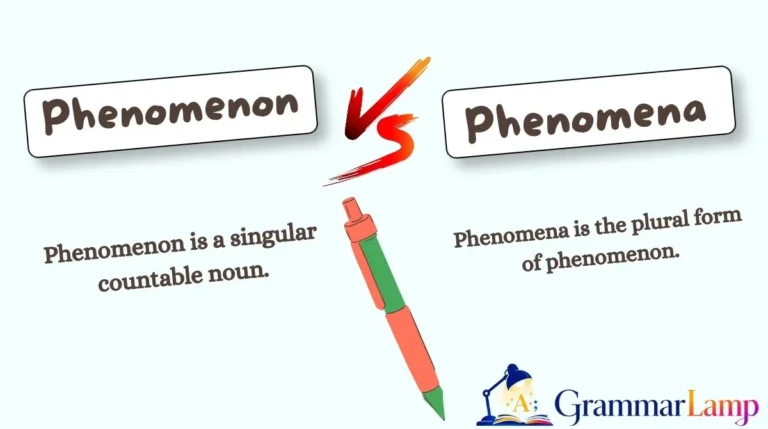
Many English learners see the words phenomenon and phenomena and wonder why they look so different.
Both words talk about things that happen or things that can be observed, but they are not used in the same way. The main reason for the confusion is simple: phenomenon is singular, while phenomena is plural.
For example, you can say, “This is a strange phenomenon,” when you are talking about one event or one unusual thing.
But when you are talking about several events or effects, you say, “These are strange phenomena.”
This small difference matters because it changes the words around them too. A singular noun usually needs a singular verb, while a plural noun needs a plural verb.
That is why we say, “The phenomenon is difficult to explain,” but “These phenomena are difficult to explain.”
Both words are common in science, education, news, history, psychology, and everyday discussions. You may hear them when people talk about weather, social trends, technology, human behavior, or unusual events.
Dictionaries such as Oxford and Cambridge list phenomena as the plural of phenomenon.
Once you understand the singular and plural pattern, the difference becomes much easier.
Explore More Posts
Honor or Honour: What Is the Difference? A Simple Guide for 2026
Collaborate vs Corroborate: Meaning, Difference, and Examples in 2026
Sleeve vs Sleave: Which Is Correct? Meaning, Difference, and Examples in 2026
Time off vs time-off: The Complete Grammar Guide for 2026
What Does “Phenomenon” Mean?
Phenomenon is a singular countable noun. It means something that exists, happens, or can be observed, especially something unusual, interesting, or worth noticing.
Cambridge defines it as something that exists and can be seen, felt, tasted, or experienced, especially when it is unusual or interesting. Oxford similarly uses it for a fact or event in nature or society, especially one that is not fully understood.
In simple English, think of phenomenon as meaning one noticeable event, fact, effect, or situation.
When should you use “phenomenon”?
Use phenomenon when you are talking about one thing.
You can place words such as a, one, this, that, or another before it:
- a phenomenon
- one phenomenon
- this phenomenon
- that phenomenon
- another phenomenon
Because it is singular, the verb used with it is normally singular as well.
Grammar rule for “phenomenon”
The basic pattern is:
one / a + phenomenon + singular verb
For example:
This phenomenon is difficult to explain.
Here, “phenomenon” refers to one thing, so we use is, not are.
Examples of “phenomenon”
- Gravity is a natural phenomenon.
- This strange phenomenon happens every winter.
- Scientists are studying the phenomenon carefully.
- Social media has created a new cultural phenomenon.
- The bright lights were a rare weather phenomenon.
- Road rage is not a new phenomenon.
- The teacher explained this phenomenon to the students.
- Nobody could explain the strange phenomenon.
Notice that each sentence refers to one thing. That is why phenomenon is correct.
A useful meaning beyond science
You may think that “phenomenon” is only a science word. That is not true.
The word can also describe a person or thing that is extremely successful, unusual, or impressive. For example:
That young singer is a phenomenon.
Here, the speaker is describing one person as unusually successful or remarkable. Cambridge and Oxford both recognize this use.
Common confusion with “phenomenon”
A common mistake is treating phenomenon as plural simply because it sounds formal.
For example, a learner may write:
Wrong: These phenomenon are difficult to explain.
The problem is that these is plural, but phenomenon is singular.
The correct sentence is:
Correct: These phenomena are difficult to explain.
Another common mistake is forgetting the article when talking about one phenomenon:
Wrong: This is strange phenomenon.
Correct: This is a strange phenomenon.
Since phenomenon is a singular countable noun, a or another suitable determiner is normally needed.
What Does “Phenomena” Mean?
Phenomena is the plural form of phenomenon.
When you are talking about two or more noticeable events, facts, effects, or situations, you use phenomena.
Cambridge directly lists phenomena as the plural of phenomenon, while Oxford gives the same plural form.
In simple English:
phenomenon = one
phenomena = more than one
When should you use “phenomena”?
Use phenomena when you are talking about several things.
Common words used with it include:
- these phenomena
- those phenomena
- many phenomena
- several phenomena
- various phenomena
- natural phenomena
- social phenomena
- scientific phenomena
Because phenomena is plural, it normally takes a plural verb.
Grammar rule for “phenomena”
The basic pattern is:
many / these / several + phenomena + plural verb
For example:
These phenomena are fascinating.
Not:
These phenomena is fascinating.
The noun is plural, so are is correct.
Examples of “phenomena”
- Scientists study natural phenomena.
- These phenomena are common in tropical regions.
- The researchers observed several unusual phenomena.
- Social phenomena can change over time.
- Students learned about different physical phenomena.
- Many weather phenomena are difficult to predict.
- These strange phenomena attracted public attention.
- Researchers are trying to understand psychological phenomena.
Here, each sentence talks about more than one event, effect, or observable situation.
Why does “phenomena” look unusual?
English normally forms plurals by adding -s or -es, such as:
- book → books
- class → classes
- car → cars
But phenomenon comes from Greek through Latin and other historical stages of English. The plural form phenomena keeps an older plural pattern. Oxford gives its word history and identifies the word as coming through Late Latin from Greek.
This is why learners also see similar pairs such as:
- phenomenon → phenomena
- criterion → criteria
- datum → data
- bacterium → bacteria
You do not need to memorize the history of the word to use it correctly. Just remember the form.
Difference Between Phenomenon and Phenomena (Detailed)
The central difference is the number of things you are talking about.
| Word | Number | Basic meaning | Example |
|---|---|---|---|
| Phenomenon | Singular | One noticeable event, fact, effect, or situation | This is a strange phenomenon. |
| Phenomena | Plural | More than one noticeable event, fact, effect, or situation | These are strange phenomena. |
1. Singular vs plural
The easiest way to understand the pair is:
Phenomenon = one
Phenomena = two or more
Compare these sentences:
One phenomenon is being studied.
Several phenomena are being studied.
The noun changes because the number changes.
2. The determiner changes
With singular phenomenon, you can use:
a phenomenon
this phenomenon
that phenomenon
With plural phenomena, you can use:
these phenomena
those phenomena
many phenomena
For example:
This phenomenon is unusual.
These phenomena are unusual.
The words this and these also help you remember the difference.
3. The verb changes
This is one of the most important grammar points.
Singular:
The phenomenon is interesting.
Plural:
The phenomena are interesting.
Singular:
This phenomenon occurs naturally.
Plural:
These phenomena occur naturally.
The noun controls the verb.
4. Meaning remains closely related
The meaning does not completely change. The main change is quantity.
Phenomenon refers to one observed thing.
Phenomena refers to multiple observed things.
For example:
Lightning is a fascinating phenomenon.
This talks about lightning as one type of observed natural event.
But:
Lightning, storms, and hurricanes are natural phenomena.
Now there are several types of natural events, so the plural form is needed.
5. Sentence structure is different
Common singular structures include:
a + adjective + phenomenon
Example:
It is a remarkable phenomenon.
Another common pattern is:
the phenomenon + singular verb
Example:
The phenomenon occurs every year.
For plural usage, common structures include:
adjective + phenomena
Example:
Natural phenomena can be dangerous.
And:
these/those/many + phenomena + plural verb
Example:
These phenomena are still poorly understood.
More Useful posts
I’m vs I Am: Complete Difference, Rules, Examples & Usage Guide 2026
Sun vs Son: Meaning, Difference, Rules, and Examples (2026)
A Majority of vs The Majority of: Easy Grammar Guide for 2026
Tomatoes or Tomatos: Which Spelling Is Correct? [2026]
Grammar Rules You Must Remember
Rule 1: Use “phenomenon” for one
When you are talking about one event, effect, fact, or unusual thing, use phenomenon.
Example:
A solar eclipse is a fascinating phenomenon.
There is one phenomenon being discussed, so the singular form is correct.
Rule 2: Use “phenomena” for more than one
When you are talking about multiple events or effects, use phenomena.
Example:
Solar eclipses and lunar eclipses are interesting phenomena.
There are multiple types of events, so phenomena is correct.
Rule 3: Match the verb with the noun
Use a singular verb with phenomenon and a plural verb with phenomena.
Example:
The phenomenon is common.
These phenomena are common.
This rule is especially important in formal writing, school assignments, research papers, and exams.
Rule 4: Watch the words before the noun
Words like a, this, that usually point to one phenomenon.
Words like these, those, many, several, various usually point to phenomena.
Compare:
This phenomenon is difficult to explain.
These phenomena are difficult to explain.
A simple clue from the word before the noun can often help you choose the correct form.
Common Mistakes Students Make
The confusion usually happens because English learners expect every plural noun to end in -s. That works for many English words, but not for every word.
Mistake 1: Using “phenomenons” for the normal plural
A learner may write:
Wrong: Scientists are studying several phenomenons.
For the usual meaning of observable events or facts, the standard plural is:
Correct: Scientists are studying several phenomena.
Cambridge and Oxford list phenomena as the plural of phenomenon.
There is a special point worth knowing, though. Oxford and Cambridge also record phenomenons in North American English for the sense of a particularly successful or impressive person or thing.
So a learner should not think that “phenomenons” can never appear. It has a limited use. For normal scientific, natural, social, or observable events, phenomena is the form you should learn.
Mistake 2: Using “phenomena” with a singular verb
Wrong: These phenomena is unusual.
Correct: These phenomena are unusual.
Because phenomena is plural, use are, were, have, and other plural forms when grammar requires them.
Mistake 3: Using “phenomenon” after “many”
Wrong: Many phenomenon affect society.
Correct: Many phenomena affect society.
“Many” refers to more than one, so a plural noun is required.
Mistake 4: Forgetting “a”
Wrong: It is unusual phenomenon.
Correct: It is an unusual phenomenon.
The noun itself is singular and countable. Also notice an, not a, because unusual begins with a vowel sound.
Mistake 5: Thinking “phenomena” is a different kind of word
Some students memorize the two forms separately and forget that they belong to the same word family.
Think of them as one pair:
phenomenon → phenomena
The relationship is the same as:
criterion → criteria
You are simply changing the number.
Easy Trick to Remember the Difference
Here is a very simple memory trick:
ONE = PHENOMENON
MORE = PHENOMENA
Look at these:
One phenomenon
Two phenomena
Many phenomena
You can also connect the ending -a in phenomena with the idea of a group or collection. It is not a formal grammar rule, but it can be a useful memory aid.
Another easy trick is to remember the matching verbs:
Phenomenon → is
Phenomena → are
So when you are unsure, check the sentence:
This phenomenon is…
or
These phenomena are…
If the sentence uses this, you probably need phenomenon.
If it uses these, you probably need phenomena.
Imagine a classroom experiment. Your teacher shows you one strange reaction.
You say:
“This phenomenon is interesting.”
Then the teacher shows you five different reactions.
You say:
“These phenomena are interesting.”
That little mental picture can make the difference much easier to remember.
Daily Life Examples
These words may sound academic, but they are useful in many normal conversations.
Example 1: Talking about weather
A: Why does the sky look so strange?
B: It may be a rare weather phenomenon.
Here, only one unusual weather event is being discussed.
Example 2: Talking about several weather events
A: What are these storms called?
B: They are different weather phenomena.
More than one event is being discussed, so phenomena is correct.
Example 3: Talking about social media
A: Why are short videos so popular?
B: It has become a huge social phenomenon.
The speaker is treating the trend as one broad development.
Example 4: Talking about several social trends
A: What are the researchers studying?
B: They are studying modern social phenomena.
The researchers are examining several social events or patterns.
Example 5: In a classroom
Teacher: What did you observe?
Student: We observed an unusual phenomenon during the experiment.
The student observed one unusual event.
Example 6: Talking about science
Scientist: This phenomenon occurs naturally.
Only one process or event is being discussed.
Example 7: Talking about human behavior
A: Why do people behave this way online?
B: It is an interesting psychological phenomenon.
Again, one behavior or pattern is being discussed.
Example 8: Talking about multiple behaviors
A: What does the study cover?
B: It covers several psychological phenomena.
The study discusses multiple patterns, so the plural form is needed.
Example 9: Talking about a famous person
A: Did you hear that singer’s first album?
B: Yes. She is a real phenomenon.
Here, the word describes someone unusually successful or impressive.
Example 10: Talking about several unusual things
A: What did you see at the science museum?
B: We saw several fascinating natural phenomena.
The plural noun is correct because several things were observed.
Practice Section
Choose the correct word: phenomenon or phenomena.
1. This is a strange ______.
a) phenomenon
b) phenomena
2. These natural ______ can be dangerous.
a) phenomenon
b) phenomena
3. The ______ is still not fully understood.
a) phenomenon
b) phenomena
4. Scientists observed several unusual ______.
a) phenomenon
b) phenomena
5. Social media has become a global ______.
a) phenomenon
b) phenomena
Answers
1. phenomenon
“This” refers to one thing, so we need the singular noun.
2. phenomena
“These” is plural, so phenomena is correct.
3. phenomenon
“The phenomenon” is singular, so is matches it.
4. phenomena
“Several” means more than one, so the plural form is required.
5. phenomenon
“A global phenomenon” refers to one broad development or trend.
A useful habit is to look at the words around the blank before choosing the noun.
Explore More Posts
In the Morning vs On the Morning: Complete Grammar Guide for 2026
Inside of vs Inside: The Easy Difference Explained in 2026
Attend vs Tend: Meaning, Differences, Grammar Rules & Examples (2026)
Tomatoes or Tomatos: Which Spelling Is Correct? [2026]
FAQs
What is the difference between phenomenon and phenomena?
Phenomenon is singular, while phenomena is plural. Use phenomenon for one observable event, fact, effect, or situation, and phenomena for two or more. Dictionaries such as Cambridge and Oxford list phenomena as the plural form.
Can we use “phenomenon” in questions?
Yes. You can use it normally in questions when you are asking about one event or situation.
For example: “What is this phenomenon?” or “Why does this phenomenon happen?”
For more than one, use phenomena: “What are these phenomena?”
Is “phenomenon” formal or informal?
“Phenomenon” is common in both general and formal English. It is especially common in science, education, journalism, and academic writing, but you can also hear it in everyday conversation.
For example, people may call a sudden social trend “a new phenomenon.”
Is “phenomena” always the plural of “phenomenon”?
In standard English, phenomena is the normal plural form for the usual meaning of phenomenon. Cambridge and Oxford both give this form.
However, dictionaries also record phenomenons in a more limited North American use, especially when describing an exceptionally successful or impressive person or thing.
Should I say “this phenomenon” or “these phenomenon”?
Use this phenomenon for one thing and these phenomena for more than one.
Correct:
This phenomenon is unusual.
These phenomena are unusual.
The words this/these can help you remember whether the noun should be singular or plural.
Why is the plural “phenomena” instead of “phenomenons”?
The word has a historical Greek and Latin background, so its traditional plural form does not follow the simple English -s pattern. Oxford traces it through Late Latin to Greek.
For English learners, the easiest approach is simply to memorize the pair:
phenomenon → phenomena
Conclusion
The difference between phenomenon and phenomena is mainly a matter of singular and plural grammar.
Use phenomenon when you are talking about one noticeable event, fact, effect, or situation:
This is a strange phenomenon.
Use phenomena when you are talking about more than one:
These are strange phenomena.
The most important thing is to make the rest of the sentence agree with the noun. A singular phenomenon usually takes a singular verb, while plural phenomena takes a plural verb.
Do not worry too much about the unusual spelling. English has many words with older plural forms, and this is simply one of them. With a little practice, phenomenon → phenomena will start to feel natural.
Try using both words in your own sentences. Once you connect one = phenomenon and many = phenomena, this common grammar confusion becomes much easier.

Liam Derren is a language writer at GrammarLamp, creating simple, helpful content about grammar, words, and everyday English. He makes language learning clear, practical, and easy to understand.