
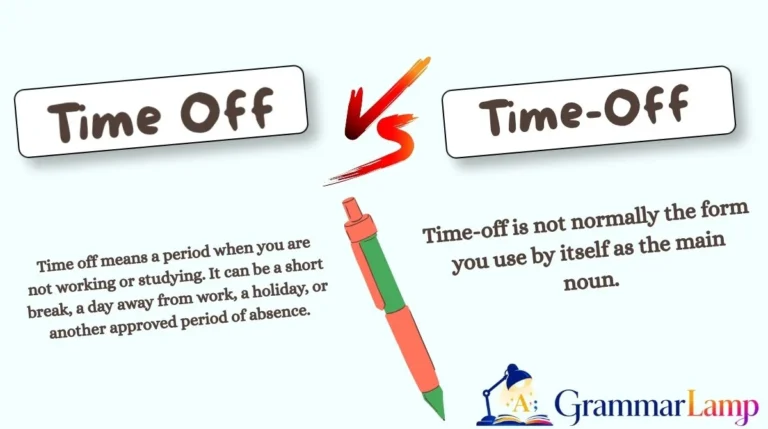
Time off and time-off look almost identical. The only visible difference is a small hyphen. Yet that little mark can confuse many English learners.
You may see:
- “I need some time off.”
- “Please submit a time-off request.”
- “She is taking time off next week.”
- “The company has a flexible time-off policy.”
Why does one example use two separate words while another uses a hyphen?
The answer is mainly about grammar and function. Time off is normally used as a noun phrase.
It means a period when you are away from work, school, or your usual duties. Cambridge Dictionary lists time off as an uncountable noun meaning a period when you do not work, often because of holidays, illness, or permission from an employer.
Time-off, on the other hand, is usually a hyphenated compound modifier. It appears before another noun when the two words work together to describe that noun, as in time-off request or time-off policy.
Hyphens are commonly used this way to show that two words form one descriptive unit.
You will learn when to write time off, when time-off may be useful, which form sounds natural in everyday English, and how to avoid common mistakes in emails, schoolwork, workplace writing, and conversation.
What Does “Time Off” Mean?
Time off means a period when you are not working or studying. It can be a short break, a day away from work, a holiday, or another approved period of absence.
Cambridge Dictionary treats time off as an uncountable noun. Common expressions include take time off, have time off, get time off, time off work, and time off from work.
For example:
I need some time off.
Here, time off is the thing the speaker needs. It is a noun phrase.
When should you use “time off”?
Use time off when you are directly talking about the period of rest or absence.
It is especially common after verbs such as:
- take
- have
- get
- need
- request
- receive
- use
- enjoy
You can also use it with phrases such as from work, from school, for a holiday, or to do something.
Grammar rule
When time off functions as a noun phrase, normally do not add a hyphen.
The basic pattern is:
verb + time off
Examples:
- I need some time off after this busy week.
- She took time off to visit her parents.
- We have time off during the summer.
- My manager gave me time off for my appointment.
- He is taking time off from work next month.
- They need more time off to rest.
- I used some of my paid time off last Friday.
- She asked for time off because she was feeling exhausted.
The phrase can also be followed by a purpose:
I took time off to study for my exam.
Or by a reason:
He took time off because his father was ill.
Cambridge also gives patterns such as time off to do something, time off for something, and time off from something.
Common learner confusion
A common mistake is to put a hyphen in every use:
❌ I need some time-off.
For ordinary noun use, this is not the best choice.
Write:
✅ I need some time off.
Another common mistake is to think that time off always means a vacation. It does not.
You can have an hour off, a day off, several weeks off, or even a short period away from work for an appointment.
For example:
I need two hours of time off tomorrow.
So, time off has a broad meaning: it is simply time when you are not working or studying as usual.
What Does “Time-Off” Mean?
Time-off is not normally the form you use by itself as the main noun.
Instead, the hyphenated form is mainly used when time off works as part of a compound modifier before another noun.
In simple terms, it helps describe what kind of thing the following noun is.
Consider this sentence:
Please submit your time-off request by Friday.
The noun is request.
What kind of request?
A time-off request — a request for time away from work.
The words time and off work together to describe request, so the hyphen can join them into one compound modifier.
When should you use “time-off”?
Use time-off mainly before a noun when the phrase acts as a compound modifier.
Common examples include:
- time-off request
- time-off policy
- time-off system
- time-off balance
- time-off approval
- time-off benefits
- time-off schedule
For example:
The company changed its time-off policy.
Here, time-off describes policy.
Compare that with:
I need some time off.
Here, there is no noun immediately after the phrase that it needs to describe. It is simply the noun phrase itself.
Grammar rule
The basic pattern is:
time-off + noun
Examples:
- Please send your time-off request today.
- The company has a new time-off policy.
- Check your time-off balance before booking your holiday.
- The manager approved my time-off request.
- Our HR department explained the time-off system.
- Employees can view their time-off schedule online.
- The company offers good time-off benefits.
- We are waiting for time-off approval.
The hyphen tells the reader that time and off belong together as a single modifier.
This follows the wider English principle that compound modifiers placed before nouns are often hyphenated when the hyphen helps make the relationship clear.
An important point about “time-off”
Do not think of time-off as a completely different word with a completely different meaning.
The basic idea is still time away from work or normal duties.
The difference is mainly grammatical function.
Compare:
I requested time off.
Here, time off is the thing requested.
I submitted a time-off request.
Here, time-off describes the type of request.
That small grammatical difference explains the hyphen.
Difference Between Time Off and Time-Off
The easiest way to understand the difference is to ask one question:
Is “time off” the thing you are talking about, or is it describing another noun?
If it is the thing itself, use time off.
If it is describing a noun immediately after it, time-off may be used as a compound modifier.
Quick comparison
| Feature | Time off | Time-off |
|---|---|---|
| Main function | Noun phrase | Compound modifier |
| Meaning | A period away from work/study | Describes something connected with time away |
| Usually followed by a noun? | No | Yes |
| Hyphen | No | Often used before a noun |
| Common example | take time off | time-off request |
| Everyday speech | Very common | Less common by itself |
| Example | I need time off. | I sent a time-off request. |
1. Usage difference
Time off is the normal form when you are talking about taking a break or being away.
I am taking time off next week.
Time-off appears when the phrase is attached to another noun.
I submitted a time-off request.
The first sentence talks about the actual absence.
The second sentence describes the request.
2. Grammar logic
Think about the jobs of the words.
In:
She needs time off.
The phrase answers the question:
What does she need?
Answer: time off.
So it functions as a noun phrase.
Now look at:
She submitted a time-off request.
The word request is the noun.
The phrase time-off answers:
What kind of request?
Answer: a time-off request.
So time-off works as a compound modifier.
3. Sentence structure
Compare these structures:
Verb + time off
He took time off.
Noun + time off
Her time off begins tomorrow.
Time-off + noun
Her time-off request was approved.
This is why simply memorizing “always use a hyphen” or “never use a hyphen” does not work.
You have to look at the sentence.
4. Meaning comparison
The core meaning remains connected.
Time off = the period of absence or rest.
Time-off = words joined to describe something related to that period.
Think of these two sentences:
I have time off next Friday.
I submitted a time-off form for next Friday.
The first sentence focuses on the free time.
The second focuses on the form.
Grammar Rules You Must Remember
Rule 1: Use “time off” when it is a noun phrase
When you mean a period away from work, school, or normal duties, use time off without a hyphen.
I need some time off.
She took time off after the project ended.
This is the most common form in normal conversation.
Rule 2: Use “time-off” when it works as a compound modifier before a noun
When time off describes a noun immediately after it, a hyphen can show that the words work together.
The company has a time-off policy.
Please complete the time-off request.
The hyphen helps readers see the relationship between the words. This is part of the general English rule for compound modifiers.
Rule 3: Do not hyphenate just because the words appear together
The presence of the words time and off does not automatically mean you need a hyphen.
Wrong:
❌ I am taking time-off tomorrow.
Better:
✅ I am taking time off tomorrow.
Here, time off is the noun phrase.
Rule 4: Follow the style of the noun phrase and modifier
Look at what comes next.
I requested time off.
No noun follows time off, so there is no need for a compound modifier.
But:
I sent a time-off request.
The phrase comes before request and describes it, so the hyphen makes the compound relationship clear.
One useful reminder is that hyphenation can depend on context and style. English does not hyphenate every possible compound in exactly the same way, and established usage can vary. General style guidance recommends checking the context and using hyphens when they clarify a compound modifier.
Common Mistakes Students Make
Many learners make these mistakes because they treat time off like a single fixed word.
Mistake 1: Adding a hyphen after “take”
❌ I want to take time-off next week.
✅ I want to take time off next week.
After the verb take, the phrase is functioning as a noun phrase.
A useful pattern is:
take + time off
Examples:
I took time off yesterday.
She wants to take time off in July.
Can I take some time off?
Mistake 2: Removing the hyphen from a compound modifier
❌ Please submit your time off request.
✅ Please submit your time-off request.
The second version clearly groups time and off as a modifier of request.
However, real-world writing can vary, especially in company documents and informal material. The important lesson for learners is to understand the standard compound-modifier principle rather than assuming every workplace document follows exactly the same style.
Mistake 3: Thinking “time-off” is always more formal
Some students believe the hyphen makes the expression more professional.
It does not.
A hyphen does not automatically make English formal.
I need some time off.
This is perfectly natural and professional.
I submitted a time-off request.
Here, the hyphen is related to grammar and structure, not simply formality.
Mistake 4: Using “time-off” as the main noun
❌ My time-off starts tomorrow.
For ordinary noun use, write:
✅ My time off starts tomorrow.
The hyphenated form is mainly useful when the phrase modifies another noun.
Easy correction tip
Before writing the phrase, look at the word after it.
If you mean the actual break:
time off
If you are describing something such as a request, policy, or balance:
time-off request
time-off policy
time-off balance
This simple check will prevent most mistakes.
Easy Trick to Remember the Difference
Here is a very simple memory trick:
Break = no break in the words.
When you are talking about your actual break from work, keep the words separate:
I need time off.
There is no hyphen because time off is the thing you are talking about.
Description = connect the words.
When time off describes something else, connect the words with a hyphen:
a time-off request
The request is not simply any request. It is a request for time off.
You can remember it like this:
time off = the break
time-off + noun = something about the break
Try these:
I have time off tomorrow.
What do you have?
Time off.
I submitted a time-off form.
What kind of form?
A time-off form.
That is the whole idea.
Do not worry too much about the hyphen when speaking. In speech, listeners cannot see whether you would write a hyphen. This is mainly a writing issue.
Daily Life Examples
Here are some natural examples you may hear at work, school, or home.
1. Talking to a manager
Employee: Can I take some time off next Friday?
Manager: Yes, that should be fine.
Here, time off means a period away from work.
2. Talking about a holiday
I am taking time off in August to visit my family.
The phrase refers to the period when the speaker will not be working.
3. Sending an email
I would like to request time off for Monday.
Again, the speaker is asking for the actual period away from work.
4. Talking about company rules
Have you read the company’s time-off policy?
Here, time-off describes the policy.
5. Talking about an application
Please send your time-off request to your manager.
The request is specifically about taking time away.
6. Talking about available leave
I still have five days of time off left.
The speaker is talking about the available period of leave.
7. Talking about an HR system
You can check your time-off balance online.
The phrase describes the balance in the system.
8. Talking with a coworker
I really need some time off after this deadline.
This is very natural spoken English.
9. Talking about approval
My time-off request was approved this morning.
The hyphenated phrase describes the request.
10. Talking about rest
Everyone needs some time off now and then.
Here, the meaning is simply time away from normal work or responsibilities.
Notice how often time off appears in everyday speech. It is the normal expression when people talk about taking a break, holiday, or leave. Dictionary.com also defines it as a break from employment or school and gives examples such as take time off and time off from teaching.
Practice Section
Choose the correct form: time off or time-off.
1.
I need some ______ after this busy month.
2.
Please submit your ______ request by Wednesday.
3.
She is taking ______ next week.
4.
The company recently changed its ______ policy.
5.
We have some ______ during the holidays.
Answers
1. time off
It is the actual period of rest.
2. time-off
It describes the type of request.
3. time off
It follows the verb taking as a noun phrase.
4. time-off
It describes the type of policy.
5. time off
It refers to the actual period away from normal duties.
One extra challenge
Which sentence is better?
A. I need to request time-off tomorrow.
B. I need to request time off tomorrow.
Answer: B.
Here, time off is the thing being requested.
But:
I need to submit a time-off request tomorrow.
Now the hyphenated form is appropriate because time-off describes request.
FAQs
What is the difference between “time off” and “time-off”?
Time off is normally a noun phrase meaning a period away from work, school, or normal duties. Time-off is mainly used as a compound modifier before another noun, such as time-off request or time-off policy. The basic meaning is closely related; the main difference is grammatical function.
Can we use “time off” in questions?
Yes. Time off is very common in questions.
Examples include:
Can I take some time off?
How much time off do I have?
When can I take time off?
Did you request time off for Friday?
No hyphen is normally needed because the phrase is being used as a noun phrase.
Is “time off” formal or informal?
Time off is neutral and very common. You can use it in casual conversation, emails, workplace communication, and many formal situations.
Cambridge Dictionary includes it as standard English and gives common workplace patterns such as take time off and time off work.
Is “time-off” always correct before a noun?
Not necessarily in every possible context. Hyphenation can depend on the exact construction, established usage, and the style guide being followed.
However, when time off is clearly acting as a compound modifier before a noun, forms such as time-off request and time-off policy are useful and clear.
Should I write “time off request” or “time-off request”?
Time-off request is a clear choice when the phrase functions as a compound modifier before request. The hyphen shows that time and off work together to describe the request. This follows the broader principle of using hyphens to clarify compound modifiers before nouns.
Is “time off” the same as “a day off”?
They are closely related, but they are not exactly the same. A day off normally means one particular day when you do not work. Time off is broader and can refer to an hour, a day, several days, or another period away from work.
For example, I have a day off tomorrow and I need some time off are both natural, but their meanings are slightly different.
Conclusion
The difference between time off and time-off is much easier once you focus on grammar instead of the hyphen itself.
Use time off when you mean a period when you are not working or studying. This is the normal form in sentences such as “I need some time off”, “She took time off,” and “We have time off next week.”
Use time-off mainly when the phrase works as a compound modifier before another noun. Examples include time-off request, time-off policy, and time-off balance.
The easiest question to ask yourself is: Am I talking about the break itself, or am I describing something connected with the break?
If it is the break, write time off. If it is describing a noun, a hyphenated time-off construction may be appropriate.
The more you see these forms in real sentences, the more natural the difference will feel. Try using them in your own emails, conversations, and writing. A tiny hyphen can seem confusing at first, but the grammar behind it is quite simple.

Liam Derren is a language writer at GrammarLamp, creating simple, helpful content about grammar, words, and everyday English. He makes language learning clear, practical, and easy to understand.
1 thought on “Time off vs time-off: The Complete Grammar Guide for 2026”