
If you have ever written the word tomatoes and suddenly wondered, “Is there an e before the final s?” you are not alone.
Many English learners get confused by this word because its spelling does not follow the simplest plural pattern.
The singular word is tomato, but the plural is usually tomatoes. The spelling tomatos is a common mistake.
It may look natural because many English nouns form their plurals simply by adding -s, such as book → books, car → cars, and apple → apples. However, tomato follows a different spelling pattern.
This small spelling difference matters because tomato and tomatoes are used in everyday English.
You may see them on a shopping list, restaurant menu, recipe, school worksheet, food label, or grocery receipt. Knowing the correct form can help you write more confidently and avoid an easy spelling error.
By the end of this guide, you will know why tomatoes is correct, why tomatos is wrong in standard English, how to use both singular and plural forms in sentences, and an easy trick that can help you remember the spelling.
What Does “Tomatoes” Mean?
Tomatoes is the plural form of tomato.
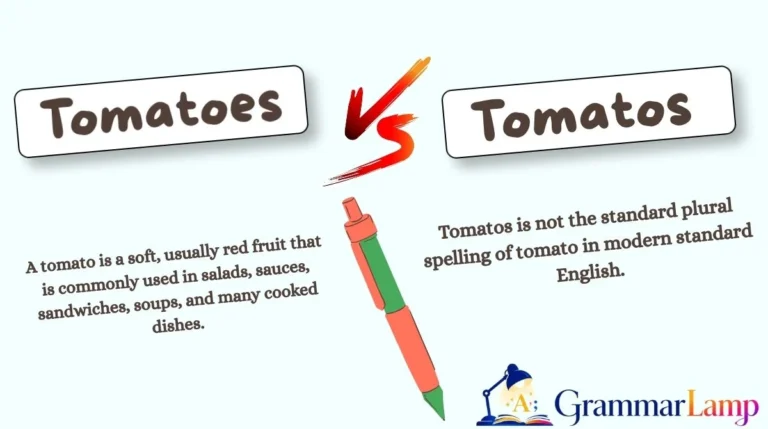
A tomato is a soft, usually red fruit that is commonly used in salads, sauces, sandwiches, soups, and many cooked dishes. Although people often use tomatoes like vegetables in cooking, botanically, a tomato is a fruit.
When you have more than one tomato, you normally use tomatoes.
The basic grammar rule
The rule is:
tomato → tomatoes
The ending changes from -o to -oes.
This is why:
- One tomato
- Two tomatoes
- A tomato
- Some tomatoes
- The tomato
- The tomatoes
The word tomatoes does not describe one tomato. It refers to two or more tomatoes.
Examples of “tomatoes”
- I bought three tomatoes from the market.
- These tomatoes are very fresh.
- She chopped the tomatoes for the salad.
- We need two tomatoes for the recipe.
- The tomatoes are growing in the garden.
- My mother added tomatoes to the soup.
- Can you wash the tomatoes, please?
- Those tomatoes look ripe.
Notice that tomatoes is used when the speaker is talking about more than one tomato.
For example:
I have one tomato.
But:
I have five tomatoes.
The noun changes because the number changes.
Why do we spell it “tomatoes”?
English has several nouns ending in -o that form their plural with -es. Tomato is one of the most familiar examples.
You may also see:
- potato → potatoes
- hero → heroes
- echo → echoes
However, English plural spelling is not completely predictable. Some nouns ending in -o simply take -s, such as:
- photo → photos
- piano → pianos
- radio → radios
So it is better to learn the common spelling of each word rather than assume that every word ending in -o follows exactly the same rule.
A common learner confusion
Many learners write tomatos because they think the normal plural rule is always:
singular + s = plural
That rule works for many English nouns:
- cat → cats
- pen → pens
- table → tables
- orange → oranges
But English has many spelling patterns. Tomato is one of the words where adding only -s gives the wrong spelling.
So remember:
tomato + es = tomatoes
Not:
tomato + s = tomatos
What Does “Tomatos” Mean?
Tomatos is not the standard plural spelling of tomato in modern standard English.
In other words, tomatos is generally a spelling mistake when you want to write the plural of tomato.
The correct spelling is:
tomatoes
This is important for students, writers, job applicants, website owners, and anyone learning English because spelling errors can make otherwise good writing look less polished.
Is “tomatos” a real English word?
You may see tomatos written online, on informal notes, or in learner writing. However, that does not make it the correct standard spelling.
When you mean more than one tomato, use:
tomatoes
For example:
❌ I bought two tomatos.
✅ I bought two tomatoes.
Examples of the correct form
Here are some sentences showing how to avoid the mistake:
- The farmer grows tomatoes.
- I need four tomatoes for dinner.
- These tomatoes are too soft.
- She sliced the tomatoes carefully.
- We planted tomatoes in our garden.
- The store sells fresh tomatoes.
- He added tomatoes to the sandwich.
- The tomatoes are ready to eat.
In all these sentences, tomatoes is correct because the meaning is plural.
Why do learners write “tomatos”?
The mistake is understandable.
When learners know that many nouns become plural by adding -s, they may naturally produce:
tomato → tomatos
The pronunciation can also contribute to the confusion. When we speak quickly, the final sound may not make the spelling pattern obvious.
Another reason is that English has inconsistent plural rules. Compare:
- photo → photos
- piano → pianos
- tomato → tomatoes
- potato → potatoes
Because these words do not all behave in exactly the same way, learners need to remember the spelling of common words.
Important point
Do not use tomatos in standard English when you mean the plural of tomato.
For schoolwork, professional writing, websites, emails, exams, and formal documents, always write:
tomatoes
Difference Between Tomatoes and Tomatos (Detailed)
The biggest difference is very simple:
Tomatoes is correct. Tomatos is incorrect in standard English.
These two forms are not two different kinds of nouns. They are not two different meanings of the word. The confusion is mainly about spelling.
| Form | Correct? | Meaning | Example |
|---|---|---|---|
| tomato | Yes | One tomato | I ate a tomato. |
| tomatoes | Yes | More than one tomato | I bought tomatoes. |
| tomatos | No | Incorrect spelling | ❌ I bought tomatos. |
Usage difference
There is no real usage difference between tomatoes and tomatos because tomatos is not the standard plural form.
Use tomato for one:
She cut a tomato.
Use tomatoes for two or more:
She cut two tomatoes.
Do not use tomatos:
❌ She cut two tomatos.
Grammar logic
The noun tomato is countable.
That means you can count individual tomatoes:
- one tomato
- two tomatoes
- three tomatoes
- ten tomatoes
For countable nouns, English normally has singular and plural forms.
The singular form is:
tomato
The plural form is:
tomatoes
The spelling changes when the noun becomes plural.
Sentence structure
The number of the noun can affect other words in the sentence.
Compare:
This tomato is fresh.
and:
These tomatoes are fresh.
With one tomato, we use this and is.
With multiple tomatoes, we use these and are.
Another example:
That tomato looks delicious.
Those tomatoes look delicious.
This shows that understanding the plural form is not only about spelling. It also helps you build grammatically correct sentences.
Meaning comparison
Tomato means one item:
There is a tomato on the table.
Tomatoes means more than one:
There are tomatoes on the table.
Tomatos does not have a separate meaning. It is simply an incorrect spelling of the plural form.
Grammar Rules You Must Remember
Rule 1: Use “tomato” for one
When you are talking about exactly one, use the singular noun tomato.
Example:
I put a tomato in the basket.
You can also use numbers or determiners with the singular form:
- one tomato
- a tomato
- this tomato
- that tomato
- my tomato
Do not write tomatoes when you mean only one.
Rule 2: Use “tomatoes” for more than one
When you are talking about two or more, use tomatoes.
Example:
I bought six tomatoes.
Other examples include:
- two tomatoes
- several tomatoes
- many tomatoes
- some tomatoes
- these tomatoes
- those tomatoes
The final -es is an important part of the standard spelling.
Rule 3: Do not spell the plural as “tomatos”
The common mistake is to add only -s:
❌ tomato → tomatos
The correct spelling is:
✅ tomato → tomatoes
A useful way to see the change is:
tomato + es = tomatoes
The final o remains, and -es is added.
Rule 4: Match the verb with the noun
A singular tomato normally takes a singular verb.
The tomato is fresh.
A plural tomatoes normally takes a plural verb.
The tomatoes are fresh.
Compare:
This tomato looks ripe.
These tomatoes look ripe.
This rule is useful because it helps you notice whether you need the singular or plural form.
Common Mistakes Students Make
Mistake 1: Writing “tomatos”
This is the most common error.
❌ The shop sells fresh tomatos.
✅ The shop sells fresh tomatoes.
The mistake happens because learners often apply the simple -s plural rule.
Easy correction tip: Remember that tomato is one of the common -o → -oes words.
Mistake 2: Using “tomatoes” for one tomato
Some learners know that tomatoes is correct but use it everywhere.
❌ I need one tomatoes.
✅ I need one tomato.
The word one clearly tells us that the noun must be singular.
Mistake 3: Forgetting the plural after a number
A number greater than one normally requires the plural form.
❌ I bought three tomato.
✅ I bought three tomatoes.
Look at the number first. If the number is two or more, use tomatoes.
Mistake 4: Mixing up “is” and “are”
This is a grammar mistake connected to the singular and plural forms.
❌ The tomatoes is fresh.
✅ The tomatoes are fresh.
Because tomatoes is plural, use are.
Likewise:
❌ The tomato are fresh.
✅ The tomato is fresh.
Mistake 5: Thinking every word ending in “o” uses the same plural rule
English does not have one simple rule for every noun ending in -o.
For example:
- tomato → tomatoes
- potato → potatoes
- photo → photos
- piano → pianos
That is why memorizing common words can be more useful than trying to create one rule for every situation.
Easy Trick to Remember the Difference
Here is a simple memory trick:
Tomato has “ES” when there are many.
Think:
One tomato → many tomatoes
You can connect “many” with the extra “es.”
Try saying this aloud:
One tomato, two tomatoes.
One potato, two potatoes.
The two words have the same plural pattern, so learning them together can make the spelling easier to remember.
Another useful trick is to imagine the word growing:
tomato → tomatoes
The word gets ES when you have more than one.
A quick classroom test
Whenever you are unsure, ask yourself:
“Am I talking about one or more than one?”
If it is one:
tomato
If it is more than one:
tomatoes
And if you write tomatos, stop and add the e:
tomatoes
This tiny habit can prevent the mistake almost every time.
Daily Life Examples
You are likely to use this word in everyday conversations, especially when talking about food, cooking, shopping, or gardening.
1. At the grocery store
A: What do we need?
B: We need five tomatoes.
2. In the kitchen
A: How many tomatoes should I cut?
B: Cut two tomatoes for the salad.
3. Talking about lunch
A: What is in your sandwich?
B: There is lettuce, cheese, and a tomato.
4. Shopping with a family member
A: Did you buy the tomatoes?
B: Yes, I bought them this morning.
5. Talking about a garden
A: What are you growing in your garden?
B: We are growing tomatoes and peppers.
6. Following a recipe
A: How many tomatoes does the recipe need?
B: It needs three tomatoes.
7. At a restaurant
Customer: Does this salad have tomatoes?
Waiter: Yes, it comes with fresh tomatoes.
8. Talking about food preferences
A: Do you like tomatoes?
B: Yes, I eat them almost every day.
9. Talking about one item
A: What is that on the kitchen counter?
B: It is a tomato.
10. Describing fresh food
A: These tomatoes look great.
B: Yes, they are fresh today.
These examples show how naturally the word appears in everyday English. You do not need complicated grammar to use it correctly. Just pay attention to whether you mean one tomato or more than one tomato.
Practice Section
Choose the correct option in each sentence.
1. I bought three ______ from the market.
A. tomato
B. tomatoes
C. tomatos
2. There is a ______ on the plate.
A. tomato
B. tomatoes
C. tomatos
3. These ______ are very fresh.
A. tomato
B. tomatoes
C. tomatos
4. She needs two ______ for the recipe.
A. tomato
B. tomatoes
C. tomatos
5. The ______ is next to the cucumber.
A. tomato
B. tomatoes
C. tomatos
Answers
- B — tomatoes
- A — tomato
- B — tomatoes
- B — tomatoes
- A — tomato
A quick way to check your answers is to look at the number or determiner. Words such as three, two, these, and many usually tell you that you need the plural tomatoes. Words such as a, one, this, and that point to the singular tomato.
FAQs
What is the difference between tomatoes and tomatos?
Tomatoes is the correct standard plural spelling of tomato. Tomatos is a common spelling mistake. If you are talking about more than one tomato, always write tomatoes in standard English.
Is “tomatos” a correct spelling?
No. Tomatos is not the standard English spelling of the plural noun. The correct form is tomatoes. This applies to school writing, professional writing, websites, emails, and other standard English contexts.
Can we use “tomatoes” in questions?
Yes. Tomatoes can be used in questions whenever you are talking about more than one tomato.
For example:
How many tomatoes do we need?
Did you buy the tomatoes?
Are these tomatoes fresh?
Is “tomatoes” formal or informal?
Tomatoes is neither especially formal nor especially informal. It is simply the standard plural form of tomato. You can use it in casual conversation, academic writing, recipes, business writing, and formal documents.
Why is tomato plural “tomatoes” and not “tomatos”?
Tomato is one of the English nouns ending in -o that commonly forms its plural with -es. Therefore, the standard spelling is tomatoes. English has exceptions, so not every noun ending in -o follows this exact pattern.
Is “tomato” singular or plural?
Tomato is singular. It refers to one tomato.
For example:
I ate one tomato.
The plural form is tomatoes:
I ate two tomatoes.
Remember: one tomato, two tomatoes.
Conclusion
The confusion between tomatoes and tomatos is easy to solve once you remember one simple spelling rule. Tomato is the singular form, meaning one fruit. Tomatoes is the standard plural form, meaning two or more.
The spelling tomatos is a common mistake, but it is not the standard plural spelling. When you are writing about several tomatoes, make sure you include the e before the final s.
Think of the pattern this way:
One tomato → two tomatoes
You can also remember it alongside potato → potatoes, since both words use the -oes plural pattern.
Do not worry if you have made this mistake before. English has many unusual spelling patterns, and even experienced learners sometimes forget them.
The best way to remember is to use the correct form in short sentences and everyday writing.
So, the answer is clear: tomatoes is correct, while tomatos is incorrect in standard English. Keep practicing, and this spelling will soon feel completely natural.

Liam Derren is a language writer at GrammarLamp, creating simple, helpful content about grammar, words, and everyday English. He makes language learning clear, practical, and easy to understand.